
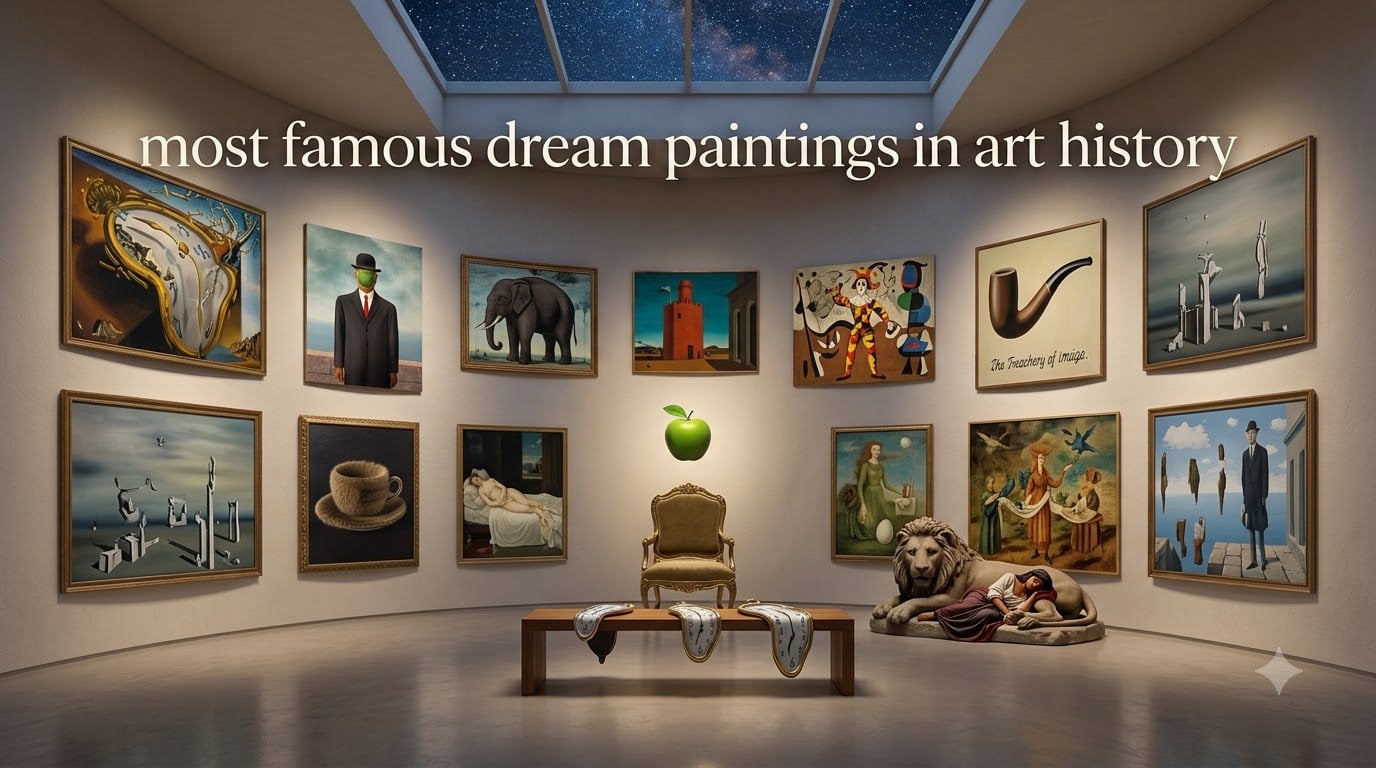
Some of the most famous dream paintings in art history are works that visualize what the mind does while we sleep: melting clocks, floating apples, incubi sitting on chests, a lion sniffing a sleeping gypsy under a desert moon. Over five centuries, painters have used strange juxtapositions and impossible physics to capture the strange logic of dreams.
This list walks through twelve of those paintings, starting with the Renaissance and ending in the late twentieth century. Each entry names the artist, year, medium, and current museum location, then unpacks what actually makes the image feel like a dream. I will also show you how to read recurring symbols (melting time, falling figures, water, animals) and where you can stand in front of each original.
Whether you are studying art history, planning a museum trip, or just hunting for surrealist inspiration for a design project, this guide is built to be useful. You will find both the household names (Dalí, Magritte, Fuseli) and a few less obvious dream paintings (Carrington, Varo, Tanning) that serious Surrealism fans keep returning to.
Table of Contents
How Dream Paintings Became Modern Art
Long before the word Surrealism existed, painters were already chasing the dream. Renaissance and Northern European artists visualized religious visions (Jacob’s ladder, Joseph’s biblical dreams) using the philosophical concept of vacatio animae, the soul freed from the body during sleep. These were dreams with morals.
The Romantic era flipped the moral. Henry Fuseli’s The Nightmare of 1781 showed an incubus crouched on a sleeping woman, while Francisco Goya’s Sleep of Reason Produces Monsters (1797-1799) let bats and owls swarm out of the artist’s own dreaming head. Dreams stopped being holy and started being dangerous.
Then came Freud. His Interpretation of Dreams (1900) reframed the dream as a coded message from the subconscious. André Breton read Freud and answered in 1924 with the Surrealist Manifesto, calling for art that bypassed reason. The twelve paintings below trace that arc, from Bosch’s medieval visions to the last generation of female Surrealists working into the 1970s.
1. The Persistence of Memory (1931) – Salvador Dalí
The Persistence of Memory (1931) by Salvador Dalí is the most famous dream painting in art history, an oil on canvas measuring about 9.5 by 13 inches, currently held at the Museum of Modern Art (MoMA) in New York. It depicts four limp watches draped over rocks, a branch, and a strange fleshy form on a Catalan coastline.
Dalí painted it in a single afternoon during a fever. The soft watches were inspired by watching Camembert cheese melt in the sun, then extended into a meditation on time’s collapse inside a dream. The dead flies, the orange clock covered in ants, and the sleeping creature in the center are all Freud-era shorthand for decay, memory, and the unconscious.
It is also the single most influential dreamscape of the twentieth century. Every movie poster, album cover, and TikTok surrealist filter that uses a melting clock is quoting this 9.5 by 13 inch canvas.
2. The Son of Man (1964) – René Magritte
The Son of Man (1964) by René Magritte is one of the most recognizable dreamlike paintings of the twentieth century, a self-portrait in an overcoat with a floating green apple obscuring the face. The original oil on canvas hangs in a private collection; giclée versions tour through Magrette exhibitions worldwide.
Magritte made it as a self-portrait in the tradition of The Surrealist’s Mouth, but the apple is the surprise. He told interviewers that everything we see hides another thing, and that we always want to see what is hidden by what we see. The bowler hat and the sea wall behind him quote his earlier bowler-hatted men and pull the figure into a foggy, dreamlike present.
The painting has been quoted on the cover of Songs of Innocence and Experience in every generation. It is the visual shorthand for “ordinary man in an extraordinary world,” which is exactly what dreams feel like.
3. The Nightmare (1781) – Henry Fuseli
The Nightmare (1781) by Henry Fuseli is the eighteenth-century painting that taught Europe to paint dreams, an oil on canvas showing a woman sprawled across a bed with an incubus crouched on her chest and a ghostly horse head peering through curtains. The original is at the Detroit Institute of Arts.
Fuseli painted it to scandalize the Royal Academy and succeeded. Critics called it obscene, audiences called it magnetic, and the image became the template for every haunted bedroom scene in Western art. The incubus is a folkloric demon, but the horse head was pure Fuseli invention, lifted from a nightmare he had after reading about a goblin pressing on his chest.
It is also a literal demonstration of sleep paralysis, the phenomenon where a person feels conscious but cannot move and senses a presence on the chest. Eighteenth-century viewers believed in incubi. Twenty-first-century viewers recognize the neurology. Either reading makes it a dream painting.
4. The Sleep of Reason Produces Monsters (1797-1799) – Francisco Goya
The Sleep of Reason Produces Monsters (1797-1799) by Francisco Goya is plate 43 from his Los Caprichos print series, an etching showing the artist slumped over his desk while bats, owls, and a lynx swarm around him in the dark. The complete Los Caprichos series is held at the British Museum and the Museo del Prado in Madrid.
Goya wrote as the caption for the plate: “Imagination abandoned by reason produces impossible monsters; united with her, she is the mother of the arts and source of their wonders.” That single sentence is the bridge between Enlightenment rationalism and Romantic dream imagery. The artist is both dreamer and dream, attacked by the fantasies his own sleeping mind conjures.
This is one of the few dream paintings where the dreamer is literally awake and horrified by what his own imagination has produced. It reads like a self-portrait of the modern artist as someone haunted by their own visions.
5. The Garden of Earthly Delights (1490-1510) – Hieronymus Bosch
The Garden of Earthly Delights (1490-1510) by Hieronymus Bosch is a three-panel Netherlandish triptych in oil on oak, the left panel showing Adam and Eve in paradise, the center panel filled with nude figures, fruits, and birds, and the right panel depicting a surreal hellscape. The original is housed at the Museo del Prado.
Bosch predates Surrealism by four centuries, but no Surrealist has matched his visual vocabulary. Oversized strawberries, glass spheres, fish flying through the air, a giant set of ears wielding a knife, the bird-headed monster eating sinners in the right panel. These are dream images in the strictest sense, painted by a man who lived in a town called ‘s-Hertogenbosch and probably saw visions of Hell.
The triptych is also one of the most analyzed dream paintings in art history because nobody agrees on what it means. The dominant scholarly view reads it as a moral warning about lust. Others see an alchemical instruction manual or a depiction of a lost Adamite sect. That ambiguity is exactly what makes it a dream image: a painting that keeps generating new meanings every century.
6. The Sleeping Gypsy (1897) – Henri Rousseau
The Sleeping Gypsy (1897) by Henri Rousseau is a Symbolist oil on canvas showing a lion sniffing at a Mandinka lute player who has fallen asleep in the moonlit desert. The original is in the Museum of Modern Art in New York.
Rousseau was a self-taught Parisian toll collector who painted dreamscapes his whole career without ever leaving France. The Sleeping Gypsy was his farewell to the genre: a scene he had dreamed of for years, finally executed at the end of his life. The lion pauses, the gypsy sleeps, the moon watches. Nothing violent happens. The strangeness is purely quiet.
Rousseau’s clean lines and flat color planes influenced Picasso (who bought several of his paintings) and fed directly into the next generation of Surrealists. A single painting on a wall can turn any room into a quiet dream, which is probably why it hangs in so many dorm rooms and design mood boards.
7. Harlequin’s Carnival (1924-1925) – Joan Miró
Harlequin’s Carnival (1924-1925) by Joan Miró is a large oil on canvas filled with floating figures, cats, birds, and musical notes over a bright yellow ground. It is held at the Albright-Knox Art Gallery in Buffalo, New York.
Miró finished it just months after André Breton published the Surrealist Manifesto. It is one of the earliest fully abstract dreamscapes, a roomful of biomorphic creatures climbing a ladder to a balcony, eating, dancing, and staring out at the viewer. The harlequin at the center is a Commedia dell’arte reference, lifted from Miró’s Catalan childhood memories of street theater.
This is the dream painting you recommend when someone says “I want something colorful and weird for above the couch.” It also reads like an instruction manual for what Miró would do for the next forty years, building a personal vocabulary of dreamlike shapes that influenced everything from Alexander Calder’s mobiles to today’s flat illustration style.
8. The Treachery of Images (1929) – René Magritte
The Treachery of Images (1929) by René Magritte is a small oil on canvas showing a single tobacco pipe floating against a beige background, captioned in French: Ceci n’est pas une pipe (“This is not a pipe”). The original is held at the Los Angeles County Museum of Art.
Magritte’s point was philosophical, not dreamlike in the strict sense, but the painting does the work of a dream: it forces you to look at the gap between an image and the thing it represents. The caption is not a lie; it is a description of the dreamlike way language pretends to be reality.
This is the painting that taught twentieth-century art how to think. It is the source citation for every “this is not a hat” joke and every conceptual artwork that follows. As a dream image, it works because it reproduces the strange moment in a dream when you realize the words in your mouth are not the words you meant to say.
9. Self-Portrait (Inn of the Dawn Horse) (1937-1938) – Leonora Carrington
Self-Portrait (Inn of the Dawn Horse) (1937-1938) by Leonora Carrington is an oil on canvas showing the artist in a high-backed white chair, surrounded by a hyena, a rocking horse, a white owl, and a ragged white horse floating out of the wall behind her. It hangs in the Museo Nacional de Arte Moderno in Mexico City.
Carrington painted it the same year she was hospitalized after a series of breakdowns in London, then fled to Mexico with the help of fellow Surrealist Remedios Varo. The painting is therefore autobiographical in the literal sense: the rocking horse is a childhood memory, the hyena is a self-portrait of her own wildness, and the floating horse represents the dawn horse, a Celtic symbol of awakening she learned about from the artist Max Ernst.
This is the dream painting that taught later generations how to read female Surrealist work. Carrington, Varo, Kay Sage, and Dorothea Tanning each used interior spaces and animals to map the inside of a mind that mainstream art history had been ignoring for fifty years.
10. Dream Caused by the Flight of a Bee (1944) – Salvador Dalí
Dream Caused by the Flight of a Bee (1944) by Salvador Dalí is a small oil on panel showing a naked woman floating above a rock slab while a bee hovers near her exposed thigh, dream-linking a pomegranate, two tigers jumping out of the water, and a darning needle with a thread that pierces the dreamer. It is held at the Museo Nacional Centro de Arte Reina Sofía in Madrid.
Dalí made the painting as a literal diagram of Freudian free association. Each element triggers the next: bee sting, pomegranate, tigers. The tigers leap out of the water because the bee’s buzz sounds like a roar. The pomegranate bursts because the bee’s sting feels like a wound. The floating body is in the brief moment between cause and effect, which Dalí treats as the dream itself.
It is Dalí’s most systematic attempt to paint a textbook example of how the unconscious makes a dream. Other Surrealists found this approach cold; later scholars found it invaluable. Either way, it is one of the few dream paintings where the dreamer’s logic is laid out on a single panel.
11. Celestial Pablum (1957) – Remedios Varo
Celestial Pablum (1957) by Remedios Varo is a small oil on masonite showing a seated woman in a tower, spoon-feeding a glowing paste into the mouth of a moon-faced figure who rises out of dough. It is held in a private collection; the major Varo retrospective of 2026 toured through the Museum of Fine Arts Houston and the Museo del Palacio de Bellas Artes.
Varo was a Spanish-born Mexican Surrealist who escaped Europe in 1941 and spent the rest of her career painting alchemists, mystics, and women in towers. The “celestial pablum” in this painting is a paste made from starlight, fed by a woman whose head is connected by a tube to a constellation. The dream logic is Varo’s: a woman is nourishing the universe by sitting very still and doing nothing.
It is the dream painting that kept showing up on Tumblr and Pinterest feeds around 2018 because it perfectly captures the feeling of being a quiet creative who feeds other people from their own invisible reserves. Varo’s work has had a quiet influence on every modern illustration that mixes alchemical imagery with low-saturation color.
12. Eine Kleine Nachtmusik (1943) – Dorothea Tanning
Eine Kleine Nachtmusik (1943) by Dorothea Tanning is a large oil on canvas showing a girl in a navy blue dress with a pomegranate blooming from her chest, standing on the wooden planks of a hotel hallway while a small creature runs away down the corridor. It hangs at the Museo Nacional Centro de Arte Reina Sofía in Madrid.
The title borrows Mozart’s serenade, but the painting is Tanning’s own dream image of female adolescence. The pomegranate is a Surrealist classic, signaling fertility and hidden things. The corridor is the hallway of the hotel where Tanning was working at the time, turned into a charged space. The fleeing creature is a self-portrait of the artist leaving her childhood behind.
It is the dream painting you look at when you want to remember what it felt like to be a teenage girl in 1943. It also happens to be one of the few dream paintings of the 1940s where the dreamer is the artist’s own body in motion, not a mannequin or a stranger.
How to Read a Dream Painting: A Short Interpretation Guide
Most dream paintings are not random. They lean on a small vocabulary of recurring symbols that any viewer can learn to read. Here is the short version.
Melting time. Soft clocks (Dalí), liquid watch faces, or sundials in moonshine (Magritte) usually mean the dreamer feels time collapsing, memory bleeding into present. Look for it whenever a clock is doing something a clock cannot do.
Water and falling. Floating bodies (Dalí, Miró), figures suspended mid-air (Carrington, Varo), or drowning figures in the right panel of a Bosch triptych signal that the dreamer’s control has been removed. You are watching someone who has stopped being able to navigate their own world.
Animals. A lion that does not attack (Rousseau), a hyena as self-portrait (Carrington), an incubus horse (Fuseli), and a fleeing creature (Tanning) all use animals to express an emotion the dreamer’s human face cannot show. Identify the animal, identify the feeling.
Doors, walls, and architecture. A wall that turns into a window (Varo), a corridor that never ends (Tanning), and a balcony that opens onto nothing (Miró) signal that the dreamer is in transition. The architecture is the dreamer’s emotional state drawn as building.
Juxtaposition. A floating apple hiding a man’s face (Magritte), a giant set of ears wielding a knife (Bosch), a pomegranate blooming from a chest (Tanning). When two unrelated things are forced together in the same image, the meaning lives in the seam between them.
You do not need a degree in art history to read these. The vocabulary is short, the symbols repeat, and most dream painters deliberately borrowed from each other. Spend an hour with two or three paintings and the rest start to decode themselves.
Where to See the Original Dream Paintings
If you want to stand in front of the originals, here is where each painting on this list currently lives.
- Museum of Modern Art (MoMA), New York – Dalí’s Persistence of Memory and Rousseau’s Sleeping Gypsy.
- Los Angeles County Museum of Art (LACMA) – Magritte’s Treachery of Images.
- Museo del Prado, Madrid – Bosch’s Garden of Earthly Delights and Goya’s Los Caprichos prints.
- Museo Nacional Centro de Arte Reina Sofía, Madrid – Dalí’s Dream Caused by the Flight of a Bee and Tanning’s Eine Kleine Nachtmusik.
- Detroit Institute of Arts – Fuseli’s The Nightmare.
- Albright-Knox Art Gallery, Buffalo – Miró’s Harlequin’s Carnival.
- Museo Nacional de Arte Moderno, Mexico City – Carrington’s Self-Portrait (Inn of the Dawn Horse).
Plan a single trip around the museums in Madrid (Prado + Reina Sofía) and you can see Bosch, Goya, Dalí, and Tanning within walking distance. New York alone gives you Dalí, Magritte, and Rousseau at MoMA plus a solid Surrealist rotation at the Met.
For European alternatives: Tate Modern in London, Centre Pompidou in Paris, and the Stedelijk Museum in Amsterdam all maintain permanent Surrealist collections that rotate loan works from the painters above. Carrington and Varo retrospectives travel regularly; check the Museo del Palacio de Bellas Artes in Mexico City for the most comprehensive Varo catalog.
The Lasting Legacy of Dream Paintings in Modern Visual Culture
These twelve paintings are still doing cultural work in 2026. Every dreamscape you have seen in the last decade, from movie posters for horror films to album covers for indie bands to the soft pastels on cottagecore mood boards, descends directly from this tradition.
The visual vocabulary of dreams (melting clocks, floating apples, impossible rooms, animals that watch you) is now common language. Fashion houses use dream motifs in campaigns (Loewe and Dries Van Noten have both leaned hard on Magritte and Rousseau in recent seasons). Film stills, especially in the work of directors like Guillermo del Toro and Yorgos Lanthimos, are practically pastiches of Dalí and Varo. Album covers for artists like Ariana Grande and The Weeknd quote Carrington and Rousseau almost directly.
Designers and illustrators keep returning to dream paintings because they solved a hard problem: how do you make a flat image feel like a place you have visited at night? The dream painters figured out that you distort scale, lift gravity, change the light, and trust the viewer’s brain to fill in the rest.
That is why this list matters beyond art history. If you are working on a visual project and the mood board is missing the source citations, this is where you start.
Frequently Asked Questions
What are some famous dream paintings?
Famous dream paintings include Salvador Dalí’s The Persistence of Memory (1931), René Magritte’s The Son of Man (1964), Henry Fuseli’s The Nightmare (1781), Francisco Goya’s The Sleep of Reason Produces Monsters (1797), Hieronymus Bosch’s The Garden of Earthly Delights (1490-1510), and Henri Rousseau’s The Sleeping Gypsy (1897). These works span five centuries and show how artists have visualized dreams, nightmares, and the unconscious mind.
What is Salvador Dalí’s most famous painting?
Salvador Dalí’s most famous painting is The Persistence of Memory (1931), a small oil on canvas depicting four melting watches draped over rocks and a branch on a Catalan coastline. It is held at the Museum of Modern Art (MoMA) in New York and is widely considered the most famous dream painting in art history.
What is Magritte’s most famous painting?
Magritte’s most famous painting is The Son of Man (1964), a self-portrait in an overcoat with a floating green apple obscuring the man’s face. The original is in a private collection, but reproductions are reproduced widely and frequently referenced in film, fashion, and design contexts.
What are 10 of the most famous artworks from Surrealism?
Ten famous Surrealist artworks are: 1. The Persistence of Memory (1931) by Salvador Dalí, 2. The Son of Man (1964) by René Magritte, 3. Harlequin’s Carnival (1924-1925) by Joan Miró, 4. The Treachery of Images (1929) by René Magritte, 5. Self-Portrait (Inn of the Dawn Horse) (1937-1938) by Leonora Carrington, 6. Dream Caused by the Flight of a Bee (1944) by Salvador Dalí, 7. Celestial Pablum (1957) by Remedios Varo, 8. Eine Kleine Nachtmusik (1943) by Dorothea Tanning, 9. The Treachery of Images (1929), and 10. The Elephant Celebes (1921) by Max Ernst.
What are some famous art pieces about dreams?
Famous art pieces about dreams include Henry Fuseli’s The Nightmare (1781), a Romantic-era painting of an incubus on a sleeping woman; Francisco Goya’s The Sleep of Reason Produces Monsters (1797); Joan Miró’s Harlequin’s Carnival (1924); and Dorothea Tanning’s Eine Kleine Nachtmusik (1943). These pre-Surrealist and Surrealist works all visualize dream states.
Where can I see famous dream paintings in real life?
You can see famous dream paintings at the Museum of Modern Art (MoMA) in New York (Dalí and Rousseau), the Museo del Prado in Madrid (Bosch and Goya), the Museo Nacional Centro de Arte Reina Sofía in Madrid (Dalí and Tanning), the Detroit Institute of Arts (Fuseli), the Albright-Knox Art Gallery in Buffalo (Miró), and the Museo Nacional de Arte Moderno in Mexico City (Carrington).
Final Thoughts on the Most Famous Dream Paintings in Art History
The most famous dream paintings in art history keep being famous because they keep meaning new things. Dalí, Magritte, Carrington, and Varo solved a hard visual problem (how do you paint a dream?) and their solutions still work as design language more than a century later.
If this list sparked something, start with the museums closest to you and see the originals in person. Then come back to the painted surfaces and notice how they feel different from what you expected. That gap between expectation and encounter is the same gap painters have been chasing since Bosch.