
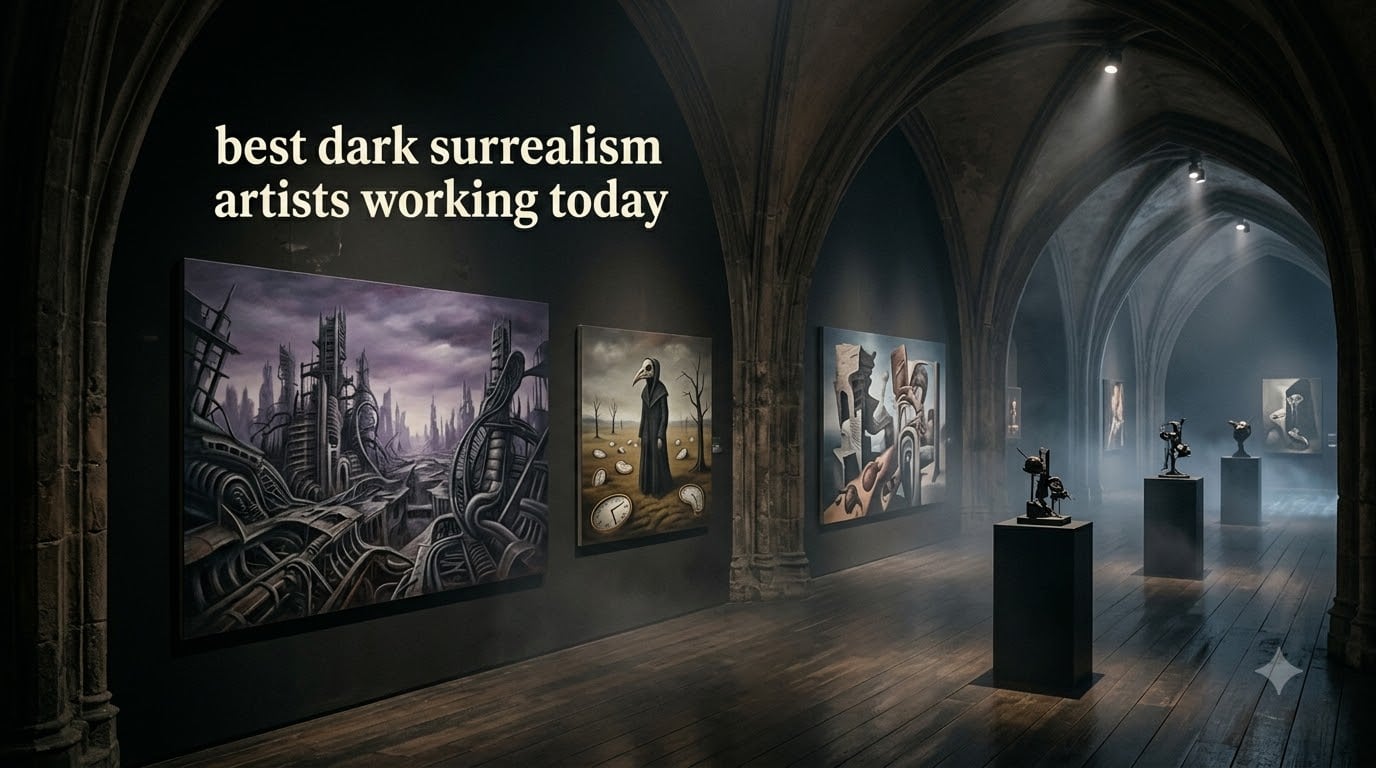
There’s something magnetic about art that makes you uncomfortable. Dark surrealism pulls you into nightmares rendered beautiful, and the artists working in this space today are pushing boundaries that the original surrealists never imagined. I’ve spent years following this movement, and the contemporary artists on this list represent the most compelling dark surrealists creating work right now.
Whether you’re a collector looking for your next acquisition, an art student exploring the genre, or simply someone drawn to the uncanny, this guide covers the most talented dark surrealism artists working today. You’ll learn what defines this genre, discover artists across multiple mediums, and find out where to experience their work firsthand.
Table of Contents
What Is Dark Surrealism?
Dark surrealism is an art genre that merges surrealist techniques with macabre, horror, and unsettling elements. It explores the subconscious mind through distorted forms, nightmarish imagery, and psychologically charged compositions that challenge the viewer’s perception of reality.
Unlike classic surrealism—think Salvador Dalí’s melting clocks or René Magritte’s bowler-hatted men—dark surrealism deliberately embraces the grotesque. The palette skews toward deep shadows, muted earth tones, and sudden accents of blood red or sickly green. Forms dissolve, merge, and reassemble in ways that trigger both fascination and revulsion.
Key characteristics of dark surreal art include dreamlike imagery that defies logical interpretation, psychological themes exploring fear and anxiety, distorted human figures and faces, symbolic elements drawn from mythology and the occult, and an overall atmosphere of unease. The art doesn’t just depict darkness—it makes darkness feel inevitable and strangely beautiful.
This movement has roots in the work of early twentieth century masters, but today’s dark surrealism artists have expanded the genre through digital tools, mixed media, photography, and even internet culture. The result is a thriving creative ecosystem that spans fine art galleries, concept art studios, and social media platforms.
Top Dark Surrealism Artists Working Today
The artists below represent the finest practitioners of dark surrealism. Some are established figures with decades of work; others are emerging voices reshaping the genre. Each brings a distinct perspective to the art of the uncanny.
1. Zdzisław Beksiński
No conversation about dark surrealism begins without Beksiński. Though he passed away in 2005, his influence on every artist on this list is immeasurable. The Polish painter created dystopian landscapes populated by skeletal figures, decaying architecture, and vast emptiness that feels both cosmic and claustrophobic.
Beksiński worked primarily in oils and later embraced digital painting, producing thousands of works across his career. His early pieces feature richly textured surfaces and organic forms that seem to breathe. Later works became cleaner and more stark, but never less unsettling. What makes Beksiński essential is his refusal to title or explain his paintings—he believed viewers should bring their own meaning.
If you’re new to dark surrealism, start with Beksiński’s middle period work from the 1970s and 1980s. These paintings perfectly balance beauty and horror in ways that still feel fresh decades later.
2. H.R. Giger
H.R. Giger created the visual language of biomechanical horror. His airbrush paintings fuse human anatomy with machine parts, producing creatures that look like they evolved in industrial nightmares. Most people know Giger through his design work on Ridley Scott’s Alien, but his personal paintings go far deeper into psychological territory.
Giger’s signature style—bone-white figures against pitch-black backgrounds, sexual and biological imagery intertwined with mechanical elements—remains instantly recognizable. His work exists at the intersection of dark surrealism, gothic art, and science fiction, and no one has successfully replicated his aesthetic.
The H.R. Giger Museum in Gruyères, Switzerland, houses the largest collection of his work and is worth the pilgrimage for anyone serious about dark surreal art.
3. Mark Ryden
Mark Ryden is the godfather of pop surrealism, a subgenre that blends dark themes with a candy-colored, almost childlike visual style. His oil paintings feature wide-eyed children, meat cuts, Abraham Lincoln, and religious iconography arranged in compositions that feel simultaneously sweet and deeply disturbing.
Ryden’s work occupies a unique space in dark surrealism. The surface beauty—lush paint handling, meticulous detail, pastel palettes—draws you in, while the subject matter makes you question what you’re looking at. A child holding a piece of raw meat. A figure made of candy with hollow eyes. The tension between attraction and repulsion is the core of his appeal.
His paintings command significant attention in the contemporary art world, bridging the gap between underground lowbrow art and mainstream gallery culture.
4. Natalie Shau
Lithuanian artist Natalie Shau creates haunting digital portraits that feel like Victorian mourning photographs filtered through a dark fairy tale. Her women stare directly at the viewer with hollow, fathomless eyes. Flowers grow from their skin. Birds nest in their hair. There’s an elegance to the darkness—a refusal to sacrifice beauty even in the most disturbing compositions.
Shau blends digital painting with photography, creating layered images that reward extended viewing. Her color palette tends toward muted pastels and deep jewel tones, giving her work a jewel-like quality that distinguishes it from grittier dark surrealists.
She’s built a devoted following through social media and has exhibited internationally. Her prints are accessible entry points for collectors interested in dark surrealist portraiture.
5. Mario Sanchez Nevado
Spanish artist Mario Sanchez Nevado creates large-scale digital paintings that function as dark symbolic narratives. His work features masked figures, barren landscapes, and architectural elements arranged in compositions that suggest stories without ever resolving them. The result is art that haunts you long after you’ve looked away.
Nevado’s palette tends toward earthy browns, dusty grays, and sudden bursts of crimson. His figures often wear masks or have obscured faces, creating a universal quality—the viewer can project themselves into the scene. This psychological accessibility, combined with exceptional technical skill, makes his work some of the most compelling in contemporary dark surrealism.
He’s active on social platforms and sells prints through various art sites, making his work relatively accessible compared to gallery-only artists.
6. Alex Konstad
Los Angeles-based Alex Konstad works primarily in digital painting and concept art, creating dark surrealist worlds that feel cinematic. His compositions have a widescreen quality—vast skies, impossibly scaled figures, and environments that suggest other dimensions bleeding into our own.
Konstad’s color work is remarkable. He uses atmospheric perspective and carefully controlled value ranges to create depth that pulls viewers into his scenes. His creatures and figures feel designed rather than accidental, with every anatomical choice serving the emotional impact of the piece.
His work has appeared in concept art for entertainment projects, and his personal paintings push further into personal dark vision. Online communities frequently recommend him as one of the best contemporary artists exploring surreal horror themes.
7. Stefan Koidl
Austrian artist Stefan Koidl creates illustrations that look like stills from nightmares you can’t quite remember. His work combines traditional illustration techniques with digital tools, producing images that feel handcrafted and organic despite their technical sophistication.
Koidl’s subjects range from twisted fairy tale scenes to Lovecraftian cosmic horror. There’s a playfulness to some of his work—an acknowledgment that horror can be fun without being less frightening. His creature designs are particularly notable, balancing biological plausibility with imaginative fantasy.
He’s developed a strong following in the horror illustration community and regularly shares process breakdowns that reveal his working methods.
8. Trevor Henderson
Trevor Henderson’s work represents dark surrealism filtered through internet culture. His viral creations—most famously Siren Head—blend creature design with found-footage horror aesthetics, producing images that feel like evidence from impossible events. His art spreads across social media because it’s designed to unsettle in a single glance.
What makes Henderson interesting beyond the memes is his genuine understanding of dark surrealist composition. His creatures emerge from fog, stand impossibly tall against mundane backyards, and interact with real-world environments in ways that violate natural law. The casual treatment of the impossible is what makes the work so effective.
Henderson has expanded into published works and collaborations, bringing dark surrealism to audiences who might never visit a gallery.
9. Vincent Lefevre
French digital artist Vincent Lefevre creates dark surrealist scenes that feel like recovered memories from a world adjacent to ours. His compositions feature solitary figures in vast, threatening landscapes, often rendered in a muted palette punctuated by single points of intense color.
Lefevre’s work explores themes of isolation and insignificance. His human figures are frequently dwarfed by their environments—standing beneath impossible structures, walking toward distant lights, or surrounded by creatures that ignore them. This scale creates a specific emotional response: awe mixed with existential dread.
His paintings circulate widely in online art communities and have influenced a generation of digital artists exploring dark atmospheric themes.
10. Roger Ballen
Roger Ballen is an American photographer based in South Africa whose work blurs the line between documentary photography and dark surrealism. His images feature found objects, hand-drawn figures, animals, and people arranged in claustrophobic spaces that feel like constructed nightmares.
Ballen’s photography doesn’t rely on digital manipulation. Instead, he creates surreal scenes in real spaces, using drawings on walls, wire sculptures, and staging to transform mundane interiors into psychological landscapes. The result is a raw, tactile quality that purely digital work rarely achieves.
His published books—including Outland, Shadow Chamber, and Asylum of the Birds—are essential viewing for anyone interested in the photographic possibilities of dark surrealism.
11. Jocelin Carmes
Argentinian artist Jocelin Carmes creates mixed media illustrations that combine traditional drawing with digital techniques. Her work features masked figures, botanical elements, and symbolic objects arranged in compositions that suggest rituals and private mythologies.
Carmes brings a distinctly feminine perspective to dark surrealism, exploring themes of identity, transformation, and hidden selves. Her use of masks and veils creates emotional distance while the intimate compositions draw viewers close. It’s a contradiction that defines much of her best work.
She’s part of a growing movement of female artists expanding dark surrealism beyond its historically male-dominated boundaries, bringing new themes and visual approaches to the genre.
Dark Surrealism Techniques and Creative Process
Understanding how dark surrealism artists work reveals the deliberate craft behind seemingly spontaneous images. These techniques separate professional-level dark surrealism from simple shock imagery.
Distorted anatomy is perhaps the most recognizable technique. Artists stretch, fragment, and reassemble human forms to create figures that exist between recognizable and alien. This distortion isn’t random—it follows internal logic that makes the impossible feel coherent.
Color theory plays a crucial role. Most dark surrealists work with limited palettes—deep blacks, earthy browns, muted grays—and introduce single accent colors for maximum impact. A splash of red in a gray composition draws the eye immediately and creates emotional weight.
Dream logic governs composition. Unlike narrative art that follows cause and effect, dark surrealism arranges elements according to emotional and symbolic relationships. Objects appear together not because they logically would, but because their combination creates the desired psychological effect.
Medium diversity distinguishes today’s dark surrealism from earlier iterations. Contemporary artists work across oil painting, digital illustration, mixed media, photography, sculpture, and collage. Some combine multiple mediums in single works, creating textures and effects impossible through any single technique.
The Psychology Behind Dark Art’s Appeal
Why do people actively seek out art that disturbs them? The answer lies in how our brains process controlled fear and discomfort.
Dark art provides emotional catharsis in a safe context. When you look at a Beksiński painting, you experience existential dread without any actual danger. Your brain processes the emotions, builds familiarity with them, and develops coping mechanisms. Art becomes a rehearsal space for difficult feelings.
There’s also the appeal of aesthetic transgression. Dark surrealism breaks rules about what art should depict, and rule-breaking is inherently exciting. When an artist creates beauty from horror, they’re challenging the viewer’s assumptions about what deserves to be beautiful. That intellectual challenge is deeply satisfying for many viewers.
Finally, dark surrealism explores territory that mainstream art often avoids. Fear, death, sexuality, madness, isolation—these universal human experiences deserve artistic exploration. Artists who tackle these themes with skill and honesty provide a service that lighter art cannot.
Where to Find and Collect Dark Surreal Art
Finding dark surrealism art has never been easier thanks to online platforms and social media. Here are the best places to discover and purchase work by the artists on this list.
Artist websites and Instagram accounts are the most direct sources. Most contemporary dark surrealists maintain active social media presences where they share new work, process videos, and links to purchase prints or originals.
Online art platforms like Saatchi Art, Society6, and Redbubble carry prints and originals by many dark surrealists. These platforms make it easy to browse by style and price point, and many offer framing services.
For established artists like Beksiński and Giger, estate-affiliated galleries and museums maintain collections and occasionally offer prints. The Beksiński Gallery in Sanok, Poland, and the H.R. Giger Museum in Switzerland are primary sources.
Art fairs and gallery exhibitions in major cities frequently feature dark surrealist work. Events like SCOPE, Context Art Miami, and dedicated dark art shows provide opportunities to see work in person and meet artists directly.
Frequently Asked Questions
Who are the most famous dark surrealism artists?
The most famous dark surrealism artists include Zdzisław Beksiński, H.R. Giger, and Mark Ryden. Beksiński created haunting dystopian landscapes, Giger pioneered biomechanical horror, and Ryden developed pop surrealism with dark themes. All three are considered foundational figures whose work influences every contemporary artist in the genre.
What is dark surrealism?
Dark surrealism is an art genre that combines surrealist techniques with macabre, horror, and psychologically unsettling elements. It explores the subconscious through distorted forms, nightmarish imagery, and compositions that challenge viewers’ perception of reality. Unlike classic surrealism, dark surrealism deliberately embraces the grotesque and disturbing.
Why do people enjoy dark surreal art?
People enjoy dark surreal art because it provides emotional catharsis in a safe context, allows aesthetic exploration of taboo subjects, and offers intellectual challenge through rule-breaking imagery. The controlled experience of discomfort through art helps viewers process difficult emotions and explore universal human experiences like fear and mortality.
Is dark surrealism the same as horror art?
Dark surrealism overlaps with horror art but isn’t identical. Horror art aims primarily to frighten, while dark surrealism uses unsettling imagery to explore psychological and philosophical themes. A horror painting might depict a monster; a dark surrealist painting might depict the feeling of existential dread through abstracted forms. Many artists work in both spaces.
Where can I buy dark surrealism art?
You can buy dark surrealism art from artist websites and Instagram accounts, online platforms like Saatchi Art and Society6, gallery exhibitions and art fairs, and museum shops for established artists. Prints are widely available at various price points, while originals require direct contact with artists or galleries.
Conclusion
Dark surrealism is thriving. The artists on this list prove that the genre continues to evolve, incorporating new techniques, media, and perspectives while honoring the tradition established by twentieth century masters. Whether you’re drawn to Beksiński’s cosmic desolation, Giger’s biomechanical nightmares, or the fresh voices pushing the genre forward, there’s never been a better time to explore dark surrealism artists working today.
Start by following a few of these artists on social media. Visit their websites. Let yourself sit with the discomfort their work creates. The best dark surrealism doesn’t just show you something frightening—it shows you something true about being human that daylight art prefers to ignore.