
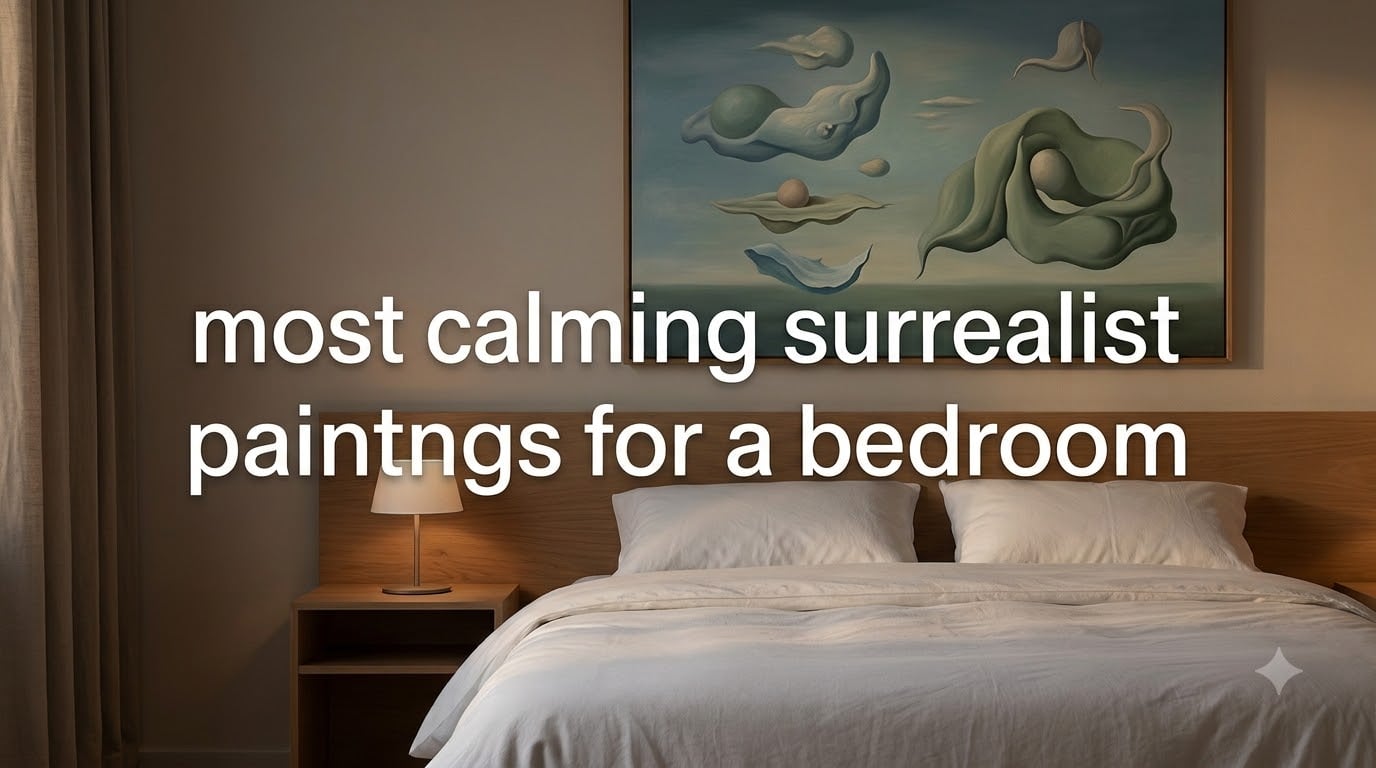
There’s a reason surrealist art feels so natural in a bedroom. The space where you sleep is the one place in your home where the conscious and subconscious genuinely blur — the same territory surrealism has been mapping since André Breton published his Surrealist Manifesto in 1924. When you choose the most calming surrealist paintings for a bedroom in 2026, you’re not just decorating a wall. You’re placing a visual companion to your dreams where it can actually do its work.
I’ve spent years studying which surrealist works support rest and which ones undermine it. The difference comes down to three things: palette, composition, and subject matter. This guide covers the 10 paintings I recommend most often, along with the reasoning behind each choice and practical tips for making them part of your sleep space.
Table of Contents
Quick Answer: The 5 Most Calming Surrealist Paintings for a Bedroom
If you want a fast starting point, these five paintings consistently deliver a calm, dreamlike presence in bedrooms: The Empire of Light by René Magritte (twilight serenity, muted blues and warm earth tones), Indefinite Divisibility by Yves Tanguy (soft organic forms in a quiet coastal palette), I Saw Three Cities by Kay Sage (architectural stillness with vertical calm), Creation of the Birds by Remedios Varo (gentle, luminous creation imagery), and The Inn of the Dawn Horse by Leonora Carrington (a self-portrait wrapped in quiet mystery). Each of these paintings uses muted or cool-toned palettes, horizontal or balanced compositions, and subject matter that invites contemplation rather than stimulation.
What Makes a Surrealist Painting Feel Calming?
Not every surrealist painting belongs in a bedroom. Dalí’s The Burning Giraffe or Ernst’s The Elephant Celebes are extraordinary works — but they’re visually aggressive in ways that fight against sleep. The calming ones share specific traits.
Color palette: The most restful surrealist works lean on soft blues, sage greens, warm greys, dusty lavenders, and muted earth tones. These colors lower visual tension. High-contrast reds, harsh yellows, or neon accents tend to raise alertness rather than lower it.
Composition: Horizontal compositions and balanced arrangements feel more stable and grounded. Vertically stretched or diagonally chaotic compositions create visual tension that can subconsciously agitate. Paintings with open, spacious backgrounds — where negative space dominates — give the eye room to rest.
Subject matter: Dreamscapes, floating objects, gentle transformations, and quiet architectural scenes read as calm. Melting forms can work if they’re slow and meditative (like certain Dalí pieces). But aggressive distortions, menacing figures, or claustrophobic imagery pull the viewer into an alert, evaluative state — the opposite of what a bedroom needs.
The dream connection: The strongest bedroom surrealist works depict states that mirror the transition into sleep: twilight, weightlessness, soft focus, solitary figures at rest. When the painting’s world looks like the edge of a dream, it becomes a visual bridge between waking and sleeping.
The 10 Most Calming Surrealist Paintings for a Bedroom
Here are the paintings I return to again and again when someone asks me which surrealist works actually support rest. Each one has been chosen for its specific calming qualities — palette, mood, composition, and the feeling it creates in a room where you’re trying to let go of the day.
1. The Empire of Light — René Magritte (1953–1954)
Magritte painted multiple versions of this image, and every one of them captures something profoundly still: a house at twilight under a daytime sky. The contradiction between the darkened foreground and bright clouds above creates a sense of suspended time. The palette — deep blue-greens, warm lamplight from a single window, soft grey stone — is exactly what sleep researchers recommend for bedroom walls. This is the painting I recommend more than any other for bedrooms. It doesn’t demand attention. It simply holds space.
2. Indefinite Divisibility — Yves Tanguy (1942)
Tanguy’s work is often overlooked in bedroom art guides, and that’s a mistake. His paintings feature soft, biomorphic forms scattered across quiet landscapes — like stones that grew organically on an empty shore. Indefinite Divisibility uses a muted palette of tans, soft greys, and pale blues that reads as almost monochromatic from across a room. The forms are strange but never threatening. They feel ancient, patient, and still — qualities that translate directly into a calming bedroom presence.
3. I Saw Three Cities — Kay Sage (1944)
Kay Sage is one of the most underrated painters in the surrealist canon, and her work is practically built for bedrooms. I Saw Three Cities presents tall, architectural forms rising from a soft, haze-filled landscape. The vertical elements give the painting a sense of quiet dignity without creating visual chaos. Sage’s palette — warm greys, muted golds, soft pinks — is among the most restful in all of surrealism. If you’re looking for a surrealist painting that feels like a calm morning rather than a fever dream, Sage is your artist.
4. Creation of the Birds — Remedios Varo (1957)
Varo painted Creation of the Birds in oil on masonite, and the result is luminous in a way that photographs can’t fully capture. The painting shows an owl-like figure painting birds into existence, each one taking flight from the brushstroke. The palette is warm — soft ochres, muted greens, and gentle amber — and the composition radiates outward from the central figure in a balanced, almost symmetrical pattern. It’s a painting about creation and becoming, and it carries that generative calm into whatever room it hangs in.
5. The Inn of the Dawn Horse — Leonora Carrington (1938–1939)
This self-portrait shows Carrington seated in a quiet interior, a white rocking horse behind her and a hyena at her feet. It sounds strange, but the effect is deeply serene. The muted earth tones, the stillness of the figure, and the enclosed domestic space make this painting feel intimate rather than unsettling. Carrington’s work consistently balances the bizarre with a gentle warmth that makes it well-suited to bedrooms. The painting rewards quiet looking — exactly the kind of attention you want before sleep.
6. The Harlequin’s Carnival — Joan Miró (1924–1925)
Miró’s carnival scene is more playful than the others on this list, but it earns its place through color and composition. The background is a warm, sandy beige, and the biomorphic forms — part animal, part instrument, part human — are rendered in soft reds, blues, and blacks that don’t fight for dominance. The painting has a contained energy. Things are happening inside it, but they’re happening gently. For a bedroom that needs a touch of whimsy without overstimulation, Miró is a reliable choice.
7. The Nostalgia of the Infinite — Giorgio de Chirico (1911–1914)
De Chirico’s metaphysical paintings are architectural and still, often showing empty piazzas under low sun. The Nostalgia of the Infinite features a tall tower casting a long shadow across an empty square, with a distant horizon. The warm terracotta tones, geometric stability, and vast negative space create a meditative quality that’s rare in art. This is a painting that makes a room feel larger and quieter. It works especially well in smaller bedrooms where you want to create a sense of openness.
8. Europe After the Rain II — Max Ernst (1940–1942)
The title sounds ominous, but the painting itself is surprisingly calm. Ernst used decalcomania — a technique of pressing paint between surfaces — to create organic, eroded forms that look like ancient ruins overgrown with soft vegetation. The palette is dominated by muted greens, greys, and warm browns. Despite its post-apocalyptic title, the painting reads as a landscape in recovery — nature reclaiming what was built. That sense of quiet aftermath has a soothing quality that suits bedrooms well.
9. The Persistence of Memory — Salvador Dalí (1931)
I include this with a caveat. Dalí’s melting clocks are iconic for a reason, and in the right bedroom context, they work. The key is that the melting here is slow, not violent. The warm amber and brown tones, the quiet coastal landscape in the background, and the sense of time literally softening all contribute to a meditative mood. The risk is that you already associate this image with pop culture — clocks on mugs, posters in dorm rooms. If you can see past that and experience the painting on its own terms, it’s genuinely calming. Choose a high-quality reproduction on canvas, not a glossy poster.
10. La Mémoire (Memory) — Man Ray (1937)
Man Ray’s painting shows a classical bust with a white cloth draped over its head, set against a simple background. The palette is minimal — warm whites, soft browns, muted reds — and the mood is one of quiet contemplation. The draped figure suggests rest, sleep, or a deliberate turning inward. It’s a small painting that rewards intimate viewing, making it ideal for a bedroom reading nook or the wall opposite your bed where you’ll see it last before closing your eyes.
Lesser-Known Calming Surrealists Worth Discovering
Three artists deserve special attention because their work is consistently calming and almost entirely absent from mainstream bedroom art guides. These are the painters I recommend when someone tells me they want surrealist art that feels personal rather than generic.
Kay Sage (1898–1963) painted architectural fantasies in muted palettes that feel like dreams of abandoned cities. Her work is spacious, geometric, and never crowded. If your bedroom has a modern or minimalist aesthetic, Sage’s paintings will feel like they were made for the space. Look for I Saw Three Cities, The Upper Side of the Sky, or Margin of Silence.
Remedios Varo (1908–1963) created luminous, warm-toned paintings of alchemists, weavers, and celestial mechanics. Her work glows from within — a quality that comes from her technique of layering thin glazes over a warm ground. Varo’s paintings feel generative and alive without being busy. They’re especially effective in bedrooms that get natural light, where the paintings’ internal luminosity can interact with the room’s own brightness.
Leonora Carrington (1917–2011) painted mythological scenes with a warmth and intimacy that sets her apart from most surrealists. Her figures are often female, often solitary, and often engaged in quiet, ritualistic activities. The mood is protective rather than exposing. For a bedroom that needs art with emotional depth without visual noise, Carrington is an exceptional choice.
How to Hang Surrealist Art in Your Bedroom
Placement matters as much as painting selection. I’ve seen beautiful surrealist prints ruined by poor positioning. These rules work for any bedroom art, but they’re especially important for surrealism, which can feel either transcendent or chaotic depending on where you put it.
Above the headboard: The most natural placement for bedroom art. Hang the painting so its center sits roughly 15 to 25 centimeters (6 to 10 inches) above the headboard. This creates a visual anchor for the bed without crowding the sleeping area. The painting’s width should be roughly two-thirds the width of the headboard for visual balance.
Eye level from the bed: When you’re lying down, the painting should be comfortable to view without straining your neck. This means hanging it lower than you would in a living room or hallway. Measure from your pillow to find your natural sightline when reclining.
The 70/30 rule: In interior design, the 70/30 principle suggests that 70% of a room’s visual weight should be in one dominant style or color family, with 30% in a complementary accent. For a bedroom with neutral walls and bedding, a surrealist painting can serve as that 30% — adding visual interest without overwhelming the calm foundation.
Avoid glare: Choose canvas prints or matte-finish reproductions rather than glossy prints behind glass. Bedroom lighting — especially bedside lamps — creates glare on reflective surfaces that defeats the purpose of calming art. Non-reflective canvas absorbs light softly and reads as calm in any lighting condition.
Pairing Surrealist Paintings with Your Bedroom Palette
The wrong wall color can neutralize even the most calming painting. Here’s how to match your surrealist art to your bedroom’s existing palette.
For soft blue or grey walls: Magritte’s Empire of Light, Tanguy’s Indefinite Divisibility, and Carrington’s The Inn of the Dawn Horse all work beautifully. These paintings share cool-toned palettes that harmonize with blue-grey rooms without competing for attention. The effect is cohesive and deeply restful.
For warm white or cream walls: Varo’s Creation of the Birds, de Chirico’s The Nostalgia of the Infinite, and Man Ray’s La Mémoire complement warm neutrals. The amber and ochre tones in these paintings pick up the warmth in cream walls and create a sense of enveloping softness.
For sage green or earth-toned walls: Ernst’s Europe After the Rain II, Sage’s I Saw Three Cities, and Miró’s The Harlequin’s Carnival pair well with organic, nature-inspired palettes. These paintings echo the earthy tones in the room while adding a layer of imaginative depth.
For dark or moody walls: If your bedroom has dark walls — charcoal, deep navy, or forest green — choose paintings with their own internal light source. Varo’s work glows. Sage’s architectural forms catch light. These paintings create focal points that lift the room’s mood without fighting the dark backdrop.
Frequently Asked Questions
What kind of paintings are good for a bedroom?
The best bedroom paintings feature muted or cool-toned palettes, balanced compositions, and subject matter that invites contemplation rather than stimulation. Paintings with soft blues, sage greens, warm greys, and horizontal layouts tend to support rest. Surrealist works that depict dreams, twilight, or gentle transformations are particularly well-suited to sleep spaces.
Is surrealist art good for bedrooms?
Surrealist art can be excellent for bedrooms when you choose the right pieces. The key is selecting paintings with calming palettes, spacious compositions, and dreamlike rather than chaotic imagery. Works by Magritte, Tanguy, Kay Sage, Remedios Varo, and Leonora Carrington are consistently calming, while more aggressive surrealist works by artists like Dali (in his more intense pieces) or Ernst’s darker paintings may be too stimulating for a sleep space.
What color surrealist art is best for sleep?
Soft blues, sage greens, warm greys, dusty lavenders, and muted earth tones are the best colors for bedroom surrealist art. These tones lower visual tension and align with sleep research showing that cool, desaturated colors promote relaxation. Avoid surrealist works dominated by harsh reds, bright yellows, or high-contrast neon accents, as these tend to raise alertness.
What is the 70/30 rule in art?
The 70/30 rule in interior design suggests that 70% of a room should follow one dominant style or color family, while 30% provides visual contrast or accent. In a bedroom, this means your walls, bedding, and furniture establish a calm neutral base (the 70%), and a surrealist painting serves as the expressive accent (the 30%). This balance keeps the room restful while adding personality.
How to hang surrealist art in a bedroom?
Hang surrealist art 15 to 25 centimeters above the headboard, with the painting width at roughly two-thirds the headboard width. Position the center of the painting at eye level when you are lying in bed. Choose canvas or matte-finish reproductions to avoid glare from bedside lamps. For smaller bedrooms, a single well-chosen piece works better than a gallery wall, which can feel busy in a sleep space.
Bringing Surrealism into Your Sleep Space
The most calming surrealist paintings for a bedroom share a few things: palettes that lower visual tension, compositions that give the eye room to rest, and imagery that mirrors the transition into sleep. Magritte’s twilight house, Tanguy’s quiet coastal forms, Sage’s architectural stillness, Varo’s luminous creations, and Carrington’s intimate mysteries — these are the works I’ve seen transform bedrooms from merely decorated rooms into genuine sleep sanctuaries.
Start with one painting. Hang it above your headboard. Live with it for a month. Surrealist art rewards patience in a way that few other genres do — the longer you look, the more you see, and the more the painting becomes part of your room’s quiet rhythm. For more guides on choosing the most calming surrealist paintings for a bedroom and living with surrealism every day, explore our other articles on the subject.