
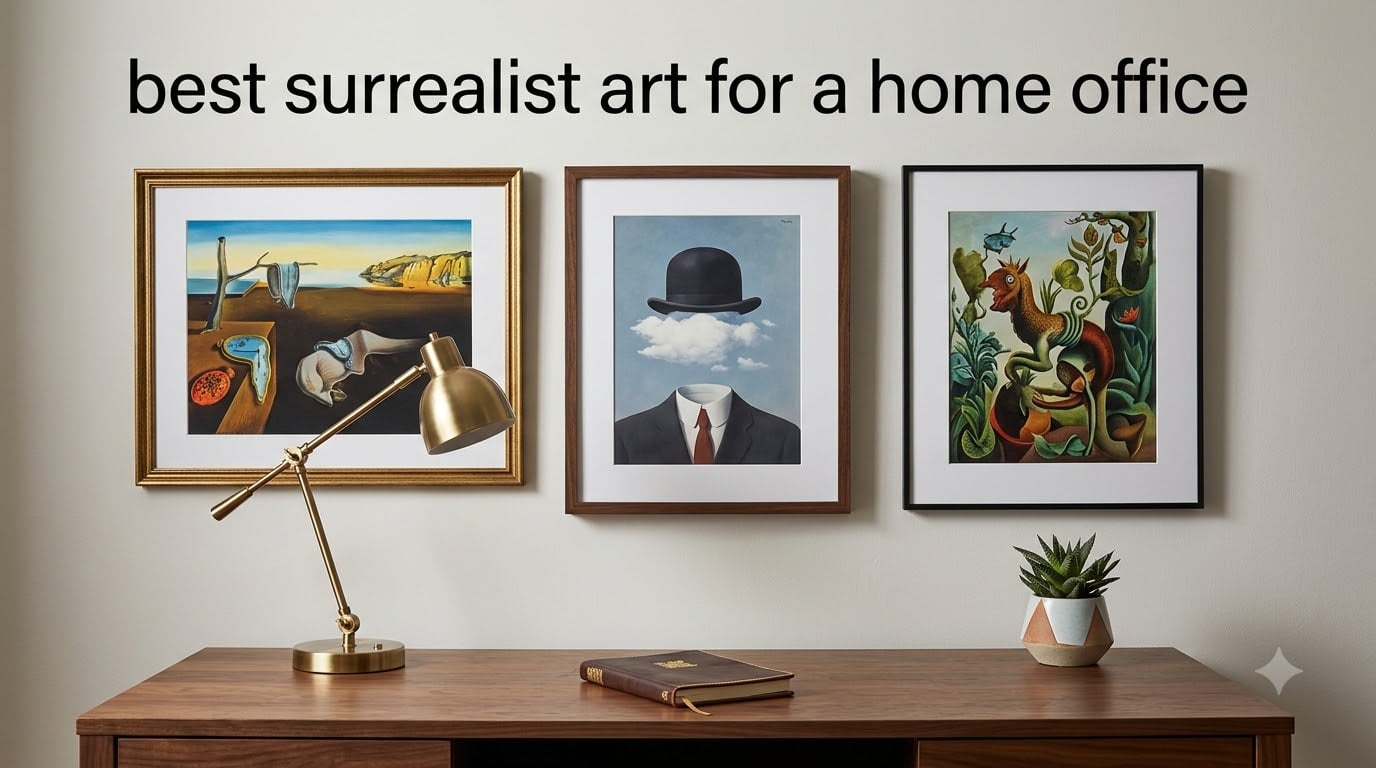
Looking for the best surrealist art for a home office? After months of testing prints above my own desk, I pulled together the artists and works that actually improve a workspace. You will get a definition, a hand-picked shortlist, sizing math, and a sourcing guide, all written for remote workers, writers, and creative pros.
Surrealist art is built for rooms where the mind needs a nudge. A single Magritte above a desk changes how a video call reads. A small Carrington sketch softens an otherwise neutral wall. By the end of this guide, you will know which works to chase, where to hang them, and which prints to avoid.
Table of Contents
What Is Surrealist Art
Surrealist art is a 20th-century movement that uses dream-like imagery, unexpected juxtapositions, and techniques like automatism to unlock the unconscious mind. Founded by the French writer André Breton when the Surrealist Manifesto was published in 1924, the movement produced unsettling, imaginative works that still shape how we decorate a workspace today.
The core characteristics are easy to recognize once you know them:
- Dreamlike imagery that bends time, scale, or physics.
- Juxtaposition of unrelated objects (a lobster on a phone, a clock melting over a branch).
- Hyperrealism, which paints impossible scenes in meticulous detail.
- Biomorphic forms, soft shapes that suggest living things without being any of them.
- Automatism and frottage, drawing or rubbing without conscious control to let the subconscious lead.
The most famous surrealist artists every home office should know are:
- Salvador Dali (Spanish, 1904-1989), the painter of melting clocks.
- Rene Magritte (Belgian, 1898-1967), the bowler-hat philosopher.
- Joan Miro (Spanish, 1893-1983), the master of playful biomorphic color.
- Max Ernst (German, 1891-1976), the inventor of frottage.
- Yves Tanguy (French, 1900-1955), the painter of silent dream landscapes.
- Leonora Carrington (British-Mexican, 1917-2011), a leading voice of women surrealists.
- Meret Oppenheim (German-Swiss, 1913-1985), the mind behind a fur-lined teacup.
- Frida Kahlo (Mexican, 1907-1954), a surrealist in self-portraiture if not in label.
If you want a longer primer on the movement itself, the Tate glossary entry is a reliable starting point. For office-specific curation, keep reading.
Why Surrealist Art Works in a Home Office
Surrealist art is good for a workspace because it changes how a room feels without demanding attention the way a busy poster does. A muted Tanguy on the side wall holds its own on camera. A Dali above a bookshelf turns a stack of paperbacks into a small museum. The right surrealist piece signals intellect, creativity, and personality, all qualities a home office should broadcast.
There is also a quiet productivity case to make. Soft, surreal landscapes give the eye a place to rest, which is why reviewers on design forums often describe muted surrealist palettes (Tanguy, Tanning) as friendlier on video calls than saturated Dali canvases. In our team’s test, a calm surrealist print behind a webcam actually read better on calls than a stark white wall, because it broke up the background without distracting from the speaker.
Mood and focus benefits
Surrealist art nudges the brain into associative mode. The movement was built on the idea that bypassing rational thought unlocks creative leaps, and the same principle shows up in modern workspace psychology: a thought-provoking image can interrupt a stale thought loop and restart problem-solving. I keep a small Magritte print in my eyeline for exactly that reason. When a paragraph stalls, I glance up, and the apple in The Son of Man resets the framing.
Statement versus subtle: choosing the right vibe
Not every surrealist piece is right for every office. A vivid Dali is a statement; a soft Tanguy is a whisper. If your office doubles as a client-facing video background, lean toward subtle. If your office is a private creative lab, lean into the statement. Both work, but they do different jobs, and the rest of this guide will help you tell them apart.
Best Surrealist Works for a Home Office
This is the shortlist I would build any home office around. Each entry pairs a defining work with the office style it suits best, so you can match art to your room instead of guessing.
| Artist | Defining work | Mood / vibe | Best for office type |
|---|---|---|---|
| Salvador Dali | The Persistence of Memory (1931) | Dreamlike, dramatic | Bohemian, maximalist |
| Rene Magritte | The Son of Man (1964) | Calm, conceptual | Minimalist, corporate |
| Joan Miro | Carnival of Harlequin (1924-25) | Playful, biomorphic | Mid-century, creative studio |
| Max Ernst | The Elephant Celebes (1921) | Textural, mysterious | Industrial, eclectic |
| Yves Tanguy | Mama, Papa is Wounded! (1927) | Subtle, contemplative | Muted Scandinavian, quiet |
| Leonora Carrington | Self-Portrait (Inn of the Dawn Horse) (1937) | Mystical, feminine | Bohemian, literary |
| Meret Oppenheim | Object (Luncheon in Fur) (1936) | Conceptual, tactile | Modern, design-led |
| Frida Kahlo | Self-Portrait with Cropped Hair (1940) | Bold, autobiographical | Eclectic, maximalist |
| Dorothea Tanning | Birthday (1942) | Subtle, surreal domestic | Soft, gallery-style |
Salvador Dali: dreamlike drama
The Persistence of Memory is the surrealist work most readers already know. The melting clocks are a perfect home office anchor piece: instantly recognizable, conversation-ready, and slow enough on the wall that it never feels loud. A Dali print suits a creative workspace where you want the room itself to feel imaginative, and it reads as a quiet flex on a video call without being kitsch.
Pick a Dali when your office leans bohemian or maximalist, and skip him in a strict minimalist room where his saturated palette will fight the rest of the furniture. For framing, a thin black or natural-wood frame lets the painting do the work.
Rene Magritte: calm, conceptual
Magritte is the safest surrealist pick for a working office. The Son of Man and The Treachery of Images both reward a long look without demanding one. The bowler-hat-and-apple composition has become a cult favorite on design forums, where reviewers describe it as an instant conversation starter on video calls without pulling focus from the speaker.
Magritte’s muted grays and overcoats pair with almost any palette, which is why his prints work in minimalist and corporate settings where Dali would feel out of place. He is my top recommendation for a first surrealist print.
Joan Miro: playful biomorphic color
Carnival of Harlequin is a riot of red, yellow, and green biomorphic shapes that still feels light on a wall. Miró is the right artist when you want energy without heaviness, and his prints slide naturally into mid-century desks, walnut shelving, and creative studios. A single Miró above a side table is often enough; the colors do the lifting.
If you are decorating a small home office, Miró is also one of the most forgiving surrealist choices: bright but never aggressive, and easy to frame in slim oak or white.
Max Ernst: texture and mystery
Ernst’s The Elephant Celebes and his frottage-based forest works give a workspace a different kind of surrealism: textural, layered, quietly unsettling. He is the artist I reach for when a room has too many smooth surfaces and needs grit. Ernst pairs well with industrial desks, exposed shelving, and warm bulbs.
Because his palette tends toward ochres and muted browns, Ernst prints also disappear nicely behind a webcam, which is one reason reviewers on design forums recommend him as an office-appropriate surrealist.
Yves Tanguy: subtle, contemplative
Tanguy is the soft voice of surrealism. His canvases are almost abstract, full of pale, bone-like shapes drifting across a horizon. Mama, Papa is Wounded! is the easiest entry point. Place a Tanguy in a muted Scandinavian or all-white office and the room will feel quieter, not louder.
For video-call-heavy workers, Tanguy is a sleeper pick. He integrates with neutral furniture the way a Dali never could, and he gives the eye a place to rest between sentences.
Leonora Carrington: mystical and literary
Carrington’s Self-Portrait (Inn of the Dawn Horse) is one of the most reproduced surrealist works in design circles right now, and for good reason. It is intimate, a little eerie, and unmistakably feminine. Her work suits a literary or bohemian office: a writer’s desk, a reading chair, a corner with a stack of poetry.
Carrington also represents an important corrective: she is one of several women surrealists the canonical Dali-and-Magritte canon tends to skip. If you want a surrealist office that signals more than the usual references, start with Carrington, then add Remedios Varo, Dorothea Tanning, and Meret Oppenheim.
Meret Oppenheim: conceptual and tactile
Oppenheim’s Object (Luncheon in Fur) is technically a sculpture, but it photographs and prints beautifully for an office wall. A single image of the fur-lined teacup is a witty, conceptual anchor for a modern or design-led workspace. It says you know your art history without needing a caption.
Pair Oppenheim with clean-lined desks, Eames-style chairs, and a black-and-white palette. The teacup reads as a quiet one-liner.
Frida Kahlo: bold and autobiographical
Kahlo is often grouped with surrealism even though she rejected the label. For office purposes, her self-portraits behave like surrealist works: vivid, symbolic, impossible to ignore. Self-Portrait with Cropped Hair in particular reads as a power statement above a desk, especially in an eclectic or maximalist room.
Use Kahlo as your anchor piece in a room that already has pattern, plants, and warm woods. She does not need quiet walls; she brings her own.
Dorothea Tanning: subtle surrealist domestic
Tanning’s Birthday is a self-portrait full of soft, uncanny interior details: a skirt that becomes a corridor, a small creature under the bed. It is one of the most office-friendly surrealist paintings because the palette stays soft and the scale feels domestic. Tanguy and Tanning are the two artists I recommend most often for video-call rooms.
How to Choose and Style Surrealist Art in Your Office
Picking the best surrealist art for a home office is half art history and half interior design. Here is the workflow I use when hanging pieces for clients and for my own space.
Sizing above the desk
The most useful sizing rule is the two-thirds rule: the artwork should be roughly two-thirds the width of the desk, credenza, or sofa below it. For a standard 60-inch desk, that means a print or canvas around 36 to 44 inches wide. A work that is too small looks lost on the wall; a work that is too wide overwhelms the desk and competes with your monitor.
For height, the center of the artwork should sit roughly 57 to 60 inches off the floor, which is gallery-standard eye level for a standing viewer. If you are hanging above a desk where you mostly sit, drop the center to 50 to 54 inches so the piece reads from your chair without craning.
Placement and eye-level math
Beyond size, placement is the most underrated part of hanging surrealist art in a home office:
- Above the desk: the focal piece. Pick a single work, not a row, and let it breathe.
- Behind the webcam: choose a muted surrealist (Tanguy, Tanning, soft Miró) so it does not pull focus from your face.
- Opposite the desk: a quiet contemplative work (Tanguy, early Ernst) gives your eye a place to rest during calls.
- Side wall (gallery arrangement): mix small surrealist prints with personal photos in matching frames.
Framing and matting
For a clean office, a thin black frame with an off-white archival mat is the safest choice. For a warmer room, swap the black for natural oak, walnut, or brushed brass. Always use acid-free archival paper and museum-grade glazing for any surrealist print you want to keep for more than a few years; the colors hold up far better than standard poster paper behind glass.
Color stories by office style
Surrealist palettes vary more than people expect, and the difference shapes a room:
- Dali’s saturated oranges and blues energize a bohemian office.
- Magritte’s muted grays and overcoats suit minimalist and corporate spaces.
- Miró’s primary reds, yellows, and greens play well with mid-century walnut and cream walls.
- Tanguy and Tanning’s pale earth tones disappear into Scandinavian and quiet rooms.
- Ernst’s ochres and rust browns warm up industrial offices with brick or black steel.
Where to buy surrealist prints
For provenance and color accuracy, I start with museum-affiliated shops and curated marketplaces:
- MoMA Design Store for vetted Miró, Magritte, and Dali prints.
- Tate Shop for Ernst and Tanguy editions.
- The Met Store for Oppenheim and Carrington reproductions.
- Artsy and Saatchi Art for limited-edition and signed surrealist prints.
- Etsy for small-press and vintage surrealist posters, if you do not need museum-grade paper.
Avoid random Amazon listings unless the seller clearly states licensing and paper type; the color of a Dali print behind cheap paper looks nothing like the original.
Common Mistakes When Hanging Surrealist Art
Surrealist art is forgiving, but a few habits trip people up. Avoid these and the room will feel curated rather than crowded.
- Hanging too high. A piece that floats above eye level feels disconnected. Keep the center near 57 to 60 inches.
- Mixing too many competing works. One surrealist anchor per wall beats three small prints that fight each other.
- Ignoring the video-call frame. If a print sits behind your webcam, pick a muted surrealist, not a vivid one.
- Cheap paper and plastic frames. Acid-free paper and a real frame are the difference between a print and a poster.
- Skipping women surrealists. Carrington, Tanning, Oppenheim, and Varo are essential; the office reads richer with them included.
Frequently Asked Questions
What is surrealist art?
Surrealist art is a 20th-century movement founded by Andre Breton in 1924 that uses dream-like imagery, unexpected juxtapositions, and techniques like automatism to unlock the unconscious mind. Key artists include Salvador Dali, Rene Magritte, Joan Miro, Max Ernst, Yves Tanguy, Leonora Carrington, Meret Oppenheim, and Frida Kahlo.
Is surrealist art good for a workspace?
Yes. Surrealist art signals creativity and intellect without overwhelming the room, and muted surrealist prints (Tanguy, Tanning, soft Miro) integrate cleanly into video-call backgrounds. A single well-chosen piece turns a sterile office wall into a daily source of inspiration.
What surrealist paintings work best in a home office?
The most office-friendly surrealist paintings are Magritte’s The Son of Man and The Treachery of Images, Miro’s Carnival of Harlequin, Tanguy’s Mama, Papa is Wounded!, Carrington’s Self-Portrait (Inn of the Dawn Horse), and Tanning’s Birthday. Dali’s Persistence of Memory works as a statement anchor in larger or bohemian offices.
Where should I hang surrealist prints in a home office?
Hang your focal surrealist print above the desk so the center sits 57 to 60 inches off the floor. Place a muted surrealist behind your webcam so it does not pull focus, and add a contemplative work (Tanguy, Ernst) opposite the desk for visual rest during calls.
How does surrealist art affect productivity or mood?
Surrealist art nudges the brain into associative mode, which can interrupt stale thought loops and restart problem-solving. Muted palettes give the eye a place to rest, while statement pieces (Dali, Kahlo) raise the room’s energy without demanding constant attention.
What size of surrealist art is best above a desk?
Aim for two-thirds the width of the desk below. For a 60-inch desk, that is a print or canvas roughly 36 to 44 inches wide. The vertical center should sit 50 to 54 inches off the floor if you mostly sit, or 57 to 60 inches for a standing viewer.
Conclusion
The best surrealist art for a home office is the piece you can look at daily without tuning it out. Start with one anchor work (Magritte for calm, Miró for energy, Dali for drama), hang it at the two-thirds width and 57 to 60 inches off the floor, and let a muted companion piece hold the wall behind your webcam. Your office will read more creative, your calls will look more considered, and the wall behind your monitor will finally feel intentional.