
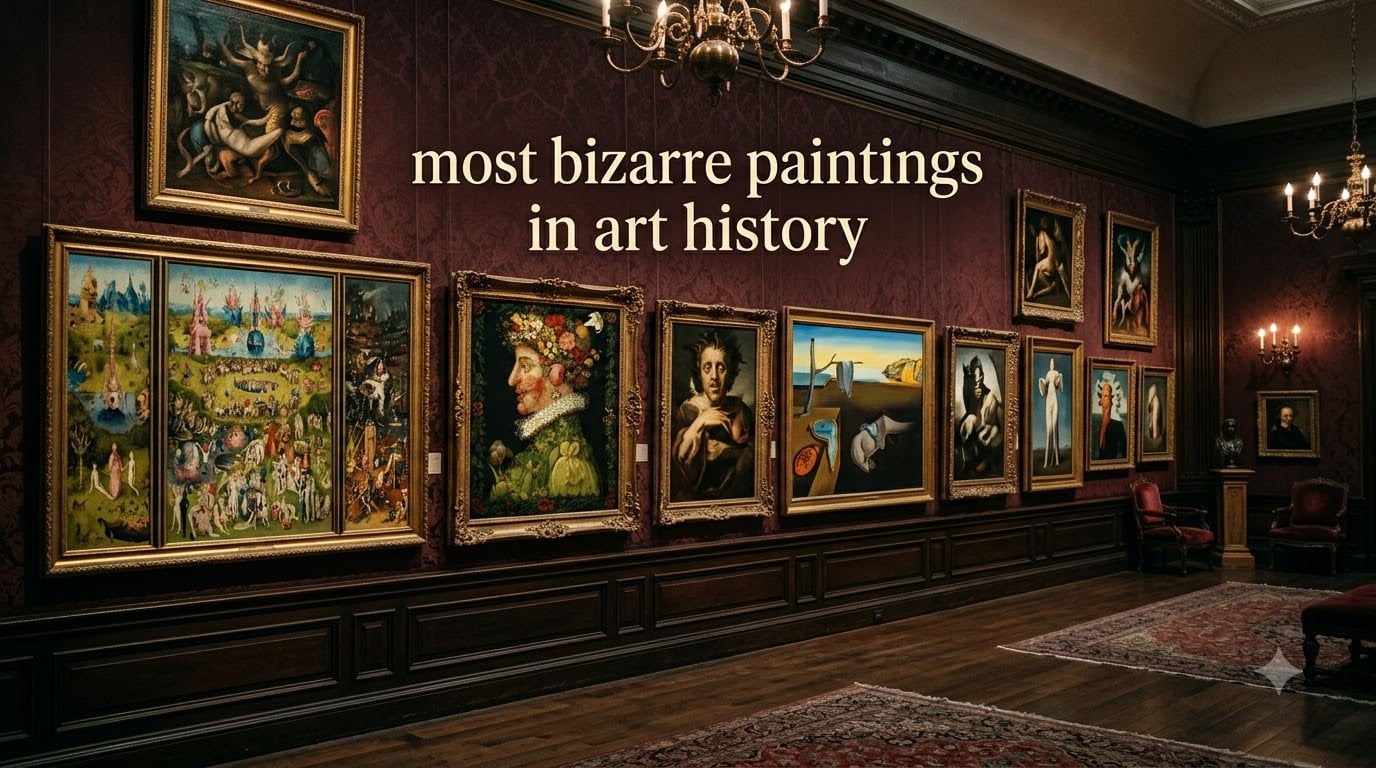
I’ve spent years wandering museum halls, and I’ll be honest: the paintings I return to most are the strange ones. The most bizarre paintings in art history aren’t famous because they’re pretty. They’re famous because they lodge themselves in your memory like a splinter you can’t quite reach. Bosch’s hellscape panel, Goya’s black-painted wall, Arcimboldo turning a face into a pile of fruit. These works unsettle, amuse, and haunt us in equal measure.
In this guide, I’m walking through 600 years of weird, strange, and unsettling art. I’ll cover the paintings every list names, plus several you won’t find on the typical roundup. We’ll look at why they feel bizarre, the symbolism hiding inside them, and what psychologists say about our compulsion to stare at things that disturb us.
Table of Contents
What Makes a Painting “Bizarre” and Why We Cannot Stop Looking
A painting earns the “bizarre” label when it breaks one of three unspoken agreements with the viewer. It violates what we expect to see (a face made of vegetables, a clock melting over a branch). It violates how we expect to feel (a serene meadow concealing cannibalism). Or it violates the rules of the art world itself (a banana taped to a gallery wall as a gallery piece).
The term “bizarre” comes from the Basque word bizar, meaning beard. It originally meant odd or eccentric in appearance, then drifted into its modern sense of strangely fantastical. Art historians use it alongside words like grotesque, surreal, and uncanny, but each carries a slightly different weight.
The curiosity we feel looking at strange art has a name in psychology. Researchers call it morbific curiosity, the pull toward mildly threatening or transgressive content that’s safe enough to inspect. We lean toward the macabre because our brains want to rehearse danger without paying the cost of real danger. Bizarre paintings give us that rehearsal in a frame.
This is also why bizarre art keeps getting remade. Every generation produces its own Bosch. The genre never ages out because the human appetite for cognitive dissonance doesn’t either.
Types of Bizarre Art: A System for Sorting the Strange
Before we dive into specific paintings, it helps to separate bizarre art into four rough categories. Most strange works borrow from more than one, but every entry leans heaviest on one.
Grotesque Bizarre: Hybrid Creatures and Distorted Bodies
This is the category Bosch and Arcimboldo own. Bodies are merged, recombined, or stitched together from incompatible parts. The grotesque tradition runs back to Roman frescoes rediscovered in caves (hence the name), where artists invented impossible beings to express the disorder of the unconscious mind.
Surreal Bizarre: Dream Logic and Impossible Objects
Surrealism officially begins in 1924 with André Breton’s manifesto, but dreamlike imagery predates it by centuries. What makes a surreal painting strange isn’t horror but dislocation. A floating bowler hat, an eye where a moon should be, a face obscured by apples. Your brain keeps trying to resolve the image and failing.
Disturbing Bizarre: Visceral Reactions and Dark Subjects
This is Goya’s territory. Disturbing bizarre art makes you look away, or forces you to keep looking despite yourself. Saturn eating his own child. The murder of a saint. Skulls staring from beneath a still life of fruit. The unsettling power comes from what’s recognizably human inside the horror.
Humorous and Whimsical Bizarre: The Strange That Makes You Laugh
Not every bizarre painting wants to scare you. Some are delightfully absurd: a cat with a pearl necklace, a man climbing out of his own portrait, a snail riding a rabbit. These works charm us because they violate the seriousness we expect from “fine art.”
Timeline: Bizarre Paintings Through 600 Years of Art History
Below is a chronological map of the paintings we’ll cover. The table gives you the year, the work, the artist, the period, and the type of bizarre we’re labeling it. This is the fastest way to scan six centuries of strange art.
| Year | Painting | Artist | Period | Why It’s Bizarre |
|---|---|---|---|---|
| 1490-1510 | The Garden of Earthly Delights | Hieronymus Bosch | Northern Renaissance | Grotesque hybrid creatures in a moralistic dreamscape |
| 1530 | The Garden of Eden | Lucas Cranach the Elder | Northern Renaissance | Sinister, elongated figures in paradise |
| 1533 | The Ambassadors | Hans Holbein the Younger | Northern Renaissance | Skull hidden in anamorphic perspective |
| 1562 | The Triumph of Death | Pieter Bruegel the Elder | Dutch Renaissance | Apocalyptic army of skeletons |
| 1563-1573 | The Four Seasons | Giuseppe Arcimboldo | Mannerism | Composite portraits built of fruits, leaves, branches |
| 1590 | Vertumnus (Emperor Rudolf II) | Giuseppe Arcimboldo | Mannerism | Emperor’s face assembled from fruits and flowers |
| 1512-1516 | Temptation of St. Anthony | Matthias Grünewald | Northern Renaissance | Demon-torn saint in nightmarish landscape |
| 1781 | The Nightmare | Henry Fuseli | Romanticism | Incubus crouched on a sleeping woman |
| 1819-1823 | Saturn Devouring His Son | Francisco Goya | Romanticism | Titan eating his own child |
| 1893 | The Scream | Edvard Munch | Symbolism/Expressionism | Anguished figure under a blood-red sky |
| 1931 | The Persistence of Memory | Salvador Dalí | Surrealism | Melting clocks over a Catalan landscape |
| 1953 | Study after Velázquez’s Portrait of Pope Innocent X | Francis Bacon | Modernism | Screaming pope trapped in a cage of paint |
| 1964 | The Son of Man | René Magritte | Surrealism | Man in bowler hat with apple obscuring his face |
| 2019 | Comedian | Maurizio Cattelan | Contemporary | A banana duct-taped to a gallery wall |
18 of the Most Bizarre Paintings in Art History
Now the part you’ve been waiting for. I’ve grouped these loosely by chronology and theme, with the canonical entries first and the more surprising picks toward the end. Each entry covers what the painting shows, why it feels bizarre, and the symbolism most art historians agree on.
The Garden of Earthly Delights by Hieronymus Bosch (1490 to 1510)
If you’ve seen one bizarre painting, it’s probably this one. Bosch’s three-panel triptych opens to reveal the entire history of humanity compressed into a fever dream. The left panel shows Adam and Eve in paradise. The central panel explodes with hundreds of nude figures riding giant birds, climbing into glass spheres, and feasting on giant strawberries. The right panel is hell, full of burning cities, knife-earred demons, and a giant bird-beaked creature eating sinners and excreting them into a pit.
What makes this painting bizarre is its density. There is no single focal point. Your eye keeps landing on small horrors: a man with a hole in his head being led by a demon, a pig in a nun’s habit, lovers sealed inside a glass bubble. The painting is a moral encyclopedia of sin, but the moral logic is buried under such overwhelming imagery that interpretation remains contested.
Bosch was a member of a local religious brotherhood in ‘s-Hertogenbosch, and most scholars read the work as a warning about the fleeting nature of pleasure. The strawberries rot; the lovers age; the demons wait.
Temptation of St. Anthony by Matthias Grünewald (1512 to 1516)
Grünewald’s panel pulls Saint Anthony into a desert so terrifying it looks like a Hieronymus Bosch outtake. A demon with a bird’s beak tears the saint’s robes. Another pulls him upward by the hair. The landscape behind them is scarred, fractured, and bleeding color. Anthony himself is small, almost crushed by the chaos around him.
What makes this panel so strange is the texture of the demons. They’re not cartoon monsters. They’re layered, muscular, and bursting with detail. You can read individual feathers, scales, and wounds. The bizarre feeling comes from how seriously Grünewald takes the impossible.
The Garden of Eden by Lucas Cranach the Elder (1530)
Cranach’s Eden looks peaceful at first glance: Adam and Eve stand beneath the tree of knowledge with a lamb at their feet. Look closer, and the figures are stretched, the proportions are wrong, and the animals gathered at the edges include creatures that don’t exist. The lamb looks at us with unsettling eyes. The serpent has a woman’s face.
Cranach’s bizarreness is subtle. He doesn’t paint monsters. He paints paradise slightly wrong, which makes the fall feel inevitable.
The Ambassadors by Hans Holbein the Younger (1533)
The Ambassadors is one of the most famous double portraits in Western art, and on first glance it’s a calm, dignified image of two wealthy young men surrounded by the symbols of their learning and wealth. Below their feet, stretched across the floor, is a smeared gray shape that looks like a smear of paint.
Walk past the painting and look at it from the side. The smeared shape resolves into a human skull, painted in anamorphic perspective so that it only makes sense from a specific angle. Holbein embedded a memento mori inside a portrait of the living. It’s a bizarre moment hidden inside restraint, which is what makes it so disquieting.
The Triumph of Death by Pieter Bruegel the Elder (1562)
Bruegel’s panorama is the apocalypse in oil paint. Skeletons march across a ruined landscape, ringing bells, leading wagon trains of coffins, and ferrying souls into a giant coffin-ship marked with a cross. Living humans try to flee, beg, or hide. None succeed.
What makes it bizarre is its scale. There is no central figure, no hero, no escape. The skeletons aren’t individuals. They’re a system. Art historians have argued about whether Bruegel intended the painting as Catholic propaganda against Protestant heresy, as a meditation on the Spanish occupation of the Netherlands, or as a simple statement that death wins regardless.
The Four Seasons by Giuseppe Arcimboldo (1563 to 1573)
Arcimboldo is the painter most responsible for composite portraits, and his Four Seasons series is his calling card. Spring is a face made of flowers. Summer is a face made of wheat, fruit, and vegetables. Autumn is built from grapes, pumpkins, and a pear-shaped nose. Winter is a gnarled face of bark and bare twigs.
What makes Arcimboldo bizarre is the recognition delay. You see the bouquet first, then the face, then the bouquet again. Your brain cannot decide which image to commit to. Renaissance viewers found this delightful; some church authorities found it disturbing. Either way, Arcimboldo built a genre of art that didn’t exist before him.
Vertumnus (Emperor Rudolf II) by Giuseppe Arcimboldo (1590)
Vertumnus is Arcimboldo’s most ambitious composite portrait. The Roman god of seasons, in this case disguised as Holy Roman Emperor Rudolf II, is built from apples, pears, cherries, grapes, pomegranates, plums, olives, beans, artichokes, gourds, mushrooms, and flowers. The emperor’s beard is made of grapes. His ear is a wheat ear. His throat is a pomegranate split open.
The painting is a piece of courtly flattery so elaborate it loops back into the bizarre. Rudolf was Arcimboldo’s patron and a famously eccentric emperor with cabinets of curiosities overflowing with strange objects. The painting flatters him as a ruler who can turn barren winter into abundant summer with his touch.
The Nightmare by Henry Fuseli (1781)
A young woman in white drapes across a bed, her head and arms hanging backward over the edge. Crouched on her chest is a small incubus, an imp-like demon, staring directly at the viewer. Behind them, a ghostly horse’s head pushes through black curtains.
Fuseli’s painting hit the late 18th century like a thunderclap. It wasn’t just the supernatural subject. It was the suggestion of sexuality. The incubus sits on the woman’s chest in a position that was, and still is, charged with erotic implication. The painting fuses the gothic, the erotic, and the supernatural into a single image that still feels uncomfortable today.
Saturn Devouring His Son by Francisco Goya (1819 to 1823)
Goya painted this directly onto the plaster wall of his house, the Quinta del Sordo, between 1819 and 1823. It shows the Titan Saturn, father of the Roman gods, eating one of his children to prevent a prophecy that one of his offspring would overthrow him. Saturn’s empty eye sockets stare out of the canvas. His fingers dig into the bloody flesh of his son’s torso. The son’s limp arm hangs in the foreground.
What makes it bizarre is the painted context. These images, sometimes called the Black Paintings, were not commissioned. Goya painted them for himself during a period of illness and isolation, and they were never meant to leave his walls. They were transferred to canvas 20 years after his death and now hang in the Prado.
The grotesque power of the image also lies in what Goya does not paint. There’s no background, no narrative. Just a Titan with a mouthful of child, painted in browns and reds, directly onto plaster. It’s one of the most disturbing paintings ever committed to canvas.
The Scream by Edvard Munch (1893)
An androgynous figure clutches its face on a bridge, mouth open in a silent howl. The sky behind is streaked with red, orange, and yellow bands. The fjord below is dark blue. There is no specific event happening, just pure panic radiating from a single figure.
The Scream is bizarre precisely because it isn’t specific. Munch said he was walking with friends when the sun set and he felt “an infinite scream passing through nature.” The image is not a portrait of a person. It’s a portrait of an emotion, and that is what makes it strange. The figure doesn’t even have a face. It’s a skull stretched over a body.
Munch painted four versions between 1893 and 1910, and the 1910 pastel was bought at auction in 2012 for nearly 120 million dollars.
The Persistence of Memory by Salvador Dalí (1931)
Three melting watches droop over a Catalan landscape. A fourth watch hangs over the edge of a rectangular block. A fourth watch is covered in ants. In the foreground, a fleshy humanoid figure lies asleep on the ground with a closed eye and exaggerated eyelashes.
Dalí called his method “paranoiac-critical,” a process of accessing his subconscious through self-induced psychosis. The melting watches are sometimes read as Einstein’s theory of relativity, since Dalí learned about non-Euclidean geometry and atomic theory while working on the painting. Sometimes they are read as Camembert cheese melting in the sun.
Whatever the interpretation, the image remains bizarre because of the relationship between the soft watches and the hard landscape. We don’t know if the watches are melting or whether the world around them has become soft.
Study after Velázquez’s Portrait of Pope Innocent X by Francis Bacon (1953)
Bacon took Velázquez’s famous 1650 portrait of Pope Innocent X and turned the dignified pope into a screaming figure trapped inside a golden cage of paint. The pope’s mouth is open in a silent scream. The robes dissolve into brown and yellow streaks. The throne becomes a cage.
What makes Bacon’s image bizarre is the violation. Velázquez’s portrait is one of the most restrained, dignified images in Western art. Bacon’s version destroys that restraint. The pope is no longer a person; he is a smear of humanity trying to break out of the frame.
Bacon said he wanted to paint “the brutality of fact.” He succeeded.
The Son of Man by René Magritte (1964)
A man in a dark suit and bowler hat stands in front of a low seawall. His face is almost entirely covered by a floating green apple. We can see his eyes peeking over the apple’s edge, looking directly at us.
Magritte’s self-portrait is one of the most parodied images in modern art, but the bizarre quality survives every copy. The painting is a commentary on the unavoidable gap between what we see and what we know. The face is hidden, but the eyes still meet the viewer. We see a man without ever seeing his face.
Magritte called the painting a self-portrait because, he said, “everything we see hides another thing. We always want to see what is hidden by what we see.”
The Ghost of a Flea by William Blake (1819 to 1820)
Blake claimed he saw the ghost of a flea in a séance-like vision and was told by the spirit to paint it. The result is a small watercolor of an oversized, muscular, semi-human flea, holding a bowl and looking directly at the viewer with an expression of cruel amusement.
The bizarre quality here is partly biographical. Blake spent years claiming he spoke to angels, fairies, and historical figures. His wife Catherine testified that she watched the flea spirit appear and that Blake sketched furiously as it vanished. The painting is bizarre because of the painting itself, but also because of the process behind it.
The Isle of the Dead by Arnold Böcklin (1880)
Böcklin painted five versions of a small boat arriving at a rocky island populated only by cypress trees and a white temple. The boatman Charon ferries a coffin-shaped white box across dark water toward an open doorway in the cliff. The colors are dark greens, blues, and grays.
The painting was so popular in its day that a Russian surgeon bought the third version to keep it from leaving the country. Hitler owned a print. Sergei Rachmaninoff composed a symphonic poem inspired by it. The bizarre quality lies in the stillness. There is no event, no drama, just the slow approach of death to its home.
Portrait of Juan de Pareja by Velázquez (1650)
Velázquez’s portrait of his assistant Juan de Pareja is a famous image, but it has a strange quality few casual viewers notice. Pareja was a slave of Moorish descent. He was freed by Velázquez four years after this portrait was painted. Velázquez painted him as a dignified, contemplative man with a piercing gaze, in a way that was unusual for portraits of enslaved people in 17th century Spain.
The bizarre quality here is not in the painting but in its existence. Velázquez painted a portrait of a person that European art of his era typically excluded from dignified portraiture. The result is a strange object: an image of beauty and dignity that the surrounding culture insisted could not exist.
The Disquieting Muses by Leonor Fini (1949)
Three masked female figures stand in a barren courtyard in front of a closed gate. Their faces are skeletal and their bodies are wrapped in black cloth. The figures are based on the three Furies of Greek mythology and on the three witches in Macbeth.
Fini was an Argentine surrealist who often painted women as powerful, threatening, or supernatural beings, an inversion of how women had been depicted in art for centuries. The bizarre quality comes from the figures’ quiet, calm demeanor. They are not screaming or attacking. They are simply there, watching.
Comedian by Maurizio Cattelan (2019)
A ripe banana duct-taped to a gallery wall sold for 120,000 dollars at the Art Basel Miami Beach fair in 2019. The piece, by Italian provocateur Maurizio Cattelan, was titled Comedian and was displayed as a limited edition of three.
Comedian is bizarre because it is not a painting, yet it tests the boundaries of what art can be. A banana taped to a wall became one of the most discussed artworks of 2026. It also raises a serious question: if a banana can be art, what makes something not art? Cattelan has made a career out of this kind of question. His 1996 sculpture of Pope John Paul II struck by a meteorite is now a permanent part of the collection at the Kunsthalle Bremen.
The bizarre power of Comedian is its simplicity. There is nothing to interpret. There is only the banana, the tape, and the gallery’s decision to call it art. The viewer’s reaction is the artwork.
Why Humans Are Fascinated by Bizarre Art
If bizarre paintings are unsettling, why do we keep going back to them? Three psychological mechanisms explain most of our attraction.
The Uncanny Valley of Visual Art
Robots that look almost-but-not-quite human freak us out. So do paintings. Masahiro Mori coined the term uncanny valley in 1970 for the dip in our comfort when something is close to human but slightly off. Bosch’s hybrid creatures, Arcimboldo’s vegetable faces, and Bacon’s smeared popes all fall into that valley. Our brains try to recognize a face, almost succeed, and recoil from the failure.
Safe Threat Simulation
Curiosity researchers have identified something called morbid curiosity, the pull toward threatening content when we are physically safe. Bizarre paintings let us rehearse fear, disgust, and awe without paying any biological cost. The Goya stays on the wall. The Bosch stays in the museum. We walk home.
Cognitive Dissonance as Reward
When our predictions fail, our brains release a small burst of attention and dopamine. Bizarre paintings violate our visual predictions so thoroughly that the brain rewards us for trying to resolve them. We keep looking because our brains keep trying, and our brains keep getting paid for trying.
These three mechanisms together explain why the most disturbing painting can also be the most popular. The Salvador Dalí Museum in St. Petersburg, Florida, draws hundreds of thousands of visitors a year specifically because the paintings make people uncomfortable and curious in equal measure.
Bizarre Art Beyond Europe: Non-Western Traditions
Most bizarre painting lists stop at the Prado, and that’s a real loss. Strange art has been made in every culture that has ever made art. Here are three traditions no European list covers.
Japanese Ukiyo-e Ghost Stories
Kawanabe Kyōsai’s late 19th century work belongs to a Japanese tradition of depicting yōkai, supernatural beings from folklore. His paintings include skeleton processions, demon wrestlers, and animals wearing human clothing. The famous Hyakki Yagyō Emaki (Night Parade of One Hundred Demons) is a medieval scroll tradition that influenced generations of Japanese painters.
Indian Tantric and Miniature Painting
Rajasthani and Pahari miniature paintings include scenes of multi-armed deities, animals with human faces, and erotic tantric imagery that European visitors found (and sometimes still find) shocking. The bizarre quality comes from the religious context: many of these images depict meditation practices, cosmological maps, or deities whose multiple limbs are signs of power, not strangeness.
Mexican Muralism and the Strange Sacred
Frida Kahlo, José Clemente Orozco, and Diego Rivera produced a tradition of 20th-century Mexican muralism that frequently depicts skeletons, devils, and martyrs in settings that blend Catholic iconography with pre-Columbian mythology. Frida Kahlo’s self-portraits with monkeys, thorns, and decapitated columns are among the most recognizable bizarre images in 20th-century art.
The point isn’t that these traditions are weird. The point is that bizarre art is universal, and the strange visions of Bosch, Arcimboldo, and Dali have parallels in nearly every culture that has ever picked up a brush.
Frequently Asked Questions
What is the most bizarre artwork of all time?
Hieronymus Bosch’s The Garden of Earthly Delights is widely considered the most bizarre artwork of all time. The three-panel triptych from around 1490 to 1510 shows paradise on the left, a moralistic dreamscape of human indulgence in the center, and a nightmarish vision of hell on the right. No other painting packs the same density of impossible creatures, hidden symbolism, and moral allegory into a single work.
What are some of the most disturbing paintings in history?
The most disturbing paintings in history include Francisco Goya’s Saturn Devouring His Son, Matthias Grunewald’s Temptation of St. Anthony, Hieronymus Bosch’s Garden of Earthly Delights, Caravaggio’s Judith Beheading Holofernes, Thomas Eakins’ The Gross Clinic, and Francis Bacon’s Study after Velazquez’s Portrait of Pope Innocent X. These works combine visceral subject matter with technical mastery to produce images viewers struggle to look away from.
What are the top 10 weirdest paintings of all time?
The top 10 weirdest paintings of all time include: 1. The Garden of Earthly Delights by Hieronymus Bosch, 2. Saturn Devouring His Son by Francisco Goya, 3. The Son of Man by Rene Magritte, 4. The Persistence of Memory by Salvador Dali, 5. Vertumnus by Giuseppe Arcimboldo, 6. The Scream by Edvard Munch, 7. The Nightmare by Henry Fuseli, 8. Study after Velazquez’s Portrait of Pope Innocent X by Francis Bacon, 9. The Triumph of Death by Pieter Bruegel the Elder, and 10. Comedian by Maurizio Cattelan.
What is the most mysterious painting in history?
The most mysterious painting in history is often considered to be the Ghent Altarpiece by Jan and Hubert van Eyck, completed in 1432. The altarpiece has been stolen 13 times, its central panel has been missing for decades, and its symbolism has generated more scholarly debate than perhaps any other painting. Other contenders include the Voynich-style works of Hieronymus Bosch and Leonardo da Vinci’s St. John the Baptist, whose gender and gesture have been debated for centuries.
Why was Hieronymus Bosch so weird?
Hieronymus Bosch was unusual for his time because he had no formal artistic training in the modern sense and was a member of a religious brotherhood called the Illustrious Brotherhood of Our Blessed Lady in ‘s-Hertogenbosch. His weird imagery likely combined folk traditions, herbal lore, apocryphal religious texts, and medieval marginalia. His paintings were widely copied during his lifetime, suggesting his strange visions struck a chord with audiences who felt the world around them was becoming stranger too.
Which famous artists made bizarre paintings?
Famous artists who made bizarre paintings include Hieronymus Bosch, Francisco Goya, Giuseppe Arcimboldo, Rene Magritte, Salvador Dali, Edvard Munch, Francis Bacon, Henry Fuseli, Pieter Bruegel the Elder, Matthias Grunewald, Leonor Fini, and Maurizio Cattelan. Each artist explored a different kind of strangeness, from Bosch’s moral grotesques to Cattelan’s conceptual provocations.
Final Thoughts on the Most Bizarre Paintings in Art History
I’ve walked through six centuries of strange art in this guide, and I keep coming back to the same conclusion. The most bizarre paintings in art history are not bizarre because their makers were strange. They are bizarre because their makers looked carefully at the world and decided to show us what they saw without softening it.
Bosch saw human desire as a path to hell. Goya saw political violence and painted his walls with it. Arcimboldo saw faces made of food and built them. Dalí saw time as soft. Cattelan saw a banana taped to a wall and called it art. Each of these painters added something to the conversation about what art can be.
If you want to see bizarre paintings in person, start with the Museo del Prado in Madrid (Bosch, Goya, El Greco), the Kunsthistorisches Museum in Vienna (Arcimboldo, Bruegel), and the Salvador Dalí Museum in St. Petersburg, Florida. Each museum holds multiple entries from this list, and each will reward a slow second look.
Strange art rewards strange attention. Take your time.