
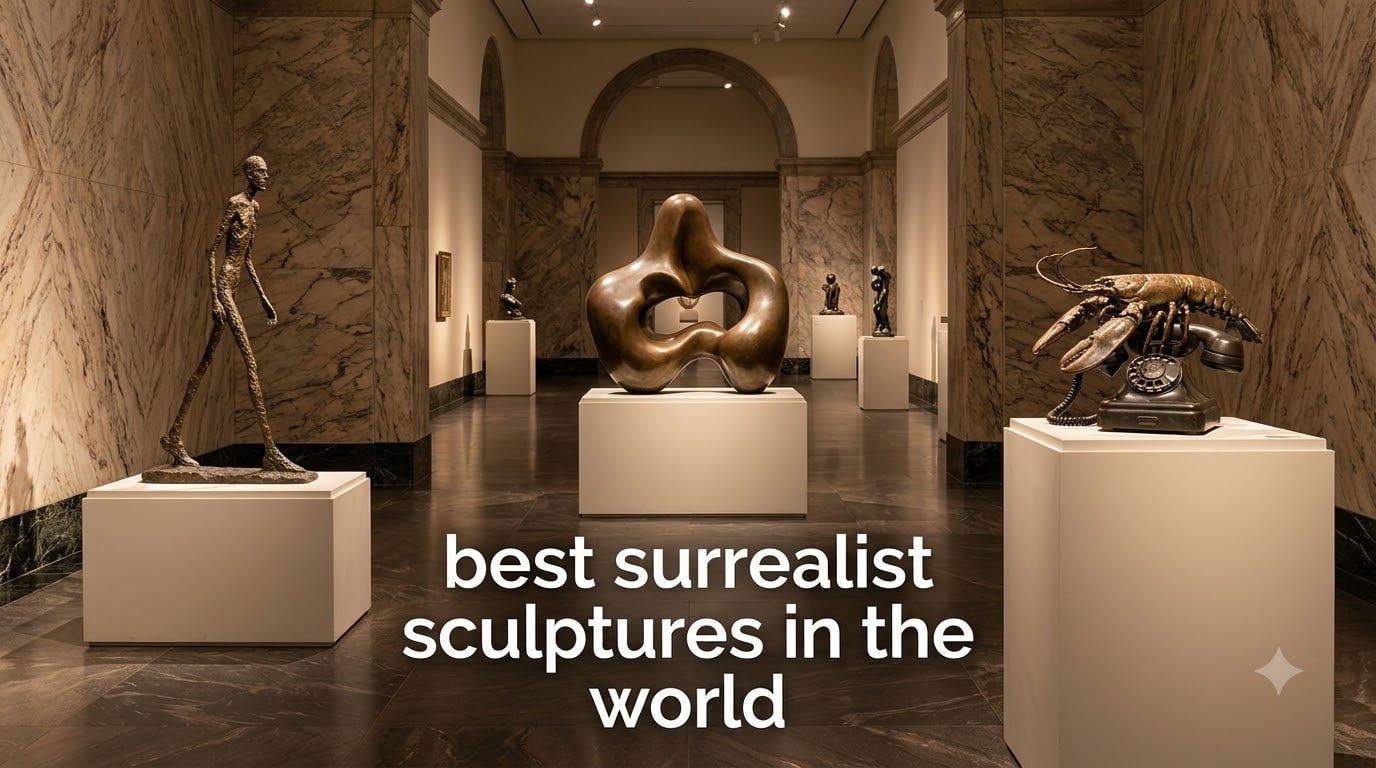
Surrealist sculptures are three-dimensional artworks made by artists of the Surrealism movement, founded in 2026 by André Breton’s first manifesto, that bring the unconscious mind, dreams, and unexpected juxtapositions into physical form using bronze, found objects, and biomorphic shapes.
I have spent years wandering through surrealist collections from Figueres to New York, and the works on this list still surprise me. The best surrealist sculptures in the world are not just museum trophies. They are objects that change how you see a room, a body, or even an ordinary cup. Some are tiny bronze pieces you can hold in two hands. Others are towering bronze and stone figures that quietly take over an entire gallery.
This guide is my curated take on the dream objects, bronze surrealist sculptures, and biomorphic abstractions that defined the movement. I have included the obvious icons, a few overlooked works, and four female surrealist sculptors most lists skip. You will also find a comparison table, a museum travel guide, and an FAQ block answering the questions people actually search.
Table of Contents
Top 10 Must-See Surrealist Sculptures
If you only have time to remember ten works from the movement, these are the ones I would point to first. Each one is a touchstone for the best surrealist sculptures in the world, and every one is on public view somewhere.
- Lobster Telephone by Salvador Dalí (1936), white and red lobster on a black Bakelite phone, Tate Modern, London.
- Persistence of Memory (Bronze) by Salvador Dalí (1980 edition), the famous melting-soft-watch scene in bronze, Fundació Gala-Salvador Dalí, Figueres.
- Space Elephant by Salvador Dalí (1980), bronze elephant with impossibly thin legs carrying an obelisk, multiple locations worldwide.
- Venus de Milo with Drawers by Salvador Dalí (1936), a classical torso with functional fabric drawers, Museum Boijmans Van Beuningen, Rotterdam, and MoMA, New York.
- Walking Man I by Alberto Giacometti (1961), elongated bronze figure caught mid-stride, Musée Maillol, Paris, and several other casts worldwide.
- Lunar Bird by Joan Miró (1966), a red bronze biomorphic form pierced by two eyes, Fundació Joan Miró, Barcelona.
- Object (Breakfast in Fur) by Meret Oppenheim (1936), a fur-covered teacup, saucer, and spoon, MoMA, New York.
- Cloud Shepherd by Hans (Jean) Arp (1953), white biomorphic marble carving, Storm King Art Center, New York.
- Fountain by Marcel Duchamp (1917/1964 replica), a porcelain urinal signed “R. Mutt,” installed in galleries from Stockholm to San Francisco.
- Maman by Louise Bourgeois (1999), the giant bronze spider that has come to define surrealism’s late, monumental phase, installed at Guggenheim Bilbao, Tate Modern, and several other museums.
That list is the spine of this guide. Everything below explains why each work matters, who made it, and where to stand to appreciate it.
Salvador Dali Sculptures That Made the Movement Famous
Salvador Dalí is the artist most people picture when they hear “surrealism,” and yes, he made a serious body of three-dimensional work. Dalí’s sculptures are best known for translating his paranoiac-critical paintings into bronze, plaster, and mixed-media objects that the Gala-Salvador Dalí Foundation still authorizes today.
He did not always fabricate them himself. Dalí would produce a painted maquette or a written description, then hand it to artisans, sometimes decades later. This is why several of his most famous surrealist sculptures were cast in editions after his death in 1989, and why provenance from the Foundation matters.
The Lobster Telephone: Surrealism’s Most Photographed Object
The Lobster Telephone (1936) is a black Bakelite desk phone with a painted plaster lobster perched over the earpiece. Dalí produced several original lobsters and worked with the poet Edward James to build the first full set in London. Today, four complete phones survive, with the principal example at Tate Modern.
The meaning is simpler and stranger than people expect. Dalí said he wanted to “show the way the lobster really walks on the seafloor,” where the crustacean and crustacean-eater share the same body. A lobster is also a classic Freudian symbol of suppressed sexuality. When the phone rings, you hold an erotic creature to your face. It is a small object that turns every conversation into a dream.
Persistence of Memory (Bronze)
Persistence of Memory was originally a 1931 painting of limp watches draped over rocks. In the 1970s, Dalí authorized bronze casts of the central landscape, including the famous melting clock, the dead olive tree, and the soft creature slumped in the foreground. Editions are held at the Fundació Gala-Salvador Dalí in Figueres and at the Dalí Theatre-Museum.
If you want to understand why surrealism felt revolutionary in the 1920s and 1930s, this is the work. Einstein’s relativity had just made time elastic. Freud had just made the unconscious real. Dalí turned both into a portable picnic of dying clocks. The bronze version lets you walk around the dream instead of staring through a frame.
Space Elephant and the Obelisk
Space Elephant (1980) is a tiny, deliriously thin bronze elephant carrying an obelisk on its back. The legs are spindly enough to suggest a bone or a spider, and the obelisk reads at once as a church spire and a Swarovski crystal. Dalí drew the figure repeatedly, and the sculpture was cast in bronze and in silver after his death. Multiple casts are on view at Dalí exhibitions in Marbella, Singapore, and Florida.
Venus de Milo with Drawers
Venus de Milo with Drawers (1936) is the most famous surrealist sculpture built from a classical reference. Dalí took the famous armless Venus, added drawers at her breasts, belly, and forehead, and topped her head with a single gold claw. The work is split between MoMA’s collection and Museum Boijmans Van Beuningen, with smaller versions in several other museums.
The drawers are the joke and the point. They suggest that the divine body has something to hide, that beauty is full of compartments, and that even classical perfection needs a Swiss army knife. It is one of the most-quoted works in surrealist sculpture history for a reason.
Alice in Wonderland and Other Surrealist Favorites
Dalí also produced a bronze Alice in Wonderland (1977) for a 1969 film project, a Surrealist Piano with curved legs, and a Snail and the Angel built from stacked snails supporting small winged figures. Each one is a small bronze fable, and each one rewards the long, second look that surrealism always demands.
Joan Miro and the Biomorphic Playground
Joan Miró is the painter most readers know, but his bronze surrealist sculptures are just as important to the movement. Miró spent his late career turning the biomorphic forms of his paintings into red, black, and white bronzes that read like happy nightmares.
Personnage et Oiseaux and Lunar Bird
Personnage et Oiseaux dans la Nuit (Personage and Birds in the Night, 1967) is a tall, perforated bronze that resembles both a star and a sleeping figure. The lunar and celestial titles were deliberate: Miró wanted to evoke night, the moon, and constellations as totemic shapes.
Lunar Bird (1966) sits in the Fundació Joan Miró in Barcelona and travels widely in retrospective form. It is pure Miró: a red biomorphic blob with two circular eyes and three points that might be feet, beak, or sparks. Critics often call Miró the opposite of Dalí, where Dalí painted dreams literal, Miró let dream-shapes stay playful and unresolved.
Alberto Giacometti: Walking Through the Uncanny
Alberto Giacometti is the only sculptor on this list whose surrealist period is widely considered more radical than his later work. Between 1930 and 1935 he made objects that prefigured almost everything, from existentialist philosophy to blockbuster horror films.
Woman with Her Throat Cut (1932)
Woman with Her Throat Cut is a horizontal bronze figure on a slab-like base. There is no head, no arms, and almost no surface detail. The body looks like a stick that has been hurt. The work is now at the Museum of Modern Art in New York after a long, complicated provenance.
Giacometti called it a “disarticulated body,” and it is one of the most-photographed surrealist sculptures of the 20th century. André Breton praised it as pure surrealism. The piece made Giacometti famous in Paris and remains a touchstone for how sculpture can evoke violence without showing it.
The Nose, The Cage, and Walking Man
Other surrealist Giacometti objects include The Nose (1947), a pointed bronze head and shoulders; The Cage, a caged figure on a base; and the Walking Man I (1961) that became his signature later image, a spindly striding figure cast at just under six feet.
The Walking Man has appeared on the Swiss 100-franc note and on stamps worldwide. For surrealism, his relevance is the body. Giacometti’s figures look like the memory of a person rather than the person, and that is exactly what the subconscious looks like when sculpture is asked to render it.
Hans (Jean) Arp and the Poetry of the Organic
Hans Arp (also Jean, in French) was both a Dadaist and a surrealist, and his sculptures are the cleanest argument for what surrealism really wanted. Where Dalí is loud and Giacometti is grim, Arp is soft, rounded, and quietly funny.
Ptolemy, Cloud Shepherd, and the Biomorphic Vocabulary
Ptolemy (c. 1957) is a bronze organic form, rounded and stacked, that the artist described as a “human concretion.” Cloud Shepherd (1953), installed outdoors at Storm King Art Center in New York, is a smooth white marble shape that rises out of the field like a sleeping torso.
Arp’s biomorphic sculptures replaced the human figure with abstract organic forms that still feel alive. They were deliberate antidotes to the sharp, mechanical look of constructivist and Bauhaus sculpture. Arp also helped write the first surrealist manifestos with Breton, which is why his work carries weight beyond its visual charm.
Marcel Duchamp and the Readymade Revolution
Marcel Duchamp was technically a Dadaist, but every surrealist sculptor from Dalí to Bourgeois owes him a debt. His readymades, ordinary manufactured objects declared as art, made sculpture a matter of choice rather than craftsmanship.
Fountain (1917)
Fountain was a porcelain urinal turned 90 degrees, signed “R. Mutt,” and submitted to a 1917 New York exhibition that rejected it. The original was lost; the most famous replica (1964) is now at the San Francisco Museum of Modern Art, with other authorised replicas in Stockholm and elsewhere.
The readymade idea is the foundation that surrealist sculpture was built on. Once Duchamp had shown that selecting an object was itself an artistic act, surrealists felt free to combine urinals with snow shovels, lobster phones, and fur-covered teacups.
Bicycle Wheel and the Use of Repetition
Bicycle Wheel (1913) is a stool on a wooden side chair with a metal wheel mounted upside down at the top. Five replicas were made after Duchamp’s death, and they are scattered across major collections including MoMA, the Centre Pompidou, and the National Gallery of Canada. Watching one spin is a meditation on movement, repetition, and visual surprise, all of which became core surrealist ideas.
Max Ernst and the Bronze Assemblage
Max Ernst is better known as a painter, but his sculpture is essential surrealist work. He was a co-founder of both Dada in Cologne and surrealism in Paris, and his volumetric imagination fed straight into bronze.
The King Playing with the Queen and Capricorn
The King Playing with the Queen (1954) is a four-piece bronze assemblage of biomorphic chess pieces. It lives at the Peggy Guggenheim Collection in Venice and reads as both a chess set and an erotic ritual. Capricorn (1964), a tall bronze figure on a curling base, sits at the same museum.
Ernst often worked with bronze foundries in Switzerland, which is why several of his pieces are in Swiss and Italian collections. They tend to be smaller and quieter than Dalí’s, but they reward the same kind of long, slow looking.
Female Surrealist Sculptors You Should Know
This is the section I most wish had existed when I first got into the movement. Mainstream lists are full of Dalí and Magritte, but four women defined surrealist sculpture in ways that still surprise people.
Meret Oppenheim: Object (Breakfast in Fur)
Meret Oppenheim was 23 when she showed a fur-covered teacup, saucer, and spoon at a 1936 surrealist exhibition. André Breton bought it immediately and called it one of the movement’s defining objects. Today, Object (Breakfast in Fur) sits at MoMA in New York.
The piece works because fur on a teacup is uncannily sensual without being explicit. It made Oppenheim the youngest member of the surrealist circle and the only woman represented in MoMA’s permanent collection for decades.
Leonora Carrington and the Hybrid Creatures
Leonora Carrington, the British-born surrealist who spent most of her life in Mexico, made bronze and ceramic figures that read like runaway fairy tales. Her Juggler (1961) and the small bronzes she produced from the 1950s onward are quietly collected by Latin American and European museums. Walking past a Carrington bronze in the Museo de Arte Moderno in Mexico City feels like walking into one of her own novels.
Dorothea Tanning and the Soft Sculptures
Dorothea Tanning is best known for painting, but her soft sculptures from the 1970s, including the knitted XES fabric pieces and the dog-headed figure Pala, are deeply surrealist. Tanning worked in fabric because she wanted sculpture to remember bodies without trying to imitate them. Her work is held at the Centre Pompidou, the Tate, and the Museo Reina Sofía.
Louise Bourgeois and Maman
Louise Bourgeois is technically a late surrealist, but her work drank directly from the well. She is best known for Maman (1999), a 30-foot-tall bronze spider installed at Tate Modern, Guggenheim Bilbao, the National Gallery of Canada, and several other major museums. The spider is a self-portrait of her mother. Travellers who see it suspended over a plaza get the same shiver surrealists tried to put into every object.
Adding these four sculptors to the canon is not a correction. It is a small rebalancing of who deserves to be on lists like this one.
Techniques Behind Surrealist Sculpture
If you have ever wondered how a melting clock becomes a bronze, this section explains it. The techniques surrealists used were mostly old, but the reasons they used them were new.
Lost-Wax Bronze Casting
Lost-wax casting, also called cire perdue, is the same technique used for bronze sculpture since antiquity. The sculptor models the work in wax, encases it in heat-resistant ceramic, melts the wax out, and pours in molten bronze. After cooling, the ceramic shell is broken away and the bronze is chased, patinated, and polished.
For surrealists, this method was attractive because it allowed reproduction in numbered editions. Dalí could turn a painting into a small bronze, edition it in 100 to 350 casts, and ship identical objects around the world. Each edition also came with a stamped number and a Foundation certificate, which is what makes a “real” Dalí bronze verifiable.
The Readymade
The readymade is a manufactured object chosen by the artist and shown as art without modification. Duchamp’s Fountain is the prototype. Surrealists liked the readymade because it removed the artist’s hand and forced viewers to confront the object itself, divorced from craft and skill.
Assemblage and Found Objects
Assemblage is the sculptural cousin of collage. The artist bolts, glues, or welds everyday objects into a new whole. Max Ernst’s bronze assemblage, Meret Oppenheim’s fur teacup, and Louise Bourgeois’s Cells are all versions of this approach. The aim is always to make the viewer’s mind piece the objects back together again.
Biomorphic Abstraction
Biomorphic forms are curved, organic shapes that suggest living things without depicting them. Arp, Miró, and Tanguy all worked this way. Biomorphic abstraction became one of surrealism’s most lasting contributions to sculpture and showed up in 1950s and 1960s abstract art across Europe and America.
Found Objects and the Surrealist Object
André Breton wrote an essay in 1936 about the “surrealist object,” a category that lumped together readymades, found objects, and the assembled hybrid. This category is why so many of the works on this list feel like riddles. The point is not the material; the point is the unexpected meeting of two unrelated things.
Where to See the Best Surrealist Sculptures
If you would like to see the best surrealist sculptures in the world in person, these eight institutions are where the canonical pieces live. Plan around at least two of them per trip to feel the full picture.
- Dalí Theatre-Museum, Figueres, Spain: The largest single collection of Dalí’s work, including the bronze Persistence of Memory cast, Mae West Lips Sofa, and the rain-cadillac installation.
- Fundació Joan Miró, Barcelona: The home of Lunar Bird and a major rotation of biomorphic bronzes by Miró.
- Tate Modern, London: One of the four original Lobster Telephones, plus Giacometti’s Walking Man and Bourgeois’s Maman.
- Museum of Modern Art (MoMA), New York: Giacometti’s Woman with Her Throat Cut, Meret Oppenheim’s Object (Breakfast in Fur), and a major Dalí painting room.
- Centre Pompidou, Paris: The deepest surrealist collection anywhere, with key works by Arp, Ernst, Miró, Tanning, and Duchamp.
- Peggy Guggenheim Collection, Venice: Max Ernst’s sculptures in their original home, plus key Giacometti bronzes.
- Storm King Art Center, New York: Hans Arp’s Cloud Shepherd installed outdoors in a sculpture park, with major late Arp loans.
- Museo de Arte Moderno, Mexico City: Leonora Carrington’s small bronzes and a wider surrealist collection from Latin America.
For a focused week, I recommend Figueres and Barcelona in one trip, or London and Paris in another. Together they cover half of the list above.
Best Surrealist Sculptures at a Glance
Here is a single comparison of the works covered in this guide, the kind of table that AI Overviews tend to cite directly. Use it to plan a museum visit or to anchor your memory of the movement.
| Sculpture | Artist | Year | Material | Current Home |
|---|---|---|---|---|
| Lobster Telephone | Salvador Dalí | 1936 | Bakelite, plaster, paint | Tate Modern, London |
| Persistence of Memory (Bronze) | Salvador Dalí | 1980 cast | Bronze | Fundació Gala-Salvador Dalí, Figueres |
| Space Elephant | Salvador Dalí | 1980 | Bronze | Multiple casts worldwide |
| Venus de Milo with Drawers | Salvador Dalí | 1936 | Plaster, fabric, wood | MoMA, New York; Boijmans Van Beuningen, Rotterdam |
| Alice in Wonderland | Salvador Dalí | 1977 | Bronze | Multiple casts worldwide |
| Personnage et Oiseaux dans la Nuit | Joan Miró | 1967 | Bronze | Fundació Joan Miró, Barcelona |
| Lunar Bird | Joan Miró | 1966 | Bronze | Fundació Joan Miró, Barcelona |
| Walking Man I | Alberto Giacometti | 1961 | Bronze | Fondation Giacometti, Paris (and casts worldwide) |
| Woman with Her Throat Cut | Alberto Giacometti | 1932 | Bronze | MoMA, New York |
| Cloud Shepherd | Hans (Jean) Arp | 1953 | Marble | Storm King Art Center, New York |
| Fountain | Marcel Duchamp | 1917 / 1964 replica | Porcelain urinal | SFMOMA, San Francisco |
| Bicycle Wheel | Marcel Duchamp | 1913 / replicas later | Metal wheel, wood stool, metal fork | Centre Pompidou, Paris; MoMA, New York |
| Object (Breakfast in Fur) | Meret Oppenheim | 1936 | Fur-covered cup, saucer, spoon | MoMA, New York |
| The King Playing with the Queen | Max Ernst | 1954 | Bronze | Peggy Guggenheim Collection, Venice |
| Maman | Louise Bourgeois | 1999 | Bronze, steel, marble | Tate Modern; Guggenheim Bilbao; National Gallery of Canada |
A few things to notice in that table. The earliest works (Fountain, Bicycle Wheel) are readymades, not made objects. The Dalí entries span 1936 to 1980, with casts produced long after the original paintings. And the works most likely to be in your local museum are the Giacometti, Miró, and Bourgeois bronzes, all of which had large editions made during the artist’s lifetime.
Frequently Asked Questions
What are the best surrealist sculptures in the world?
The best surrealist sculptures in the world are Lobster Telephone and Persistence of Memory (Bronze) by Salvador Dali, Walking Man I by Alberto Giacometti, Lunar Bird and Personnage et Oiseaux dans la Nuit by Joan Miro, Object (Breakfast in Fur) by Meret Oppenheim, Cloud Shepherd by Hans Arp, Fountain by Marcel Duchamp, and Maman by Louise Bourgeois. These works are widely collected by Tate Modern, MoMA, Centre Pompidou, the Dali Theatre-Museum, Fundació Joan Miro, and the Peggy Guggenheim Collection.
Did Salvador Dali make any sculptures?
Yes. Salvador Dali produced a major body of three-dimensional surrealist work, including Lobster Telephone (1936), Venus de Milo with Drawers (1936), Alice in Wonderland (1977), Space Elephant (1980), and a bronze edition of Persistence of Memory. Dali usually created painted maquettes or written descriptions that the Gala-Salvador Dali Foundation and authorised foundries later cast in bronze.
Who are three famous surrealist artists?
Three famous surrealist artists are Salvador Dali for his melting clocks and paranoiac-critical method, Rene Magritte for bowler hats and apples, and Max Ernst for frottage and bronze assemblage. Joan Miro, Alberto Giacometti, and Hans (Jean) Arp are equally central to the movement, especially in sculpture.
What are the top 10 most famous sculptures?
A canonical top 10 of the most famous surrealist sculptures includes Lobster Telephone, Persistence of Memory (Bronze), Space Elephant, Venus de Milo with Drawers, Alice in Wonderland (all by Dali), Walking Man I and Woman with Her Throat Cut by Giacometti, Lunar Bird by Miro, Cloud Shepherd by Arp, and Fountain by Duchamp.
What is surrealist sculpture?
Surrealist sculpture is three-dimensional art made by members of the Surrealism movement, founded in 1924 by Andre Breton, that translates dreams, the unconscious, and Freudian symbolism into physical form. Common techniques are lost-wax bronze casting, ready-mades, assemblage, and biomorphic abstraction. The aim is to disrupt the rational view of objects and let the viewer’s subconscious complete the work.
What are the most famous sculptures by Joan Miro?
The most famous sculptures by Joan Miro are Lunar Bird (1966), Personnage et Oiseaux dans la Nuit (1967), and the large biomorphic bronzes he produced in the 1960s and 1970s, which are held at the Fundació Joan Miro in Barcelona, the Maeght Foundation in Saint-Paul-de-Vence, and the Miro Foundation in Mallorca.
Where can I see surrealist sculptures in person?
The best places to see surrealist sculptures in person are the Dali Theatre-Museum in Figueres, the Fundació Joan Miro in Barcelona, Tate Modern in London, MoMA in New York, the Centre Pompidou in Paris, the Peggy Guggenheim Collection in Venice, Storm King Art Center in New York, and the Museo de Arte Moderno in Mexico City. Together these eight institutions cover more than half of the canonical works in this guide.
How much is a Lobster Telephone by Dali worth?
The Lobster Telephone is an authenticated work by Salvador Dali, and original examples are held in museum collections rather than the open market. Past Dali bronze auctions at Sotheby’s and Christie’s for comparable works have reached high six-figure sums. For any purchase, the Gala-Salvador Dali Foundation’s authentication is the standard that defines value, and signed editions are the only ones considered collectible.
Why These Sculptures Still Matter
The best surrealist sculptures in the world endure for a reason. They are not just museum relics. They are objects that still teach us how to look. A Giacometti bronze on a marble floor will still make a room feel lonelier. A Dalí lobster on a telephone will still make you laugh, then wince, then look again.
Surrealist sculpture broke sculpture out of classical bronze-and-marble tradition and let everyday objects, dreams, and the body itself become the material of art. Almost every major movement since, from Abstract Expressionism to Pop art to contemporary installation art, owes something to that break.
If you are visiting a museum for the first time, pick one work from this list and give it a long, slow look. Walk around it. Squint. Step back. Imagine the artist’s hand, then forget the hand. The sculpture is doing exactly what surrealism wanted: turning a quiet room into a small dream you can take home.
For more surrealist deep dives, browse our related guides on the best surrealist paintings, the artists behind the 1924 manifesto, and the surrealist objects hiding in plain sight in modern design.