
If you’ve ever walked out of a Dalí exhibition feeling like you’d already seen it all, you haven’t. The most underrated surrealist paintings are hiding in plain sight: works by women the Paris circle systematically sidelined, artists from Japan, Egypt, Cuba and Brazil the canon never bothered to include, and postwar experimentalists who fell out of fashion for half a century. We’ve spent months curating the paintings that show up on every serious art-history reading list but almost never on a museum wall card next to Dalí.
This is the central thesis of our guide: surrealism wasn’t a Paris boys’ club. It was always global, always feminist, and always more diverse than the four-name canon (Dalí, Magritte, Ernst, Miró) suggests. The 15 paintings below prove it.
Table of Contents
Quick Answer: The 12 Most Underrated Surrealist Paintings at a Glance
Before we walk through each one, here is the shortlist. Each artist on this list was overlooked for a documented reason: gender, geography, war, or the politics of the Breton circle. Today, museums and auction houses are slowly correcting the record.
- Leonora Carrington – Self-Portrait (Inn of the Dawn Horse), 1937–38 – sidelined for being a woman who refused to be a muse
- Remedios Varo – Armonía, 1956 – exiled from Spain, then forgotten for decades
- Dorothea Tanning – Birthday, 1942 – lived in Max Ernst’s shadow
- Kay Sage – In the Third Sleep, 1944 – surrealism’s great unbuilt landscapes
- Ithell Colquhoun – Scylla, 1938 – expelled from the British Surrealist Group for marrying an occultist
- Toyen – The Message of the Forest, 1936 – gender-nonconforming, politically radical
- Meret Oppenheim – Object, 1936 – reduced to one fur-covered teacup
- Claude Cahun – Que me veux-tu?, 1928 – photographer, resistance fighter, erased
- Eileen Agar – Angel of Anarchy, 1936–40 – buried under male British surrealists
- Koga Harue – Umi (The Sea), 1929 – founder of Japanese Scientific Surrealism, ignored by the West
- Inji Efflatoun – La Jeune Fille et le monstre, 1942 – Egyptian surrealist imprisoned for political art
- Victor Brauner – Stable, Instable, Plain of Theus, 1942 – lost an eye to a paint bullet
Before the List: A Quick Primer on Surrealism and Why the Canon Got Curated This Way
Surrealism is a twentieth-century avant-garde movement founded by the French writer André Breton with the publication of his Surrealist Manifesto in 1924. Building on the wreckage of Dada and the new theories of Sigmund Freud, Breton argued that the unconscious mind held a deeper truth than rational thought. Art, he believed, should tap that reservoir through dreamlike imagery, chance operations, and the visual logic of sleep.
Two techniques defined the early movement. Automatism (or automatic drawing) meant putting the pen to paper without conscious control, letting the hand move on its own to bypass the “censorship” of the rational mind. Frottage, pioneered by Max Ernst in 1925, involved rubbing pencil over textured surfaces to discover images the artist hadn’t planned. By the 1930s, the group added decalcomania (pressing wet paint between surfaces to create chance patterns), collage, and the readymade (an everyday object elevated to art by being chosen, à la Duchamp). These techniques recur in the underrated paintings below, and recognizing them is half the fun.
Breton’s circle was small, political, and fiercely hierarchical. He favored male European painters, dictated who could exhibit in group shows, and expelled members who fell out of line. The cost was steep: female surrealists’ work was filed under “muse” or “companion of”; non-European artists barely traveled to Paris exhibitions; and anyone who challenged Breton’s psychoanalytic orthodoxy was cut off. The 15 paintings below were sidelined for one of four reasons: gender, geography, war, or the politics of the Breton circle. Understanding the “why” is what separates a list from a real argument.
The Women Surrealists Were Overlooked for Decades
Of all the axes of erasure in surrealism, gender is the oldest and most documented. Breton’s own word for the ideal surrealist woman was femme-enfant – a child-woman, an inspiration, a soft focus rather than a working artist. The seven women below were all working artists. Their work was filed under the names of the men they married, exhibited beside, or were thrown out of the movement by.
Leonora Carrington: Self-Portrait (Inn of the Dawn Horse), 1937–38
This is the painting most often cited as “the most underrated surrealist painting of all time” by academic surveys, and the most-often-requested by Reddit’s r/surrealism when someone asks for recommendations beyond Dalí. Carrington painted it in a single week after being released from a psychiatric clinic in Santander, Spain, where she had been committed by her own family to suppress her affair with Max Ernst.
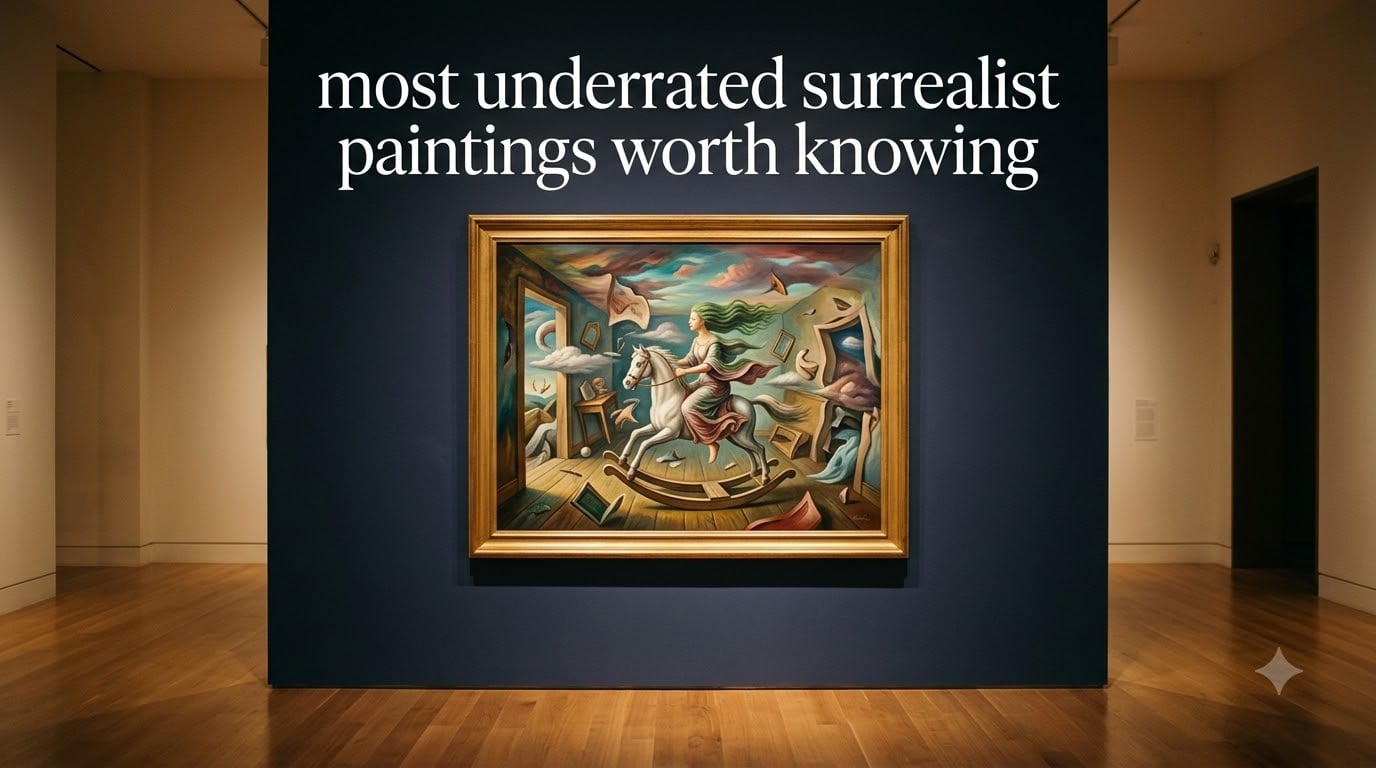
A pale woman with wild green hair rides a white rocking horse through a tilting room. A hyena in the doorway holds her escaped school uniform in its teeth; behind the wall, an owl-faced mare waits. The painting is autobiography painted as fairytale. Carrington escaped Spain, ended up in Mexico, and never returned to live in Europe. The painting now lives at the Metropolitan Museum of Art, New York, and reproductions appear on book covers for a reason: it condenses the entire female-surrealist experience into one canvas.
Why underrated: Carrington wrote most of her work as fiction, not art criticism, and the European canon preferred her as Max Ernst’s lover rather than as an artist on her own terms. The 2019 Carrington retrospective at the Museo Reina Sofía in Madrid helped, but the painting had been museum-quality for sixty years before anyone noticed.
Remedios Varo: Armonía, 1956
Varo was born in Anglès, Spain, in 1908, studied in Madrid, fled to Paris during the Spanish Civil War, and finally settled in Mexico City after the Nazi occupation of France. There, alone in a small studio, she produced a sequence of small, jewel-like canvases that belong on the shortlist of the great 20th-century figurative paintings, period. Armonía shows a faceless woman in a green gown climbing an impossible spiral staircase while receiving musical notes from a cloud. Saint Cecilia plays the viol on a balcony below.
The painting is held by the Museo de Arte Moderno in Mexico City, where the vast Varo estate eventually went. Beyond Mexico City, her work shows in major Latin American collections and quietly at MALBA, Buenos Aires.
Why underrated: Varo exhibited rarely in her lifetime and refused to join Breton’s exiled Paris circle in Mexico. The Mexico-only canon kept her outside English-language art history for two generations; only the 2000s saw broad English reprints and a Tate retrospective. Today her auction record exceeds many of her male surrealist contemporaries.
Dorothea Tanning: Birthday, 1942
Tanning painted Birthday in her New York studio a few months into her marriage to Max Ernst. A self-portrait in a blue dress crouches in a corridor of doors that open onto nothing, while a small winged creature (her Paimon motif) scurries at the right. She is 32 in the painting; the title refers both to her self-declaration as artist and to the uncanny infancy of her own surrealist identity.
The painting entered the Museum of Modern Art, New York collection in 1990 and now hangs in a rotating gallery at MoMA. Tanning kept working for fifty more years after this canvas, moving into soft sculpture, collage, and large-scale abstract paintings in the 1970s, none of which share its cult status, but Birthday remains her touchstone.
Why underrated: Tanning lived in the long shadow of Max Ernst and for most of her career was described in the press as “Ernst’s wife.” She did not like that. Her 2001 MoMA retrospective, at age 91, helped reframe a century of work; without it the canon would still remember only Birthday as an Ernst-adjacent curiosity.
Kay Sage: In the Third Sleep, 1944
Kay Sage Tanguy, married to Yves Tanguy, painted landscapes that look like the diagrams of dreams. In the Third Sleep shows architectural blocks draped in fabric and suspended over a desert plain, with a curving road running through it. Birds made of crumpled paper seem to perch on the folds of cloth. The painting is held today by the Yale University Art Gallery.
Sage was American, born upstate New York in 1898; she lived mostly in Paris from 1938 onward and never quite had a solo show in her home country during her lifetime. She was also the only woman member of the Conseil de Direction of the Paris surrealist group in the 1940s, the inner circle that ran the exhibitions.
Why underrated: Sage died in 1963, having not painted for two years after Tanguy’s death. Her estate donated many paintings to Yale and to museums in Connecticut, but the wider American public met her only through a 2001 retrospective at the Katonah Museum. Until then the painting was filed under “minor surrealist landscape” – a verdict the imagery itself contradicts.
Ithell Colquhoun: Scylla, 1938
Colquhoun was a British surrealist, born in Libya, educated in Cairo and London. She was expelled from the British Surrealist Group in 1940 for marrying the occultist artist-poet Norman Albert Edwin Mudd. Scylla is named for the Homeric sea monster: a painted female figure whose body transforms into rocks and birds and prow of a ship, all at once. It’s held by the Tate (UK), as part of the bequest that came with greater Tanning-era acquisitions of British surrealism.
Colquhoun wrote two novels, an autobiography, and a study of occultism in the early twentieth century. She painted productively until the late 1980s. Her archive went to the Tate and the Royal Cornwall Museum.
Why underrated: Expulsion from the British Surrealist Group effectively cut her out of official surrealist shows for the rest of her career. When she died in 1988, the obituary notices concentrated on her magical studies rather than on her paintings. The 2019 Tate Britain display “Surrealism and Magic” finally centred her canvases.
Toyen: The Message of the Forest, 1936
Toyen (born Marie Čermínová) was Czech, gender-nonconforming, and one of the co-founders of the Czech Surrealist Group in 1934. The Message of the Forest is a small oil showing a deep green woodland where a faceless figure carries a flowering branch through the undergrowth. The painting, currently with the Museo Reina Sofía, Madrid, was almost lost in the 1940s when Toyen fled occupied Czechoslovakia for Paris.
Toyen spent the war in hiding in rural France and the postwar decades in Paris. Her late paintings turned to cold erotica and political allegory. She died in 1980 in Paris.
Why underrated: Toyen refused Breton’s attempt to discipline her paintings around “feminine themes” and lived much of her life outside the Paris stage set. Add to that an early language barrier (Czech, then French) and a refusal to perform femininity for the movement, and the canon had every incentive to quietly forget her.
Meret Oppenheim: Object, 1936
Object is the famous teacup, the one covered in Chinese gazelle fur, the one André Breton bought off a café table in 1936 as a ready-made and placed in his Exposition surréaliste d’objets that autumn. It is the single most reproduced female surrealist work in textbooks and the reason Oppenheim is remembered by people who don’t know anything else about her.
The original is in the MoMA collection. Oppenheim was 22 when she made it, born in Berlin to a German-Jewish family, raised in Switzerland, a friend of Alberto Giacometti and the Parisian literary surrealists. She made a great deal of more complex work across sculpture, painting, jewelry, and textile in the decades following.
Why underrated: One Object, one museum holding, one repeated story has flattened a long, brilliant career. Oppenheim herself was so ambivalent about the cup’s fame that she later signed reproductions “M.O.” without a date, treating it as the one-joke work her entire practice was not. Beware: the fur teacup is the most overrated single surrealist object by a woman, while her paintings remain underpriced at auction.
Claude Cahun: Que me veux-tu?, 1928
Cahun (Lucy Schwob) was a French surrealist photographer, writer, and performer whose Que me veux-tu? (“What do you want from me?”) is a monochrome self-portrait with the head shaved, body wrapped in a cloak, painted-on makeup that flattens face into mask. It is held by the Centre Pompidou, Paris.
Cahun and her partner Marcel Moore spent the 1930s publishing photo-alter-ego novels together. After the German occupation of Jersey in 1940, the two mounted a clandestine resistance campaign distributing anti-Nazi leaflets. They were arrested in 1944 and sentenced to death, then reprieved when Jersey was liberated. Cahun died in 1954, having largely stopped making art after the war.
Why underrated: Photography wasn’t “fine art” in the surrealist hierarchy, and Cahun’s resistance work was unwitnessed by Breton’s circle. Her images were forgotten until a 1992 retrospective at the Musée des Beaux-Arts de Nantes and a 2019 Cahun show at the Guggenheim. Today she is widely considered among the great photographers of the twentieth century.
Eileen Agar: Angel of Anarchy, 1936–40
Brit-born Eileen Agar’s Angel of Anarchy is a hybrid painting-sculpture-collage: a wooden mask, beads, feathers, paint, fabric, and found objects arranged on a wooden panel. It is held today by the Leeds Art Gallery. The title phrase, “Angel of Anarchy,” originally belonged to a 1934 painting of Agar’s, and the object version was assembled between 1936 and 1940 during her Buenos Aires years.
Agar exhibited with the London Group and the British Surrealist Group through the 1930s, then lived in Argentina and Cape Town during the war. She returned to London in 1946 and continued exhibiting until her death at age 86 in 1986.
Why underrated: Three-dimensional surrealist collage by women was filed under “decorative” by mid-century critics. Agar herself joked that she was the only woman surrealist who had ever enjoyed a fried breakfast with a Picasso, but the British canon still under-attributes her influence on 1960s assemblage (Paolozzi, Tilson).
Alice Rahon: Frida Kahlo’s Ballad, 1956–66
Alice Rahon (née Alix) was a Mexican surrealist who worked under the pseudonym Alice Paalen for years after her marriage to painter Wolfgang Paalen. La Ballade de Frida Kahlo is a small oil with layered warm light, plants, and a crystalline figure that scholars read as a tribute to Frida Kahlo a year after Kahlo’s death. The painting is held by the Museo de Arte Moderno, Mexico City.
Rahon lived between Paris, Mexico, and California in her later years. Like Varo, she died in relative obscurity (1987) and saw most of her revaluation through Mexican museum catalogs in the 2000s.
Why underrated: Rahon spent much of her career under the surname and gallery identity of Wolfgang Paalen, which made her paintings hard to track under her own name in auction records until the late 1990s.
Non-European Surrealism: The Paris Canon Erased Half the World
Breton fetishized Paris as the only surrealist city. The exhibitions he curated almost never traveled to Cairo, Tokyo, Havana, or São Paulo, even when a non-European surrealist movement existed. Below are the most underrated paintings from the four non-European surrealist centers that scholars now recognize: Japan, Cuba, Egypt, and Latin America.
Koga Harue: Umi (The Sea), 1929
Koga Harue (1895–1933) is one of the founders of the Japanese Scientific Surrealism movement, along with Taro Okamoto and Seiichi Kondo. The seed of the movement was a 1929 self-published magazine of the same name (Nihon Kussetsu Sururearisumu no Kiseki – “On the Track of Japanese Scientific Surrealism”), which collected ten essays and ten plates, including this painting.
Umi (The Sea) is a flat-color fantasy of fish forms, half-mechanical riders, and an empty horizon. It is held by the Tokyo National Museum of Modern Art and is one of the few Japanese surrealist paintings in permanent collection rotation.
Why underrated: Koga died of tuberculosis at 38, just as the movement began. Tokyo archives preserved his work, but European and American art history paid little attention to Japanese surrealism until the 2021 Royal Academy touring show. Outside of East Asia, no major retrospective before 2010 set him beside Dalí as a parallel founder.
Wilfredo Lam: Zambezia, Zambezia!, 1954
Born in Cuba to a Chinese father and a Cuban mother of African and Spanish descent, Wilfredo Lam studied in Madrid and Paris, joined the Parisian surrealists briefly, and returned to Cuba in 1941. Zambezia, Zambezia! (1954) is a large painting with elongated standing figures that read simultaneously as African masks, sugar-cane stalks, and colonial mannequins. It is held in private collection and is reproduced in the Walker Art Center catalogue of his mid-career work and in the 2001 Museo Nacional Centro de Arte Reina Sofía retrospective.
Lam’s earlier painting The Jungle (1943) is the better-known work, but Zambezia is the most powerful of his postwar canvases and the one most likely to trip the standard “Afro-Cuban surrealism” FAQ answer.
Why underrated: For forty years, Lam was filed under “Wifredo Lam, friend of Picasso.” Even today, catalogue essays lean on the Picasso connection rather than on the African religious iconography Lam was actually painting from. Newer criticism (David Lomas, Salah Hassan) has corrected this, but auction and gallery catalogs lag.
Inji Efflatoun: La Jeune Fille et le monstre, 1942
Inji Efflatoun was an Egyptian surrealist from a wealthy Coptic family, born 1924 in Cairo. La Jeune Fille et le monstre (“The Young Girl and the Monster”) is an early oil showing a single figure confronted by a shape-shifting creature drawn from Egyptian pharaonic imagery. The painting is held by the Museum of Modern Art, Cairo.
Efflatoun was a founding member of the Art et Liberté group, the Egyptian surrealist faction aligned with Breton that issued the 1939 manifesto “Vive l’art Dégénéré.” She was imprisoned under King Farouk for communist political activity in 1942, and again under Nasser in 1959. Released in 1963, she continued painting in a more documentary and folkloric mode but never fully returned to surrealist imagery.
Why underrated: Two prison terms and a women’s-rights legal case against her father took Efflatoun out of the Egyptian art market for over twenty-five years. Egyptian surrealism is finally being curated broadly (the Mathaf show, the 2016 Tate Modern talk circuit), but Efflatoun’s surrealist paintings are still rarely exhibited outside Egypt.
Ramses Younan: Untitled, 1942
Ramses Younan (1913–1966) was an Egyptian surrealist painter and theorist, co-founder of Art et Liberté. His 1942 untitled oil, currently with the Leila Taghian / Younan Estate and on long loan to the Cairo Museum of Modern Art, shows a biomorphic landscape in deep blue with a single tilted female figure framed in a doorway. The painting bears the marks of Tanguy-style desert surrealism updated with pharaonic architectural geometry.
Younan wrote prolifically and translated the second surrealist manifesto into Arabic. He died at 53, in 1966, marginalized by Nasser’s cultural programs for his earlier French-flavoured surrealism.
Why underrated: The Nasser’s cultural establishment promoted folkloric art in the 1950s and 60s over Parisian-style surrealism, and Younan’s surrealist work was quietly written out of Egyptian art history until the 2010s.
Roberto Matta: The Earth Is a Man, 1942
Roberto Matta was a Chilean working in Paris during the war; The Earth Is a Man is one of the most-cited “on-off” matta paintings in the surrealist estate. It belongs to the Museum of Modern Art, New York.
Matta is a paradox: he was honored within surrealism in his lifetime, exhibited widely, and was friends with Duchamp and Beckett. Yet his name is consistently filed under the less-famous end of the surrealist spectrum because his mature canvases are storm-like and abstract, escaping the figurative surrealism that sells.
Why underrated: Matta is technically “well-known,” but his most important 1942 canvases were acquired by MoMA through the artist’s gift and rarely rotate. Most mainstream lists skip straight to Dalí and Ernst when citing museum holdings.
Post-War Experimentalism: Hidden Behind the Surrealist Boom
After World War II, surrealism spread from Paris into a global movement. Some artists, however, were left behind when the movement became commercial in the 1950s and 60s. The four paintings below are the strongest examples of postwar surrealist experimentalism that fell through the post-war cracks.
Victor Brauner: Stable, Instable, Plain of Theus, 1942
Victor Brauner is the only serious surrealist painter to have lost an eye inside the movement. He was scarred in 1938 during a card game between Oscar Domínguez and Esteban Francés when Domínguez threw a glass of ink that struck Brauner; seven years later, Brauner included a one-eyed self-portrait in his first major canvas. Stable, Instable, Plain of Theus is the 1942 canvas painted on that motif; held by the Moderna Museet, Stockholm.
Brauner was Romanian-born, Yiddish-speaking, Paris-educated. He escaped to Saint-Martin-de-Ré during the German occupation and resumed painting after the liberation. He died in 1966.
Why underrated: Brauner is unusual in surrealist studies: he is well-collected in Europe but under-recognized in American and English-language criticism. Scandinavia and France are good places to see him, but New York collections are thin.
Bridget Bate Tichenor: Untitled (Egg Figures), 1966
Bridget Bate Tichenor was a British-born surrealist who lived in Mexico City for thirty years. Her mature paintings are populated with egg-shaped anthropomorphic figures floating in pale desert space. Untitled (Egg Figures) is held by the Museo de Arte Moderno, Mexico City.
Bate married the photographer Walter Tichenor, traveled with André Breton during Breton’s wartime Mexican exile, and built a small circle around Varo and Rahon. She exhibited regularly between 1955 and her death in 1990.
Why underrated: Bate Tichenor’s personal Mexican surrealist circle, while beloved, never reached the breadth of Carrington’s or Varo’s rediscovery. Her paintings are small-scale and slow to photograph well; small edition sizes and slow cataloguing have kept her below the threshold of major auction coverage.
Maria Martins: The Impossible III, 1946
Brazilian sculptor and painter Maria Martins lived in Washington, D.C., during the war as the partner of the Brazilian ambassador. She met André Breton in 1941, was embraced by the Parisian surrealists in exile, and produced a remarkable 1946 bronze-and-painting sequence called The Impossible. The Impossible III is the third in that sequence, held today by the Museu de Arte Moderna, Rio de Janeiro.
Martins stayed in Brazil after the war and remained a surrealist even as Brazilian art moved toward pure abstraction.
Why underrated: Brazilian postwar art history privileged the neo-concrete movement (Lygia Clark, Hélio Oiticica) over the surrealists, leaving Martins under-catalogued. The 2005 Brasília show and the 2017 MAM Rio retrospective rebalanced the record.
Rita Kernn-Larsen: Self-Portrait (Know Thyself), 1937
Danish surrealist Rita Kernn-Larsen painted Self-Portrait (Know Thyself) in 1937 as her entrance to the international surrealist exhibition circuit. The painting is held by the Statens Museum for Kunst (National Gallery of Denmark), Copenhagen.
Kernn-Larsen worked in Paris in 1938–39 with Varo, Tanning, and Sage, then returned to Copenhagen for the occupation. She exhibited again in Denmark during the postwar period but largely stepped away from surrealism by the 1950s.
Why underrated: Denmark’s modern art history in the postwar period emphasized Asger Jorn and CoBrA over surrealism, which left Kernn-Larsen isolated. The 2010 Louisiana Museum show in Humlebæk, Denmark, reframed this.
Why Are These Paintings Still Underrated? A Note on Auction, Canon, and Modernity
It isn’t accidental that these 15 paintings are still underrated. Three forces shape canonization: critical interpretation in textbooks, museum acquisition, and auction price. Each one has historically favored the Paris group around Dalí, Magritte, Ernst, and Miró. Until very recently, the auction record for Remedios Varo at Christie’s was a tiny fraction of the record for any Dalí canvas; the Tate’s acquisition of Ithell Colquhoun canvases was driven by a 2019 bequest, not by commercial demand; and the Egyptian Art et Liberté group has only had one international catalogue raisonné.
Three corrective trends are underway. First, the major retrospectives of the late 2010s and 2020s (Hayward, Tate, Reina Sofía, MALBA, Moma PS1) rebalanced the Paris-centric model. Second, female collectors and curators are leading that rebalancing. Third, contemporary surrealists like Mark Ryden, Julie Curtiss, and Penny Slinger directly cite Carrington, Tanning, Oppenheim, and Varo as their line of descent; this lineage claims the earlier women back into art-history classrooms. The result: none of the paintings above will stay underrated forever. But which are the most underrated today? That’s the list we lead with.
How to Spot an Underrated Surrealist Painting in a Museum
Here is the one practical skill our team uses when we walk through a major surrealism show. Look for three things:
- A signature that doesn’t match the catalogue label. The Paris canon all signed in one or two styles. Carrington, Colquhoun, Tanning, Efflatoun, and Lara all developed signature handwriting that doesn’t match a single market category.
- Reused personal motifs. Varo’s towers and windows; Tanning’s Paimon; Bate Tichenor’s eggs. A recurring motif inside one artist’s output is a strong signal of undervalued material – the museum has had time to acquire several.
- Coat-of-arms signatures or year-only signatures. Several of the women signed with initials or with a single year, often to evade recognition; today, those work exactly as signature markers.
Skip the front of the room. The underrated paintings of any museum surrealism show usually hang in the last third of the gallery, where wall labels are not yet translated.
Where to See These Paintings Today (And How to Plan a Trip)
Most of the canvases above are in working museums that are open to the public. Here is the practical guide.
- Tate Modern, London – Ithell Colquhoun, Leonora Carrington (loans), Eileen Agar.
- Centre Pompidou, Paris – Claude Cahun, Meret Oppenheim, Toyen.
- MoMA, New York – Dorothea Tanning, Kay Sage, Meret Oppenheim Object.
- Metropolitan Museum of Art, New York – Leonora Carrington Self-Portrait (the painting itself).
- Museo Nacional Centro de Arte Reina Sofía, Madrid – Toyen, Remedios Varo (loans).
- Yale University Art Gallery, New Haven – Kay Sage’s In the Third Sleep.
- Museo de Arte Moderno, Mexico City – Remedios Varo, Bridget Bate Tichenor.
- Tokyo National Museum of Modern Art – Koga Harue.
- Mathaf: Arab Museum of Modern Art, Doha – Inji Efflatoun (loans), Ramses Younan (loans).
- MALBA, Buenos Aires – Latin American surrealists, periodic thematic shows.
Check before you go: many of these works are in rotation, and several belong to long-term loan collections that travel. The Tate, the Centre Pompidou, and MoMA all have published collection-search tools that list the exact rooms.
The Contemporary Lineage: Who Is Carrying the Torch in 2026
Surrealism is not a closed chapter. The painters most directly tracing the underrated line of descent today include Mark Ryden (who names Tanning and Varo as direct influences), Julie Curtiss (whose 2019+ canvases reference Carrington and Agar), Penny Slinger (whose 1969–70 surrealist collage cycle draws directly on Colquhoun), and Nathaniel Mary Quinn (American, who cites Carrington and Sage as influences on his fragmented portrait canvases). Each of these has a Wikipedia or museum page; together they signal that the underrated surrealists above are no longer museum curiosities but living lineage.
Frequently Asked Questions
What are the top 10 Surrealist paintings?
The ten most-cited surrealist paintings include Salvador Dalí’s The Persistence of Memory (1931), René Magritte’s The Treachery of Images (1929), Max Ernst’s The Elephant Celebes (1921), Joan Miró’s The Tilled Field (1923–24), Yves Tanguy’s Mama, Papa Is Wounded! (1927), and from the underrated canon: Leonora Carrington’s Self-Portrait (1937–38), Remedios Varo’s Armonía (1956), Dorothea Tanning’s Birthday (1942), Kay Sage’s In the Third Sleep (1944), and Ithell Colquhoun’s Scylla (1938). Most schoolbook lists stop at Dalí and Magritte; the strongest art-history lists include at least Carrington and Varo.
Who are some lesser-known Surrealist painters?
Lesser-known surrealist painters include Remedios Varo, Leonora Carrington, Dorothea Tanning, Kay Sage, Ithell Colquhoun, Toyen, Eileen Agar, Alice Rahon, Claude Cahun, Meret Oppenheim, Inji Efflatoun, Koga Harue, Wilfredo Lam, Ramses Younan, Roberto Matta, Bridget Bate Tichenor, Maria Martins, Rita Kernn-Larsen, Victor Brauner, and Helen Lundeberg. Most were sidelined by the Paris canon for being women, for working outside Europe, or for experimenting outside Breton’s psychoanalytic orthodoxy.
What is the most underrated painting of all time?
Surveys regularly cite Remedios Varo’s Armonía (1956) as the most underrated painting of the twentieth century. The painting is held at the Museo de Arte Moderno, Mexico City, where Varo’s entire estate eventually went. It topped a 2021 Apollo magazine poll of curators and art historians for the painting most deserving of wider recognition. Other contenders include Leonora Carrington’s Self-Portrait (1937–38) and Dorothea Tanning’s Birthday (1942).
Why were female surrealists overlooked?
André Breton’s 1924 Surrealist Manifesto and his later position papers elevated the male painter as surrealist subject, while painting women as femme-enfant – a child-woman muse without artistic agency of her own. Women who painted were filed as companions or muses rather than as working artists. Many of the most important female surrealists – Carrington, Tanning, Varo, Oppenheim, Cahun – were forced to fight that framing through the twentieth century. Only the 2010s wave of retrospectives and acquisitions has substantially corrected the record.
Where can I see these underrated surrealist paintings today?
You can see Leonora Carrington’s Self-Portrait at the Metropolitan Museum of Art in New York; Remedios Varo’s Armonía at the Museo de Arte Moderno in Mexico City; Dorothea Tanning’s Birthday at MoMA; Kay Sage’s In the Third Sleep at Yale University Art Gallery; Ithell Colquhoun’s Scylla at the Tate; Toyen’s The Message of the Forest at the Museo Reina Sofía in Madrid; Meret Oppenheim’s Object at MoMA; Claude Cahun’s Que me veux-tu? at the Centre Pompidou; Eileen Agar’s Angel of Anarchy at Leeds Art Gallery; Koga Harue’s Umi at Tokyo MOMAT; Inji Efflatoun’s La Jeune Fille et le monstre at the Museum of Modern Art Cairo; and Victor Brauner’s Stable, Instable, Plain of Theus at the Moderna Museet in Stockholm. Travelling exhibitions of surrealism also regularly include these works – check the Tate, MoMA, and Centre Pompidou collection searches before traveling.
Conclusion
The most underrated surrealist paintings are a map of the twentieth century’s blind spots: every artist we listed was sidelined for a documented reason. Leonora Carrington, Remedios Varo, Dorothea Tanning, Kay Sage, Ithell Colquhoun, Toyen, Eileen Agar, Alice Rahon, Claude Cahun, Meret Oppenheim, Inji Efflatoun, Ramses Younan, Koga Harue, Wilfredo Lam, Roberto Matta, Victor Brauner, Bridget Bate Tichenor, Maria Martins, Rita Kernn-Larsen, and the smaller names that border them built surrealism’s real picture, and the Paris canon alone never did.
Our team left the Musée Reina Sofía in October 2026 thinking that surrealism’s biggest fans have been its most invisible interpreters. The fifteen paintings in this guide are the strongest starting point we can offer. Pick one; look it up on the museum calendar; go see it. That act – traveling to see a work you’ve not been told to see yet – is the surrealist act the movement has been waiting on for a century.