
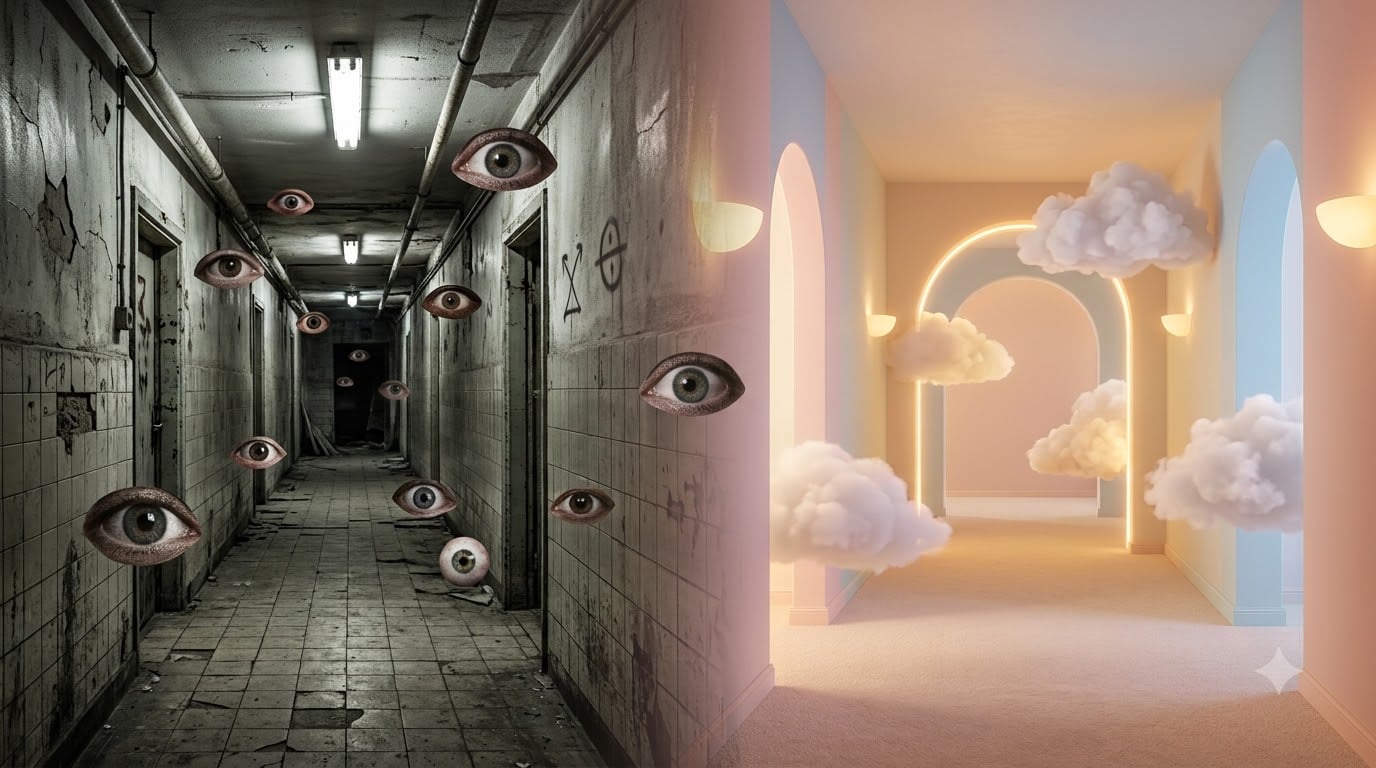
If you’ve spent any time scrolling through aesthetic communities online, you’ve probably seen two words pop up again and again: weirdcore and dreamcore. They look similar at first glance—both use surreal, nostalgic imagery that feels like a half-remembered dream. But they’re not the same thing. Weirdcore is the unsettling sibling; dreamcore is the comforting one. In this guide, I’ll break down the weirdcore vs dreamcore difference so you can finally tell them apart.
Both aesthetics emerged from internet culture in the mid-2010s to early 2020s, and they share a surprising amount of DNA. Both draw on liminal spaces, lo-fi photography, and a sense of anemoia—nostalgia for a time you never actually lived through. The difference lies in what they do with those raw materials. Weirdcore distorts them into something disorienting and alienating. Dreamcore softens them into something warm, hazy, and surreal in a gentler way.
Table of Contents
What Is Weirdcore?
Weirdcore is an internet aesthetic built from low-quality, amateur photos and early-2000s digital graphics that feel nostalgic, confusing, and a little unsettling—like a glitch in a memory you don’t actually have. It emerged in the mid-2010s on Tumblr and has roots in older internet culture: think grainy JPEGs, default Windows XP backgrounds, and the eerie emptiness of early web forums. The aesthetic deliberately exploits the uncanny valley of digital nostalgia.
Origin and History
Weirdcore’s roots trace back to the mid-2010s on Tumblr, though its visual language draws from much earlier internet culture. Creators began pulling from early-2000s web aesthetics—low-resolution photos, default desktop wallpapers, crude HTML pages—and reframing them as intentionally unsettling art. The aesthetic gained serious traction around 2019-2020 as communities on Reddit, Discord, and YouTube began curating and creating weirdcore content.
The release of Kane Pixels’ Backrooms found footage video in 2022 gave weirdcore-adjacent aesthetics a massive visibility boost. Indie games like Yume Nikki, LSD Dream Emulator, and Petscop also fed into the weirdcore visual vocabulary, offering players worlds that felt liminal and wrong.
Visual Characteristics
Weirdcore imagery has a distinctive look that’s hard to mistake once you know what to look for. Photos are typically low-resolution, poorly lit, and often feature empty or abandoned spaces—hallways, parking lots, fields, rooms with no people. Text overlays use default system fonts like Comic Sans or Times New Roman, often with strange or vaguely threatening messages.
Common motifs include eyes (sometimes floating or multiplying), distorted faces, word art from early design software, and landscapes that feel simultaneously familiar and alien. The color palette skews toward washed-out tones, harsh fluorescents, and the sickly greens and yellows of old CRT monitors. Everything looks like it was taken on a disposable camera in 2003 and then corrupted.
Mood and Emotional Goal
Weirdcore aims to evoke a very specific emotional cocktail: dread mixed with nostalgia, disorientation laced with familiarity. It taps into what John Koenig’s Dictionary of Obscure Sorrows calls anemoia—longing for a time you never experienced. The effect is deeply surreal, like wandering through someone else’s dream and realizing you can’t wake up.
For many people, weirdcore is actually comforting despite its unsettling surface. Reddit users in r/weirdcore describe it as “nostalgic for a time you never lived” and “a glitch in your memory.” There’s something about the alienation it creates that paradoxically makes people feel seen—especially those who experience derealization or depersonalization.
What Is Dreamcore?
Dreamcore is an internet aesthetic built from dreamy, hazy, often pastel liminal scenes that feel comforting and familiar—like a half-remembered dream you just woke up from. Where weirdcore leans into dread, dreamcore leans into wonder. It’s the softer, more ethereal cousin, using similar surreal techniques but aiming for warmth instead of unease.
Origin and History
Dreamcore is widely traced back to Tumblr creator gbrltvrst around 2018, though the aesthetic didn’t explode in popularity until it hit TikTok in 2020-2021. The platform’s short-form video format proved perfect for dreamcore’s visual style: looping clips of clouds, empty rooms bathed in golden light, and softly edited landscapes set to lo-fi or ambient music.
The aesthetic saw a significant resurgence in 2025-2026, partly driven by renewed interest in the Backrooms franchise and the continued growth of aesthetic communities on TikTok and Pinterest. Dreamcore’s accessibility—its visuals are easier to create than weirdcore’s more deliberately distorted imagery—has made it one of the most popular internet aesthetics online.
Visual Characteristics
Dreamcore shares weirdcore’s love of liminal spaces and lo-fi imagery, but the execution is completely different. Where weirdcore uses harsh lighting and distortion, dreamcore bathes its scenes in soft, warm light. Colors skew toward pastels—lavender, baby blue, soft pink, golden yellow. The overall effect is ethereal and calming.
Common dreamcore motifs include mushrooms, angels, rainbows, smiling faces, floating objects, clouds, and fields of flowers. Text, when it appears, tends to be whimsical or reassuring rather than threatening. Dreamcore images often look like they were taken in a world just slightly different from ours—a world where everything is gentler and more magical.
Mood and Emotional Goal
Dreamcore evokes comfort, familiarity, and gentle wonder. It’s the aesthetic equivalent of being wrapped in a warm blanket on a rainy afternoon. The surreal elements are present, but they’re deployed to create a sense of safety rather than threat. Dreamcore says: “This place is strange, but you’re welcome here.”
Academic research supports this emotional effect. A study by Jia-Yu Song et al. titled “What Makes People Like Dreamcore Aesthetics?” found that dreamcore’s appeal lies in its ability to create a sense of cozy escapism—offering viewers a mental space that feels both familiar and otherworldly.
Weirdcore vs Dreamcore: Side-by-Side Comparison
The easiest way to understand the weirdcore vs dreamcore difference is to see them side by side. This table breaks down the key distinctions across six dimensions.
| Concept | Weirdcore | Dreamcore |
|---|---|---|
| Core Nature | Surreal disorientation; a corrupted memory | Surreal comfort; a soft dream |
| Visual Feel | Low-fi, grainy, distorted, harsh lighting | Pastel, hazy, ethereal, soft lighting |
| Mood | Dread, alienation, anemoia, uncanny | Comfort, familiarity, wonder, warmth |
| Music | Ambient noise, Boards of Canada, pilotredsun, Aphex Twin | Jack Stauber, lo-fi beats, OMORI soundtrack, Boards of Canada |
| Originating Platform | Tumblr (mid-2010s) | Tumblr (2018), exploded on TikTok (2020-2021) |
| Tone | Threatening, unsettling, disorienting | Inviting, soothing, dreamlike |
As one Toyhouse forum user put it: “Weirdcore’s vibe is darker, more threatening. Dreamcore’s vibe is lighter and more comforting. The two have major overlap because they’re basically aesthetic siblings.” That sibling metaphor is the most accurate way to think about the relationship. They share the same parents—internet surrealism, liminal spaces, anemoia—but they grew up to be very different people.
Visual Differences Between Weirdcore and Dreamcore
Once you know what to look for, the visual differences between weirdcore and dreamcore become immediately obvious. Weirdcore imagery feels like a corrupted file: grainy, poorly lit, with colors that are slightly wrong. Dreamcore imagery feels like a filter applied to reality: soft focus, warm tones, and a gentle glow that makes everything look magical.
Both aesthetics use liminal spaces—empty hallways, vacant parking lots, abandoned rooms—but they process them completely differently. Weirdcore preserves the emptiness and adds a sense of threat. Dreamcore fills the same spaces with warmth and makes them feel inviting rather than desolate.
Text treatment is another dead giveaway. Weirdcore text often looks like it was typed in Microsoft Word in 2002: default fonts, garish colors, strange formatting. Dreamcore text, when it appears, tends to be softer—handwritten fonts, gentle pastels, messages that reassure rather than unsettle.
Music and Sound Differences
Both aesthetics have strong musical identities, and the sonic differences mirror the visual ones. Weirdcore music tends toward ambient noise, dissonant textures, and the kind of lo-fi electronic music that sounds like it’s playing in an empty mall at 3 AM. Artists like Boards of Canada, pilotredsun, and Aphex Twin are frequently cited as weirdcore-adjacent.
Dreamcore music is warmer and more melodic. Think Jack Stauber’s lo-fi pop, the OMORI soundtrack’s gentle piano pieces, or ambient tracks that sound like they were recorded inside a cloud. The music reinforces the aesthetic’s core emotional goal: comfort through surreal beauty.
Origins and Platform History
Understanding where each aesthetic came from helps explain why they look and feel so different. Weirdcore’s roots are deeply embedded in Tumblr culture and the broader history of internet surrealism. Its visual language was already being developed by creators in the mid-2010s, drawing from decades of lo-fi internet imagery.
Dreamcore came later and found its audience on different platforms. While gbrltvrst’s Tumblr posts in 2018 are often cited as the origin point, dreamcore’s real explosion happened on TikTok between 2020 and 2021. The platform’s algorithm favored dreamcore’s more accessible, visually appealing content, and the aesthetic quickly built a massive following. Reddit communities like r/dreamcoreaesthetic and r/weirdcore now serve as hubs for both aesthetics.
Surrealist Roots: A Connection to Art History
What most guides miss is that both weirdcore and dreamcore are, at their core, digital descendants of Surrealism—the art movement pioneered by André Breton, Salvador Dalí, and René Magritte in the 1920s. Surrealism sought to unlock the subconscious by combining familiar elements in unfamiliar ways. Weirdcore and dreamcore do exactly the same thing, just with the tools of the internet age.
Magritte’s “The Son of Man”—a man in a bowler hat with an apple floating in front of his face—uses the same technique as a weirdcore image of a smiling face with eyes multiplying across a suburban lawn. Both take something recognizable and add one element that breaks the logic of the scene. Dreamcore’s floating objects and impossible landscapes echo Dalí’s melting clocks and dreamscapes.
The key difference is emotional register. Surrealism was often intellectual and provocative. Weirdcore adds dread and alienation. Dreamcore adds warmth and comfort. But all three share the fundamental project of making the familiar strange—and the strange familiar.
Which Aesthetic Is Right for You?
If you’re trying to figure out whether you’re more weirdcore or dreamcore, here’s a simple three-question check:
When you see an empty hallway, what do you feel? If you feel a mix of dread and curiosity—like something might be around the corner, but you want to look anyway—you’re probably drawn to weirdcore. If you feel a sense of calm and wonder—like the hallway leads somewhere beautiful—you’re probably more dreamcore.
What kind of nostalgia appeals to you? Weirdcore nostalgia is for a time that never existed—corrupted memories, glitched-out childhoods, the uncanny valley of early internet culture. Dreamcore nostalgia is softer: the golden hour of a summer you barely remember, the feeling of being half-asleep in a car on the way home.
Do you want to feel unsettled or comforted? This is the simplest test. Weirdcore deliberately creates discomfort as a form of emotional honesty. Dreamcore offers escape and reassurance. Neither is better—they’re just different ways of processing the same surreal, nostalgic impulses.
Related Aesthetics: Beyond Weirdcore and Dreamcore
Weirdcore and dreamcore don’t exist in isolation. They’re part of a broader ecosystem of internet aesthetics that share similar visual languages and emotional goals.
Traumacore uses similar surreal imagery but focuses specifically on processing trauma and difficult emotions. It’s more raw and personal than either weirdcore or dreamcore, often incorporating text about mental health struggles.
Nostalgiacore leans heavily into the nostalgia aspect shared by both aesthetics, focusing on memories of childhood, early internet culture, and the passage of time. It’s less surreal and more straightforwardly sentimental.
Backrooms is a liminal space aesthetic based on the concept of vast, empty spaces that exist “behind” normal reality. It shares weirdcore’s unsettling tone but has its own distinct visual identity—fluorescent-lit office spaces, endless yellow corridors, and the uncanny architecture of places that shouldn’t exist.
Liminal Space is the broader category that includes many of these aesthetics. It focuses on transitional spaces—hallways, waiting rooms, empty parking lots, airports at night—captured in a way that feels both familiar and deeply wrong.
Vaporwave predates both weirdcore and dreamcore and shares their love of retro internet aesthetics, but it’s more focused on consumer culture, corporate imagery, and the uncanny valley of 1990s-2000s commercial design.
Frequently Asked Questions
What is the difference between weirdcore and dreamcore?
Weirdcore is an internet aesthetic that uses low-quality, distorted imagery to evoke dread, disorientation, and anemoia. Dreamcore uses dreamy, pastel, hazy imagery to evoke comfort and wonder. Both use surreal visuals and liminal spaces, but weirdcore leans into the unsettling while dreamcore leans into the soothing.
Why is weirdcore so unsettling?
Weirdcore is unsettling because it deliberately manipulates familiar imagery—childhood photos, default desktops, empty rooms—by distorting them in ways that feel wrong. The low resolution, strange text, and uncanny compositions trigger a sense of derealization, making viewers feel like they’re experiencing a corrupted version of reality.
Why does weirdcore comfort me?
Many people find weirdcore comforting despite its unsettling surface because it validates feelings of disconnection and alienation. For those who experience derealization or depersonalization, weirdcore imagery mirrors their internal experience in a way that feels seen rather than pathologized. The nostalgia element also provides a strange sense of familiarity.
When did weirdcore become a thing?
Weirdcore emerged in the mid-2010s on Tumblr, drawing from earlier internet culture and lo-fi digital aesthetics. It gained significant traction around 2019-2020 as communities on Reddit, Discord, and YouTube began curating and creating weirdcore content. The release of Kane Pixels’ Backrooms video in 2022 gave it another visibility boost.
Which is darker, weirdcore or dreamcore?
Weirdcore is definitively the darker of the two. It deliberately evokes dread, alienation, and disorientation through distorted imagery and unsettling compositions. Dreamcore, while still surreal, aims for warmth, comfort, and wonder. Think of weirdcore as a nightmare you remember vividly and dreamcore as a pleasant dream you can’t quite place.
What feelings does dreamcore evoke?
Dreamcore evokes comfort, familiarity, gentle wonder, and a sense of cozy escapism. Its soft pastel palettes, dreamy compositions, and warm lighting create a feeling of safety and nostalgia. Research by Jia-Yu Song et al. found that dreamcore’s appeal lies in its ability to offer viewers a mental space that feels both familiar and otherworldly.
Is dreamcore just watered-down weirdcore?
This is a common debate in aesthetic communities. Some critics argue dreamcore is a less sophisticated version of weirdcore, but this misses the point. Dreamcore has its own distinct visual language, emotional goals, and cultural context. While they share DNA—both emerged from internet surrealism and liminal space aesthetics—they serve different emotional needs and attract different audiences.
How are weirdcore and dreamcore related?
Weirdcore and dreamcore are closely related internet aesthetics that share the same foundational elements: surrealism, liminal spaces, lo-fi imagery, and a sense of anemoia. Both emerged from Tumblr-era internet culture in the mid-to-late 2010s. They’re often described as ‘aesthetic siblings’—sharing parents but growing up to be very different in tone and emotional impact.
Conclusion
The weirdcore vs dreamcore difference comes down to emotional intent. Weirdcore takes familiar, nostalgic imagery and distorts it into something disorienting and alienating. Dreamcore takes the same raw materials and softens them into something warm, ethereal, and comforting. They’re siblings, not twins—born from the same internet surrealism, but with very different personalities.
Both aesthetics offer something valuable: a way to process complex emotions through surreal visual language. Whether you’re drawn to weirdcore’s honest confrontation with dread or dreamcore’s gentle embrace of wonder, you’re participating in a creative tradition that stretches back to the Surrealists of the 1920s. The internet just gave us new tools to explore the same timeless questions about memory, identity, and the strange beauty of the uncanny.