
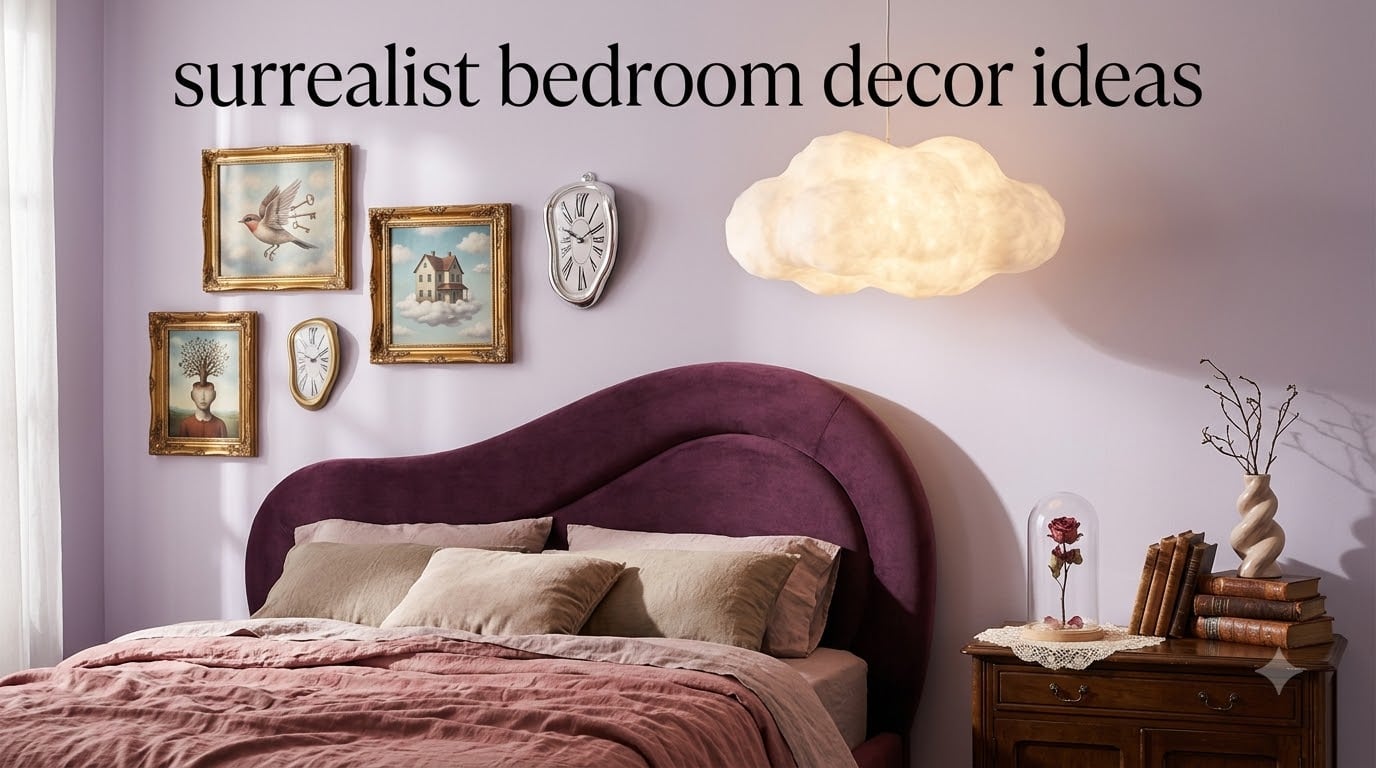
Your bedroom should feel like more than a place to sleep. It should feel like a portal. That is the heart of surrealist bedroom decor ideas: turning the most personal room in your home into a dreamlike, otherworldly escape. We have spent months studying the surrealist movement, talking to designers, and testing what actually works in a real bedroom. The result is this guide. It will walk you through what surrealism means in interior design, the elements that make it sing, and exactly how to bring it into your own space without it tipping into costume-party chaos.
I have always been drawn to rooms that feel like they belong in a Magritte painting. There is something about waking up surrounded by floating shapes, unexpected color, and art that bends reality that makes ordinary mornings feel cinematic. Surrealism lets you treat your bedroom as a canvas. And in 2026, more designers and everyday decorators are leaning into that freedom than ever before.
Table of Contents
What Is Surrealism in Interior Design?
Surrealism is an art and literary movement that began in 1924, when French poet André Breton published the Surrealist Manifesto. It explored the unconscious mind, dreams, and the strange overlap between reality and imagination. Artists like Salvador Dalí, René Magritte, and Leonora Carrington built visual worlds that bent logic. Melted clocks floated above desolate plains. Apples filled rooms. A single eye stared from the sky.
When surrealism meets interior design, those same principles come indoors. Surrealist interior design borrows dreamlike imagery, unexpected pairings, distorted shapes, and fantastical objects to create spaces that feel like stepping into a painting. It is not about being weird for the sake of weird. It is about creating an atmosphere that provokes curiosity and emotion.
The style sits at the intersection of maximalism, art, and personal mythology. Sophie Halliday, founder of interior design studio Holloway Li, has described surrealist interiors as spaces that “tell a story rather than follow a trend.” That storytelling quality is what separates a truly surrealist bedroom from a room that just has a couple of weird lamps.
Key Elements of Surrealist Bedroom Design
Every surrealist bedroom shares a handful of recurring elements. If you understand these, you can mix and match them confidently and build a room that feels intentional rather than chaotic. Here are the nine elements I lean on most when designing a dreamlike bedroom.
- Optical illusions and distorted shapes. Furniture and decor that play with perception, like wavy mirrors, curved headboards, or melting-style vases, are signature surrealist pieces.
- Unexpected juxtapositions. Pairing items that do not traditionally belong together, such as a classical bust next to a neon sign, creates that sense of surprise at the heart of surrealism.
- Bold, saturated colors. Surrealist spaces rarely use safe neutrals as the only palette. Deep jewel tones, acid pastels, and high-contrast combinations are common.
- Statement wall art. Oversized art prints, surrealist paintings, and dreamlike photography anchor the room and tell visitors what to expect.
- Whimsical lighting. Sculptural lamps, cloud-shaped pendants, and lamps that look like melting wax transform a ceiling into art.
- Maximalist layering. Layering textures, patterns, and objects densely creates the immersive feeling of a surrealist painting.
- Symbolic or narrative objects. Items that hint at a personal story, like an antique key, a vintage globe, or a small glass dome covering a single flower, give the room meaning.
- Asymmetry and imperfection. Surrealist rooms rarely feel like a furniture showroom. A lopsided stack of books, a chair pulled slightly out of line, or art hung at unconventional heights adds character.
- Biomorphic and abstract forms. Shapes inspired by nature, cells, pods, waves, and amoebas, anchor the space in the surrealist tradition.
You do not need every one of these. I usually pick three to four anchor elements and let the rest of the room support them.
Color Palettes for Surrealist Bedrooms
Color is the fastest way to transport someone into a dreamlike state. Surrealist color palettes lean into contrast and the unexpected. There is no single right answer, but I keep coming back to a few combinations that consistently deliver that otherworldly bedroom energy.
Deep midnight and soft powder pink. The contrast between dark and soft creates a feeling of dusk, the hour when dreams and reality blur. This is a favorite of contemporary surrealist designers.
Acid yellow, electric blue, and cream. Inspired by Dalí’s late work, this palette feels sunny but uneasy. It works well in smaller bedrooms where you want the walls to feel like sunlight.
Forest green, terracotta, and bone white. A more earthy surrealist palette that pulls from Magritte’s “Empire of Light” paintings, where day and night exist at once.
Lavender, silver, and black. A nocturnal palette that reads as soft and mysterious, perfect for anyone who wants their bedroom to feel otherworldly rather than playful.
Color application matters too. I like painting one wall in a saturated surrealist color while keeping the other three neutral. That way the room feels dreamy without overwhelming your senses. You can also paint ceilings an unexpected color, which is a classic surrealist move that makes a bedroom feel turned inside out.
Furniture and Decor Ideas to Transform Your Bedroom
Once you have your palette, the furniture and decor is where the surrealist vision really comes to life. The goal is to choose pieces that feel sculptural and slightly askew, not the kind of matching bedroom set you would find in a catalog.
The bed. Treat the bed as the centerpiece. Consider a headboard with curved, organic edges, or one upholstered in a rich velvet. I love boucle or velvet fabrics in surrealist bedrooms because they pick up light in soft, almost liquid ways. A canopy or draped fabric above the bed can also create a cocoon-like, dreamlike feeling.
Nightstands. Skip the matched pair. Instead, choose two nightstands that feel like they belong in different decades. An antique wooden table on one side and a sculptural modern piece on the other side creates a subtle tension that feels very surrealist.
Seating. A curved accent chair in a corner, especially in a bold color, adds a sculptural moment that breaks up the room’s geometry. Chairs shaped like lips, hands, or soft pods are classic surrealist moves that designers like Jonathan Adler have popularized.
Mirrors. Mirrors are essential surrealist tools. Choose one with an unusual shape, like a melting or wavy frame, and place it where it catches something unexpected in the room. Magritte famously used mirrors in his paintings to suggest hidden realities.
Objects. A glass dome covering a small sculpture, a vintage anatomical model, a framed collection of pressed flowers, or a small ornate clock all add narrative. The point is to fill the room with objects that hint at a story without spelling it out.
Wall Art and Murals for a Dreamlike Atmosphere
Art is the soul of any surrealist bedroom. Walls should not be empty. The fastest way to make a bedroom feel surrealist is to cover one wall in something visually arresting.
Reproductions of famous surrealist works. Prints of Dalí’s melting clocks, Magritte’s floating apples, or Leonora Carrington’s mystical creatures instantly set the tone. Large-format surrealist prints are widely available and cost less than original art.
Murals. If you want a more immersive feel, a hand-painted or wallpaper mural of a dreamy landscape, a cloudy sky, or an abstract dreamscape transforms the entire room. I have a soft spot for murals that depict windows opening onto impossible landscapes, a recurring surrealist motif.
Gallery walls with unexpected pairings. Mix antique portraits with modern abstract art. Pair a botanical illustration next to a contemporary photography print. The juxtaposition is the point.
Three-dimensional wall objects. Consider mounted antlers, sculptural ceramic faces, or shadow boxes. Three-dimensional pieces blur the line between decor and art, which is exactly what surrealism asks for.
Whatever you choose, treat the wall as a scene, not a backdrop. The art should feel like it belongs in a story you are telling.
Lighting Ideas for Surrealist Spaces
Lighting is the most underrated surrealist design tool. It is rarely covered by competitors, which is exactly why it is one of my favorite ways to push a bedroom into dreamlike territory.
Sculptural lamps. A lamp that looks like a melting figure, a floating orb, or a tangled vine is doing double duty as lighting and art. Designers like Vincent Darré have built entire careers on sculptural surrealist lighting.
Color-changing bulbs. Smart bulbs that shift through unexpected colors, like sunset peach into deep magenta, can make your bedroom feel like a different place at different hours of the day.
Layered sources. Do not rely on a single overhead light. Combine a sculptural pendant with table lamps, sconces, and candles. The variation in light sources creates pools of brightness and shadow that feel mysterious and dreamlike.
Hidden uplighting. Tuck LED strips behind the headboard, under a floating shelf, or along the top of a curtain rod. The indirect glow creates a soft, otherworldly atmosphere without harsh glare.
Projector lights. Small star, cloud, or aurora projectors are an inexpensive way to bring movement and color to a ceiling. They feel straight out of a Magritte sky.
I often tell clients to test their bedroom lighting at night. That is when surrealism lives. If your room still feels like a catalog at 11 pm, your lighting is not doing enough work.
How to Incorporate Surrealism into Your Bedroom
If you are starting from a regular bedroom, you do not need to gut the whole space. Here is the step-by-step process I walk people through.
Step 1: Pick one anchor piece. Choose a single item, like a sculptural headboard, a surrealist art print, or a statement lamp, and design the rest of the room around it. This prevents the “novelty shop” look that scares people away from the style.
Step 2: Establish your palette. Settle on three to four colors and stick to them across the walls, bedding, and major furniture. Pick one bold accent color and use it sparingly.
Step 3: Add one unexpected juxtaposition. Find one place where you can pair something traditional with something modern, something organic with something geometric, something old with something new. That contrast is the spark.
Step 4: Layer texture, not clutter. Mix velvet, boucle, linen, and leather to add depth. Surrealism is about richness, not stuffiness. Choose fewer objects, but make each one feel tactile.
Step 5: Edit the practical. Make sure you can still sleep, store your clothes, and charge your phone. Surrealism should enhance daily life, not complicate it. I always make sure the bedside table still has space for a glass of water and a book.
Budget-Friendly Surrealist Decor Tips
Surrealist decor has a reputation for being expensive, but that is mostly because original surrealist art is rare and valuable. The style itself is very accessible. Here is how to get the look without a designer’s budget.
Print your own surrealist posters. Many classic surrealist paintings are in the public domain. You can download high-resolution images from museum websites and print them at home or through an inexpensive print service.
Thrift for the unexpected. Vintage shops, estate sales, and secondhand marketplaces are gold mines for surrealist decor. Old anatomical prints, ornate mirrors, and quirky lamps show up regularly at thrift stores. They cost a fraction of new sculptural pieces and bring more character.
DIY your statement pieces. Paint a single wall in a surrealist color, hand-painted a cloud mural with sponge brushes, or build a plywood headboard with curved edges. These projects cost very little and are fully customizable.
Use lighting as the wow factor. A single sculptural lamp or a string of cloud-shaped lights does more to make a bedroom feel surrealist than a lot of expensive furniture. This is the highest-impact, lowest-cost lever you can pull.
Start with textiles. Bedding, throw pillows, and curtains are an affordable way to bring surrealist color and texture into a bedroom without committing to permanent changes.
Many of the most magical surrealist bedrooms I have seen cost very little. They just relied on clever choices rather than expensive pieces.
Famous Surrealist Artists and Designers to Know
Understanding the artists behind the movement helps you draw from the source rather than imitate surface-level looks. Here are the names I recommend every surrealist bedroom enthusiast learn.
Salvador Dalí is the most recognizable surrealist artist. His melting clocks, dreamlike landscapes, and bizarre juxtapositions are the visual shorthand for surrealism itself. Look to his work for inspiration on unexpected pairings and impossible scales.
René Magritte painted bowler-hatted men, floating apples, and cloudy skies that often featured day and night at the same time. His paintings are quieter than Dalí’s but equally dreamlike. Magritte is a great reference for surrealist color palettes and quiet absurdity.
Leonora Carrington brought mysticism, folklore, and feminine power into surrealism. Her work is a rich source of inspiration for anyone drawn to the magical side of the movement.
Designer Vincent Darré is known as the “King of Surrealism” in contemporary interiors. His rooms feature sculptural furniture, whimsical lighting, and maximalist layers. He is the closest the design world has to a modern Dalí.
Edward James created the surrealist garden Las Pozas in Mexico, with concrete structures inspired by dreamlike forms. His work shows how surrealism extends beyond interiors into architecture.
Ken Fulk is an AD100 designer whose rooms blend historical opulence with surrealist whimsy. His interiors are useful references for anyone wanting surrealism with a touch of grandeur.
DIY Surrealist Projects for Your Bedroom
One of the most rewarding ways to bring surrealism into your bedroom is to make something yourself. DIY surrealist projects let you tailor the dreamlike quality to your own vision. Here are three projects I have seen work beautifully in real homes.
Cloud ceiling mural. Using a sponge and three shades of white, blend a fluffy cloud pattern across your entire ceiling. Add soft LED uplighting along the edges to create a glowing sky effect at night. It takes a weekend and transforms how the room feels.
Floating shelf illusion. Cut a piece of plywood into a curving, organic shape, paint it to match your wall, and mount small objects on it. The shelf appears to grow out of the wall like a surrealist tendril. This is one of my favorite tricks for displaying small treasures.
Surrealist gallery wall. Collect five to seven mismatched vintage frames from a thrift store. Print a mix of classic surrealist paintings, vintage portraits, and personal photos. Arrange them tightly in a clustered layout with no consistent spacing. The imperfect grid feels deliberate, not chaotic.
DIY projects are also a great way to involve the whole family or share the style with roommates. Every surrealist piece you make becomes part of your own visual story.
Frequently Asked Questions
What is surrealist interior design?
Surrealist interior design is a style inspired by the Surrealist art movement of the 1920s. It blends dreamlike imagery, unexpected juxtapositions, distorted shapes, and bold colors to create rooms that feel like stepping into a painting. Surrealist bedrooms often include sculptural furniture, optical illusions, and symbolic objects that challenge conventional design.
How do I make my bedroom look surrealist?
Start with one anchor piece, like a sculptural lamp or a surrealist art print, and build the rest of the room around it. Establish a three-color palette with one bold accent, add an unexpected juxtaposition between traditional and modern objects, layer velvet and boucle textures, and use multiple soft lighting sources to create a dreamlike atmosphere.
What are key elements of surrealist decor?
The key elements of surrealist decor include optical illusions, distorted shapes, unexpected juxtapositions, bold saturated colors, statement wall art, whimsical sculptural lighting, maximalist layering, symbolic narrative objects, asymmetry, and biomorphic forms inspired by nature. Combining three or four of these elements is usually enough to set a surrealist tone.
What colors are used in surrealist design?
Surrealist design uses bold, saturated, and unexpected color combinations. Common surrealist palettes include deep midnight blue with soft powder pink, acid yellow with electric blue and cream, forest green with terracotta and bone white, and lavender with silver and black. The goal is contrast and emotional impact rather than safe neutrality.
Is surrealist decor expensive?
Surrealist decor can be created at almost any budget. Original surrealist artwork and sculptural designer furniture are expensive, but the look can be achieved affordably through public-domain art prints, thrifted vintage objects, DIY projects like painted cloud ceilings, sculptural lighting, and budget-friendly textile layering. The style is more about creative choices than expensive pieces.
Bringing Surrealism Home
Surrealist bedroom decor is not about copying a painting or chasing a trend. It is about building a room that feels like it belongs to you and your dreams. Whether you start with a single sculptural lamp, a magenta accent wall, or a thrifted vintage portrait, the principles stay the same: lean into the unexpected, prioritize story over symmetry, and let your imagination guide the choices.
Our team has tested these ideas across small apartments and large master bedrooms, and the takeaway is consistent. A surrealist bedroom does more than decorate a space. It changes how you feel when you wake up. In 2026, as more people look for ways to make their homes feel personal and imaginative, surrealist bedroom decor ideas are an antidote to the mass-produced look dominating interiors. Start with one piece, build from there, and trust your instincts. Your bedroom can be the most magical room in your home.