
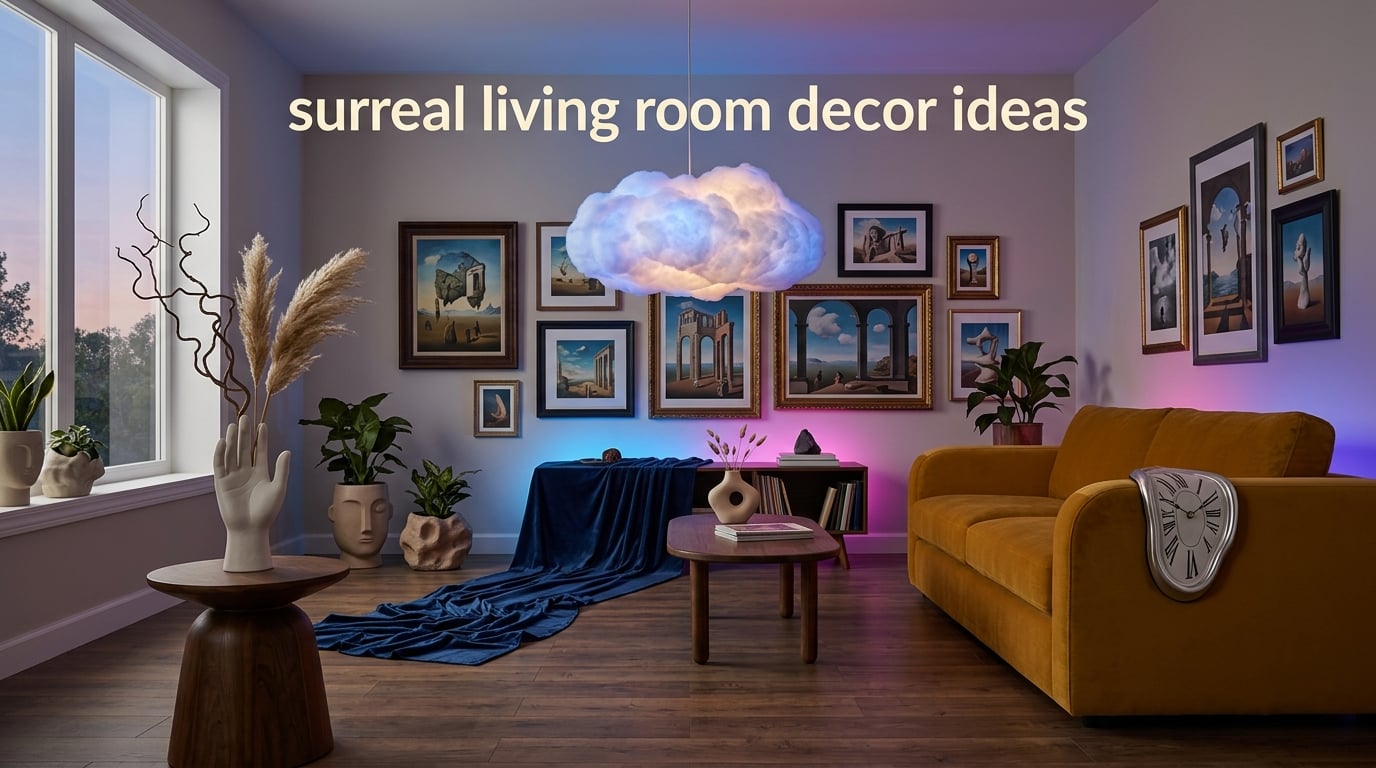
If your living room feels like it could belong to anyone, you’re not alone. I hear the same complaint from readers all the time: the space looks fine, but it doesn’t feel like theirs. Surreal living room decor ideas solve that problem fast. They trade cookie-cutter design for a room that surprises you, makes guests linger, and reflects a real inner world.
I’ve spent the last few months collecting, testing, and writing about surrealist decor for onesurrealistaday.com. In this guide, I’ll walk you through what surrealism actually means in a home setting, the key elements that make a room feel dreamlike, and how to pull it off on any budget. You’ll also get room-specific ideas, DIY projects, and answers to the questions people ask most.
Table of Contents
What Is Surrealism in Home Decor?
Surrealism in home decor is the practice of blending dreamlike, fantastical, and unexpected elements into everyday living spaces. It draws from the Surrealist art movement of the 1920s, when artists like Salvador Dali, Rene Magritte, and Joan Miro began painting the unconscious mind rather than the visible world. When you bring that idea into a living room, you create an environment that feels like stepping into a painting.
The core principle is contradiction. You pair soft velvet with rough stone, oversized hands with delicate glass, oversized clocks that droop over a shelf. The room works on a logical level – you can still sit on the sofa and read a book – but it also whispers to your subconscious. That tension between function and fantasy is what makes surrealism stick, even in 2026 when most design trends lean minimalist.
Surrealism is also deeply personal. Unlike Scandinavian or coastal styles, which follow a fairly strict visual playbook, surrealist decor rewards whatever jolts your imagination. A Reddit user in r/HomeDecorating put it well: they wanted “portals or windows to other worlds” rather than another beige sofa. That instinct is the entire starting point.
The Brief History Behind the Style
The movement began in 1924 with Andre Breton’s Surrealist Manifesto. The goal was to unleash the creative power of the unconscious mind. Breton was influenced by Freudian psychoanalysis and the chaos of World War I, and he wanted art that revealed hidden truths rather than polite ones.
By the 1930s, designers and architects had joined in. Edward James built a surrealist concrete jungle in the Mexican rainforest, and Elsa Schiaparelli collaborated with Dali on fashion pieces like the lobster dress. Decor was never a separate category from fine art in the original movement, which is why so much of today’s surrealist home decor draws directly from paintings.
Key Elements of Surrealist Living Room Decor
Every surreal living room relies on a small toolkit of visual ideas. You don’t need every single one – I usually recommend starting with two or three – but knowing the full list helps you choose combinations that feel coherent instead of chaotic.
1. Sculptural Furniture with Organic Forms
Look for seating, tables, and shelving that look more like sculpture than furniture. A wavy-edged console, a chair shaped like a hand, or a coffee table with a melting base immediately shifts the tone of a room. Pieces inspired by Dali’s melting clocks or Magritte’s bowler hats are crowd favorites.
If you can’t find true sculptural pieces, fake the look. Drape a soft fabric over a side table so it puddles on the floor like spilled paint. The effect reads as surreal even when the materials are ordinary.
2. Optical Illusion Wall Art
Art is the easiest entry point. A single trompe l’oeil canvas that looks like a window onto a desert, a melting clock print, or an impossible-geometry poster does the heavy lifting on an otherwise plain wall. Optical illusion wall art adds depth and surprise without taking up floor space.
Mix scales. One large statement piece above the sofa plus a cluster of small surrealist prints in mismatched frames feels collected and intentional. Avoid perfectly matched gallery walls; that grid pattern works against the dreamlike feel.
3. Whimsical Lighting
Lighting in a surrealist room shouldn’t look like ordinary lighting. Cloud-shaped ceiling fixtures, dripping wax-style pendants, animal-shaped table lamps, or color-changing LED strips all create an otherworldly glow. The trick is to make the light source itself feel like art.
Reddit users in r/TripCaves frequently credit color-changing LEDs as the single most affordable way to make a room feel “trippy.” You can leave the rest of the decor neutral and let lighting do the surrealism.
4. Surrealist Accessories and Objects
Small objects matter. A hand-shaped ceramic vase holding dried flowers, a melting clock propped against a stack of books, a decorative eye on the mantel, or a tray painted with clouds all add surrealist punctuation. Group them in odd numbers on a single surface so they read as a still life.
These are also the most budget-friendly elements. You can rotate them with the seasons or your mood, which keeps the room feeling alive.
5. Unexpected Color and Pattern
Surrealist color palettes don’t follow safe rules. Sage green walls paired with mustard sofas, or powder pink ceilings over deep navy floors, are common moves. Patterns lean toward organic abstraction – swirling marbling, painted cloud skies, or wallpaper that looks like a torn page from a 1930s novel.
The 2/3 rule helps here: keep roughly two-thirds of the room in a calm base tone and one-third in the bolder, more surreal element. That ratio stops the room from tipping into chaos.
6. Living Plants with Attitude
Plants fit naturally into surrealist decor because they already look strange. Hang trailing pothos from the ceiling, prop a giant monstera in a face-shaped planter, or cluster carnivorous plants on a tray. Plants bring movement and life, which keeps the dreamlike quality from feeling sterile.
How to Incorporate Surrealism Into Your Living Room
Knowing the elements is one thing. Pulling them off without the room looking like a themed restaurant is another. I’ve found that the best results come from a few simple rules of thumb. The next sections cover the practical side: how to start, how to budget, how to handle small spaces, and how to DIY your way into the look.
Start With One Statement Piece
Pick a single surrealist anchor – a sculptural chair, a dramatic art piece, or a cloud-shaped light – and build around it. Once you have one piece that the room orbits, the rest of the styling falls into place more easily. A room full of small oddities without an anchor tends to feel cluttered rather than surreal.
Mix High and Low Pieces
You don’t need a Magritte original. Pair one investment piece – maybe a vintage Dali print in a good frame – with thrifted accessories, DIY art, and discount store finds. The mix of values feels collected over years, which is the entire illusion.
A reader on r/HomeDecorating mentioned completing their surrealist living room on a budget under 500 by combining a single framed poster, color-changing LEDs, and thrifted sculptural vases. That approach works in most rooms.
Use the 3-5-7 Rule for Object Groupings
Designers often use the 3-5-7 rule when grouping decor: arrange objects in odd-numbered clusters (3, 5, or 7 items per surface) so the eye moves naturally. In a surrealist room, this matters even more because the objects are unusual. Odd groupings stop the room from looking like a museum display.
Lean Into the 2/3 Rule for Color Balance
The 2/3 rule for living rooms is a simple guideline: roughly two-thirds of the visible surfaces should be in calm, supporting tones, and one-third should be the bold or surreal focal area. So if your sofa, walls, and rug take up two-thirds in soft neutrals, your art wall, accent chair, or one feature wall can carry the surrealist punch.
Try DIY Surrealist Projects
DIY is where surrealist decor gets fun. A few projects I’ve seen work well:
- Marbled clay vases. Mix two colors of air-dry clay and swirl them together before forming a small vase. Once dry, paint the inside and use it for dried flowers.
- Cloud ceiling. Tape cotton batting to the ceiling in soft, billowy shapes and hide battery fairy lights behind them. Reads as a dream cloud day or night.
- Impossible-geometry shelves. Use mirrored panels to build an M.C. Escher-inspired floating shelf. The reflections turn a small corner into an optical illusion.
- Trompe l’oeil book spines. Wrap old hardcovers in paper printed with surrealist landscapes. They look like portals on your bookshelf.
None of these projects require specialized tools, and each costs a fraction of what you’d pay for the same look in a design store.
Solutions for Small Living Rooms
Small spaces are easier to make surreal than large ones, in my experience. Wall art, lighting, and one sculptural accessory do the work without crowding the floor. Optical illusion wallpaper on a single accent wall, a small cloud-shaped pendant, and a face-shaped planter on the windowsill can carry the entire look in a studio apartment.
Surreal Living Room Decor Ideas You Can Try Today
Below is a list of specific ideas I would actually try in my own living room. Each one is concrete enough that you can recreate it this weekend, and most work in any size space.
Build a Statement Art Wall
Dedicate one wall to surrealist art. Mix one large statement piece – a melting clock print, a cloud landscape, or a portrait with eyes where the pupils should be – with smaller prints in mismatched frames. Leave negative space between pieces so the wall feels like a gallery, not a grid.
Swap Out One Lamp for Something Strange
A dripping-wax lamp, a hand holding a bulb, or a cloud-shaped pendant on its own can transform a quiet corner. Lighting is one of the easiest changes to reverse if you change your mind, which makes it a low-risk first step.
Add a Face or Hand-Shaped Accessory
A hand-shaped ring dish on the coffee table, a face-shaped planter on the shelf, or a sculptural head vase in the corner all carry surrealist DNA without committing to a full theme. Look for these in ceramic, plaster, or stone.
Drape Fabric in Unexpected Places
Let a soft velvet runner puddle dramatically off the edge of a console. Hang a sheer curtain behind an open bookshelf to suggest a hidden window. Surrealism loves a fabric that behaves like water.
Paint One Feature Ceiling
Paint the ceiling in a sky scene, a deep twilight blue, or a swirling marbled pattern. Most people ignore ceilings, which is exactly why a surrealist ceiling surprises.
Use Mirrors to Bend Reality
A single oversized round mirror with an unusual frame – an irregular shape, an ornate baroque edge, or a hand-carved silhouette – reflects the room back in a slightly off-kilter way. Pair it with a sculptural object on the mantel below for a quick Magritte moment.
Curate Books and Objects as Still Life
Don’t arrange books alphabetically. Stack them with a candle, a small sculpture, a dried flower stem, and an odd vintage object on top. The result is a still life that shifts every time you use a book.
Add One Bold Rug
A rug that mimics a landscape, a melting form, or an abstract painting ties the room together. Choose a rug with surrealist imagery and build your palette from the colors in the weave.
Layer Vintage and New Pieces
Surrealism celebrates juxtaposition, so mix a vintage brass lamp with a modern sculptural chair. Hunt thrift stores and estate sales for pieces with patina; they bring a sense of history into the room.
Hang a Tapestry With Surreal Imagery
Tapestries are one of the most budget-friendly ways to add large-scale surrealist imagery to a wall. Look for artists like Fran Rodriguez, whose surrealist tapestries come up frequently in Reddit recommendations. They cover a lot of wall space for very little.
Frequently Asked Questions
What is the 3-5-7 rule in decorating?
The 3-5-7 rule is a styling guideline that recommends grouping decor objects in odd numbers – three, five, or seven items per surface or vignette. Odd groupings create more visual movement than even numbers, so the eye keeps traveling around the arrangement. In a surrealist living room, applying the 3-5-7 rule helps unusual objects feel intentionally curated rather than cluttered.
What are some cool surrealist ideas?
Cool surrealist ideas for a living room include melting clock wall art, cloud-shaped ceiling lights, hand-shaped vases, trompe l’oeil murals that look like windows or doorways, oversized face planters, impossible-geometry shelves, dripping or puddling fabric runners, mirrored accent walls, and curated still-life book stacks. Combine two or three of these ideas rather than using all at once so the room keeps its dreamlike feel.
What decor is trending in 2026?
Decor trending in 2026 leans toward maximalism, personal expression, and nature-inspired surrealism. Color drenching, handcrafted ceramics, vintage revival pieces, statement lighting, and art that doubles as decor are all popular. Surrealist living rooms fit this trend because they reject minimalism in favor of spaces that feel personal, layered, and visually surprising.
What is the 2/3 rule for living rooms?
The 2/3 rule for living rooms means keeping roughly two-thirds of the room’s visible surfaces – walls, large furniture, and rugs – in calm, supporting tones and using the remaining one-third for a bold focal area such as a statement wall, a sculptural chair, or a feature light. The ratio stops a room from feeling visually chaotic while still leaving room for a surrealist focal point.
Final Thoughts on Surreal Living Room Decor
Surreal living room decor is less about filling a room with strange objects and more about choosing a few pieces that genuinely surprise you. Start with one anchor – a sculptural chair, a dramatic print, or a cloud-shaped light – and let the rest of the room support it. Mix high and low, follow the 2/3 rule for color balance, group accessories in odd numbers, and remember that DIY works just as well as designer pieces.
The point of surrealist home decor is to make your living room feel like yours in a way no one else can replicate. If a piece makes you pause, smile, or wonder why it’s there, that’s the right piece. Build from there, and the dreamlike quality takes care of itself.