
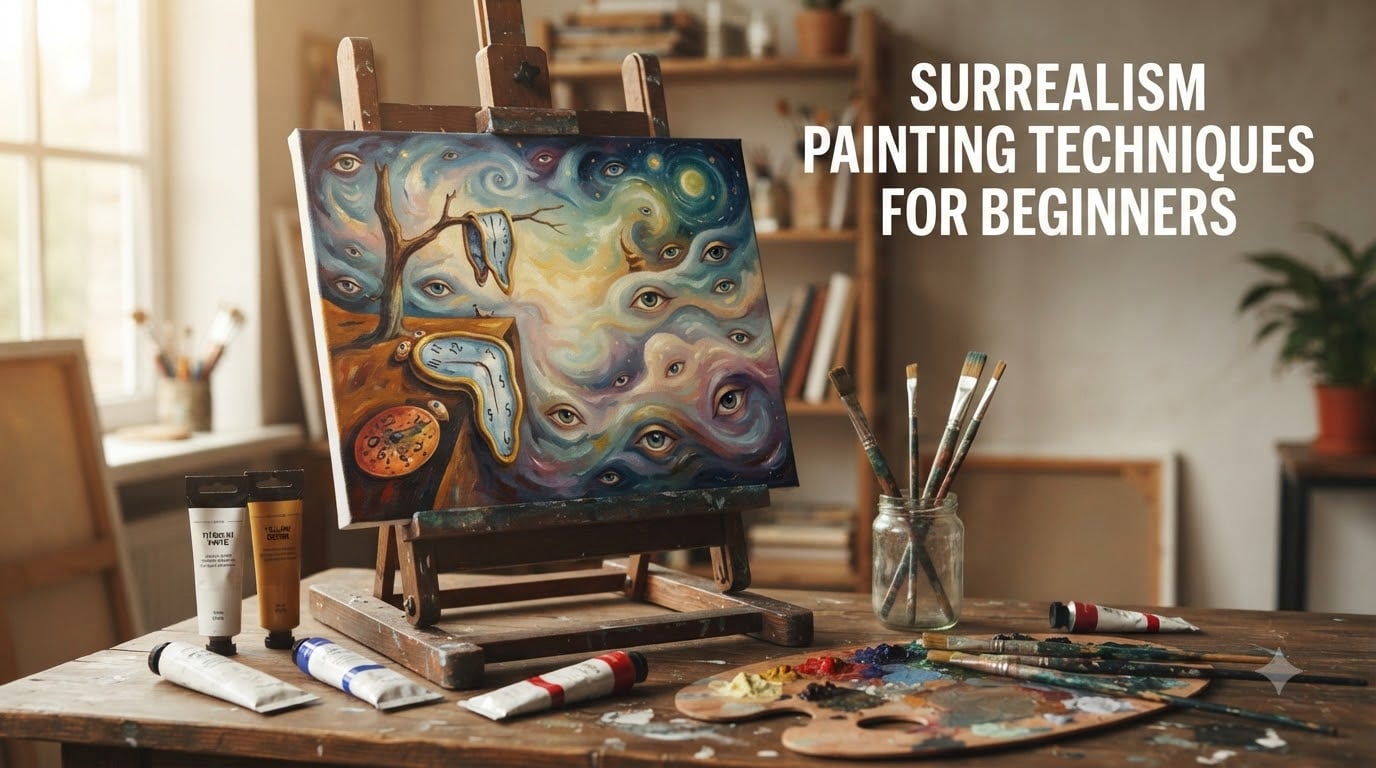
Surrealism painting techniques for beginners are more accessible than most people think. You don’t need years of art school or flawless drawing skills to start creating dreamlike, imaginative paintings. The surrealist movement was founded on the idea that anyone can tap into their unconscious mind to produce powerful, unexpected imagery. In this guide, I’ll walk you through the most important surrealism painting techniques, show you exactly how to use them, and give you practical exercises to start creating surrealist art today.
Whether you’re drawn to Salvador Dali’s melting clocks or René Magritte’s impossible skies, the techniques behind surrealism are surprisingly learnable. I’ve spent years studying and practicing these methods, and I’m going to break them down in a way that makes sense even if you’ve never picked up a paintbrush before.
Table of Contents
What Is Surrealism Painting?
Surrealism is a 20th-century art movement that sought to express the workings of the unconscious mind through unexpected, dreamlike imagery and irrational juxtapositions of objects. Unlike realistic painting, surrealism doesn’t aim to reproduce what the eye sees. Instead, it channels what the mind imagines when rational thought steps aside.
What makes surrealism particularly beginner-friendly is its built-in permission to be weird. There are no anatomical rules to master first, no perspective grids to memorize, and no “wrong” results. If your painting looks strange and unexpected, congratulations — you’re doing it right. Surrealism is one of the few fine art styles where imagination matters more than technical skill.
A Brief History of Surrealism
Surrealism emerged in Paris in the 1920s, rising from the ashes of the Dada movement that had rejected logic and reason in response to the horrors of World War I. In 1924, the French poet André Breton published the Surrealist Manifesto, officially defining surrealism as “pure psychic automatism” — a way of expressing thought free from rational control.
Breton was deeply influenced by Sigmund Freud’s theories of the unconscious mind. He believed that dreams, free association, and unfiltered thought contained deeper truths than logical reasoning. Artists quickly embraced these ideas, developing a range of techniques to bypass conscious decision-making and access subconscious imagery.
By the 1930s and 1940s, surrealism had produced some of the most recognizable paintings in art history — from Dali’s The Persistence of Memory to Magritte’s The Son of Man. The movement’s influence extends far beyond paintings into photography, film, literature, and even modern digital art.
Core Surrealism Painting Techniques Every Beginner Should Know
Here are the essential surrealism painting techniques that form the foundation of the movement:
- Automatism — Painting or drawing without conscious planning, letting your hand move freely to reveal subconscious imagery.
- Juxtaposition — Combining two or more unrelated objects in a single image to create unexpected meaning or visual tension.
- Frottage — Rubbing pencil or paint over textured surfaces to create chance patterns, then developing them into imagery.
- Decalcomania — Pressing wet paint between surfaces (or smearing it) to create random textures and forms as a starting point.
- Dream Painting — Using dream imagery and dreamlike atmosphere as the direct subject matter of a painting.
- Exquisite Corpse — A collaborative drawing game where each participant adds to a composition without seeing the previous sections.
- Grattage — Scraping away layers of wet paint to reveal colors and patterns beneath, often using palette knives or combs.
- Collage — Combining found images, photographs, and painted elements into a single composition.
Each of these techniques works differently, but they all share one goal: disrupting your normal thought patterns to produce imagery you’d never create through deliberate planning. Let’s break down the most beginner-friendly techniques in detail.
Automatism: Painting Without Thinking
Automatism is the foundational surrealist technique, and it’s where most beginners should start. The concept is simple: you pick up a brush, pencil, or even just your fingers, and you begin making marks on the surface without any plan, goal, or intention. You don’t think about what you’re drawing. You don’t try to make it look like anything. You just move.
The idea comes directly from André Breton’s definition of surrealism as “psychic automatism.” He believed that when you remove conscious control from the creative process, your subconscious mind takes over — and that’s where the real art lives.
How to Practice Automatism
Here’s a step-by-step approach to your first automatism session:
Step 1: Gather your materials — a large sheet of paper (at least 11×17 inches), soft pencils, charcoal, or watercolor paint. Bigger paper gives your hand more room to move freely.
Step 2: Set a timer for 10 minutes. Close your eyes or look away from the paper.
Step 3: Begin making marks. Don’t try to draw anything specific. Let your hand glide, scratch, swirl, or press across the surface. Change direction when it feels natural. Speed up, slow down, press harder, lighten your touch.
Step 4: When the timer ends, look at what you’ve made. You’ll likely see shapes, figures, or patterns that your conscious mind didn’t intend. Now you have a starting point.
Step 5: Use paint or ink to develop the shapes your subconscious created. Find faces in the swirls, landscapes in the textures, creatures in the patterns. Let the random marks guide your composition.
Many beginners report that automatism is the most liberating surrealist exercise they try. Even when the results look “weird,” the process itself feels exciting and freeing. You’re not judging your skills — you’re discovering what your imagination produces when your inner critic is silenced.
Juxtaposition: The Power of Strange Combinations
Juxtaposition is probably the technique most people picture when they think of surrealism — an elephant with spider legs, a fish with human eyes, a clock melting over a tree branch. It’s the art of placing two objects together that don’t logically belong in the same image, creating a sense of surprise, unease, or poetic meaning.
René Magritte was the master of juxtaposition. His paintings show bowler-hatted men raining from the sky, a pipe that is not a pipe, and an apple floating in front of a face. The genius of Magritte’s work is that he painted everything in a calm, realistic style — which made the impossible elements feel even more unsettling.
How to Create Surrealist Juxtapositions
Method 1 — The Word Game: Write down 10 random objects on slips of paper. Draw two at random and paint them combined into a single entity. A chair with butterfly wings. A violin with roots growing from it. A birdcage filled with clouds. The more unrelated the objects, the more surrealist the result.
Method 2 — Scale Displacement: Take an ordinary object and paint it at a completely wrong scale. A massive toothpick towering over a city. A tiny ocean in a teacup. Changing scale instantly transforms mundane objects into surreal images.
Method 3 — Context Swap: Place an object somewhere it doesn’t belong. Fish swimming through a living room. A door opening onto a desert in the middle of a forest. The object itself stays realistic — only its context changes.
The key to effective juxtaposition is painting both elements convincingly. When everything looks technically “real,” the impossibility of the combination becomes more powerful. Beginners often make the mistake of making everything look intentionally abstract, which weakens the surrealist impact.
Frottage and Decalcomania: Letting Chance Help
These two techniques are favorites among beginners because they remove the pressure of starting from a blank page. Both methods use chance and texture as creative partners — you create random patterns, then develop them into surrealist imagery.
Frottage
Frottage (from the French word “frotter,” meaning “to rub”) was invented by Max Ernst in 1925. Place a sheet of paper over a textured surface — wood grain, fabric, a coin, leaves, crumpled foil — and rub a soft pencil or crayon over it. The texture transfers onto the paper as a pattern of lines and shapes.
Now look at the texture and find images within it, the same way you might see shapes in clouds. Develop those shapes with paint, ink, or colored pencil until a surrealist scene emerges. Ernst created entire series of paintings this way, starting with textures and letting his imagination fill in the rest.
Decalcomania
Decalcomania works with paint instead of rubbing. Apply thick paint (gouache or acrylic works best) to one surface — a sheet of glass, plastic, or even another piece of paper — then press your canvas or paper onto it and lift. The paint creates random, organic textures with bubbles, streaks, and uneven patterns.
Artists like Oscar Dominguez and later Max Ernst used decalcomania to generate haunting landscapes, organic forms, and atmospheric backgrounds. Once the paint dries, look for shapes within the texture and develop them with a fine brush. Many surrealists found that decalcomania produced some of their most atmospheric and emotionally resonant work.
Dream Painting and Veristic Surrealism
Dream painting draws directly from the imagery of dreams and uses it as the literal subject of the painting. This approach is closely related to veristic surrealism — a style where surreal subjects are painted with photographic precision and realistic detail.
Salvador Dali was the undisputed master of veristic surrealism. His technique involved painting impossible scenes — melting watches, elephants on spider legs, drawers growing from human bodies — with the exacting detail of a Renaissance master. The contrast between hyper-realistic technique and impossible subject matter is what gives Dali’s work its distinctive power.
How to Start Dream Painting
Keep a dream journal. Place a notebook and pen next to your bed. The moment you wake up, write down everything you remember about your dreams — images, feelings, colors, strange logic. Don’t edit or interpret. Just record.
Sketch your dream images. Within 24 hours, sketch the strongest images from your dreams. Don’t worry about making them “look good” — focus on capturing the emotional quality and the strange combinations that dreams create naturally.
Develop one image into a painting. Choose the most compelling sketch and plan a painting around it. Use realistic rendering techniques to make the impossible feel real. This is where veristic surrealism shines — the more precisely you paint the impossible, the more powerfully it affects the viewer.
Dream journaling is consistently rated as one of the most useful habits for generating surrealist concepts. Your dreams are already surrealist — you just need to record and translate them into paint.
Veristic vs. Biomorphic Surrealism
When exploring surrealism painting techniques for beginners, you’ll encounter two main stylistic approaches. Understanding the difference helps you choose a direction for your own work.
Veristic surrealism aims for photographic realism in depicting impossible scenes. Salvador Dali, René Magritte, and Yves Tanguy worked in this style. The images are clearly “impossible” but rendered with meticulous detail — sharp edges, realistic textures, precise lighting. Veristic surrealism works best when you want your viewer to feel unsettled by how real the impossible looks.
Biomorphic (abstract) surrealism uses organic, flowing, abstract forms instead of recognizable objects. Joan Miró, Jean Arp, and André Masson were key figures in this approach. Biomorphic surrealism feels more playful and free — shapes suggest living organisms without being specific. Colors are often bright and primary, lines are loose, and the overall effect is more poetic than disturbing.
Neither approach is “better” for beginners. If you love drawing and want to develop precision, veristic surrealism gives you a clear goal. If you love color and movement and want maximum freedom, biomorphic surrealism lets you work more intuitively. Many surrealist artists eventually blend both approaches.
Famous Surrealist Painters and What Beginners Can Learn From Them
Studying the masters is one of the fastest ways to develop your own surrealist skills. Here are five painters every beginner should study — and the specific lesson each one teaches.
Salvador Dali (1904–1989)
Lesson: Master the contrast between technique and impossibility. Dali painted his melting clocks and elephants on stilts with the skill of an Old Master. His work teaches beginners that technical precision and wild imagination aren’t opposites — they’re partners. Even if your drawing skills are developing, studying how Dali rendered surfaces, shadows, and reflections will improve your painting.
René Magritte (1898–1967)
Lesson: Ideas matter more than technique. Magritte’s paintings are famous for their concepts — not their brushwork. His simple, flat style proves that a powerful surrealist idea executed clearly is more effective than a technically perfect painting with a weak concept. For beginners who feel insecure about their drawing skills, Magritte is proof that imagination is your most important tool.
Max Ernst (1891–1976)
Lesson: Experiment with process. Ernst invented or popularized many surrealist techniques — frottage, grattage, decalcomania, collage. His career shows that discovering new ways of making art is itself an artistic act. Beginners should follow Ernst’s lead and try as many techniques as possible to find what resonates.
Joan Miró (1893–1983)
Lesson: Embrace playfulness and color. Miró’s biomorphic surrealism is joyful, colorful, and full of childlike energy. His paintings of stars, moons, and abstract creatures remind beginners that surrealism doesn’t have to be dark or disturbing. It can be bright, playful, and full of wonder.
Leonora Carrington (1917–2011)
Lesson: Draw from personal mythology. Carrington’s paintings feature transforming women, magical animals, and alchemical symbols drawn from Celtic mythology, Jungian psychology, and her own rich imagination. Her work teaches beginners to mine their personal interests, cultural heritage, and inner life for surrealist material — instead of just copying the established surrealist “greatest hits.”
Beginner Surrealism Exercises and Prompts
Ready to start painting? These exercises give you a structured way to practice the surrealist techniques we’ve covered.
Exercise 1 — Automatic Drawing Warm-Up (10 minutes): Set a timer and draw without looking at the paper. Fill the entire page with automatic marks. Then find three recognizable shapes in your drawing and develop them with color.
Exercise 2 — The Juxtaposition Challenge (30 minutes): Pick two completely unrelated objects from around your room. Paint or draw them merged into a single entity. Give the combined object a name.
Exercise 3 — Dream Sketch Transfer (20 minutes): After your next dream, sketch the three strongest images from memory. Pick the most interesting one and create a small painting of it in a realistic style.
Exercise 4 — Frottage Landscape (25 minutes): Collect three textured surfaces from around your home. Create frottage rubbings of each. Look at the textures and develop a surrealist landscape painting on top of them.
Exercise 5 — The Exquisite Corpse Game (with friends): Fold a piece of paper into thirds. Person 1 draws a head and folds it hidden. Person 2 draws a torso. Person 3 draws legs. Unfold to reveal a surrealist creature.
Start with Exercise 1 — the automatic drawing warm-up. It takes the least planning, requires no special skills, and gives you immediate results. From there, move to the exercises that interest you most.
Supplies You Need to Start Painting Surrealism
You don’t need expensive materials to start painting surrealism. Here’s a basic beginner kit:
Surfaces: Mixed-media paper or canvas boards. Mixed-media paper handles wet and dry media and is much cheaper than canvas for practice. Get a pad of at least 9×12 inch sheets.
Paints: Acrylic paints are the best starting point for beginners. They dry quickly, clean up with water, and work on paper and canvas. Start with a basic set of 12 colors — you can mix nearly anything from a limited palette.
Brushes: A small set of soft synthetic brushes — one flat (1 inch), one round (size 6–8), and one fine detail brush (size 0–2). You don’t need many brushes to start.
Drawing tools: Soft graphite pencils (2B–6B), a kneaded eraser, and a stick of charcoal for automatism exercises. These are inexpensive and essential for sketching and automatic drawing.
Extras: A water cup, paper towels or rags, a palette (a paper plate works fine), and a spray bottle for keeping acrylics workable. Some surrealist techniques also benefit from having textured materials on hand — fabric scraps, leaves, crumpled foil, coins — for frottage and collage.
The total investment to start a surrealist painting practice is minimal. Most of what you need is probably already in your home.
Common Beginner Mistakes and How to Avoid Them
After studying surrealist communities and talking with beginner artists, I’ve noticed the same mistakes come up again and again. Here’s how to avoid them.
Mistake 1: Copying Dali too literally. Many beginners start by trying to paint melting clocks and elephants. This is a great way to learn technique, but if you stop there, your work will always look derivative. Use Dali’s techniques, not his imagery. Take his method of rendering impossible objects with realistic precision and apply it to your own dreams and ideas.
Mistake 2: Making everything abstract to hide weak drawing skills. Beginners sometimes default to vague, blurry shapes because they’re afraid of drawing specific objects. But surrealist paintings work best when the impossible elements are clearly defined. Practice drawing specific objects from life — even 15 minutes a day of observational sketching will dramatically improve your surrealist work.
Mistake 3: Overloading the canvas. A surrealist painting doesn’t need 47 strange objects to be effective. Some of the most powerful surrealist works contain just one or two impossible elements in an otherwise simple composition. Focus your impact instead of spreading it thin.
Mistake 4: Forgetting about atmosphere and color. The “dreamlike quality” of surrealist paintings comes as much from color choices and lighting as from subject matter. Cool blues and purples create a nighttime dream feel. Warm, muted tones evoke nostalgia. Dramatic lighting creates tension. Think about the emotional atmosphere of your painting, not just the objects in it.
Mistake 5: Not studying enough reference material. Many beginners jump straight into painting without spending time looking at surrealist art. Visit museum websites, browse surrealist art books, and spend time really looking at how master surrealists handle surfaces, lighting, and composition. The more visual reference you absorb, the richer your own work becomes.
Frequently Asked Questions
What are the basic surrealism painting techniques?
The basic surrealism painting techniques include automatism (painting without conscious planning), juxtaposition (combining unrelated objects), frottage (rubbing over textured surfaces), decalcomania (pressing wet paint to create textures), dream painting (using dream imagery as subject matter), and exquisite corpse (collaborative drawing). These techniques all share the goal of bypassing rational thought to access subconscious imagery.
How do beginners start surrealism painting?
Beginners can start surrealism painting by practicing automatism — simply make marks on paper without planning for 10 minutes, then find shapes in the results to develop. Keep a dream journal to capture surrealist imagery naturally. Try the juxtaposition exercise: combine two unrelated objects into one painting. Start with acrylic paints on mixed-media paper, which is affordable and forgiving for experimentation.
What is automatism in surrealism?
Automatism is a surrealist technique where the artist creates without conscious planning or control. The artist lets their hand move freely across the surface — drawing, painting, or making marks — without trying to produce a specific image. André Breton defined surrealism itself as ‘pure psychic automatism,’ making this the movement’s foundational practice. The goal is to let the unconscious mind direct the creative process.
What techniques did Salvador Dali use in surrealism?
Salvador Dali used veristic surrealism, painting impossible and dreamlike scenes with hyper-realistic precision and Old Master technique. His specific methods included the paranoiac-critical method (inducing hallucinatory states to generate imagery), double images (forms that can be read as multiple subjects), and meticulous rendering of surfaces, shadows, and reflections. Dali’s key innovation was combining Renaissance-level painting skill with completely irrational subject matter.
What is frottage in surrealism?
Frottage is a surrealist technique invented by Max Ernst in 1925. The artist places paper over a textured surface — such as wood grain, fabric, or leaves — and rubs a soft pencil or crayon over it to transfer the texture. The resulting patterns become starting points for surrealist imagery. The artist looks for shapes and forms within the texture and develops them into a complete painting or drawing.
What is the easiest surrealism technique for beginners?
Automatism is the easiest surrealism technique for beginners because it requires no drawing skill, no planning, and no specific materials. Simply set a timer for 10 minutes and make marks on paper without thinking about what you’re drawing. Another easy starting point is frottage — rubbing pencil over textured surfaces — which produces interesting patterns without any artistic training. Both techniques remove the pressure of creating something ‘good’ and let your subconscious guide the process.
What paint do surrealists use?
Most surrealist painters use either oil paint or acrylic paint. Oil paint was the traditional choice for classic surrealists like Dali and Magritte because it allows for smooth blending, long working times, and precise detail work. Acrylic paint is the better choice for modern beginners — it dries quickly, cleans up with water, works on paper and canvas, and is more affordable. Some surrealists also use gouache for its matte finish and vibrant colors.
Who are the most famous surrealist painters?
The most famous surrealist painters include Salvador Dali, known for melting clocks and hyper-realistic dream scenes; René Magritte, known for conceptual paintings like The Son of Man; Max Ernst, who invented frottage and grattage techniques; Joan Miró, known for colorful biomorphic abstract surrealism; and Leonora Carrington, whose work drew from Celtic mythology and personal symbolism. Other important surrealists include Frida Kahlo, Yves Tanguy, and André Masson.
Final Thoughts: Finding Your Own Surrealist Voice
Surrealism painting techniques for beginners open a door to creative freedom that few other art styles offer. You don’t need formal training to start. You don’t need perfect drawing skills. You need curiosity, a willingness to experiment, and the courage to let your subconscious guide your brush.
Start with automatism and frottage — they require the least skill and produce the most immediate results. Keep a dream journal. Study the masters, especially Magritte and Ernst, before trying to copy Dali. Most importantly, paint regularly. Even 20 minutes a day of surrealist practice will build your visual vocabulary faster than you expect.
The surrealist movement began with a simple idea: the unconscious mind holds truths that rational thought can’t reach. Your paintings are waiting on the other side of that idea. Pick up a brush, close your eyes, and start.