
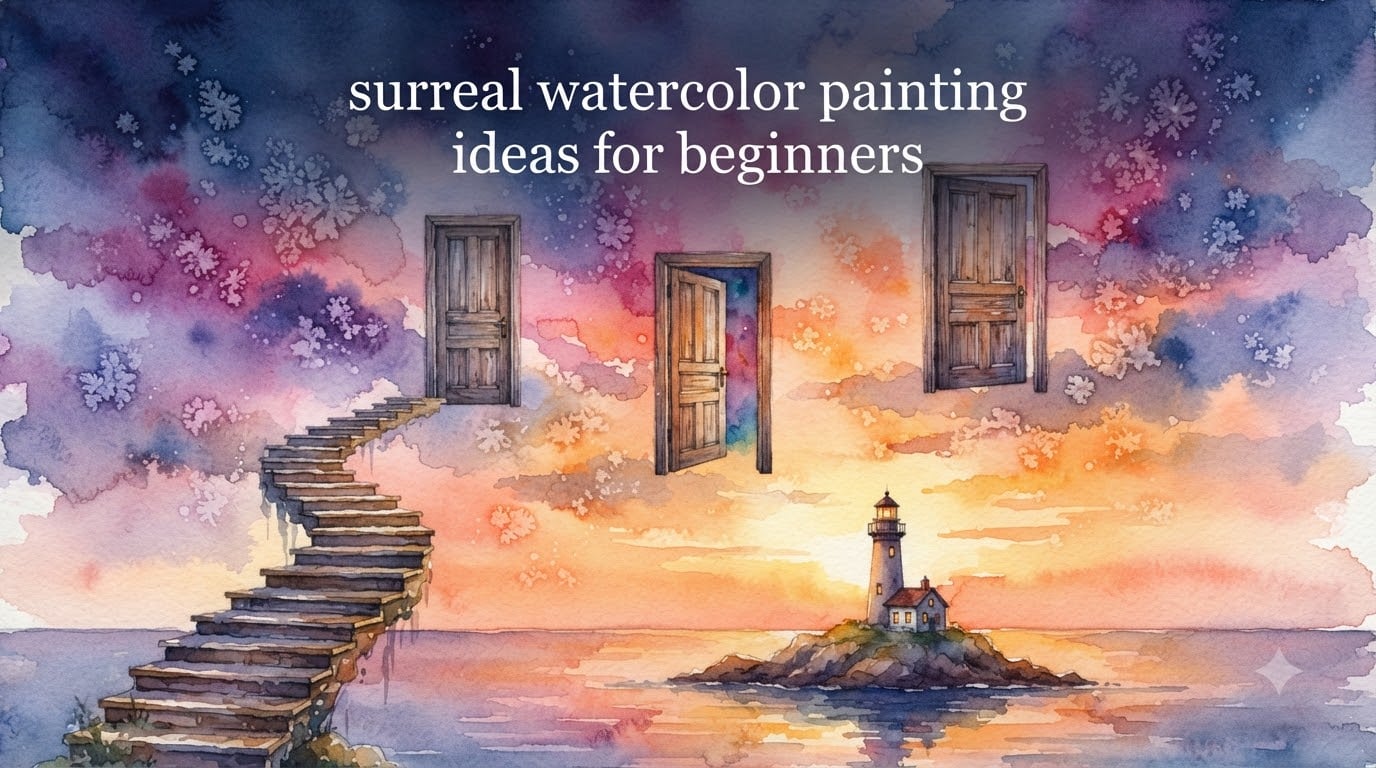
Surrealism is an art style that places real objects into impossible or dreamlike situations to express the subconscious mind. In watercolor, this style feels especially alive because soft bleeds, flowing edges, and unexpected color blends naturally create the dreamy mood surrealists chase. That’s exactly why this guide exists: I want to walk you through surreal watercolor painting ideas for beginners that feel approachable, forgiving, and genuinely fun to paint at home.
If you’ve ever felt intimidated by the word “surrealism” or worried your painting has to look like a Salvador Dali original to count, let me reassure you up front: surreal watercolor is one of the most forgiving watercolor styles a beginner can try. The soft transitions hide small mistakes, and what looks like an “imperfection” often reads as an intentional dream effect. By the end of this guide, you’ll have 12 specific ideas to try, a full step-by-step walkthrough, a supplies list with student-grade alternatives, and a simple framework for inventing your own surreal concepts.
Table of Contents
12 Quick Surreal Watercolor Ideas to Try Today
If you only have ten minutes to skim this guide, this is the section to focus on. I picked each of these surreal watercolor painting ideas because it works well with basic supplies, has clear visual payoff, and gives beginners that “I actually painted something surreal” feeling fast.
- Floating doors in a dream sky
- Eye floating inside a teacup
- Melting clock dripping off a windowsill
- Staircase climbing into the clouds
- Cello growing leaves like a tree
- Transparent figure standing in a forest
- Ocean waves spilling out of a bedroom window
- Lamp casting a shadow of a different object
- Bird with a key instead of a wing
- Hand holding a tiny house
- Levitating furniture in an empty room
- Face melting into a desert landscape
Each of these is explained in more depth later in this guide, with the supplies and color palette I’d recommend. Pick one to start with. Most beginners can finish any of these in 60 to 90 minutes, even on their first attempt.
What Is Surrealism in Watercolor Painting?
Surrealism is an early 20th-century art movement that explores the unconscious mind by placing ordinary objects into impossible, dreamlike, or symbolic situations. The movement started in 1924 with André Breton’s Surrealist Manifesto and was practiced by artists like René Magritte, Salvador Dalí, Max Ernst, and Leonora Carrington. Their goal wasn’t to paint realistic scenes but to jolt the viewer into feeling something irrational, poetic, or quietly unsettling.
When surrealism meets watercolor, something special happens. Watercolor naturally wants to bleed, blur, and surprise you. That soft wet edge that watercolor beginners often consider a “mistake” is exactly the visual quality that makes a painting feel dreamlike. A floating door painted with crisp hard edges feels like a Photoshop edit; the same door painted with soft watery edges feels like something you’d half-remember from a dream.
You don’t need to know art history to paint surreal watercolor. You only need three things: a normal scene, one impossible element, and a willingness to let the paint do some of the thinking. That’s it. The rest of this guide is about giving you the techniques, prompts, and confidence to actually do it.
Why Watercolor Is the Perfect Medium for Surrealism
I tell every beginner I teach the same thing: if you want to paint surreal art and you’re nervous about realism, choose watercolor over acrylic or oil. Here’s why watercolor specifically supports surrealist watercolor painting better than other mediums.
Soft bleeds mimic how dreams actually feel. Dreams don’t have hard edges. Real objects in a dream often blur into their surroundings, and watercolor is the only mainstream medium that does this naturally. Acrylic dries sharp; oil can stay sharp even with blending; watercolor bleeds on its own.
Mistakes read as intentional. In realistic watercolor, a bloom or a backrun is a problem to fix. In surreal watercolor, a bloom or backrun often makes the painting feel more dreamlike. Beginners consistently tell me surreal watercolor “felt easier” than realistic watercolor because the medium itself forgives their hesitations.
Wet-on-wet makes impossible transitions feel natural. Want a sky that bleeds into the floor? A hand that dissolves into water? Wet-on-wet watercolor lets you blend two colors, two textures, or two ideas into each other in a way that other mediums force you to fake.
The medium invites experimentation. Salt on wet paint, splattering with a toothbrush, masking fluid for crisp shapes, lifting with a damp brush. These experimental techniques are core to the surrealist spirit of letting chance and accident shape the work.
None of this means watercolor is the “easy” medium. It just means watercolor’s quirks happen to align with what surrealism is trying to express. That’s why surreal watercolor painting ideas work so well for beginners, and why the rest of this guide is built around watercolor, not acrylic or oil.
Beginner Supplies Checklist for Surreal Watercolor
You do not need expensive supplies to start painting surreal watercolor. Here is the kit I recommend for beginners, with student-grade alternatives where they make sense.
Paper (most important). Buy 100 percent cotton watercolor paper, 140 lb (300 gsm) cold press, in a pad or block. Cold press has a slight tooth that holds pigment beautifully. For surreal watercolor, I’d avoid student-grade cellulose paper because it buckles badly under heavy wet washes and limits how much bleeding you can do. Brands like Arches, Saunders Waterford, and Stonehenge are artist-grade. Bee Paper and Canson XL are student-grade but acceptable for practice.
Paints. A starter set of 12 to 24 artist-grade watercolor pans or tubes is enough for the rest of your surrealist journey. Look for a set with at least one warm and one cool version of each primary color (a warm red and a cool red, a warm blue and a cool blue). Winsor & Newton Cotman and Daniel Smith are both beginner-friendly. Student-grade sets work fine if budget matters, but pigment quality varies a lot.
Brushes. You only need three brushes to start: a large round (size 10 or 12) for washes, a medium round (size 6) for general work, and a small detail brush (size 2 or a rigger) for crisp lines and floating objects. Synthetic brushes from brands like Princeton or Rosemary & Co are excellent and affordable. Avoid cheap “value packs” of brushes; they lose their shape fast.
Masking fluid. Optional but extremely helpful for surrealism. Masking fluid (also called frisket) lets you cover an area you want to keep white, paint freely around it, then peel off the fluid to reveal a crisp white shape underneath. It is perfect for floating doors, levitating objects, or any element that needs to glow against a busy background. Winsor & Newton masking fluid is the standard.
Table salt. Yes, ordinary table salt. When sprinkled on a wet wash, salt absorbs pigment and creates a starry, textured bloom. It is one of the easiest “wow effects” in surreal watercolor and costs nothing. Coarse sea salt gives bigger blooms; fine table salt gives smaller stars.
Water container, paper towel, palette. Two water containers (one for rinsing, one for clean water), a roll of paper towel, and any palette with wells for mixing. A white ceramic plate works in a pinch.
Pencil and eraser. A soft 2B pencil for sketching the composition lightly, and a kneaded eraser for lifting mistakes or lightening pencil lines.
That is the full beginner kit. You can finish every surreal watercolor painting idea in this guide with these supplies plus a cup of tea and some quiet music.
Core Surrealist Watercolor Techniques to Learn First
You don’t need to master every watercolor technique to paint surrealist watercolor well. You need five core techniques that pair especially well with surrealist subjects. I teach these in this order because each one builds on the previous.
1. Wet-on-wet for dreamlike transitions
Wet-on-wet means dropping pigment onto paper that is already wet with clean water. The paint blooms and bleeds outward, creating soft edges and unexpected color mixing. This is the single most important technique for surreal watercolor. Use it for skies, melting objects, transparent figures, and any place where you want two realities to bleed into each other.
How to do it: Wet an area of paper with clean water using a large brush, wait 5 to 10 seconds until the shine disappears but the paper is still damp, then drop color into the damp area with a smaller brush. Watch the pigment bloom and move. Don’t fight it. Let the paint suggest the form, then refine only when the paper has dried.
2. Wet-on-dry for crisp impossible details
Wet-on-dry is the opposite: you brush pigment onto dry paper, and the edge stays where you put it. Use it for floating objects, sharp architectural elements (door frames, windows, stairs), and any “real” element that contrasts with the dreamy background. The contrast between a soft wet-on-wet background and a sharp wet-on-dry foreground is the visual signature of surreal watercolor.
3. Dry brush for texture and atmosphere
Dry brush means using a brush with very little water and a lot of pigment, dragged across paper so only the high points of the paper texture pick up color. It’s perfect for clouds, fur, wood grain, fabric, and rough surfaces. In surreal watercolor, dry brush adds tactile texture that makes impossible objects feel like they really exist.
4. Masking fluid for glowing white shapes
Masking fluid lets you preserve pure white paper underneath busy washes. It’s the easiest way to paint a glowing moon behind a bleeding sky, a floating door against a dark wash, or a starry window in a dreamy room. Apply it with an old brush (it ruins brushes), let it dry fully, paint over it freely, then peel or rub it off when the wash is bone dry.
5. Salt, splatter, and lifting for happy accidents
Salt on wet washes creates starry blooms. Splattering paint from a toothbrush or tapping a loaded brush creates texture. Lifting wet pigment with a damp brush lets you “erase” mistakes or pull light back out of dark areas. These three techniques are core surrealist tools because they introduce chance into your work, which is exactly how dreams behave.
If you master these five techniques (wet-on-wet, wet-on-dry, dry brush, masking fluid, and salt/splatter), you have everything you need to paint every idea in this guide.
Color Palettes That Capture a Dreamlike Mood
Color is half the magic in surreal watercolor. Beginners often default to using every color in their pan set, which produces muddy, busy paintings. A restricted palette is much more dreamlike. Here are the three palettes I recommend for beginners, with the mood each one creates.
Muted dreamy palette: Ultramarine blue, burnt sienna, and a touch of cadmium yellow. Mix them in different proportions and you can paint almost any dreamlike scene: misty skies, foggy rooms, melting objects, soft transitions. This is the safest palette for your first surreal watercolor painting idea.
Cool twilight palette: Indigo, dioxazine purple, and a pale lemon yellow. This palette feels like late evening or pre-dawn, which suits floating objects, transparent figures, and surreal interior scenes. It’s my favorite palette for dream interiors.
Warm desert palette: Burnt sienna, raw umber, cadmium orange, and a little ultramarine. This palette suits surreal desert landscapes, melting clocks, and metamorphosis paintings. It also pairs beautifully with the dripping, melting quality of wet-on-wet bleeds.
High-contrast surrealist palette: Cobalt blue, cadmium red, cadmium yellow, plus black for deep shadows. Use this when you want a Magritte-style hard-edge surreal painting rather than a dreamy one. Limit the palette to three or four colors plus white paper, and your paintings will feel intentional rather than busy.
A useful beginner trick: paint your entire surreal watercolor in just three colors plus the white of the paper. Restriction forces your eye to focus on shape, light, and impossible juxtapositions, which is the actual point of surrealism.
Surreal Watercolor Painting Ideas by Theme
The 12 ideas at the top of this article were a quick list to anchor the search snippet. Now I want to expand each idea into themed buckets with a short prompt you can use as a starting point. Pick a theme that resonates with you, then sketch your own variation.
Theme 1: Sky and impossible architecture
Skies are forgiving backgrounds because watercolor loves painting them. Add impossible architecture and you have a surrealist scene for free.
- Floating doors in a dream sky. Paint a wet-on-wet sunset or sunrise, then drop three or four crisp doors floating in the sky once the wash is dry. Doors read as portals and add mystery.
- Staircase climbing into the clouds. Paint a soft cloud wash, then add a stone staircase that climbs upward and disappears into the clouds at the top of the page. A classic surrealist move.
- Lighthouse on a tiny floating island. Paint a small island with a single lighthouse, surrounded by a wash of soft sky instead of ocean. The horizon disappears.
Theme 2: Impossible objects and metamorphosis
This theme is about one object becoming another. Magritte and Dalí built entire careers on this single idea.
- Bird with a key instead of a wing. Paint a simple bird silhouette, then replace one wing with an old-fashioned key painted in detail.
- Cello growing leaves like a tree. Paint a cello in dry brush detail, then add watercolor leaves and branches growing out of the f-holes like a tree.
- Hand holding a tiny house. Paint an open palm in warm tones, then add a tiny watercolor cottage sitting in the palm. Scale shift makes it surreal.
Theme 3: Dream figures and transparency
Human figures painted with watercolor softness feel inherently dreamlike. Make them transparent and they cross into surrealism.
- Transparent figure standing in a forest. Paint a forest with strong vertical tree trunks, then add a human figure whose body lets the trees show through. Wet-on-wet is your friend here.
- Face melting into a desert landscape. Paint a profile face on one side, then let the lower half dissolve into sand dunes painted in burnt sienna.
- Levitating furniture in an empty room. Paint a room in flat perspective, then add a chair, lamp, or table floating mid-air with no visible support.
Theme 4: Mundane objects behaving impossibly
The quietest surrealism comes from one small impossible detail in a normal scene. Beginners often find these easier than big dramatic compositions.
- Eye floating inside a teacup. Paint a teacup and saucer in careful detail, then place a single human eye looking up from the surface of the tea. Strange and a bit unsettling.
- Lamp casting a shadow of a different object. Paint a lamp, then paint its shadow as the shape of a tree, a whale, or a person instead of the lamp’s actual silhouette.
- Ocean waves spilling out of a bedroom window. Paint a bedroom wall and window in straight perspective, then have soft wet-on-wet waves rolling out of the window onto the floor.
These four themed buckets give you 12 specific surreal watercolor painting ideas. You can pick one and have a finished painting by the end of an afternoon.
How to Dream Up Your Own Surreal Concept
Beginners tell me the same thing: “I can copy ideas, but I don’t know how to invent my own surreal concept.” That hesitation is completely normal. Surrealism has a reputation for being about genius ideas, when in reality it’s about a few simple moves you can repeat. Here’s the four-step ideation framework I use with my own students.
Step 1: Start with a normal place. Pick a real, ordinary setting. A bedroom, a kitchen, a street, a beach, a forest. The more ordinary, the better. Surrealism depends on the contrast between “normal” and “impossible.”
Step 2: Add one impossible element. Just one. Floating door, melting clock, transparent figure, eye in a teacup. One is enough. Two is a lot. Three is a circus.
Step 3: Change one scale or one material. Either make the impossible element tiny inside a normal scene (a tiny house in a hand) or make a normal element gigantic (a giant key where a door should be). Or change its material (a stone made of fabric, a tree made of water).
Step 4: Soften the edges. Let the wet-on-wet bleed connect the normal place to the impossible element. The bleed is what tells the viewer “this is a dream, not a photo.”
That’s the whole framework. Normal place + impossible element + scale or material shift + soft bleed. Every surrealist watercolor painting in this guide uses that exact structure. Once you have it, you can invent infinite variations. Try sketching five thumbnail concepts in pencil before painting, and pick the one that feels most emotionally true to you.
Composition Tips for Surreal Watercolor Paintings
Composition matters more in surrealist painting than beginners realize. A floating door placed randomly feels like a sketch. A floating door placed thoughtfully feels like a Magritte. Here are the composition rules I follow when placing impossible objects.
Rule of thirds for the impossible element. Don’t put the impossible object dead center. Place it on one of the upper or lower thirds of the picture. Magritte almost always used this rule, and it instantly makes a painting feel intentional.
Use the “impossible gaze.” If your painting has a figure or eye in it, have it look toward the impossible element. The viewer’s eye follows the gaze and lands on the surreal element automatically.
One light source, even if the scene is impossible. Pick one direction for the sun or moon and keep your shadows consistent. Surreal paintings with inconsistent shadows feel unfinished; surreal paintings with consistent shadows feel real.
Anchor with a foreground. Even the dreamiest surreal watercolor painting benefits from one grounded foreground element (a windowsill, a table, a hand, a chair leg). Without an anchor, the eye has nowhere to land.
Leave negative space. Surrealist watercolor paintings almost always have more white paper than pigment. Resist the urge to fill the page. The white space is what lets the impossible element breathe.
These five composition rules will get you most of the way to a Magritte-style surreal watercolor painting even on your first attempt.
Step-by-Step: Paint a Dream Sky With Floating Doors
This is the painting I walk every beginner through. It teaches wet-on-wet, wet-on-dry, masking fluid, and salt in a single project, and it always looks impressive even when nothing goes to plan. Set aside about 90 minutes.
Step 1: Tape your paper and plan the composition
Tape a sheet of 140 lb cold press paper to a board using painter’s tape or gummed paper tape. This prevents the paper from buckling when you apply wet washes. Lightly sketch three door shapes in different sizes, scattered across the upper two thirds of the page. Leave plenty of sky between them. The bottom third will be the horizon.
Step 2: Apply masking fluid to the doors
Using an old brush, carefully apply masking fluid inside each door outline. Let it dry completely (about 10 minutes). The masking fluid should look rubbery and slightly yellow when dry. Don’t worry if your application is messy; you’ll be peeling it off later.
Step 3: Wet-on-wet sky wash
Wet the entire sky area with clean water using your large round brush. Wait 5 to 10 seconds for the shine to disappear. Drop in ultramarine blue at the top, blend down into a warmer tone (a touch of burnt sienna) near the horizon. Let the colors bleed into each other naturally. While the wash is still wet, sprinkle a pinch of table salt across the sky for a starry effect.
Step 4: Paint the horizon and any landscape
Once the sky wash is fully dry (this takes 10 to 15 minutes), paint a soft horizon line in burnt sienna or raw umber. Add any landscape elements you want: distant mountains, a field, a single tree. Keep them simple so they don’t compete with the doors.
Step 5: Wet-on-dry door details
Now paint each door in careful wet-on-dry detail. Doors can be wooden, painted, ornate, or simple. Use dry brush for wood grain. Add doorknobs, panels, even tiny keyholes. The contrast between the soft sky and the crisp doors is the entire effect.
Step 6: Remove the masking fluid
Once everything is bone dry, gently rub the masking fluid with your finger or a soft eraser. It will peel away, leaving pure white door shapes glowing against your painting. If any masking fluid remains in the texture of the paper, dab it gently with a clean damp brush.
Step 7: Final touches
Add shadows beneath each floating door to anchor them slightly in space. A subtle soft shadow under each door makes the surreal effect stronger. Sign the painting, remove the tape, and admire your first surreal watercolor.
That single project teaches you more about surrealist watercolor than reading five theory articles. If your doors look crooked, your bleed looks muddy, or your shadows are too dark, you have actually learned something useful. Welcome to surreal watercolor.
Surrealist Artists Who Used Watercolor
Surrealism isn’t only an oil-painting tradition. Many of the movement’s most important artists used watercolor as a primary or secondary medium, and studying them can spark new ideas for your own work.
Salvador Dalí produced watercolor illustrations for his own literary works throughout his career, including dreamscapes and biblical illustrations. His watercolor work is precise and detailed compared to his oil paintings, with hard edges and intense color.
René Magritte is famous for his oils, but his gouache and watercolor studies show how he worked out impossible compositions before committing them to canvas. Studying his watercolor sketches is one of the best ways to learn his compositional logic.
Leonora Carrington used watercolor extensively for her mystical, surrealist paintings of magical figures, animals, and alchemical scenes. Her work is a wonderful reference for soft, dreamy surreal watercolor with strong symbolic content.
Remedios Varo painted surrealist watercolor and gouache scenes of solitary figures in mystical interiors. Her palette and sense of quiet mystery are very beginner-friendly.
Yayoi Kusama works in many media, but her watercolor pumpkins and infinity nets are core surrealist works in their own right. Studying her use of repetitive mark-making can inspire dreamlike patterns in your own surrealist watercolor paintings.
You don’t need to copy these artists to paint surrealist watercolor, but spending 10 minutes looking at their watercolor work before you start painting is a small habit that quietly teaches you a lot.
Common Beginner Mistakes and How to Fix Them
Beginners consistently make the same handful of mistakes in surrealist watercolor. Here’s what they are, why they happen, and exactly how to fix them.
Mistake 1: Muddy colors from over-blending. This happens when you keep working a wash until the colors turn brown. Fix: accept that watercolor wants to move on its own. Mix your color in the palette, drop it onto the paper, and leave it alone. Less brushwork means cleaner color.
Mistake 2: Hard edges where you wanted soft bleeds. Your paper dried too much between the wet water and the pigment. Fix: work in smaller sections and rewet if needed, or accept the hard edge and let it become part of the composition (it can read as a sharp architectural element).
Mistake 3: Soft bleeds where you wanted crisp edges. Your paper was too wet when you tried to paint a sharp detail. Fix: wait longer between washes, or use a hair dryer on low to speed drying. Reserve a small dry area in the corner of your paper to test paint behavior.
Mistake 4: Paper buckling badly. Cheap paper or not enough water in your brush when stretching the paper. Fix: tape your paper to a board before painting, buy 140 lb weight minimum, and consider artist-grade cotton paper for serious projects.
Mistake 5: The painting looks like a child’s drawing rather than surrealist art. Usually this comes from too many impossible elements competing for attention. Fix: simplify. Pick one impossible element per painting, make it large, and let everything else support it.
Mistake 6: Trying to make watercolor look like oil paint. Beginners often want crisp, opaque coverage and feel frustrated when watercolor stays transparent. Fix: lean into transparency. It’s the medium’s greatest strength and the heart of the surrealist mood.
Mistake 7: Giving up too soon. Watercolor looks washed-out and unfinished while wet. Fix: always judge a watercolor after it’s dry, ideally the next day. Most beginners are surprised by how much their paintings improved once the water fully dried.
If you hit any of these mistakes, you’re not failing. You’re having a normal first surrealist watercolor painting experience. Each fix is a small technique lesson you’ll carry into the next painting.
Frequently Asked Questions
What is surrealism in watercolor painting?
Surrealism in watercolor is an art style that places real objects into impossible, dreamlike, or symbolic situations. Watercolor suits surrealism especially well because its soft bleeds and flowing edges naturally create the dreamy mood surrealists try to express. Common surrealist watercolor subjects include floating objects, melting clocks, transparent figures, and unexpected scale changes.
How do you paint a surreal watercolor painting?
Start with a normal scene like a sky, room, or landscape. Add one impossible element (a floating door, a melting clock, a transparent figure). Use wet-on-wet for soft dreamlike transitions and wet-on-dry for crisp impossible details. Limit your palette to three colors plus the white of the paper. Allow bleeds and accidents, they often make the painting feel more surreal.
Can beginners paint surrealist watercolor?
Yes. Surrealist watercolor is one of the most forgiving watercolor styles for beginners because soft bleeds hide small mistakes and imperfections often look intentional. You only need basic supplies, a willingness to experiment, and an idea. The step-by-step dream sky project in this guide is a perfect first painting.
What supplies do I need for surreal watercolor painting?
You need 140 lb cold press watercolor paper, a small set of artist-grade watercolor paints (12 to 24 colors is plenty), three round brushes (sizes 10, 6, and 2), masking fluid, table salt, water containers, paper towel, a palette, and a soft pencil. Student-grade alternatives exist for most items if budget matters.
What colors work best for surreal watercolor paintings?
A restricted palette of three colors plus the white of the paper usually works best. For dreamlike paintings try ultramarine blue, burnt sienna, and cadmium yellow. For twilight interiors try indigo, dioxazine purple, and pale lemon yellow. For warm desert scenes try burnt sienna, raw umber, and cadmium orange. Magritte-style hard-edge surrealism works well with cobalt blue, cadmium red, cadmium yellow, and black.
How long does a surreal watercolor take to paint?
Most beginner surreal watercolor painting ideas take 60 to 90 minutes from sketch to finished painting. The step-by-step dream sky project in this guide takes about 90 minutes including drying time. More complex compositions with masking fluid and multiple layers can take 2 to 3 hours over a couple of sessions.
What subjects work best for surreal watercolor paintings?
Surreal watercolor works well with a small set of recurring subjects: floating objects (doors, eyes, furniture), melting or dripping items (clocks, candles, faces), transparent or dissolving figures, impossible scale shifts (tiny house in a hand, giant key on a door), and metamorphosis (a cello growing leaves, a hand made of stone). Pick one subject per painting and let the rest of the composition support it.
Start Painting Your First Surreal Watercolor Today
Surreal watercolor painting ideas for beginners don’t have to be intimidating. Pick one idea from this guide, gather the supplies on the checklist, and paint it this week. Expect your first painting to feel awkward. Expect your second to feel better. By your fifth surreal watercolor painting, you’ll have a style of your own and a small collection of dreamlike images nobody else could have painted.
If you found this guide useful, the next thing to explore is surreal watercolor journaling: a daily prompt practice where you paint one small surrealist watercolor scene in a sketchbook each day. It’s the most enjoyable way to develop your own surreal voice, and it costs almost nothing. Welcome to the strange, soft, beautiful world of surrealist watercolor.