
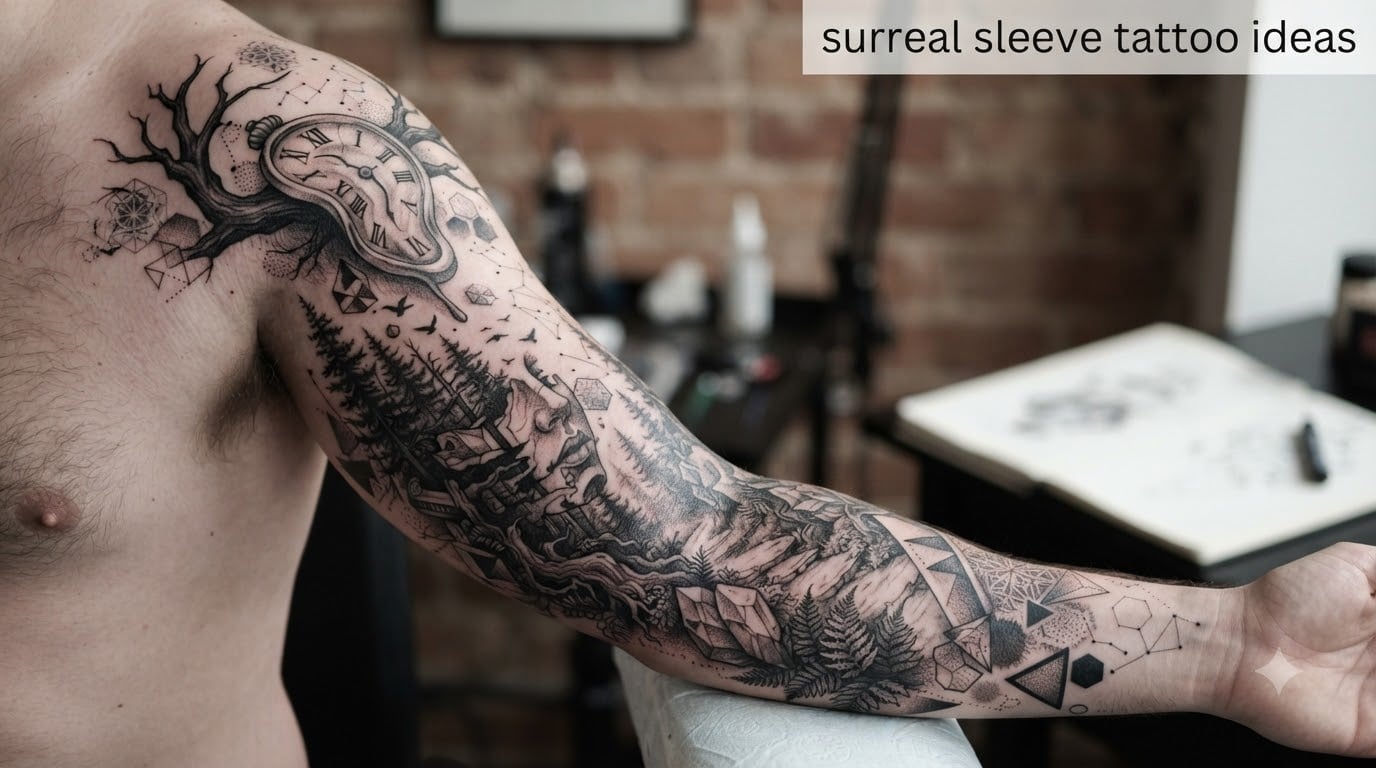
If you have been collecting surreal sleeve tattoo ideas on a Pinterest board for months, you already know the pull of this style: dreamlike imagery, melting objects, impossible architecture, and portraits that refuse to behave. Surrealism as a tattoo style borrows directly from the early 20th-century art movement founded by André Breton in 1924, then translates its dream logic onto the curved canvas of the arm. The result reads like a moving painting whenever you turn, bend, or rest your hand on a table.
We pulled together this guide after months of reading sleeve threads on r/tattoos, r/TattooDesigns, and r/surrealism, studying healed surrealism portfolios, and comparing what each style does well at arm scale. Below you will find a direct definition, the art-history roots, thirteen surreal sleeve tattoo ideas you can bring to a consultation, the composition principles that hold a surreal sleeve together, placement and aging notes, and a practical FAQ.
Whether you want a full Dalí tribute sleeve or a quiet micro-realism patch on the inner forearm, the goal here is the same: help you walk into a studio with a clear concept, a calm head, and the right questions.
Table of Contents
What Is a Surreal Sleeve Tattoo?
A surreal sleeve tattoo is a full- or half-arm tattoo built around surrealist imagery: dreamlike scenes, melting or floating objects, impossible architecture, distorted portraits, and optical illusions drawn from the early 20th-century surrealism movement founded by André Breton and popularized by Salvador Dalí, René Magritte, and M.C. Escher. It borrows three core surrealist techniques, which are juxtaposition, metamorphosis, and paradox, and maps them onto the curved canvas of the arm so the design reads in motion as the body turns.
A surreal sleeve is not just a realism sleeve with odd shapes. The difference lives in the rules. Realism tries to render the world as a camera would. Surrealism breaks the rules of physics on purpose: a clock droops over a branch, a face dissolves into a forest, a staircase climbs into nothing. When you bring those ideas to skin, the artist treats your arm like a museum wall, not a photograph, which is why the style rewards planning, value range, and a willingness to let the sleeve hold more than one focal point.
The Art-History Roots of Surrealist Tattoos
Every surreal sleeve traces back to one of seven wells. Knowing them helps you brief an artist in their language, and it helps you pick which surrealist “flavor” you actually want.
Salvador Dalí and the Melting World
Dalí’s The Persistence of Memory (1931) is the single most quoted source in surrealist tattooing. Melting clocks, the soft watches draping over branches and rocks, became shorthand for dream time and the breakdown of logic. Most “Dalí-inspired sleeves” lift the melted-clock motif and weave it into landscapes, ribcages, or portraits. The trick is restraint: one or two melted timepieces carry weight; six melted clocks in one sleeve reads like a meme.
René Magritte and the Silent Obvious
Magritte taught surrealism that the strangest image can be the calmest. A floating bowler hat, a cloud inside a room, an apple filling a room, a man with a hidden face. Magritte-style sleeves tend toward black and grey with a single surreal gesture rather than a busy dreamscape. If your taste runs quieter, Magritte is your blueprint.
M.C. Escher and Impossible Geometry
Escher’s impossible staircases, tessellations, and figure-ground reversals show up in optical-illusion sleeves. These pieces work because the brain keeps trying to resolve the geometry and failing. Tattoo artists translate Escher with careful perspective work and a controlled value range, which is why these sleeves reward an artist who understands vanishing points.
Max Ernst and the Subconscious Surface
Ernst used frottage and grattage, rubbing and scraping, to pull imagery out of textures. The tattoo equivalent is dense black and grey surrealism with lots of crosshatching, organic forms, and ambiguous anatomy. Think birds growing out of faces, forests with eyes, hands where leaves should be.
Giuseppe Arcimboldo and the Built Portrait
Sixteenth-century Arcimboldo painted portraits out of fruits, flowers, fish, and books. Tattoo sleeves built in his style swap a face for a stack of books, a bouquet, or a tower of teacups. These compositions are perfect for sleeves because the build can climb from wrist to shoulder.
Frida Kahlo and the Symbolic Self-Portrait
Kahlo mixed surrealism with autobiography: floating ribbons, plants growing from her body, animals floating in clouds, ribbons of hair and thorn. A Kahlo-coded surreal sleeve usually centers on one face and lets symbolism spill out around it.
Giorgio de Chirico and the Empty Plaza
De Chirico’s metaphysical paintings feature long shadows, classical arches, and eerie plazas. Tattoo sleeves in this style feel quieter than Dalí, more architectural than Escher, and read beautifully in a value-planned black and grey palette.
Surreal Sleeve Tattoo Ideas to Try
Here are thirteen surreal sleeve tattoo ideas that survive the move from Pinterest pin to skin. Each description tells you what the sleeve is, where it works best, and how it ages. Bring one or two of these to your consult as a tonal anchor.
1. Dalí-Inspired Melting-Clock Sleeve
The classic surreal sleeve: a flowing landscape with melting clocks draped over branches, a distant horizon of bone-white cliffs, and a single face in the foreground with one realistic side and one soft, drooping side. The composition flows from wrist to shoulder with the largest timepiece near the bicep, where the canvas is widest. Aging is friendly because the heavy blacks in the shadows anchor the design while the fine numerals need a touch-up around year three. Wear loose long sleeves to every session: tight cuffs on fresh ink will smear the linework in the first 48 hours.
2. Magritte-Style Quiet Black and Grey Sleeve
A black and grey sleeve built around a single Magritte gesture: a floating apple, a bowler hat suspended in cloud, or a doorway opening onto a plain sky. The sleeve reads like a series of vignettes rather than one continuous scene. This style is forgiving on the inner forearm because the value range can stay gentle, and fine line stays sharper when not packed against dense black.
3. Escher Impossible-Architecture Sleeve
Staircases that climb into nothing, rooms that fold into rooms, a single window that opens onto two skies. The success of this sleeve depends entirely on perspective and value planning. Ask your artist for a mockup that shows how the impossible geometry reads when the arm is bent at 90 degrees, because that is how people will see it most often.
4. Micro-Realism Surrealist Portrait Sleeve
A single-needle, almost photographic portrait with one surreal crack running through it: half the face is rendered in clean micro-realism, the other half dissolves into a swarm of butterflies, an ocean, or a forest. The arm reads like a turning painting. Micro-realism blurs on the inner forearm faster than the outer bicep, so plan the densest detail on the deltoid and shoulder, not the wrist.
5. Patchwork Surrealism Sleeve
A patchwork sleeve breaks the arm into separate surreal “panels,” each with its own focal point and its own empty breathing room around it. Patchwork is the most forgiving format because you can build it over years and replace individual panels as your style evolves. Bring a few unrelated surreal ideas to your consult, and let the artist design the negative space between them.
6. Optical Illusion Surreal Sleeve
An Escher-style or geometric optical illusion sleeve plays with figure-ground reversal: a face made of staircases, a checkerboard that morphs into a face, a forest where the trees form a hand. These sleeves read strongest in a narrow value range, mostly mid-grey, with crisp edges. They are perfect for the outer forearm and bicep where there is room for the geometry to resolve.
7. Surreal Botanical Sleeve
A sleeve where every leaf, petal, and vine refuses to follow nature: flowers open into eyes, vines become veins, mushrooms sprout tiny doors. A botanical surreal sleeve pairs with Kahlo and Ernst and ages beautifully because the heavy blacks in the leaves and stems hold up well over time. Keep the tiny details on the upper arm, where sun exposure and friction are gentler.
8. Surreal Architectural Sleeve
An impossible-city sleeve: floating staircases, doorways in mid-air, towers that turn into ribcages, a moon stuck behind a clock tower. Architectural surrealism rewards careful one-point and two-point perspective. Plan the value range from a single vanishing point near the elbow so the whole sleeve feels like one drawing.
9. Dark Surreal Skull-to-Landscape Sleeve
A single skull that flows into a mountain range, a forest, or a moonlit sea across the bicep. The skull reads at distance; the landscape rewards close inspection. This is one of the most forgiving surreal sleeves because the heavy blacks anchor the design and the soft gradients can be touched up easily at year three or five.
10. Surreal Fabric and Ribbon Connector Sleeve
A long, flowing ribbon or piece of fabric threads through every panel of the sleeve, tying the whole arm together. The ribbon can morph into water, smoke, or hair at different points. The connector sleeve is a great way to unite a patchwork that was built over years into one cohesive piece.
11. Surreal Mixed Blackwork Sleeve
A blackwork sleeve with surrealist motifs: a hand emerging from a cloud, an eye inside a cage, a face dissolving into crows. Mixed blackwork ages better than fine line alone, because the heavy black fills hold shape. Avoid the trap of six focal points: three to five across a full sleeve is the sweet spot, according to senior artists on r/tattoos.
12. Surreal Distorted Portrait Sleeve
A portrait sleeve built around a single face that turns into something else partway through: a woman whose hair becomes a waterfall, a man whose torso is a forest, a child whose eyes are clocks. Distorted portraits are the most personal surreal sleeve option. The artist will need a clear reference photo of the face and a clear reference of the morph target. Bring both.
13. Minimalist Surreal Mountain-Band Sleeve
A quiet, low-detail sleeve: a single mountain range wrapping the upper arm, a moon behind it, a tiny surreal detail in the negative space (a clock, an eye, a keyhole) that rewards closer look. The minimalist mountain sleeve ages the best of any on this list because there is little fine detail to fade. Perfect for a first sleeve.
Composition Principles That Make Surrealism Work
Most bad surreal sleeves fail on composition, not on drawing. The following four principles are what separates a surreal sleeve that reads from one that dissolves into visual noise.
Figure and Ground
Surrealism lives or dies on figure-ground relationships: which shape reads as the figure and which as the background. If every part of the sleeve is equally detailed, the eye has nowhere to rest. Plan two or three clear focal points and leave breathing room around them.
Metamorphosis
The signature surrealist move is one form becoming another: a face becoming a forest, a clock becoming a river. Pick one or two metamorphosis moments in your sleeve and let everything else support them.
Paradox and Impossible Geometry
Escher-style paradox works when the eye keeps trying to resolve the geometry and cannot. The trick is to plan the value range so the contradiction reads cleanly. A sleeve with three paradox moments plus four normal scenes will read as chaos; a sleeve with one paradox and a quiet rest of the design will read as art.
Negative Space vs Horror Vacui
Horror vacui is the fear of empty space, which leads to sleeves packed with detail at every angle. The opposite, restraint, lets a few strong shapes breathe. Most surreal sleeves fail by trying to fit every surrealist idea into one arm. Pick three ideas, not thirteen.
Where a Surreal Sleeve Lives on the Arm
Placement changes how a surreal sleeve ages, how much it hurts, and how often it is seen. The arm is not one canvas; it is five zones with different rules.
Shoulder Cap
The shoulder cap takes the highest detail best because it sits flat on the deltoid. Fine-line surrealism stays sharp here, and a circular surreal vignette (a face, a clock, a moon behind mountains) reads beautifully when the sleeve is sleeveless. Pain is moderate and sessions are usually short.
Bicep and Outer Arm
The bicep is the widest canvas and the most forgiving. Heavy black surrealism, large metamorphosis moments, and big surreal portraits all work here. Aging is gentle because the bicep is rarely in direct sun and rarely rubbed by clothing.
Elbow
The elbow is the awkward zone. Skin folds, ink can blow out, and fine line blurs quickly. Most surreal sleeves use the elbow as a transition piece: a clock face, a moon, an eye, a small architecture detail that connects the upper and lower arm. Plan fewer fine details here and more solid blacks.
Inner Forearm
The inner forearm is the most personal canvas and the most fragile. Fine-line surrealism blurs here faster than anywhere else. Use the inner forearm for softer, larger surreal gestures, and keep micro-realism and tiny numerals for the outer forearm and bicep.
Wrist to Mid-Forearm
The lower forearm and wrist see sun, friction, and constant movement. This zone ages the fastest. A small surreal anchor (a floating object, a single eye, a melted clock) works well, but avoid placing your sharpest fine-line work here.
How Surreal Sleeves Age Over Time
Every sleeve changes after it heals. Plan for that change.
Six Months In
Fresh surrealism looks darker and crisper than it will ever look again. The blacks are still fully saturated, the fine line is still sharp, and the gradients are at their highest contrast. This is the “Instagram look.”
Two Years In
Most surreal sleeves settle into their long-term look around the two-year mark. Blacks soften by a shade, fine line loses a tiny bit of edge, and the contrast between the deepest black and the lightest highlight begins to feel more natural. This is when most people fall in love with their sleeve.
Five Years In
At five years, fine line on the inner forearm and wrist often needs a touch-up. Heavy black holds shape well. Mid-tone surreal gradients (the soft cheek on a melting face, the cloud behind a clock tower) are usually the first to fade and the easiest to refresh. Plan a single touch-up session every three to five years.
Fine Line vs Bold
Fine-line surrealism blurs first. If you want a fine-line sleeve, plan to commit to SPF 50 on the inner forearm, regular moisturizing, and a touch-up at the two-year mark. Bold surrealism with heavy blacks holds the longest between touch-ups.
How to Brief and Choose a Surreal Tattoo Artist
The most common regret on r/tattoos is “I picked an artist because their Instagram was great, but their healed work looked muddy.” Avoid that. Here is the practical version of how to find your artist.
Look at Healed Work First
Ask every artist you consult with for photos of surreal sleeves they have done that are at least one year healed. Fresh work lies. Healed work tells the truth about how the artist handles value range, fine line, and skin fatigue across multiple sessions.
Specialization Beats Versatility
A surrealism-only or surrealism-dominant portfolio is a stronger signal than a generalist who “can do surrealism too.” Reddit veterans warn that sleeves look best when the artist has done dozens in the same style, not three or four dabbles.
What to Bring to a Consult
Bring three reference photos: one for the mood (lighting and palette), one for a specific motif (the melt, the clock, the staircase), and one for the composition (the way elements sit together). Avoid bringing finished tattoos from other artists; the best surrealists want to design for you, not copy someone else.
Questions to Ask
Ask how they plan the value range across the sleeve, how they handle elbow transitions, and what their touch-up policy looks like at year one and year three. A transparent answer to those three questions separates a surrealism specialist from a dabbler.
What to Wear
Wear a loose tank top or a loose button-down to every appointment. Tight sleeves will rub fresh inner-arm linework and smear the design. Bring a clean zip hoodie for after-session cover-up without friction.
Frequently Asked Questions
What is surrealism tattoo style?
Surrealism tattoo style is a tattoo approach that borrows directly from the early 20th-century surrealism movement founded by André Breton in 1924. It uses dreamlike scenes, melting or floating objects, impossible architecture, distorted portraits, and optical illusions, and applies three core surrealist techniques to the skin: juxtaposition of unrelated objects, metamorphosis from one form to another, and paradox or impossible geometry.
How much should I budget for a surreal sleeve?
Surreal sleeves are large, multi-session pieces that combine detailed linework, dense black fills, and complex value range planning, so they sit at the higher end of tattoo pricing. Realistic budgets vary by city and artist reputation, but plan for a full custom sleeve to be a serious, multi-session investment rather than a small piece. Always ask for an itemized quote that breaks down hourly rate, estimated session count, and touch-up policy before booking.
How do surreal sleeve tattoos age over time?
Surreal sleeves age predictably if you plan for it. Heavy black surrealism holds shape the longest. Fine line elements, especially on the inner forearm and wrist, blur first. Mid-tone surreal gradients, such as the soft cheek on a melting face, fade faster than deep blacks. Most surreal sleeves settle into their long-term look around the two-year mark, and a touch-up every three to five years keeps fine line and mid-tones crisp.
Which placements age best for fine-line surreal elements?
Fine-line surrealism ages best on the shoulder cap, the outer bicep, and the outer forearm, where there is less friction and less direct sun exposure. The inner forearm and wrist blur faster because they see constant movement, clothing rub, and sun. Keep your sharpest fine-line details on the upper arm and shoulder, and use larger softer surreal gestures on the inner forearm.
How do I find a surreal tattoo artist near me?
Search artist portfolios for the term surrealism or black and grey surrealism, then filter by healed work. Specialization matters more than proximity. A surrealism-dominant portfolio of healed pieces is a stronger signal than a generalist who can dabble. Look at healed photos that are at least one year old, ask about value range planning, and confirm the artist’s touch-up policy before booking.
How often will a surreal sleeve need touch-ups?
Most surreal sleeves need one touch-up session around year two or three, focused on fine line and mid-tone gradients. Heavy blacks usually need no touch-up at all. Plan a refresh every three to five years depending on sun exposure, aftercare, and how much fine line the design includes. A clear touch-up policy from the original artist is a strong trust signal when choosing your tattooist.
What should you avoid with sleeve tattoos?
Avoid three common traps: horror vacui sleeves packed with too many focal points, fine-line work placed on the inner forearm or wrist where it blurs fastest, and tight clothing that rubs fresh ink in the first 48 hours. Also avoid picking an artist based only on fresh Instagram photos: healed work is the real measure. And avoid skipping the value range plan; a sleeve without a planned light-to-dark flow reads as noise after healing.
The Short Version on Surreal Sleeve Tattoo Ideas
Surreal sleeve tattoo ideas work best when you treat the arm like a museum wall instead of a photo album. Pick two or three surrealist anchors from Dalí, Magritte, Escher, Ernst, Arcimboldo, Kahlo, or de Chirico, build a sleeve around clear value range and breathing room, and let one or two metamorphosis moments carry the weight. The sleeve you walk out of the studio with is not the sleeve you will live with for twenty years; plan for the year-three touch-up, the inner-forearm fade, and the moment when heavy blacks soften into something that feels more like you.
If you only remember one thing from this guide, remember this: the surreal sleeve that ages best is the one whose strongest piece is on the bicep, whose finest detail is on the outer arm, and whose artist is a specialist you trust with healed work. Bring three references, ask about value range, and wear a loose button-down on appointment day.