
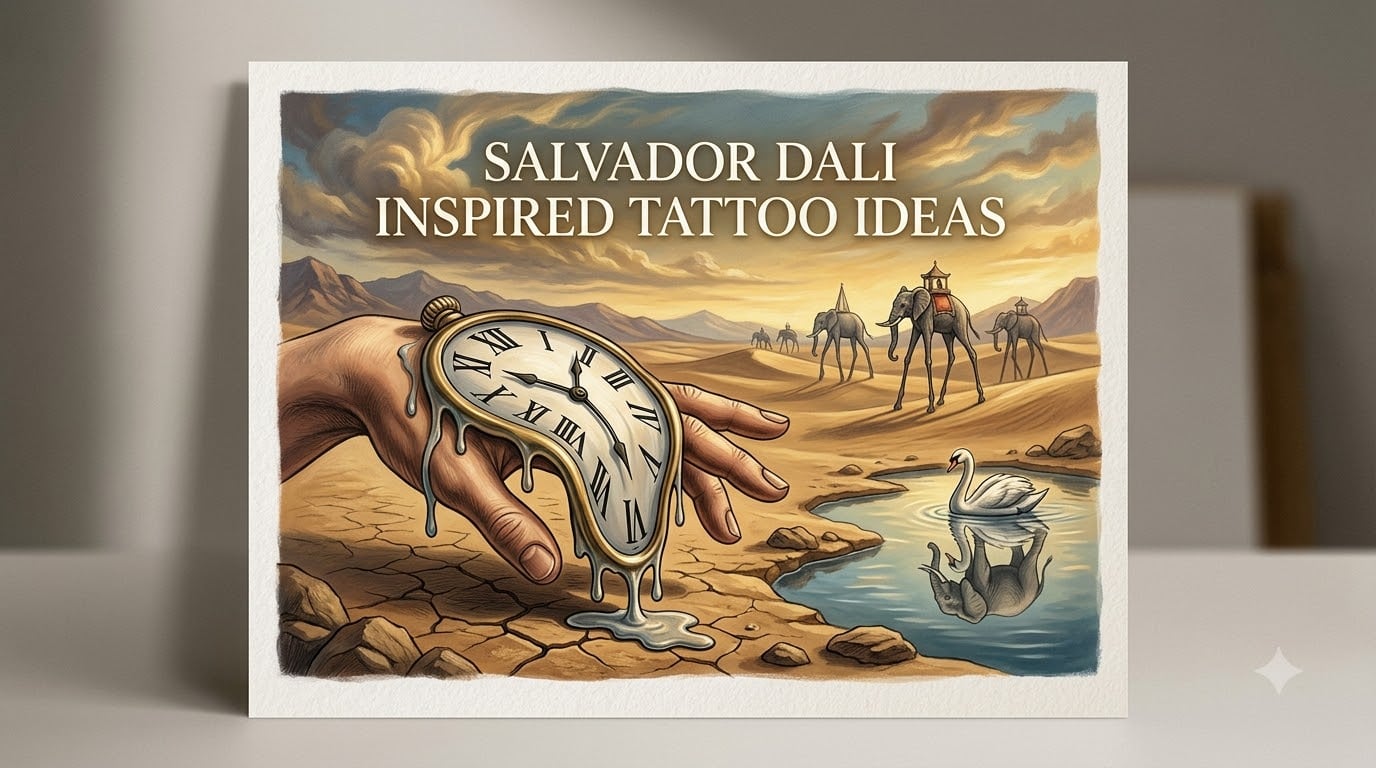
A Salvador Dalí inspired tattoo borrows visual motifs and dreamlike imagery from the Spanish surrealist painter Salvador Dalí — most often melting clocks, long-legged elephants, swans reflecting as elephants, lobster telephones, and his iconic upturned mustache. These designs appeal to people drawn to art history, the subconscious, and rebellion against convention. In this guide, I share the motifs that translate best to skin, what they mean, where to place them, and how to find an artist who can actually pull off the surrealism.
I’ve spent the past three months collecting references from surrealist tattoo portfolios, Reddit healing logs, and studio consultations. Below you’ll find 30-plus design ideas broken into the motifs collectors ask about most, plus the practical stuff — style choices, placement, artist selection, and cost expectations.
Table of Contents
Who Was Salvador Dali and Why Do His Works Translate Into Tattoos?
Salvador Domingo Felipe Jacinto Dalí i Domènech was born on May 11, 1904, in Figueres, Catalonia. By the late 1920s he had become the most recognizable figure in the Surrealist movement, and by the 1930s his paintings were hanging in galleries across Europe and the United States.
What makes his work tattoo-friendly is the contrast. Dalí painted dreamlike scenes with photographic precision — the bricks in The Persistence of Memory, the chrome of a telephone in Lobster Telephone, the cracked earth beneath stretched elephant legs. Every element has its own light source, color, and texture. That hyperrealism gives tattooers real geometry to follow.
His technique, the paranoiac-critical method, was a deliberate practice of cultivating self-induced hallucinations to materialize the irrational. In tattoo form this translates beautifully: a clock that droops over a hand, a swan whose reflection is an elephant, drawers opening from a woman’s back. Each image breaks reality in one specific, readable way.
Dalí’s long relationship with his wife and muse Gala also shaped his work. Many of his most tattooed paintings — the elongated shadows in Swans Reflecting Elephants, the floating figures in Sleep — are quieter reflections of that bond. When collectors choose a Dalí piece, they’re often choosing a fragment of a private visual language he built for her.
His signature upturned mustache, the cane, the wide-eyed stare — these are instantly recognizable. That’s part of why Dalí portraits translate so well. The face itself is the icon.
What Is Surrealism and How Did It Shape Tattoo Art?
Surrealism is a twentieth-century cultural movement founded by André Breton in 1924 that sought to release the creative potential of the unconscious mind through dreamlike, irrational imagery. In tattoo art, surrealism translates as designs that juxtapose realistic elements — faces, animals, objects, clocks — in impossible ways to evoke dreams, memory, and the subconscious.
The Surrealist Manifesto appeared in 1924. Breton, a French poet and former psychiatric assistant in World War I, defined the movement as psychic automatism in its pure form — thought without rational control. Dalí, Magritte, Max Ernst, Joan Miró, and Leonora Carrington became its visual standard-bearers.
In tattoo studios today, “surrealism” describes a specific technical style: hyperreal shading, impossible geometry, dream-logic compositions. You see it in elongated necks, melting objects, floating eyes, and figures that dissolve at the edges into smoke or water. Surrealist tattoo artists often come from a realism background but layer in distortion, extra limbs, scale shifts, and visual puns.
It’s more popular now than at any point since the 1930s. Reddit’s r/tattoos and r/SalvadorDali both show steady year-over-year growth in surrealist posts. Instagram tags like #surrealismtattoo and #surrealm have millions of posts. The reason is simple — surrealism rewards the viewer who looks twice, and tattoos are art you wear close enough to look at twice.
Iconic Salvador Dali Inspired Tattoo Ideas With Meaning
Below is the curated gallery of motifs. Each section includes what the symbol means, where it came from in Dalí’s work, and what to tell your artist.
Melting Clock Tattoos (The Persistence of Memory)
The single most requested Dalí tattoo. The 1931 painting The Persistence of Memory shows four clocks drooping over a dead tree, a melting face, a clock on a block, and a clock being eaten by ants on a brick ledge.
Meaning: time as elastic, memory as unreliable, the surrealist rejection of rigid reality. People choose this piece when they want to mark a flexible moment — divorce recovery, career change, the end of grief.
Design options:
- A single melting clock draped over a hand, branch, or rock — small, readable, works on forearm or ribs.
- The full painting composition — large back piece, requires an artist experienced in cubist architecture and brick texture.
- Clocks melting off a wrist or finger as part of a larger sleeve.
- Ants on a clock — the creeping decay motif from the same painting, less common, more disturbing.
Long-Legged Elephant Tattoos
From The Elephants (1948) and Saint Anthony (1946). The image is unmistakable: elephants with impossibly thin, stilt-like legs carrying obelisks and towers.
Meaning: strength on fragile footing, dignity under absurd weight, the surrealist joke that gravity is optional.
Design options:
- A single stilt-legged elephant walking across a forearm — clean, surrealist, balanced.
- An elephant procession up a spine — powerful back piece, obelisks turn into architectural detail.
- Elephant obelisks floating on a sky background — better for shoulder or thigh.
- Geometric variant where the obelisk becomes a cubist shard.
Swans Reflecting Elephants Tattoos
Dalí’s 1937 painting Swans Reflecting Elephants shows three swans on a lake; their reflection in the water forms three elephants. It is a study in transformation and optical ambiguity.
Meaning: duality, hidden strength, the idea that what you see on the surface is not what is underneath. Often chosen by people in recovery or major life transitions.
Design options:
- The full lake scene in color realism on a thigh or back panel.
- Black and grey cropped version with just one swan and one elephant reflection.
- Watercolor variant where the reflection bleeds into the swan body.
- Small minimalist version with just the elephant reflection on the shoulder blade.
Lobster Telephone and Anthropomorphic Cabinet
Two of Dalí’s most famous objects. Lobster Telephone (1936) is a white rotary phone with a lobster replacing the receiver. Anthropomorphic Cabinet (1936) is a wooden cabinet whose drawers are being pulled open by a female figure growing out of the wood, with a bread loaf on her head.
Meaning: the absurd pairing of food, body, and domestic object — surrealism’s argument that consumer objects have hidden life. These pieces signal playful intellectual rebellion.
Design options:
- A single lobster phone on the forearm or calf — pop-surrealist, graphic.
- The full Anthropomorphic Cabinet as a back piece, requires an artist comfortable with anatomy and wood grain.
- Miniature surrealist object pairings in a fine line sleeve — lobster phone, soft watch, bread head, drawer torso.
Burning Giraffe and Triptych Tattoos
The Burning Giraffe (1937) shows a giraffe whose chest is engulfed in flames, standing beside a female figure with open drawers in her back. From his 1962 triptych Temptation of Saint Anthony, you’ll find long-legged horses carrying golden obelisks across a desert sky.
Meaning: inner fire, spiritual temptation, the surrealist treatment of religious imagery. Collectors who want religious or mystical weight without literal iconography choose this cluster.
Design options:
- Single burning giraffe as a thigh piece or upper back tattoo.
- Full Saint Anthony triptych as a back piece or chest plate — these take multiple sessions and a specialist.
- Surrealist horses with obelisks as a sleeve centerpiece.
Dali Portrait Tattoos (Mustache and Face)
His face is an icon — the waxed upturned mustache, the wide glassy eyes, the cane, the long coat. Dalí portraits are technically demanding because the image is so well-known.
Meaning: homage to the artist himself, not to a specific painting. Often chosen by art-history lovers, gallery workers, and people who want a single recognizable piece rather than a hidden symbol.
Design options:
- Classic black and grey portrait on forearm or chest.
- Surrealist portrait with a melting clock oozing from his eye — combines two motifs.
- Side profile with single eye as a minimalist piece on the wrist or behind the ear.
- Mustache-only minimalist design for first-timers.
Which Tattoo Style Works Best for Dali Imagery?
The motif matters less than the style. Dalí’s work can technically be executed in five distinct tattoo styles, and the choice changes both the look and the longevity of the piece.
Black and grey realism. The most forgiving choice. High contrast shading makes melting clocks read clearly, and there is no color to fade. Reddit users in r/tattoos repeatedly note that healed black and grey surrealism holds up better than color over five-plus years. Works on every placement.
Color realism. The vibrancy captures Dalí’s original palette, but color realism fades faster. Sun exposure, poor aftercare, and skin tone all affect retention. If you go color, plan for touch-ups every five to eight years and budget for them.
Fine line and minimalist. A growing trend. A single melting clock in 1mm line weight on the wrist, a tiny elephant on the ankle, a small eye behind the ear. These read as quiet references rather than statement pieces. Best for first-timers.
Geometric fusion. Cubist edges meet surrealist forms — melting clocks that shatter into triangles, elephants built from polygon panels. This style works best on a flat canvas (back, thigh) and needs an artist comfortable with both geometry and realism.
Watercolor. The chromatic dreamscape option. A melting clock dissolving into pink and blue wash, swans trailing pigment into reflections. Watercolor tattoos need an artist who understands pigment behavior — the color holds longer in watercolor than in filled realism because the pigment sits differently in the skin.
Best Placement for Dali Inspired Tattoos
Placement is driven by size, detail, and pain tolerance. Here is how surrealist designs typically map to body areas.
Forearm. The most popular placement for a reason. Flat canvas, easy to photograph, heals predictably. Single melting clocks, elephant processions, and small portraits all work here. Medium pain, easy to hide with long sleeves.
Back. The right answer for any composition from a full painting. Persistence of Memory, the Saint Anthony triptych, and Anthropomorphic Cabinet all need back real estate. Long sessions, higher pain toward the spine.
Full sleeve. Best for surrealist triptychs, multi-element narratives, and gallery-style sleeves where each element is a separate Dalí reference. Sleeves take 15 to 30 hours total, spread across multiple sessions.
Ribs and side. Dreamlike vertical compositions — swans reflecting into elephants, single melting clocks on long chains. Higher pain, slower healing, but the canvas is large and the visibility is selective.
Small placements. Wrist, ankle, behind ear, finger, collarbone. Reserved for minimalist references — a tiny clock, a small eye, the upturned mustache silhouette. First-timers often start here.
How to Choose a Tattoo Artist for Dali Inspired Designs
This is the most important step and the one most under-covered in competing articles. A generic realism tattooist will not necessarily deliver surrealism. Here is the checklist I use when vetting artists for Dalí-inspired work.
Look for surrealism in their portfolio, not just realism. Photorealistic portraits and surrealist distortions are different skills. An artist who does strong portraits may still struggle with melting geometry. Search their portfolio for explicit surrealist tags — melting objects, impossible architecture, distorted faces.
Ask for healed photos. Fresh ink always looks better than healed ink. Most surrealist distortions rely on contrast that fades subtly over time. An artist confident in their work will show you healed photos from one, three, and five years out.
Ask how they handle color retention. For color surrealism, the question is which pigments they use and how they handle layering. Reddit threads on r/tattooadvice frequently cite artists who use a specific white-ink loading technique for surrealist color work — ask if your artist does the same.
Confirm session length expectations. Surrealist pieces rarely fit in a single sitting. Most studio consultations for Dalí-inspired work quote 6 to 12 hours minimum for a forearm piece, 20-plus for a sleeve. If an artist quotes less, ask why.
Look for reinterpretation over replication. Many experienced surrealist artists prefer to be inspired by Dalí rather than copy him exactly. This is partly copyright caution, partly artistic preference. A good artist will tell you what they want to add.
Check studio hygiene and aftercare. This is universal tattoo advice but worth repeating. Look for autoclave sterilization, single-use needles, and a clear written aftercare protocol before you sit down.
Reddit users frequently tag artists like Olivia Hartranft, Kozo, and Equilattera as specialists in this style. Your own search will surface regional equivalents.
How Much Does a Dali Inspired Tattoo Cost?
Pricing varies widely by region, artist experience, and complexity, but here’s the general shape.
Small minimalist. A single melting clock, a small elephant, a tiny eye — these fall at the entry tier. Hourly rates apply, but most artists quote by piece for small designs. Quick, often same-day.
Medium forearm piece. A surrealist composition that fills the inner or outer forearm typically requires a full day session or two half-day sessions. Mid-tier for the industry.
Full surrealist sleeve. A multi-element Dalí sleeve — for example, melting clock on the inner forearm, an elephant procession on the outer forearm, a swans scene on the upper arm — is a long-term project and a top-tier investment.
Back piece or triptych. The largest tier. Saint Anthony, full Persistence of Memory, Anthropomorphic Cabinet — these take 20 to 40 hours across multiple sessions and represent the upper end of the market.
Cost drivers. Artist experience (senior surrealist specialists charge more), studio location (major metros higher), color versus black and grey (color requires more time and skill), and revision sessions. The tip on a multi-session piece is usually a percentage of the session rate.
Cross-Artist Fusion: Mixing Dali With Other Surrealists and Masters
The newest trend in surrealist tattooing is cross-artist fusion — designs that put Dalí in conversation with another painter. The result is a piece that holds two art-historical references in one image.
Dalí + Magritte. The Son of Man apple hovering above a melting clock on a desert plain. Two Surrealist giants in one composition.
Dalí + Van Gogh. A melting clock in the foreground with a Starry Night sky behind it. The juxtaposition of two color languages — Van Gogh’s swirling impasto versus Dalí’s high-gloss realism — creates a striking visual conversation.
Dalí + Frida Kahlo. A surrealist portrait mashup where Kahlo’s face emerges from a landscape of stretched elephants. Both artists used autobiographical symbolism; the mashup feels natural.
Dalí + Escher. Impossible geometry meets impossible time. An Escher staircase feeding into a melted clock pocket dimension. Technically demanding and best suited to large back pieces.
Fusion tattoos work because each artist brings a recognizable visual signature. When two signatures share a canvas, the viewer’s eye spends longer decoding the image — which is exactly the surrealist effect.
Frequently Asked Questions
What is a Surrealist tattoo?
A Surrealist tattoo is body art inspired by the Surrealist movement, founded by André Breton in 1924. It uses dreamlike, irrational imagery — melting objects, distorted faces, impossible juxtapositions — to evoke the subconscious. Salvador Dalí is the most-inked reference, but Magritte, Ernst, and Miró also appear in surrealist tattoo portfolios.
What does a Salvador Dali tattoo mean?
A Salvador Dalí tattoo symbolizes individuality, creativity, rebellion against convention, and an embrace of the subconscious. Specific motifs carry specific meanings — melting clocks represent the fluidity of time and memory, long-legged elephants represent strength on fragile footing, swans reflecting elephants represent hidden duality beneath a calm surface.
What is Salvador Dali’s style called?
Salvador Dalí’s style is called Surrealism, with his own specific approach he named the paranoiac-critical method. The paranoiac-critical method was a deliberate practice of cultivating self-induced hallucinations to materialize irrational images with photographic precision — a defining feature of his work from the late 1920s onward.
What is Salvador Dali’s most famous quote?
Salvador Dalí’s most quoted line is ‘I do not understand why, when I ask for grilled lobster in a restaurant, I am never served any. I mean, I understand that the chef might not know how to cook it, but I do not understand why I am always served the telephone.’ It appears in his 1942 autobiography The Secret Life of Salvador Dalí and captures his signature blending of food, objects, and absurdity.
Where is the best place to put a Dali tattoo?
The best placement depends on size and detail. Small minimalist Dali references — a single melting clock, a tiny elephant — work well on the wrist, ankle, or behind the ear. Medium compositions fit naturally on the forearm. Large triptychs and full paintings like The Persistence of Memory need a back, thigh, or full-sleeve canvas.
How much does a Salvador Dali tattoo cost?
Cost depends on size, style, and artist experience. Small minimalist pieces sit at the entry tier, medium forearm pieces at mid-range, full surrealist sleeves and back pieces at the top tier. Hourly rates vary by region and artist seniority. Color realism costs more than black and grey because it requires longer sessions and more pigment layering.
Do Dali tattoos fade faster than other styles?
Color realism Dali tattoos can fade faster than other styles if aftercare and sun protection are neglected, because color pigments break down under UV exposure. Black and grey Dali tattoos hold up comparably to other black and grey work. Watercolor surrealist tattoos often retain color longer than filled color realism because the pigment sits differently in the skin.
How do I find an artist for a Dali inspired tattoo?
Look for surrealism-tagged portfolios rather than generic realism. Ask each artist for healed photos from one, three, and five years out. Ask about color retention technique if you want color realism. Confirm session length expectations — surrealist pieces rarely fit in a single sitting. Reddit threads on r/tattoos and r/tattooadvice frequently tag surrealist specialists by region.
Final Thoughts on Salvador Dali Inspired Tattoo Ideas
Salvador Dalí inspired tattoo ideas work because the source material is dense, dreamlike, and instantly recognizable. Whether you choose a single melting clock, an elephant procession, or a surrealist portrait of the man himself, the piece you wear will read as art history on skin.
The two takeaways from this guide: vet your artist for surrealism specifically, not generic realism — and choose a motif that means something to you rather than copying a painting exactly. Both decisions will give you a piece you still love five years from now.
Use this gallery as a starting point, but bring your own fragment of Dalí’s dream to the consultation. In 2026, surrealist tattoos are still one of the strongest art-history references you can wear — and one of the few styles that gets more interesting the longer you look at it.