
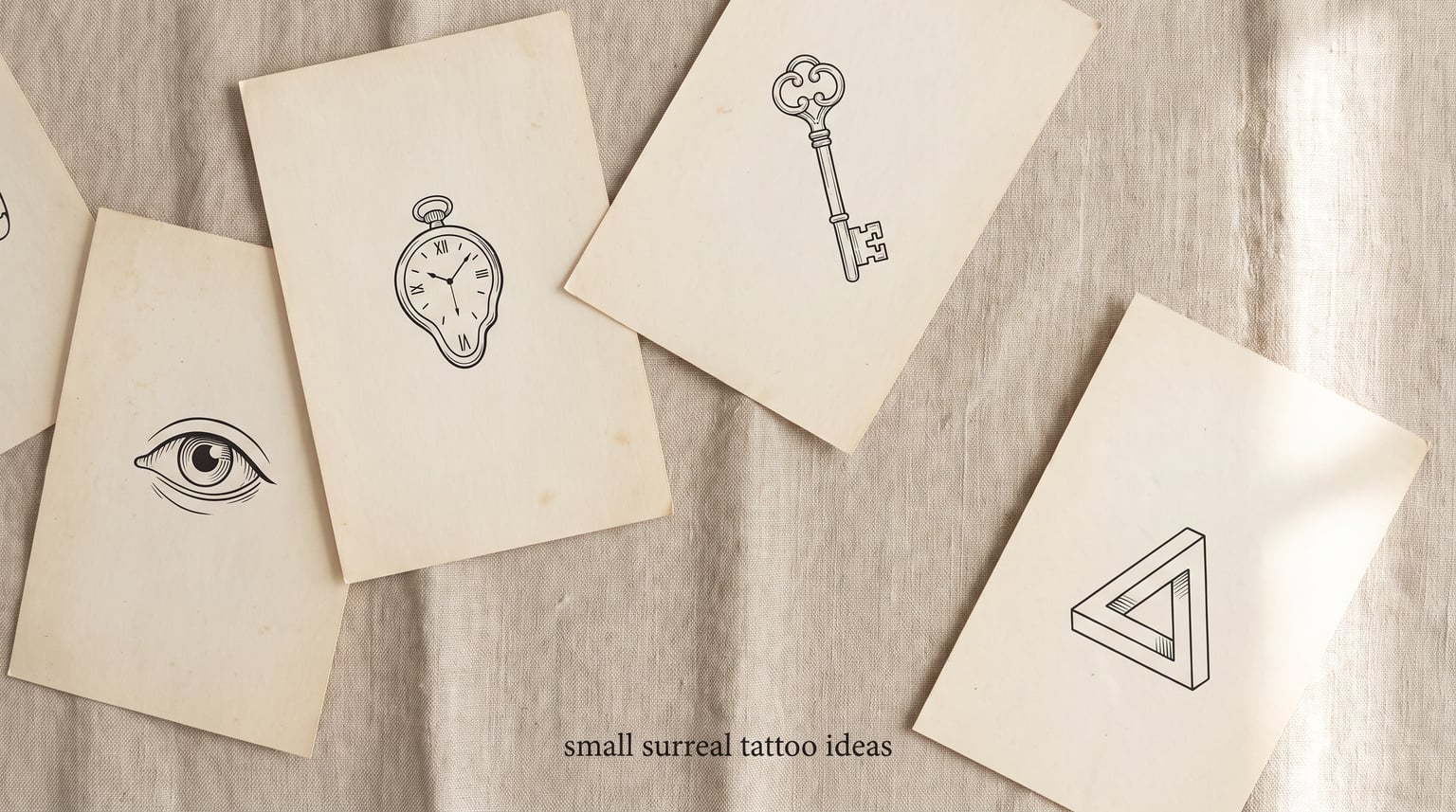
If you have ever stared at a Dalí print and wished you could wear a piece of it on your wrist, you are not alone. Small surreal tattoo ideas are quietly becoming one of the most-requested design categories for first-time tattoo clients and seasoned collectors alike, and for good reason: a tiny, dreamlike image can carry the same conceptual weight as a full surrealist painting without taking over your whole arm.
We put together this guide after scrolling through countless Pinterest boards, reading r/surrealism threads, and talking to artists who specialize in fine-line work. What you will find below is a working list of 22 small surreal tattoo ideas, each one chosen because it actually reads well at small scale, plus placement tips, symbolism notes, and the practical stuff (cost, aftercare, how to find an artist) that almost no one else covers.
Table of Contents
What Is a Small Surreal Tattoo?
A small surreal tattoo is a compact design, usually 1 to 3 inches tall, that uses dreamlike, impossible, or distorted imagery drawn from the surrealist art movement. Think melting clocks, floating objects, hybrid creatures, and optical illusions, rendered with fine-line or single-needle detail so the concept stays readable when the artwork is tiny.
The “small” part is what makes surrealism interesting as a tattoo category. Most surrealist paintings are large, busy canvases full of impossible physics and dream logic. A small surrealist tattoo has to distill that chaos into one single concept: one melting watch, one floating staircase, one eye inside a hand. That constraint is also the appeal. You are not asking the artist to recreate The Persistence of Memory on your forearm. You are asking them to capture one idea from it.
Surrealist work at small scale is usually executed in black and grey ink using fine-line or single-needle setups. That style choice is not accidental. Black-grey ages more evenly than color at small sizes, and fine lines keep the precision that surrealist details demand.
Why Small Surreal Tattoos Work So Well
Surrealism is built on a single, simple trick: take something ordinary and make it slightly wrong. A clock that drips off a branch. A fish swimming through the air. A door opening onto a desert. That trick does not need a large canvas. In some ways, it works better when the image is small enough that someone has to lean in and notice the impossible part.
There are two reasons the small format pairs naturally with surrealist ideas. First, a single surrealist concept is usually self-contained. A melting watch does not need background detail. A floating key does not need a sky. Second, fine-line and single-needle techniques are now widely available, so the kind of precise linework that surrealism requires is no longer reserved for big pieces.
The conceptual power of small scale
When a surrealist image is shrunk down to wrist or finger size, it gains a private quality. The viewer has to get close to “get” the joke. That makes small surrealist work feel more like a personal symbol than a public statement, which is exactly the energy most people want from a tiny tattoo.
Single-needle and fine-line execution
If you have been researching this for more than five minutes, you have seen “fine line” and “single needle” used interchangeably. They are not quite the same thing. Fine-line tattooing uses small needle groupings (often 3 to 5 needles) for thin lines, while single-needle setups use literally one needle. Single-needle work gives the most delicate line possible, which is why it is the default for tiny surrealist pieces. The trade-off is healing: finer lines can blur a little faster than bolder ones, which is why aftercare matters.
Top Small Surreal Tattoo Ideas for 2026
This is the working list. Each idea has been chosen because real artists confirm it works at 1 to 3 inches and because r/TattooDesigns and r/surrealism users have shared successful versions of it. We have grouped them by surrealist theme so you can scan quickly.
Melting clocks and time distortions
1. Miniature melting pocket watch. The classic Dalí reference, shrunk down to thumb size. One watch face that drips into a flat puddle at the bottom. Reads beautifully at 1.5 inches and is the most recognized surrealist tattoo in existence.
2. Watch face morphing into a flower. The watch dial stays geometric, but the strap and case soften into petals. Great on the inner wrist where the skin is flat and the line stays crisp.
3. Clock with no hands, floating off a branch. Strip the watch of its hands entirely, so time literally stops. The branch grounds the floating object, which is a classic surrealist move.
Floating objects and impossible physics
4. Floating key with a tiny door. A small key hovering above a door knob that opens onto nothing. Two motifs in one. Works well on the forearm or shoulder blade.
5. Levitating teacup with steam turning into birds. Steam becomes a flock of small birds flying off the rim. Whimsical without being childish.
6. Single feather falling upward. The feather is drawn mid-air with directional arrows or wind lines that point up. A quiet, brain-tickling image that works behind the ear or on a finger.
Optical illusions and impossible geometry
7. Penrose triangle inked as a tiny ring. The impossible triangle loops back on itself. Best executed as a single black outline. Reddit users caution that anything below 1.5 inches starts to read as a blob, so keep this slightly larger than other ideas.
8. Endless staircase spiraling into a single point. Escher reference. The stairs fold in on themselves until they vanish. Works as a forearm band or a sternum piece.
9. M.C. Escher hand holding a pencil that draws itself. The hand is holding a pencil, but the pencil is drawing the hand. Tiny scale works because the joke is instantly readable.
Surrealist animal hybrids
10. Bird with a human eye for a head. A small songbird with one realistic eye where its face should be. This is one of the most-shared small surrealist designs on r/surrealism for a reason. It reads at thumbnail size.
11. Fish swimming through a cloud. The fish is whole and detailed, but the medium it swims through is a soft cloud, not water. Quiet and dreamlike.
12. Moth with a human skull pattern in its wings. The moth’s wing pattern resolves into a tiny skull when you look closer. A two-layer reading: pretty at distance, dark up close.
Body-part surrealism (eyes, hands, faces)
13. Single eye floating in a geometric frame. One open eye inside a thin diamond or circle outline. Clean, modern, Magritte-adjacent. Works on the sternum, forearm, or behind the ear.
14. Open palm with an eye in the center. A hand with fingers spread, an eye drawn in the middle of the palm. A direct nod to palm-reading imagery turned surreal.
15. Face split between portrait and skull. Half of the face is a normal portrait, half dissolves into a skull or cloud. Best at 2 to 3 inches. Smaller than that and the line between portrait and skull blurs.
Nature gone wrong (melting, floating, morphing)
16. Mushroom cloud that is actually a tree canopy. From a distance it looks like a mushroom cloud. Up close you see leaves, branches, and birds. A clever visual double-take.
17. Flower stem growing out of an eye. A single closed eye with a thin flower stem rising from the tear duct. Quiet, poetic, and very small-format friendly.
18. Tree with a staircase spiraling around the trunk. A small tree with a staircase winding around it instead of branches. Reads like a fairy-tale detail.
Surrealist symbols and personal iconography
19. Open door floating in empty space. A simple door, slightly ajar, with no wall around it. You can put any landscape behind it that has personal meaning: a childhood home, a favorite coastline, the place you met someone.
20. Hourglass where the falling sand is actually stars. Standard hourglass shape, but the lower chamber fills with tiny stars instead of sand. The cliché of time turns cosmic.
Whimsical and dark surrealism options
21. Smiling moon face inside a cracked egg. A small egg cracked open, with a tiny smiling crescent moon sitting inside it. Light, whimsical, beginner-friendly.
22. Tiny burning match with smoke forming a question mark. A single match head with a flame, and the smoke curls into a question mark above. A small “what are we doing here” kind of image.
Symbolism and Meaning Behind Popular Surrealist Motifs
One of the reasons surrealism tattoos resonate so strongly is that the imagery is rarely just visual. Each motif carries an older symbolic reading, and when you shrink it down to a private tattoo, that reading becomes yours alone. Here is what the most common small surrealist motifs tend to mean in tattoo context.
| Motif | Common symbolic reading | Surrealist reference |
|---|---|---|
| Melting clock | Time is not fixed, or your relationship to time is personal | Dalí, The Persistence of Memory |
| Single floating eye | Awareness, observation, being watched or watching | Magritte, The False Mirror |
| Impossible triangle | Things that look correct but cannot exist | Penrose, Escher |
| Bird with human face | The animal inside the human, or vice versa | Magritte, Kafka |
| Open door onto nothing | Possibility, threshold, unchosen paths | De Chirico, Magritte |
| Eye in the palm | Inner vision, intuition, hidden knowledge | Surrealist folk iconography |
| Hourglass of stars | Time passing into something larger than us | Ernst, mixed symbolism |
| Floating key | Access, secrets, the unlockable | Ernst, Magritte |
| Flower from an eye | Growth from feeling, beauty from pain | Mixed surrealist and botanical |
| Cracked egg with moon | New beginnings, cycles, softness | Whimsical surrealism |
If a motif speaks to you for a different reason, that is the version that matters. Surrealism is intentionally open-ended, so the meaning your tattoo carries is always partly yours.
Best Placements for Small Surreal Tattoos
Placement changes everything about how a small surrealist design reads. The same melting pocket watch on the wrist tells a different story than the same watch behind the ear. Below is a placement guide built from forum input and what tattoo artists we have talked to recommend.
| Placement | Pain level | Healing | Visibility | Best for |
|---|---|---|---|---|
| Inner forearm | Mild | Easy | Easy to hide or show | Most motifs, especially fine-line surrealism |
| Inner bicep | Mild | Easy | Hidden by default | Larger surrealist scenes up to 3 inches |
| Behind the ear | Moderate | Moderate | Discreet | Tiny motifs: floating eye, moth, key |
| Wrist | Mild to moderate | Moderate | Always visible | Melting clocks, single eye, hourglass |
| Ankle | Moderate | Moderate | Discreet | Small icons: feather, key, teacup |
| Sternum | Moderate to high | Slower | Hidden by clothing | Symmetric motifs, eye-in-hand |
| Rib | High | Slower | Hidden by clothing | Larger surrealist portraits or scenes |
| Collarbone | Moderate | Moderate | Easy to show | Horizontally-oriented motifs |
| Finger | High | Hardest | Always visible | Avoid for detail; only for bold icons |
Reddit users consistently warn against finger tattoos for any detailed surrealist work. The skin there sheds faster, ink falls out, and a fine-line melting clock on a finger will look like a smudge within a year. Save fingers for bold, simple shapes.
Style Options: Minimalist, Dark, and Surreal Realism
Small surrealist tattoos split into three rough sub-styles, and which one you pick will affect how the artist approaches the linework, the contrast, and the shading.
| Style | Look and feel | Best for |
|---|---|---|
| Minimalist surrealism | Clean lines, minimal shading, often just outlines | First surrealist tattoo, professional settings, very small sizes |
| Dark surrealism | Heavy black-and-grey contrast, sometimes red accents | Skull motifs, unsettling hybrids, horror-adjacent themes |
| Surreal realism | Micro-realism shading on surrealist subjects | Hybrid creatures, portraits with impossible elements, larger small-tattoo sizes (2-3 inches) |
If this is your first small surrealist tattoo, minimalist surrealism is the safest starting point. If you already have a few tattoos and want something heavier, dark surrealism reads strongly at small scale. Surreal realism gives the most photogenic result, but it needs a slightly larger canvas to do the shading justice, so plan for 2.5 to 3 inches rather than 1.
Surrealist Artists to Reference for Your Design
Most small surrealist tattoos start with a reference image, and the strongest references come from the original surrealist painters themselves. You do not need to copy a painting. You need to borrow one idea from it.
Salvador Dalí is the most obvious starting point. His melting clocks, limp watches, and dream-logic landscapes are instantly recognizable, and a single Dalí motif translated into fine-line work is the foundation of most small surrealist tattoos. René Magritte is the second pillar. His single eyes, floating apples, and silhouette portraits lend themselves naturally to small, clean execution. Frida Kahlo’s self-portraits and Ernst’s collage animals give surreal realism its dreamlike weight.
If you want to push toward the dark end of surrealism, look at Leonora Carrington or Dorothea Tanning. Their animal-human hybrids and unsettling domestic scenes have aged beautifully as tattoo references. M.C. Escher sits outside the formal surrealist movement but is constantly referenced in this category, especially for impossible geometry.
How to Find the Right Tattoo Artist for Small Surreal Work
Not every tattoo artist does small surrealist work well. Detail-heavy surrealism at small scale is its own discipline, and you want someone whose portfolio shows it specifically. Here is the checklist our team uses when we are vetting an artist for a small surrealist piece.
First, look at their healed photos, not just fresh work. A fine-line surrealist tattoo that looks crisp on day one can blur badly by year two. If the artist posts healed photos from 1, 2, or 3 years out, that is a strong sign. Second, ask to see surrealism specifically in their portfolio. A great realism or traditional artist is not automatically a great surrealist artist. Surrealism requires a different kind of compositional thinking.
Third, pay attention to how they respond to size. If you ask for a detailed impossible triangle at 1 inch and the artist tells you it will not read well at that size and suggests a better motif or a slightly larger canvas, listen to them. Artists who refuse work that will not turn out well are protecting you, not turning you away.
Fourth, ask what setup they use. Single-needle or fine-line (3-round) is standard for small surrealist work. If an artist only does bold-line traditional, they may not be the right fit regardless of how talented they are.
Cost and Session Length Expectations
Small surrealist tattoos usually land in the 1 to 3 inch range and take 30 to 90 minutes in a single session. Pricing varies widely by city and artist, but two patterns hold across most markets.
First, most studios have a shop minimum, usually covering the artist’s setup time and sterilization costs. That minimum is often the same for a small tattoo as for a medium one, which is why forum users report paying the same for a tiny surrealist piece as they would for a much larger traditional design.
Second, artists who specialize in fine-line surrealism tend to charge slightly above the shop average, because the work is slower and the precision required is higher. You are paying for patience as much as ink.
Aftercare Tips for Fine-Line Small Surreal Tattoos
Fine-line work heals differently than bold traditional tattoos. The lines are thinner, which means they are slightly more vulnerable during the first two weeks and over the long term. The aftercare routine does not have to be complicated, but it does have to be consistent.
Keep the tattoo clean with lukewarm water and a gentle, fragrance-free soap for the first two weeks. Avoid submerging it in baths, pools, or hot tubs during that window. Apply a thin layer of artist-recommended aftercare balm rather than slathering it on. More product is not better. Once healed, use SPF 30 or higher on the tattoo whenever it is in direct sunlight. UV exposure is the single biggest reason fine-line work fades unevenly.
Avoid tight clothing that rubs the area during the first month, especially for inner-wrist and rib placements where fabric constantly moves across the line. If you notice any lines thickening or blurring during healing, contact your artist rather than trying to fix it yourself. Touch-ups on fine-line surrealist work are common and expected, and most reputable artists include the first touch-up in the original price.
Small Surreal Tattoo Ideas to Avoid at Tiny Size
Not every surrealist motif survives being shrunk. Some designs lose the very thing that makes them surreal when the linework gets too thin. Reddit threads on r/TattooDesigns and r/surrealism repeatedly flag the same patterns.
Avoid anything that relies on negative space to create the impossible effect (like a Penrose triangle below 1.5 inches) because the negative space collapses into a smudge at small scale. Avoid full-face portraits at sub-2-inch sizes because facial features blur into a single shape. Avoid complex Escher-style tessellations unless you commit to 3 inches or more. Avoid very thin finger tattoos for any detailed surrealist motif because finger ink falls out fast and fine lines disappear first.
Stick to one concept per tattoo. A small surrealist piece should communicate a single impossible idea, not three. That is the rule that holds the format together.
Frequently Asked Questions
What are small surreal tattoo ideas?
Small surreal tattoo ideas are compact, usually 1 to 3 inch designs that use dreamlike or impossible imagery drawn from the surrealist art movement, like melting clocks, floating objects, impossible geometry, and animal-human hybrids, typically executed in fine-line or single-needle black-and-grey work.
How small can a surreal tattoo be?
Surrealist tattoos work best between 1 and 3 inches. Below 1 inch, almost any detailed motif loses readability and starts to blur within a year. Above 3 inches, you are no longer in small-tattoo territory and should plan for a longer session.
Do small surreal tattoos age well?
Yes, when they are done in black and grey with fine-line or single-needle technique and given proper aftercare including SPF protection. Color surrealist tattoos age less predictably at small scale, which is why most artists recommend black-grey for tiny surrealist work.
Where should I place a small surreal tattoo?
The inner forearm, inner bicep, and behind the ear are the most popular placements because they offer flat skin, easy healing, and discretion. Avoid fingers for detailed surrealist work, since finger ink sheds quickly and fine lines blur first.
What small surreal tattoo ideas should I avoid?
Avoid motifs that depend on negative space (like Penrose triangles below 1.5 inches), full-face portraits at sub-2-inch sizes, complex Escher tessellations at small scale, and any detailed design on fingers. Stick to one clear surrealist concept per tattoo for the best result.
How much does a small surreal tattoo cost?
Pricing varies by city and artist, but small surrealist tattoos typically land at or just above a studio’s shop minimum because the precision required is higher than average. Most clients pay the studio minimum plus a small premium for fine-line or single-needle work.
Final Thoughts on Choosing Your Small Surreal Tattoo
The best small surrealist tattoo is the one that distills a single impossible idea into a private image you will still want to wear in ten years. Start with one motif from the list above, find an artist whose healed portfolio shows that style of detail work, and resist the urge to pack too much into too small a canvas. Small surreal tattoo ideas thrive on restraint. One melting clock, one floating key, one eye in a palm. That is the whole format.
Take your time with the reference images, save Dalí, Magritte, Kahlo, Ernst, and Escher boards that catch your eye, and bring those references to your artist consultation. The right surrealist tattoo at small scale feels less like a decoration and more like a private riddle you carry with you. That is the version worth getting.