
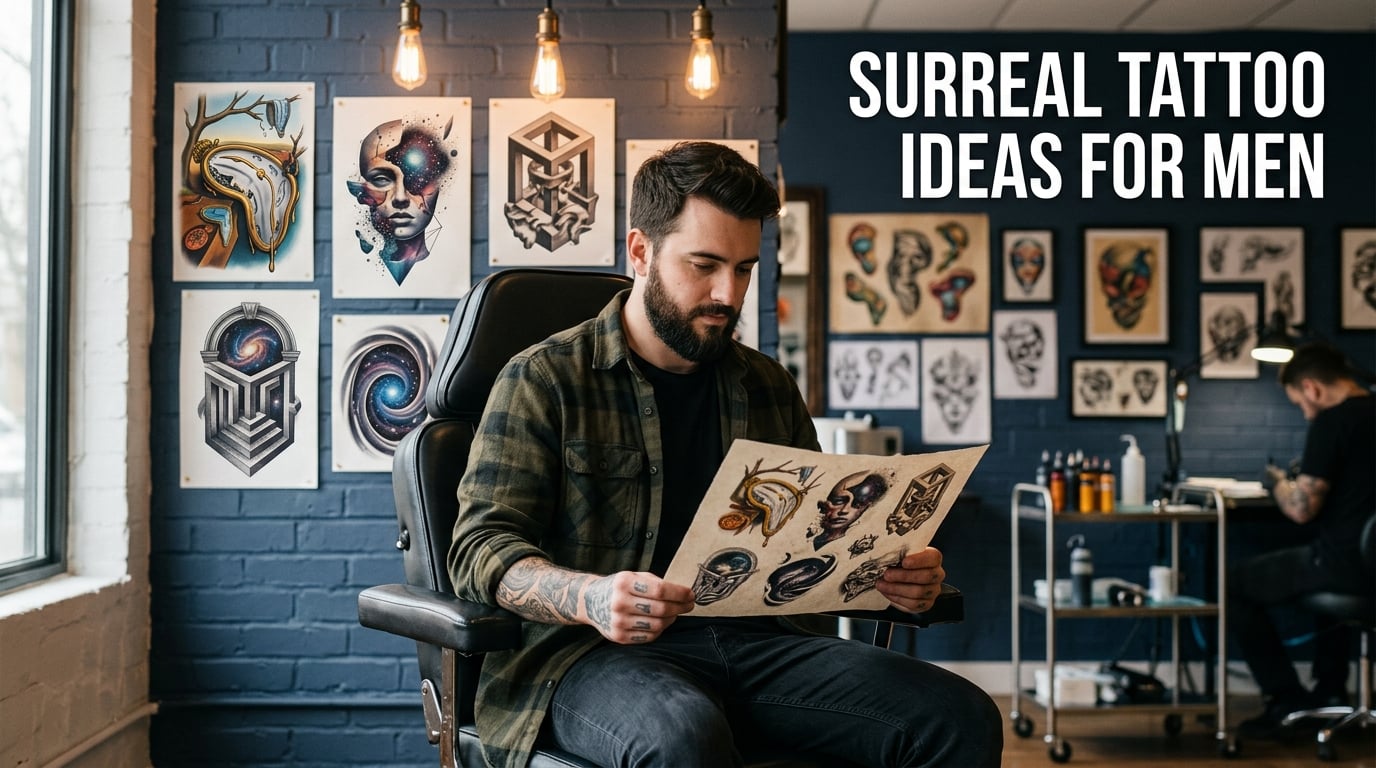
I’ve spent the last few months collecting surreal tattoo ideas for men from artist portfolios, Reddit threads, and gallery walls in three cities. What you’ll find below is a curated list of motifs, placements, and styles that actually translate well to skin – not just a Pinterest dump.
If you’ve been searching for a tattoo that looks like fine art rather than flash, surrealism is one of the strongest directions a man can take in 2026. It lets you wear philosophy on your arm instead of a literal image, and it ages far better than most trend-driven styles.
Table of Contents
What Is a Surrealist Tattoo?
A surrealist tattoo is a tattoo inspired by the surrealism art movement of the early 20th century. It features dreamlike, impossible, or subconscious imagery – melting clocks, floating objects, distorted faces, optical illusions, and juxtapositions of unrelated objects – designed to evoke emotion and challenge perception. Unlike traditional flash, each surrealist piece is usually custom-drawn so the composition feels personal rather than copied.
The style borrows directly from Salvador Dalí, René Magritte, and Max Ernst, but the rules of physics are deliberately broken. A clock droops over a branch. An eye peers out from the palm of a hand. A mountain floats above a city. Realistic shading makes these impossible scenes feel tactile on the skin.
10 Best Surreal Tattoo Ideas for Men
These ten motifs come up again and again in artist portfolios and on r/TattooDesigns. Each one works on a forearm, sleeve, chest, or back, and most can be scaled from a small palm-sized piece to a full back project.
- Dalí melting clock draped over a branch, skull, or face. The single most iconic surreal image. Symbolizes impermanence and the unreliability of time. Works best on a forearm or upper arm where the dripping shape has room to flow.
- Cosmic portal or levitating planet over a landscape. A round window opening onto galaxies, a desert, or an ocean. Conveys curiosity, escape, and the feeling that there’s more beyond what we see.
- Eye embedded in an unexpected surface. An iris hidden inside a hand, a leaf, a wall, or a wave. Magritte’s signature. Reads as awareness, watchfulness, or being seen by the world.
- Fragmented or shattered face. A realistic portrait breaking apart into geometric pieces, smoke, or butterflies. Carries themes of identity loss, mental fragmentation, or transformation.
- Human-animal hybrid. A man’s face dissolving into a wolf, stag, owl, or raven. Strong on chest pieces and shoulder caps. Connects personal identity to instinct or spirit animal energy.
- Biomechanical surrealism. Skin opening to reveal gears, pistons, or roots inside the body. Made famous by H.R. Giger and embraced by biomech specialists. Best on biceps, back, or thigh where there is a long canvas.
- Impossible architecture (Escher-style). Staircases that loop back on themselves, buildings folding into themselves, or rooms with multiple gravity directions. A favorite for full-back or full-sleeve projects.
- Floating objects over a realistic landscape. Rocks, books, fish, or umbrellas suspended above mountains or forests. Quiet, surreal, and surprisingly minimal for the visual impact.
- Dark surrealism – skeletal or decayed figures. Skulls growing flowers, skeletons holding hands, or portraits that fade into dust. A heavier, more emotional direction tied to mortality and memory.
- Surrealist portrait (Magritte-style). A man in a suit with an apple, bird, or bowler hat obscuring the face. Reads as classic, intellectual, and instantly recognizable as surrealist.
Surreal Tattoo Ideas for Men by Theme
Grouping motifs by theme helps you pick a direction that matches what you actually want to say with the piece. Most men land on one of the following five.
Time, Memory, and Mortality
This is Dalí’s home territory. Melting clocks, hourglasses with bones instead of sand, decaying portraits, and skulls dissolving into petals all belong here. These pieces are emotional rather than decorative and tend to suit men who want a tattoo that means something private.
Metamorphosis and Duality
The hybrid figure sits in this theme – a man becoming a wolf, a stag, or an owl. Fragmented faces and figures dissolving into smoke or butterflies belong here too. The visual question is always “what is becoming what,” which makes the piece feel alive even when static.
Cosmic and Portal Surrealism
Portals, planets, galaxies, and impossible skies fall into this category. These designs work well in color or in deep black & grey, and they pair nicely with negative space on a forearm or chest plate. Many first-time surreal clients start here because the imagery is bold without being graphic.
Biomechanical and Nature-Meets-Machine
A sub-genre of surrealism where skin splits to reveal gears, circuitry, or mechanical anatomy. Artists like H.R. Giger and the biomech specialists in Eastern Europe popularized this. It reads as a meditation on what it means to be human in a technological age and looks especially strong on a back piece or a leg sleeve.
Dark Surrealism
Skeletal figures, horror-tinged portraits, surrealist interpretations of grief. This is heavier than standard surrealism and skews toward tattoo collectors who already have a sleeve and want the next piece to push further emotionally. Black & grey realism is the natural style choice here.
Best Placements for Surreal Tattoos on Men
Surreal pieces need real estate. Tiny surreal details get muddy fast, which is one of the most common regrets in r/TattooDesigns threads. These are the placements that consistently work best for men.
Full Arm Sleeve
The single most popular surreal canvas for men. A full sleeve gives the artist room to develop a multi-element composition – a melting clock flowing into a fragmented face, then a cosmic portal on the shoulder. Expect 12 to 20 hours of work split across 4 to 8 sessions.
Chest Plate
A chest piece frames a surreal portrait, hybrid, or dark surrealism design under the collarbones. The broad flat surface is ideal for detailed shading and works well with a Magritte-style portrait or a biomechanical chest plate that mimics a ribcage opening.
Back Piece
The back is the largest canvas on the body. Most ambitious surreal projects – Escher-style architecture, full cosmic landscapes, or large biomechanical spreads – end up here. Healing is easier than the chest because the back doesn’t flex against clothing.
Forearm
For men who want surrealism but don’t want a sleeve, the forearm is the smart middle ground. A forearm surreal piece runs from inner wrist to elbow and shows easily in short sleeves. Artists can pack a complete composition into this space if the design is planned well.
Shoulder Cap
A shoulder cap works as either a standalone surreal piece – an eye, a floating object, a small portal – or as the starting point of a sleeve. It’s one of the lower-pain placements for men, which makes it a solid choice for first surreal tattoos.
Thigh and Leg Sleeve
A leg sleeve gives the surrealist room to build a vertical narrative. Many men choose the leg for larger surreal portraits or impossible landscapes that they want visible in shorts but hidden under trousers. Pain level is moderate and healing is straightforward.
Surreal Tattoo Styles and What Works Best
The motif is only half the choice. The style you commission decides whether the piece reads as classic, modern, painterly, or graphic. These are the styles that surrealist tattoo artists use most.
Black & Grey Realism
The default style for surrealist tattoos. Smooth gradients, soft shading, and no hard outlines make impossible imagery feel photographic. This is what most men pick and what ages best on skin. It also photographs cleanly under any lighting, which matters for sleeve wearers who want the piece to look strong on Instagram.
Neo-Traditional Surrealism
Combines the bold outlines and saturated color of neo-traditional with surrealist imagery. The hybrid figure, the Magritte portrait, and floating-object scenes all translate well into this style. It tends to look more graphic and illustrative than black & grey realism.
Watercolor Surrealism
Pieces that look like brushstrokes of color are blooming around surreal subjects – a fragmented face in washes of blue and purple, a cosmic portal bleeding pigment. Watercolor surrealism is striking but ages faster than black & grey because pigment density drops over time.
Trash Polka Surrealism
A collage-style approach with realistic elements layered over black smudges, red paint splashes, and typographic fragments. Originally from Germany, trash polka suits men who want a surreal piece that feels editorial and chaotic rather than dreamy.
Fine Line Surrealism
Thin, precise linework with delicate dotwork shading. Lets artists pack intricate detail into smaller areas. Works beautifully for small or minimalist surreal tattoos – a single eye, a tiny floating object, a small melting clock on the wrist.
Biomechanical Surrealism
A specialized sub-genre blending surrealist ideas with mechanical anatomy. Skin tearing to reveal chrome gears, roots replacing veins, or cables threading through muscle. It’s a different skill set and worth finding an artist who specifically does biomech rather than a general surrealist.
Color vs. Black & Grey Surrealism: Which Should You Choose?
The black & grey vs. color question comes up in nearly every surreal tattoo thread on Reddit. Both directions work, but they age differently and suit different motifs.
Black & grey surrealism is the safer long-term choice. Soft shading holds detail for decades, suits the dreamlike quality of surreal imagery, and reads as classic fine art on skin. Most male surreal-tattoo wearers on r/TattooDesigns report picking black & grey and being happy with that choice five years later.
Color surrealism makes sense for cosmic portals, surrealist portraits, and neo-traditional surrealism where saturation is part of the look. The trade-off is more sun-care discipline and a touch-up session every few years to keep pigment dense. If you pick color, plan for at least one refresh around the 5-year mark.
A useful rule: if the surreal image you want is built around mood, shadow, or impermanence – melting clocks, dark surrealism, fragmented faces – go black & grey. If it’s built around spectacle, planets, or bold symbolism, color is worth the maintenance.
Surreal Tattoo Symbolism and Meaning
The most common PAA question around this topic is what surreal imagery actually means. Here’s how the major motifs are typically interpreted by surrealist artists and the men who wear them.
- Melting clock: Impermanence, the unreliability of time, the Salvador Dalí reference to a dream state where clocks lose their meaning.
- Single eye in an unusual place: Awareness, being watched, hidden truth, or the Magritte idea that we only see what the surface shows us.
- Fragmented face: Identity loss, mental fragmentation, or the dissolution of self into something larger – a common theme for men processing change.
- Human-animal hybrid: Connection to instinct, spirit animal energy, or the merging of human reason with animal intuition.
- Cosmic portal or floating planet: Escape, curiosity, the feeling that reality is wider than what we see, or a literal love of astronomy.
- Impossible architecture: Perception, the unreliability of logic, the Escher idea that rules are negotiable.
- Skeletal or decayed figure: Mortality, memory, the surrealist tradition of pairing beauty with decay.
- Floating objects over a landscape: Levitation, weightlessness, the feeling of being unmoored – a popular surreal motif for men going through major life transitions.
A Brief History of Surrealism in Tattoo Art
Surrealism started as a literary and visual movement in 1924, founded by the French poet André Breton. Its visual branch was led by Salvador Dalí, René Magritte, Max Ernst, and Yves Tanguy – artists who used realistic painting technique to depict impossible scenes pulled from the subconscious.
The style took decades to reach tattoo studios. Black & grey realism in the 1990s gave artists the technical foundation to attempt Magritte and Dalí imagery on skin, but the cost of full custom sleeves kept surreal tattoos rare until the 2010s. The rise of Instagram portfolios and reference-driven tattoo conventions in the early October of this decade pushed surrealism into the mainstream.
Today, surrealist tattoo artists are some of the most-followed creators on social media, and the genre has expanded into recognizable sub-styles – biomechanical surrealism, dark surrealism, trash polka, and fine line surrealism. The men commissioning these pieces have moved from early adopters to a regular share of every serious tattoo clientele.
How to Brief a Custom Surreal Tattoo Artist
Custom surreal pieces live or die by the brief. Artists report that vague references (“I want something surreal like Dalí”) lead to generic results, while a tight brief leads to a one-of-a-kind piece. These steps come straight from working surrealist artists and the r/TattooDesigns community.
Step 1: Collect Visual References
Save 10 to 30 images that capture the mood, motifs, and color palette you want. Mix them – some Dalí, some Magritte, some modern surrealist tattoo work. The collage teaches the artist what your eye is drawn to, even if the final piece won’t look like any single reference.
Step 2: Decide the Core Motif
Pick one anchor image – the melting clock, the eye, the fragmented face – and let the artist build outward from it. A surreal composition without an anchor tends to feel cluttered. With an anchor, it feels intentional.
Step 3: Lock Down Canvas and Size
Tell the artist exactly where on the body the piece will sit and the rough dimensions in inches. Surreal details need room; under-sizing is the most common regret.
Step 4: Agree on Style and Color
Decide black & grey vs. color, fine line vs. bold realism, neo-traditional vs. trash polka before the first drawing. Re-doing the style decision after a finished custom design wastes everyone’s time.
Step 5: Set Session and Cost Expectations
A surreal forearm takes 2 to 4 sessions. A full sleeve takes 6 to 10. Get the artist’s estimate in writing and plan finances around that. Many artists offer to split the work over months so the cost doesn’t hit all at once.
Small and Minimalist Surreal Tattoos for First-Timers
Not every surreal piece needs to be a sleeve. A growing number of surrealist artists design small, single-motif pieces for men getting their first tattoo or wanting a low-commitment surreal design.
The motifs that work best at small scale are the ones with a single recognizable element: a tiny melting clock on the inner wrist, a small eye hidden behind an ear, a single floating planet on the sternum, or a minimalist fragmented face on the forearm. Fine line and dotwork shading keep these pieces legible at 2 to 3 inches.
A small surreal tattoo also costs less per session than a sleeve, which makes it a practical entry into the style. Many men start with a small surreal piece and then commission a larger surreal project once they’ve lived with the imagery for a year.
Pain, Healing, and Aftercare for Surreal Tattoos
Surreal tattoos tend to be detail-heavy and heavily shaded. That makes them slightly more demanding to sit through and slightly slower to heal than a bold linework tattoo of the same size.
Pain Level by Placement
Outer upper arm, forearm, and shoulder cap are the lowest-pain surreal canvases. Chest, ribs, spine, and inner bicep are the highest. A surreal chest plate will hurt more than a surreal forearm of the same detail because the skin is closer to bone and flexes more.
Healing Timeline for Shaded Pieces
A heavily-shaded surreal tattoo typically takes 2 to 3 weeks for surface healing and 2 to 3 months to fully settle into the skin. The shading can look cloudy or raised during the first month. That’s normal and not a sign of a bad tattoo.
Aftercare for Detail-Heavy Work
Wash gently twice a day with fragrance-free soap, pat dry, and apply a thin layer of artist-recommended aftercare balm for the first two weeks. Skip the gym for the first few days, avoid swimming for at least three weeks, and keep the piece out of direct sun during healing. Once healed, daily SPF on the tattoo keeps surreal shading from fading.
Surreal Tattoo Trends for Men in 2026
Based on what surrealist artists are posting and what men are booking, these are the surreal directions trending this year.
- Hybrid surrealism – surrealism fused with portraiture. Realistic faces dissolving into surrealist landscapes or mechanical elements. Combines two of the most requested genres.
- Negative space surrealism. Surreal imagery built around the skin itself as a design element. A face where the missing half is bare skin, a clock outlined by absence rather than ink.
- Color cosmic portals. Saturated blue, purple, and green cosmic scenes replacing the older all-black galactic work. Especially popular on forearms and chest plates.
- Dark surrealism and horror-adjacent surrealism. Heavier emotional content – grief portraits, decayed figures, surreal interpretations of personal loss.
- Minimalist fine-line surrealism. Smaller, more delicate surreal pieces for men who want the style without committing to a full sleeve.
Frequently Asked Questions
What is a surrealist tattoo?
A surrealist tattoo is a tattoo inspired by the surrealism art movement of the early 20th century. It features dreamlike, impossible, or subconscious imagery – melting clocks, floating objects, distorted faces, optical illusions, and juxtapositions of unrelated objects – rendered with realistic shading so the impossible scenes feel tangible on the skin.
What does a surreal tattoo symbolize?
Surreal tattoos typically symbolize impermanence, perception, identity, duality, mortality, or the subconscious. A melting clock represents the unreliability of time, an eye represents awareness, a fragmented face represents identity loss, a human-animal hybrid represents the merging of human reason with instinct, and a cosmic portal represents curiosity and escape.
What are the best surreal tattoo ideas for men?
The best surreal tattoo ideas for men include Dalí melting clocks draped over a branch, cosmic portals over landscapes, eyes hidden in unexpected surfaces, fragmented or shattered faces, human-animal hybrids, biomechanical surrealism, Escher-style impossible architecture, floating objects over landscapes, dark surrealism with skeletal figures, and Magritte-style surrealist portraits.
Where is the best place to put a surreal tattoo on a man?
The best placements for a surreal tattoo on a man are the full arm sleeve, chest plate, back piece, forearm, shoulder cap, and thigh or leg sleeve. Surreal details need real estate, so under-sizing is the most common regret. A forearm or shoulder cap works well for a first surreal piece, while a sleeve, chest plate, or back piece suits ambitious multi-element compositions.
How long does a surreal sleeve tattoo take to finish?
A surreal forearm takes 2 to 4 sessions of 2 to 4 hours each. A full surreal sleeve takes 6 to 10 sessions spread over several months. Back pieces can take 10 or more sessions depending on the level of detail. Most artists split the work monthly so the skin has time to heal between sessions.
Do surreal tattoos hurt more than other tattoos?
Surreal tattoos do not necessarily hurt more than other tattoos of the same size, but they tend to involve more shading and longer sessions than bold linework. Pain level depends almost entirely on placement. Outer upper arm, forearm, and shoulder cap are low-pain surreal canvases. Chest, ribs, spine, and inner bicep are the highest-pain surreal placements.
Are surreal tattoos trending in 2026?
Yes – surreal tattoos are one of the strongest tattoo trends for men in 2026. The trending directions are surrealism fused with portraiture, negative space surrealism where the skin itself becomes a design element, saturated color cosmic portals, dark and horror-adjacent surrealism, and minimalist fine-line surrealism for smaller pieces.
Can a surreal tattoo be small or minimalist?
Yes – a surreal tattoo can absolutely be small or minimalist. Single-motif designs like a tiny melting clock on the inner wrist, a small eye behind an ear, a single floating planet on the sternum, or a minimalist fragmented face on the forearm all read clearly at 2 to 3 inches when done in fine line or dotwork shading. Small surreal pieces are a popular entry point for first-timers and a low-commitment way to wear the style.
Final Thoughts: Choosing Your Surreal Tattoo
The strongest surreal tattoo ideas for men come from a personal anchor rather than a Pinterest board. Pick the motif that already means something to you – impermanence, awareness, transformation, escape, duality – and let the artist build the composition around that core image. Style, placement, and color are easier decisions once the anchor is clear.
If you’re starting from scratch, save at least twenty surrealist references this week, identify the two or three motifs you keep coming back to, and book a consultation with an artist whose healed surreal portfolio matches what you want. That process – reference, motif, consultation – is the same one working surrealist clients follow, and it’s the most reliable path to a surreal tattoo you’ll be proud of for decades.