
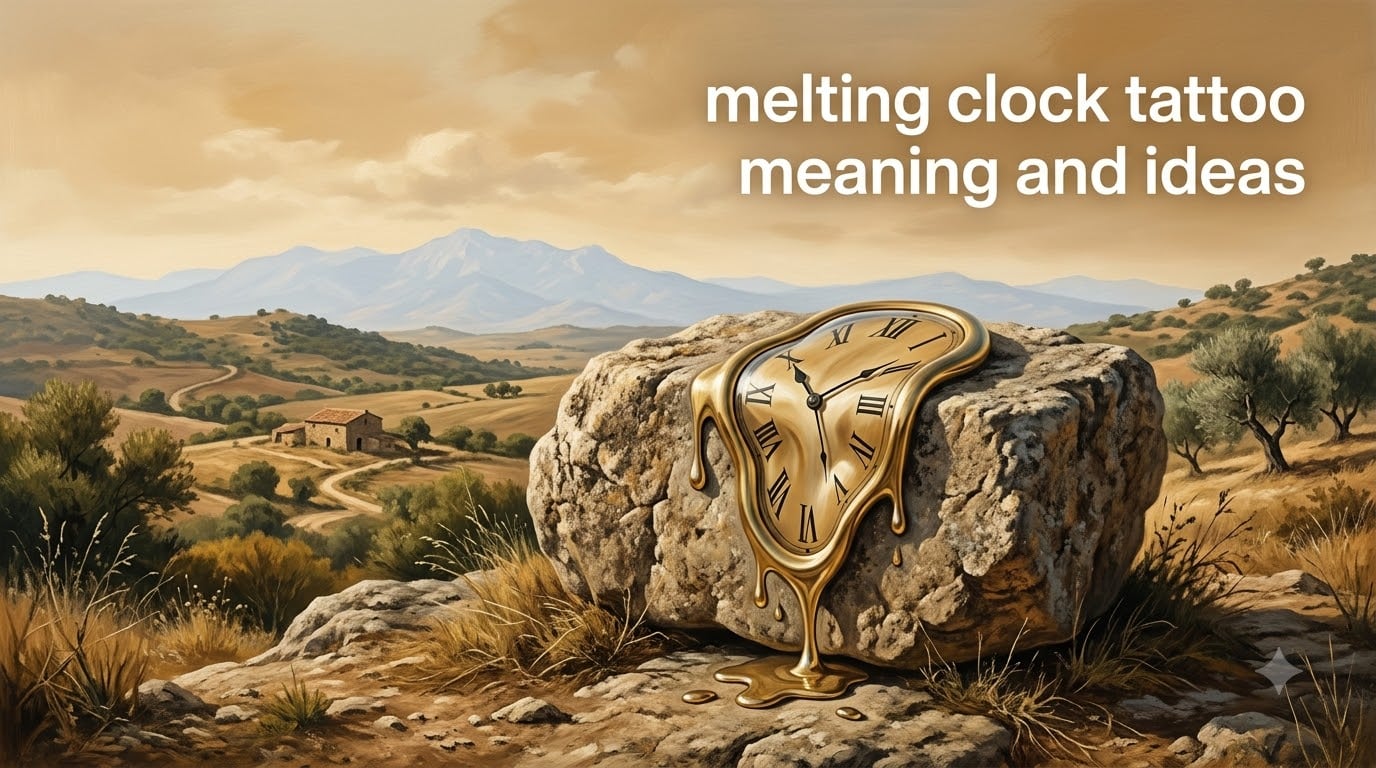
A melting clock tattoo is a surrealist body art design inspired by Salvador Dali’s 1931 painting The Persistence of Memory, depicting a clock that droops, drips, or bends as if made of soft, melting material. It symbolizes the fluidity of time, the impermanence of life, dreams, and the unconscious mind, and a quiet rebellion against rigid schedules.
Below, I’ll walk you through the meaning of a melting clock tattoo, the art history that gave it shape, the layered symbolism, design ideas, placement tips, and how to make the design truly yours.
Table of Contents
What Is a Melting Clock Tattoo and Why It Matters
A melting clock tattoo borrows one of the most recognizable images in modern art: a clock face that has lost its rigidity and begun to sag across an object, a shelf, or open air. The image comes straight from The Persistence of Memory, the small 1931 oil painting Dali finished in his Catalan studio.
The design matters because it transforms a centuries-old symbol of discipline, the mechanical clock, into a meditation on softness, decay, and dream logic. People choose the melting clock tattoo for personal meaning rather than decoration. It signals that time is not a tight grid, that memories erode, and that the mind wanders into stranger, more interesting rooms than any schedule allows.
The Story Behind Salvador Dali’s The Persistence of Memory
The Persistence of Memory was painted in 1931 in Port Lligat, the small Catalan fishing village where Dali kept his home studio. The original is a modest oil on canvas, roughly 9.5 by 13 inches, and it now lives at the Museum of Modern Art (MoMA) in New York.
Dali painted it during his deep dive into the Surrealism movement, the literary and artistic wave begun by Andre Breton in Paris in 1924. Surrealism sought to express the workings of the unconscious mind by pairing irrational, dreamlike imagery with photographic precision. Dali called his own technique “paranoiac-critical method,” a state of self-induced paranoia that let him hallucinate shapes within ordinary objects.
Two scientific and psychological ideas fed the work. The first was Albert Einstein’s theory of relativity, which Dali read closely and which made him wonder whether time itself was as solid as a clock face implies. The second was Sigmund Freud’s psychoanalytic writing on dreams and the unconscious, which Dali cited directly. The melting clocks are not gimmicks; they are Dali’s visual argument that time, memory, and desire are all unreliable narrators.
Core Symbolism: The Relativity of Time
The first and most direct reading of a melting clock tattoo is that time is not absolute. A traditional pocket watch or wristwatch says: time is a fixed grid, obey it. A melting clock says: time stretches, collapses, repeats, and disappears, depending on your state of mind.
Wearers often tell artists they chose this design because Einstein’s theory of relativity made them rethink the tyranny of the daily schedule. A clock that drips off a table acknowledges that an hour spent in grief can stretch for a year, while a joyful afternoon vanishes in a minute.
This is also why the design shows up on people who work in rigid environments: software developers, nurses, lawyers, teachers. The melting clock is a quiet protest that no clock, no calendar, no manager, gets the final word on your attention.
Core Symbolism: Impermanence and Embracing Change
Melting also means decay. Dali painted the clocks sagging because nothing rigid lasts, including the clocks themselves. A melting clock tattoo therefore carries a strong impermanence meaning in the spirit of the Japanese mono no aware and the Buddhist annica.
Wearers often pair this symbol with personal milestones: recovery from illness, end of a long relationship, the birth of a child, a year of sobriety, or the death of someone they loved. The tattoo becomes a small visual reminder that change is the only constant and that softening is not failure.
This is also where the design crosses over from art history into living philosophy. A melting clock tattoo can read as permission to let go, to forgive yourself for the past, and to let yourself change shape under pressure instead of cracking.
Core Symbolism: Dreams, the Subconscious, and Rebellion
Because the image was born inside the Surrealist movement, it carries the movement’s core values. Surrealism, following Freud, treated dreams and the unconscious as legitimate sources of truth rather than noise. A melting clock tattoo acknowledges that there is a mind beneath the waking mind, and that mind runs on a different clock.
There is also a rebellious layer. Dali painted drooping clocks at a moment when European art worshipped clean geometry, industrial modernism, and mechanical precision. A melting clock is, in part, a refusal. The design fits people who feel pressure to be productive, optimized, and on time, and who want a permanent reminder that they contain a stranger, slower self.
In tattoo culture, this rebellious meaning extends to anyone who refuses to read the melting clock as a tattoo cliche. Reddit users in r/tattoo and r/tattooadvice regularly post their Dalí-inspired pieces with captions along the lines of “my fourth year sober,” “in memory of my grandfather,” and “for everyone who told me my mind works wrong.” Personal meaning lifts the design out of the gallery wall and onto the wearer’s skin.
Melting Clock vs. Broken Clock vs. Hourglass: Meaning Compared
Melting, broken, and hourglass clocks each say something different about time. Many wearers land here because they are choosing between three of the most common time-themed designs and want to know the gap before booking a consultation.
| Design | Core Meaning | Best Style | Ideal Placement |
|---|---|---|---|
| Melting clock | Time is fluid, subjective, dreamlike | Surreal realism, fine line | Forearm, back, thigh |
| Broken clock | Time stopped, a moment frozen, grief | Black and grey, traditional | Chest, forearm, ribs |
| Hourglass | Life measured, mortality, patience | Black and grey, dotwork | Forearm, calf, upper back |
| Pocket watch | Memory, heritage, time carried | Vintage realism, engraving | Ribcage, thigh, inner arm |
If your story is about slipping memory or dream logic, the melting clock is your symbol. If your story is about a single moment you cannot move past, a broken clock usually fits better. If your story is about mortality and the value of each grain of sand, the hourglass stays the classic choice.
Design Ideas: Style Variations for Surrealist Tattoos
Once you settle on the melting clock as your symbol, the next decision is style. Style decides how the design reads, how it ages, and how much real estate it needs on your skin.
- Black and grey realism: The closest visual match to Dali’s original palette. Holds up beautifully over decades, even at small sizes, and is the most forgiving on healed skin. Best for the forearm, back, and thigh.
- Fine line: Soft 1RL to 3RL needles, very thin strokes, no shading blocks. Beautiful when fresh but Reddit users in r/tattooadvice repeatedly warn that the drape effect can blur after 3-5 years on areas that flex.
- Watercolor: Loose washes of blue, ochre, or red bleeding around the clock. Reads as painterly on the body. Needs a careful artist, since pure watercolor pigment has no outline and fades faster than shaded work.
- Surreal realism (full color): The painterly high-end option. Pulls in the warm Catalan sky tones from Dali’s original. Requires a large canvas and a specialist artist. Looks like a painting on skin.
- Dotwork or stippled: The newest surrealist style, built from thousands of tiny dots. Creates soft gradients without line weight. Slower to tattoo but ages extremely well.
A simple rule of thumb: the closer you want to reproduce Dali’s painting, the more space and budget you need. The smaller and more minimalist you go, the more you should strip the design back to a single drape and a few Roman numerals.
Small and Minimalist Melting Clock Tattoos
Small melting clock tattoos are quietly one of the most popular variations, but almost no competitor article covers them. They work because the design reduces to three core elements: a circular face, a sag or drape, and Roman numerals or hands.
At 2 to 3 inches, the tattoo reads as a surrealist flourish rather than a reproduction. Wrist, ankle, inner bicep, and behind the ear are the most common placements. Reddit users repeatedly note that these small pieces read best when the numerals are simplified to 12, 3, 6, and 9 instead of all twelve, and when the “drape” is a single soft curve instead of detailed fabric folds.
Minimalist melting clocks tend to age better than full painterly ones. A single black drape, two clean lines for numerals, and a subtle shadow will still look sharp a decade later, while crowded fine-line details can blur into a smudge under sun exposure and skin movement.
Placement Options: Where a Melting Clock Reads Best
The melting effect needs surface area to “drip” across. The flatter and broader the canvas, the more convincing the illusion. Small, curvy areas force the design into a tight blob, which kills the surrealism.
- Forearm (inner or outer): The most popular placement in Reddit threads. Flat, visible, roomy, heals well, easy to show off or cover with a long sleeve.
- Back: The largest canvas. Ideal for painterly surreal realism, paired objects (a melting clock draped over a stone, a tree branch, a closed eye), or full back surrealist scenes.
- Thigh: Discreet, low-pain, plenty of room. Heals cleanly because the area sees less sun and friction than arms or hands.
- Wrist: Best for small or minimalist versions. Higher pain level since skin is thin, but easy to glance at as a daily reminder.
- Ribs: Dramatic and largely hidden. Higher pain, slow healing, but excellent for tall or wide compositions that mimic the drape of Dali’s original shelf.
- Shoulder blade: Subtle alternative to the back. The natural slope reads as a melt when paired with a clock face at the top.
Two placements to be cautious about: hands/fingers and feet. The high friction and sun exposure on these areas fade ink quickly, and the curved surface flattens the melting illusion into an oval that looks more like a melted coin than a clock.
Pairing the Melting Clock With Other Symbols
Pure copies of Dali’s painting are easy to find online and easy to regret. The most interesting melting clock tattoos pair the central image with one or two secondary symbols that deepen your own meaning.
- Eyes: A melting clock draped over a closed or open eye leans into the unconscious symbolism of Surrealism and ties the design back to Dali’s recurring eye motifs.
- Hourglass: Pairs the relativity of time with the discipline of a measured life. Common in memorial tattoos.
- Skull or skeleton: Adds a memento mori layer. The clock melts, the skull stays: a meditation on what decays and what remains.
- Roses or wilting flowers: Highlights impermanence. A melting clock over a single rose is one of the most-requested surrealist designs on Instagram.
- Landscapes: Place the melting clock as if it were draped over a mountain, cliff, or shoreline. Couples your meaning with a place you love.
- Specific Roman numerals or hands: Setting the clock to 1:00, 4:00, 9:00, 11:11, or 00:00 personalizes the piece to a date, a loved one’s birthday, or a moment of change.
One or two companions work best. Three or more secondary symbols turn a surrealist meditation into a busy collage.
How to Personalize Your Melting Clock Tattoo (Without Copying Dali)
The fastest way to make a melting clock tattoo unique is to commission a custom interpretation rather than asking an artist to reproduce the painting. Several Reddit users in r/tattoos describe this exact process: sending 3-5 reference images, sharing a paragraph of personal meaning, and letting the artist distort the clock in a new way.
Common personalization routes include:
- Setting the numerals to a date or hour that means something to you.
- Replacing the cliff or shelf Dali used with a place that has personal weight: a childhood home, a coastal town, your office desk.
- Adding a single word in handwritten script: “still,” “drift,” “softer,” “now,” or a name.
- Turning the drape into a personal object: a violin, a book, a window frame, an open palm.
- Choosing a non-traditional color palette: ice blue, neon pink, monochrome black, or warm ochre.
A few designs are worth avoiding if your goal is to grow with the tattoo instead of regretting it later. Pure recreations of Dali’s full painting tend to age into large, busy pieces that feel like posters on skin. Tattoos of multiple clocks melting in a row lose the surrealist punch and read as repetitive. And tiny, hyper-detailed fine-line versions often blur within a few years on flexible skin.
Finding an Artist Experienced in Surrealist Tattoos
A melting clock tattoo lives or dies on the skill of the artist. Surrealism is one of the harder styles to tattoo well because the distortion has to read correctly even after your skin stretches, heals, and ages.
Three things to look for in a portfolio before booking:
- Healed photos, not just fresh shots. Instagram reels and TikToks show pieces a few hours old. Ask the artist directly for healed photos, ideally 1-3 years old, of any surreal or melting clock work.
- Work in the style you want. A portrait specialist is rarely also a watercolor specialist. Pick the artist whose style matches your style. Black and grey realism artists often handle melting clocks beautifully; fine-line generalists may not.
- Comfort with distortion. A surrealist tattoo needs an artist who understands how to make a circle look like it is sagging in just one area, not collapsing everywhere.
Useful questions for the consultation: how many melting clocks or surrealist pieces have you tattooed in the last two years; can I see healed photos; do you prefer forearm, back, or thigh for this style; and how do you handle the drape effect at small sizes? Artists who specialize in surrealism will answer all four in detail.
Two practical notes on tattoo aging. Bold surrealism with strong outlines and shading holds up far better than fine line work, especially on areas that flex like wrists and ribs. And sun protection, ideally SPF 50+ on the tattoo whenever it is exposed, is the single biggest determinant of how sharp the design looks in year five.
Frequently Asked Questions
What does a melting clock symbolize?
A melting clock symbolizes the fluidity of time, the impermanence of life, dreams, and the unconscious mind, and a quiet rebellion against rigid schedules. The image comes from Salvador Dali’s 1931 painting The Persistence of Memory and became one of the central symbols of the Surrealism movement.
What does a melting clock tattoo symbolize?
A melting clock tattoo carries the same symbolism as the painting: time is unreliable, memory decays, and the inner life of dreams matters as much as the schedule of the outer world. Wearers often choose it to mark a turning point in recovery, grief, identity, or major life change.
What does a clock tattoo symbolize in general?
A clock tattoo can symbolize the passage of time, mortality, a specific moment or loved one, or the value of the present. Different clock designs carry different meanings: melting clocks signal fluid time, broken clocks signal a frozen moment, hourglasses signal mortality and patience, and pocket watches signal heritage and carried memory.
What does Dali’s melting clock mean?
Dali’s melting clocks mean that time is not a fixed, mechanical grid but a fluid, subjective experience shaped by the mind. Dali painted them while reading Einstein’s theory of relativity and Freud’s writing on dreams, and the dripping clocks were his visual argument that time, memory, and desire are unreliable narrators.
What does 00:00 mean as a tattoo?
00:00 as a tattoo often marks a clean break, a fresh start, or the moment before something begins. It pairs naturally with a melting clock design because it visually reinforces the idea of time resetting, slipping, or dissolving. Common meanings include sobriety start dates, the start of a new relationship, or the moment of a major life change.
What are the different styles of Surrealism tattoos?
The most common Surrealism tattoo styles are surreal realism (full color, painterly), black and grey surrealism (matching Dali’s muted original palette), fine line surrealism (thin 1RL to 3RL needles, softer drape), watercolor surrealism (loose pigment washes around the image), and dotwork or stippled surrealism (built from tiny dots). Each style handles the melting effect differently and ages differently on the skin.
What are unique tattoo placement ideas for a melting clock?
Unique melting clock placements include the inner forearm (most popular on Reddit), outer forearm, full back, shoulder blade, ribs, outer thigh, inner bicep, and behind the ear for minimalist versions. Hands, fingers, and feet tend to fade faster and flatten the melting illusion, so most surrealist artists recommend broad, flat canvases instead.
What are some tattoos to avoid when copying Dali?
Tattoos worth avoiding include full-scale reproductions of The Persistence of Memory (they read like posters), rows of multiple melting clocks (they lose the surrealist punch), and tiny hyper-detailed fine-line versions that blur within a few years on flexible skin. Commissioning a custom surrealist interpretation is usually a stronger choice than copying the original painting.
Conclusion
A melting clock tattoo is one of the few surrealist designs that carries its own philosophy with it. It says: time is not a machine, memory is not a vault, and the inner life of dreams is real. That symbolism is why the design keeps showing up on forearms, backs, and ribs more than ninety years after Dali dipped his brush.
Before you book the appointment, run through this short checklist. Decide which symbolism pillar matters most to you: relativity, impermanence, or rebellion. Pick a style that matches your canvas (broad areas favor surreal realism; small areas favor minimalism). Choose the placement last, not first. Find an artist who has tattooed surrealist pieces before, ask for healed photos, and personalize the design with one element that no one else’s tattoo has.
Done well, a melting clock tattoo becomes a small piece of Dali’s surrealism that you actually live inside. Time, after all, was always softer than any clock face said it was.