
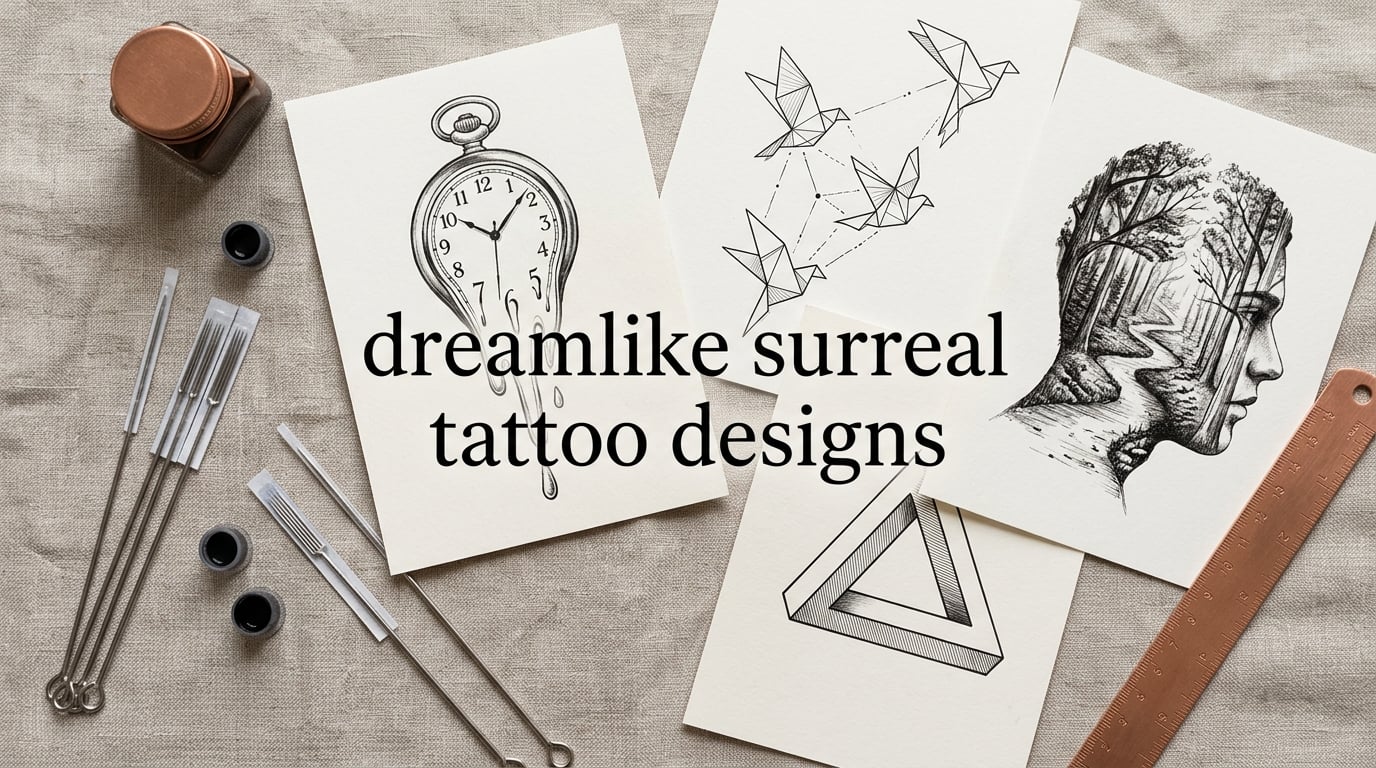
If you’ve ever stared at a tattoo and felt like you were peering into someone else’s dream, you already understand dreamlike surreal tattoo designs. These pieces fuse realistic subjects – faces, eyes, animals, architecture – with one impossible twist. The result feels familiar and unsettling at the same time, like a memory you can’t quite place.
In this guide, I’ll walk you through where the style came from, the visual motifs that define it, the execution choices that make it last, and how to brief an artist so your piece actually looks like what you imagined. Our team has spent months cataloging surrealism tattoo references, talking to artists, and comparing how these tattoos age across placements.
You’ll come away with a clear definition, a list of themes to choose from, and a practical checklist for talking to a surreal tattoo artist.
Table of Contents
What Are Dreamlike Surreal Tattoos?
A dreamlike surreal tattoo is a body-art style inspired by the Surrealist movement that fuses realistic subjects with one impossible twist to create an image that feels like a remembered dream. The piece usually renders one clear subject – a portrait, an animal, a clock, an eye – in photoreal shading, then introduces a single dream-logic disruption: melting, floating, metamorphosis, or impossible geometry.
What separates the style from regular realism is the twist. A face dissolving into smoke. A staircase floating in the sky. A clock draped over a branch like fabric. These aren’t random oddities; they read like still frames from a dream because they obey dream logic, not waking physics.
Five visual traits define the style across artists and studios:
- Melting or dripping objects – clocks, faces, candles, hands – drawn with realistic shading so the eye accepts them before catching the impossibility
- Floating subjects – architecture, anatomy, or animals suspended without support in a believable sky
- Double-exposure portraits – a face filled with a second scene (forest, ocean, city, galaxy) so the two subjects merge
- Impossible geometry – Penrose triangles, Escher staircases, and other objects that can be drawn but not built
- Metamorphosis – one creature transforming into another across the same body of skin (human to wolf, fish to bird, butterfly to skull)
If a piece has a realistic base and exactly one of these disruptions, it sits inside the dreamlike surrealism tattoo family. If it has three or four, it usually reads as chaotic rather than dreamlike.
Origins of the Surrealist Movement and Tattoos
Surrealism began in 1924 when French poet André Breton published the Manifesto of Surrealism. He defined the movement as pure psychic automatism – art made by letting the unconscious speak without censorship. Freud’s writings on dreams gave Breton the vocabulary he needed.
The visual artists who shaped the movement matter more than the manifesto for tattoo design. Salvador Dalí gave us melting clocks and crutches. René Magritte gave us bowler hats, floating apples, and the famous “ceci n’est pas une pipe.” Max Ernst pioneered frottage and layered dreamscapes. Yves Tanguy painted alien landscapes that look like tattoo backgrounds already.
A few painters worth knowing beyond Dalí:
- Giorgio de Chirico – long shadows, empty piazzas, mannequins; the dream-logic ancestor
- Leonora Carrington – Celtic myth, alchemy, and hybrid creatures
- Frida Kahlo – rooted surrealism; identity, pain, and the body as canvas
- H.R. Giger – biomechanical surrealism, the bridge between Surrealism and modern dark tattoo work
The style crossed into tattooing slowly through the 2000s, then exploded on Instagram in the 2010s as fine-line and micro-realism tools made photoreal shading easier to deliver on skin. Today’s surrealism tattoo artists blend classical references with personal symbolism, often working from client dreams or memory.
Core Visual Motifs That Define the Style
The motifs below appear in roughly 80% of the dreamlike surreal tattoo designs our team reviewed across Pinterest boards and artist portfolios. Pick one, not three.
Melting clocks and dripping objects. The Dalí signature. Best when paired with a single anchor – a face, a hand, a tree branch – so the eye lands somewhere before the impossible registers.
Floating architecture and anatomy. Rooms, staircases, doors, and skulls suspended in clouds or void. Reads well on large placements like the back, thigh, or full sleeve.
Double exposure. A silhouette filled with a second scene – mountains, ocean, forest, galaxies. Works beautifully for memorial pieces or identity-based designs.
Penrose triangle and impossible geometry. Optical illusions that can be drawn but not constructed. Clean lines, geometric shading, and a single focal point make these read as tattoos instead of math problems.
Escher staircase. Interlocking staircases that loop impossibly. Often combined with a portrait or animal to anchor the impossible structure.
Metamorphosis and dissolving forms. One creature becoming another, or a face dissolving into smoke, water, leaves, or static. The most narrative-heavy motif; gives your artist room to tell your specific story.
Shattered skin and keyhole eyes. Skin cracking to reveal a second scene underneath; eyes replaced by doors or keyholes looking into another world. Symbolic, often used for transformation or hidden-self pieces.
Popular Themes and Design Ideas for 2026
These themes come up constantly in client briefs and reference boards. Use them as starting points, then add your own twist.
- Dreamscape landscape – mountains floating over an ocean, a forest growing through a bedroom window, a city built inside a glass jar
- Animal transformation – a wolf head dissolving into geometric birds, a deer carrying a forest on its antlers, a butterfly made of dozens of smaller eyes
- Identity portrait – your own face with a second scene inside it (where you’ve been, what you value, what you’re becoming)
- Memory piece – a childhood room rendered with one impossible object (a ceiling that opens into stars, a window looking onto a different decade)
- Escape and freedom – a bird carrying a house, a figure walking out of their own portrait, an open door on a mountainside
- Fear and shadow work – a face half-lit and half-shadow with different expressions on each side; a figure meeting their own silhouette
- Time and impermanence – melting pocket watches, hourglasses leaking into rivers, calendars being eaten by moths
The “one subject, one twist” rule is the simplest way to make any of these themes yours. Choose the subject that already matters to you. Add the single impossible element that tells the rest of the story.
How Surrealism Tattoos Differ From Realism
These two styles get confused often, but they answer different questions and use different tools.
| Dimension | Realism Tattoo | Dreamlike Surreal Tattoo |
|---|---|---|
| Goal | Reproduce a real subject accurately on skin | Render one realistic subject plus one impossible twist |
| Subjects | Portraits, animals, objects, landscapes as they are | Same subjects, then broken, melted, floating, or merged |
| Technique | Photoreal shading, single-pass gradients, smooth blends | Photoreal base plus a clear dream-logic disruption |
| Feel | Documentary, faithful, anchored | Dreamlike, uncanny, symbolic |
| Best placement | Forearm, calf, back, chest – flat surfaces for detail | Same large placements, but works well on chest and ribs where the body itself becomes part of the twist |
A surrealism tattoo inherits realism’s shading discipline and adds one impossible rule. That’s why the best surreal tattoo artists usually come from a realism background.
Execution Styles: Black and Grey, Fine Line, and Color Pop
How a surrealism tattoo is inked changes how it ages, how it reads, and what it costs.
Black and grey with graywash is the most common execution. It gives you the soft shading surrealism needs without the color commitment. Fine for large pieces. Watch out for very thin graywash lines fading on fingers, hands, and feet.
Fine line and micro-realism suits smaller pieces and clients who want detail at a smaller scale. Lines heal crisper but soften faster than bold work, so SPF and touch-ups matter more.
Color pop on a black and grey base is the modern hybrid: a dreamscape rendered in grayscale with one or two saturated elements (red lips, a yellow moon, a copper clock). Color pop reads instantly and ages better than full watercolor because the contrast protects the linework.
Watercolor surrealism uses soft color washes without outlines. Beautiful fresh, but the washes fade and blur faster than other styles. Choose this only if you commit to SPF and accept touch-ups every few years.
Color palette theory matters more than people think. Cool blues and greys feel dreamlike and atmospheric. Warm yellows and oranges feel uncanny and sunlit. Limiting your palette to two or three colors keeps a surrealism tattoo cohesive instead of busy.
Meaning and Symbolism in Surreal Tattoos
Surreal tattoos symbolize transformation, memory, identity, escape, and the parts of yourself that don’t fit a literal image. Unlike traditional symbols, they don’t map one meaning to one icon. They use dream logic so a single piece can hold several readings at once.
The most useful meaning-making method I’ve seen is the “one subject, one twist” rule. Pick the subject that already means something to you – a grandparent’s house, a favorite animal, the ocean where you grew up. Add one impossible element that says the part you can’t say directly: the door that’s always open, the clock that stopped, the staircase going nowhere.
Surrealism also leaves room for the viewer to misread. A face dissolving into birds can mean grief, freedom, becoming, or simply that the wearer liked the image. That ambiguity is the point. The style lets you carry private meaning without having to explain it.
Placement, Pain, and Aging Guide
Placement changes how a surrealism tattoo ages and how much it hurts. Here’s the practical reference our team uses when talking to first-timers.
| Placement | Pain (1-10) | Detail Retention | Aging Outlook | Best For |
|---|---|---|---|---|
| Outer bicep | 3 | High | Excellent | First surreal piece, medium detail |
| Forearm | 4 | High | Very good | Fine line, micro-realism, color pop |
| Thigh | 4 | High | Excellent | Large dreamscapes, full surrealism sleeves |
| Back | 5 | Very high | Excellent | Largest canvases, full back pieces |
| Chest | 6 | High | Very good | Identity portraits, double-exposure work |
| Ribs | 8 | Medium | Good if sized large | Dramatic pieces, multi-hour sessions |
| Spine | 8 | Medium | Good | Vertical compositions, staircases |
| Hand and fingers | 7 | Low | Fades fast; expect touch-ups | Small surreal accents only |
| Behind the ear | 6 | Low | Fades; needs touch-ups | Tiny surreal symbols |
Three rules hold across placements. Bold contrast ages better than delicate graywash. Sun exposure is the single biggest reason color surreal tattoos fade; daily SPF is non-optional. Hand, finger, and behind-the-ear pieces almost always need touch-ups within 12 months – go in knowing that.
How to Brief an Artist for a Surreal Piece
The biggest gap between client and artist is the brief. Surreal pieces live or die on what you say before the needle touches skin.
Step 1: Write one sentence about what the piece means to you. “It represents my grandfather’s workshop.” “It marks the year I left home.” Anything longer than one sentence usually means you haven’t found the core yet.
Step 2: Collect 5 to 10 reference images. Include at least two references from the artist’s own portfolio so they know what you liked about their work. Include one reference that shows the impossible element you want.
Step 3: Ask to see their healed portfolio. Fresh Instagram work looks crisp; healed photos show how the piece actually sits on skin 6 to 18 months later. Reddit users in r/tattooadvice report this is the single best predictor of satisfaction.
Step 4: Insist on one clear focal point. If your artist offers a sketch with three competing elements, ask them to simplify. The dreamlike surrealism tattoo family rewards restraint.
Step 5: Budget honestly. Detail-heavy surrealism costs more than flash because the artist is essentially painting one original artwork on your body. If a quote feels too low, ask what is being cut.
Mistakes to Avoid With Surreal Tattoos
These are the issues our team and the r/tattooadvice community see most often.
- Over-detailing small placements. A surrealism tattoo smaller than 4 inches loses its twist when lines blur during healing. Scale up, or pick a simpler motif.
- Collage-style compositions. Cramming five unrelated elements into one piece kills the dreamlike feel. One subject, one twist.
- Hand and finger placements for detail work. These fade fast. Either accept touch-ups or move the design.
- Bargain pricing on detail-heavy work. Surrealism execution reflects skill. If a quote feels low, the artist is probably cutting detail or skipping references.
- Skipping the healed portfolio review. Fresh Instagram work lies. Healed photos tell the truth.
- No SPF on color surrealism. Color fades faster than black and grey. Daily sunscreen, every day, on the tattoo.
Frequently Asked Questions
What is surrealism tattoo style?
A surrealism tattoo style fuses a realistic subject with one impossible twist – melting, floating, metamorphosis, or impossible geometry – to create an image that obeys dream logic instead of waking physics. The result reads like a still frame from a remembered dream.
What does a surreal tattoo symbolize?
A surreal tattoo usually symbolizes transformation, memory, identity, escape, or the parts of yourself that don’t fit a literal image. Because it uses dream logic, the same piece can hold several meanings at once without forcing one reading.
What does surrealism mean in tattoos?
In tattoos, surrealism means taking a realistic subject – a face, animal, clock, building – and breaking one physical rule about it so the result feels like a remembered dream rather than a photograph.
What is a good symbol for a dream tattoo?
Strong dream tattoo symbols include melting clocks, floating architecture, double-exposure portraits, Penrose triangles, dissolving faces, and animal transformation. The symbol matters less than the pairing – pick one clear subject, then add one impossible twist.
What are some unique tattoo ideas in this style?
Unique surreal tattoo ideas include a childhood room with a ceiling that opens into stars, a wolf head dissolving into geometric birds, an hourglass leaking into a river, a face half-lit and half-shadow with different expressions on each side, and a door cut into the pupil of an eye.
What does an arm sleeve tattoo symbolize?
A surrealism arm sleeve usually symbolizes a personal narrative – identity, transformation, memory, or a chapter of life. Because the sleeve is large, it lets the artist build one impossible world piece by piece across the arm rather than fitting everything into a single image.
What should you avoid with sleeve tattoos?
Avoid sleeve tattoos with too many unrelated elements, avoid tiny detail work that fades during healing, avoid placing high-detail pieces on fingers or hands, and skip artists who won’t show you a healed portfolio on similar sleeves. Stick to one clear concept and bold contrast for best aging.
Final Thoughts on Dreamlike Surreal Tattoo Designs
Dreamlike surreal tattoo designs work because they let you carry private meaning without explaining it. Pick one subject that already matters to you, add one impossible twist that says the part you can’t say directly, and choose an artist whose healed portfolio shows they can actually deliver both the realism and the dream.
If you’re starting from scratch, the simplest path is one clear concept, a medium-to-large placement on a flat surface, and a black and grey execution with optional color pop. From there, the style gives you a lifetime of room to grow.