
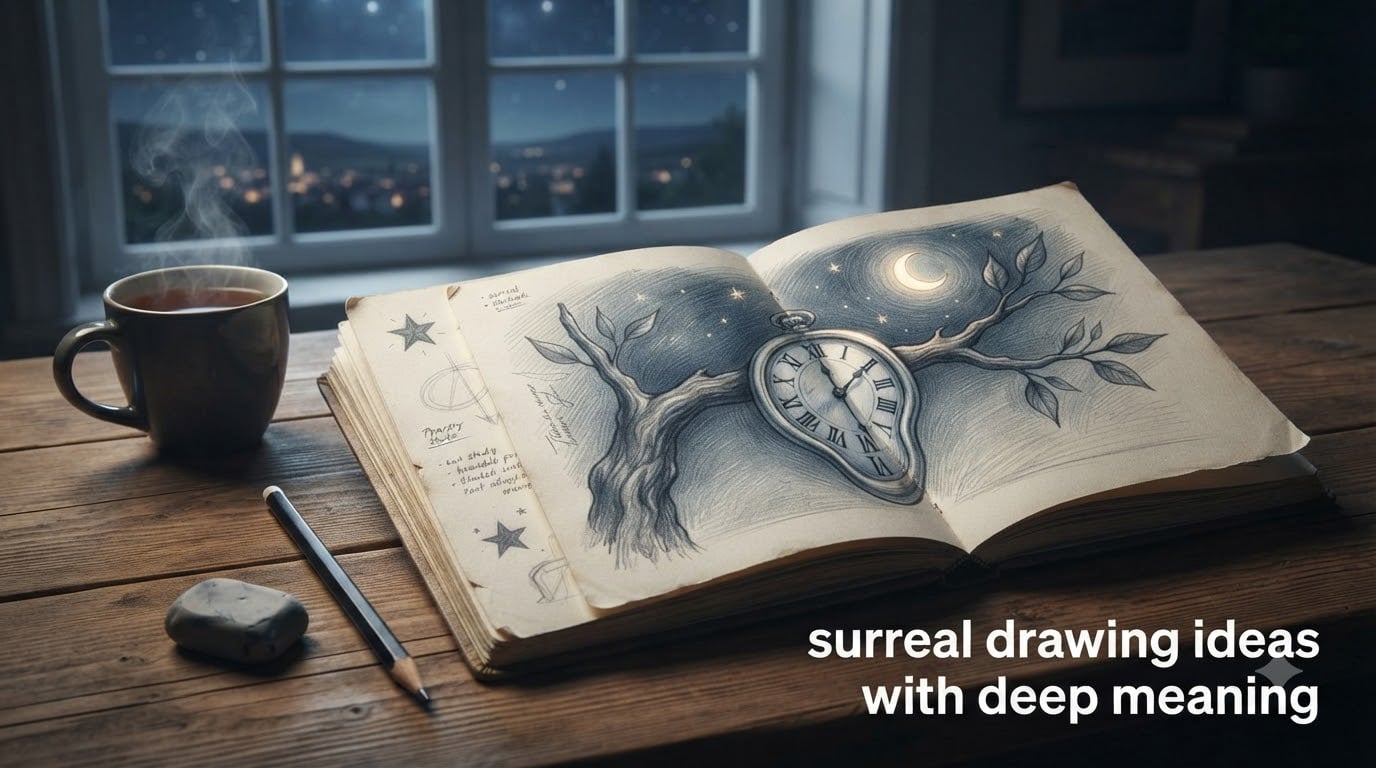
Surreal drawings with deep meaning combine impossible or dreamlike imagery with symbolic emotional themes, creating visual metaphors that express ideas about consciousness, identity, transformation, and human experience. The strange image becomes meaningful when one realistic anchor meets one impossible twist, and the viewer feels something they cannot quite name.
I have spent years sketching in coffee-stained notebooks, pulling ideas from half-remembered dreams and quiet afternoons. The drawings on this page are the ones that taught me the most. Each comes with its own deep meaning, a practical starting point, and a few honest tips I wish someone had given me sooner.
Table of Contents
What Makes a Drawing Surreal and Meaningful
A drawing becomes surreal when one familiar element behaves impossibly while everything around it stays realistic. A melting clock on a bare branch reads as surreal because clocks do not drip, but the branch, the shadows, and the lighting all behave like a normal afternoon. That single broken rule is the engine of the whole image.
Deep meaning arrives when the broken rule carries an emotional idea. The dripping clock becomes a meditation on memory, regret, or the elasticity of grief. Without meaning, surreal imagery feels random. Without surreal imagery, meaning can feel like a poster slogan. The two halves need each other.
The surrealist movement, founded by Andre Breton in 1924, treated the unconscious mind as the richest subject an artist could study. Salvador Dali, Rene Magritte, and Max Ernst built their work on visual paradox, metamorphosis, and juxtaposition. Their drawings are not fantasies about other worlds. They are honest portraits of this one, drawn with one rule removed.
Surreal Drawing Ideas With Deep Meaning
Each idea below opens with the deep meaning first, then a clear visual, then beginner-friendly technique notes. Pick one that already feels like yours. Drawing an idea that already resonates with you is the fastest way to make surreal art that feels intentional rather than random.
1. The Melting Clock of Personal Time
Deep meaning: Time is not as solid as it pretends to be. A melting clock says that the minutes spent in grief, joy, or waiting stretch and compress in ways no calendar can measure.
Draw a pocket watch draping over the edge of a wooden table like soft wax. Keep the table, the wall behind it, and the shadows photorealistic. Let only the clock distort. A simple graphite gradient from soft to sharp across the dial sells the illusion faster than any clever trick.
2. Windows Opening Into Other Worlds
Deep meaning: The interior life is just as real as the room you are sitting in. A window into a different landscape says that memory, dream, and imagination deserve windows of their own.
Sketch an ordinary bedroom window. Through one pane, render a stormy sea. Through the other, a quiet forest. Keep the wooden frame, curtains, and light on the wall perfectly accurate. The contrast between domestic stillness and outside chaos is the whole point.
3. The Door That Leads Nowhere
Deep meaning: Not every opportunity is meant to be walked through. Some doors exist to teach us what we want, or to remind us that we chose to stay.
Draw an ornate door standing alone in an empty field. The door is detailed, weathered, real. Beyond it, there is only grass and sky. Render the hinges and panels with care. The absence on the other side will feel louder than any landscape would.
4. Eyes Blooming Like Flowers
Deep meaning: Seeing is a kind of growing. We are shaped by what we look at, and what we look at grows out of us.
Place a single open eye in the center of a page. Around it, draw petals unfurling outward like a daisy or a lotus. Keep the iris detailed and reflective. Add a thin stem curling below as if the eye is the bloom itself. Soft pencil shading on the petals keeps the image tender rather than creepy.
5. A Forest Growing From an Open Book
Deep meaning: Stories plant worlds inside us. What we read becomes a landscape we carry around and return to.
Draw a hardcover book lying open on a desk. From the gutter of the book, sketch trees rising upward, branches curling across the page and beyond. Use thin vertical strokes for the trunks and lighter cross-hatching for distant foliage. A reading lamp tilted above adds a believable light source.
6. The Floating House Over the Ocean
Deep meaning: Home is something we carry with us, even when the ground beneath is uncertain.
Render a small cottage complete with chimney and lit windows, suspended above a calm sea. Add a thin rope ladder dangling down toward the water. The ocean should be quiet and detailed, not stormy. The contrast between weightless architecture and grounded sea makes the image sing.
7. Hands That Grow Roots
Deep meaning: The hands we use to grasp the world also anchor us to it. What we hold eventually holds us.
Draw two open palms, fingers slightly spread, with thin roots dropping from the wrists into dark soil below. Keep the skin texture and fingernails precise. Add a few tiny shoots or leaves budding from the knuckles to suggest growth, not decay.
8. Staircases Climbing Into the Sky
Deep meaning: Growth is rarely a straight line. We climb in spirals, doubling back on ourselves, and the view changes even when the step feels familiar.
Sketch a stone staircase rising straight up past a small village, then disappearing into clouds. Make the lowest steps the most detailed and let the upper ones fade into mist. Add one figure near the bottom looking up. The viewer follows their gaze, and the image becomes a journey.
9. The Mirror Reflecting a Different Self
Deep meaning: We are not one thing. The self we show the world is one version of several that share our skin.
Draw a person from behind, looking into an ornate standing mirror. In the reflection, render a different version of the figure: older, younger, an animal form, or a silhouette made of leaves. Keep the frame, the wall, and the figure’s clothing identical. Only the reflection breaks the rule.
10. A Fish Swimming Through Clouds
Deep meaning: Belonging is partly a matter of where we dare to swim. The sky is not where fish belong, and yet here one is, gliding through.
Place a single koi or carp mid-leap through a soft cumulus sky. The fish should be detailed with delicate scales. The clouds below should be slightly darker than the sky above, hinting at a sea that exists somewhere out of frame. Light from the upper left sells the illusion.
11. An Hourglass Pouring Stars
Deep meaning: Time does not just drain us. It also fills us, grain by grain, with moments that become constellations of their own.
Draw a wooden hourglass tipped on its side. From the upper chamber, render fine sand pouring out, but transform the sand into tiny stars and nebulae as it falls. Use a soft graphite for the sand and small sharp dots for the stars. The transition zone is the emotional core of the drawing.
12. A Face Made of Crumbling Stone
Deep meaning: Identity is more fragile than the faces we show it through. Some selves crack slowly, and that slow cracking is part of who we are.
Render a serene face in profile. Then carve the cheek and jaw as if it were weathered marble, with chips, cracks, and small plants growing in the fissures. Keep the eye and brow smooth and calm. The contrast between intact and breaking skin carries the meaning.
13. Locks With Keys Made of Light
Deep meaning: The things that free us are often not things at all. They are ideas, beliefs, or moments of clarity that we cannot hold in our hands.
Draw a heavy iron padlock hanging from an old door. Above it, instead of a metal key, sketch a beam of soft light shaped exactly like a key, slipping into the lock. Use careful gradient shading to make the light feel volumetric. The lock must look solid and heavy for the light key to feel earned.
14. Birds Carrying Lanterns at Dusk
Deep meaning: Hope is a small thing we pass to each other. It weighs nothing, but it lights the path forward.
Sketch three or four small birds in flight across a dusky sky. Each bird carries a glowing paper lantern in its beak or claws. Use soft graphite for the birds and a warm, smudged halo for each lantern. The dusk sky is the emotional key: not night, not day, but the in-between hour when hope feels most plausible.
15. A Room That Opens Into a Desert
Deep meaning: The inner life can feel vast, dry, and exposed, like standing alone in an endless landscape that begins the moment our front door ends.
Draw the corner of a quiet bedroom. Where the second wall should be, render a slow drift of sand dunes extending to a flat horizon. Keep the bed, lamp, and rug precise. Add a single set of footprints leading from the doorway into the dunes.
16. Trees Made of Human Figures
Deep meaning: Families and communities grow like trees. The branches above only exist because of the roots and trunk below, and we are all part of the same upward movement.
Sketch a strong tree trunk. Replace the trunk and main branches with overlapping human silhouettes holding each other up, climbing, supporting. The figures near the roots should be larger and rougher; the figures near the canopy can be lighter, almost dissolving into leaves.
17. The Moon Reflected in a Cup of Tea
Deep meaning: The vast can be met in the small. A single cup of tea can hold an entire evening, an entire sky, an entire season of memory.
Draw a simple teacup and saucer from a slight overhead angle. Inside the dark tea, place a perfect reflection of the moon, complete with craters and soft halo. Around the cup, add a quiet windowsill, a folded napkin, and a small spoon. The stillness of the room is what makes the reflection feel sacred.
18. A Piano Growing Like a Coral Reef
Deep meaning: Music is alive. What we play leaves a living structure behind, branching and growing in the listeners who hear it.
Render an upright piano sitting on a flat sea floor. From the keyboard, pedals, and open lid, let coral branches, sea fans, and small fish emerge. Keep the piano wood texture and brass details accurate. The contrast between musical instrument and underwater life turns a strange image into a quiet tribute to memory.
Techniques That Bring Surreal Drawings to Life
Technique is the bridge between the idea in your head and the image on the page. The right tool applied at the wrong moment will still leave the drawing feeling flat. Below is the core toolkit I rely on, and when each technique earns its place.
| Technique | Best for | When to skip it |
|---|---|---|
| Soft graphite gradient | Melting, draping, or breathing objects | Crisp, geometric surreal scenes |
| Cross-hatching | Shaded skin, weathered surfaces, fabric folds | Areas meant to glow or feel weightless |
| Sharp edge contrast | Scale shifts, impossible architecture | Dreamlike, atmospheric scenes |
| Negative space | Mirrors, windows, openings into other worlds | Busy collage-style compositions |
| Soft blur or smudge | Reflections, distant memory, fog | The single impossible element, which should be sharp |
| Controlled white highlights | Light-as-object, glowing motifs | Fully graphite pieces with no light source |
The single most useful rule I can offer: render the impossible element as carefully as the realistic parts around it. A melting clock rendered carelessly reads as a doodle. A melting clock rendered with the same patience you would give a still life becomes surreal.
How to Create a Surreal Drawing in Five Steps
Beginners often freeze at the blank page. The five steps below turn an empty sheet into a finished surreal drawing you can be proud of. Use them as a scaffold, then let the specific idea reshape each step.
Step 1: Choose one anchor and one impossible rule
Pick a familiar subject you can already draw: a teacup, a window, a person sitting at a desk. Then choose exactly one rule to break: gravity, scale, material, reflection, time. One anchor plus one rule is enough. Adding more usually makes the image feel cluttered.
Step 2: Sketch the anchor realistically first
Lightly block in the anchor subject with accurate proportions, perspective, and lighting. Do not yet draw the impossible element. The realism here is what will carry the illusion later.
Step 3: Insert the impossible element
Add the broken rule so it interacts with the anchor. Light should still match. Shadows should still make sense. If the impossible element casts a believable shadow on the realistic parts, the drawing begins to feel like one world.
Step 4: Refine values and edges
Strengthen the contrast where you want attention, soften the edges where you want mystery. Use a kneaded eraser to lift small highlights. Pull the focal point forward with sharp detail and push the rest of the page back with softer marks.
Step 5: Step back and check the meaning
Place the drawing at arm’s length and ask yourself what feeling it leaves. If the image only feels clever, return to step one and choose a more personal anchor. The drawing earns its meaning when the anchor is something the viewer, or the artist, has actually lived.
Common Mistakes That Make Surreal Art Look Random
Most surreal art that feels random fails for one of three reasons. Knowing them in advance saves weeks of frustration, especially when you are learning.
Too many broken rules at once. A face made of water, with melting eyes, growing wings, in a floating room, while clocks drip. Each idea on its own is beautiful. Together, they cancel each other out. The viewer stops feeling anything specific.
Sloppy rendering of the anchor. The realistic parts of a surreal image must look more realistic than usual, not less. If the anchor is loose, the broken rule has nothing to break against. The contrast is the magic, and the contrast needs two clearly different qualities.
Impossible elements without emotional weight. Floating teacups, melting everything, eyes in unusual places. These are tropes, not meanings. A trope becomes meaningful only when it carries a feeling the artist actually has. Skip the image if you cannot name the feeling.
Ignoring light and shadow. A common beginner mistake is to draw the impossible element as if it exists outside the lighting of the rest of the scene. The shadow direction, light color, and shadow softness must match across the whole drawing.
Skipping the value plan. A surreal drawing without a clear light-to-dark hierarchy reads as flat. Before refining, decide where the deepest black, the brightest white, and the middle gray will sit. The impossible element should usually live near one of those poles.
Frequently Asked Questions
How do you make a drawing surreal?
Start with a familiar anchor subject, then break one realistic rule while keeping everything else photorealistic. The contrast between the accurate anchor and the single impossible element creates the surreal feeling.
What makes an image look surreal?
An image looks surreal when one familiar element behaves impossibly while the rest of the scene obeys normal physics, lighting, and scale. The single broken rule carries the whole feeling.
What are easy surreal drawings for beginners?
Easy starting points include a melting clock on a table, a window opening onto an unexpected landscape, an eye blooming like a flower, a fish flying through clouds, and an hourglass pouring stars. Each uses one anchor plus one simple broken rule.
What techniques are used in surrealism drawing?
Core surrealist techniques include juxtaposition (placing unrelated objects together), metamorphosis (gradually changing one object into another), scale shift (changing the size of a familiar object), impossible space (rendering Escher-like architecture), and precision realism (rendering the impossible element with realistic care).
Can I make surreal art with pencil only?
Yes. Pencil is ideal for surreal drawing because it rewards careful shading, lets you lift highlights with a kneaded eraser, and supports the precise realism that makes impossible elements feel believable. A full surreal piece can be done with a set of graphite pencils, a sharpener, a blending stump, and good paper.
How do I stop a surreal drawing from looking random?
Limit yourself to one broken rule per drawing, render the realistic anchor more carefully than usual, match lighting across the whole scene, and choose a subject that carries a feeling you can name. Random images almost always have too many competing impossible elements.
What should I draw first in a surreal composition?
Draw the realistic anchor subject first, including accurate proportions, perspective, and lighting. Then add the single impossible element so it casts a believable shadow and shares the same light source. This order keeps the composition intentional.
What materials work best for surrealism drawings?
A basic surrealism toolkit includes graphite pencils in a range of hardness, a kneaded eraser, a blending stump, and heavyweight smooth paper. Charcoal adds drama for melting or fading elements. Colored pencil or light watercolor washes add symbolic mood when the meaning calls for color.
Should surrealism drawings always have hidden meanings?
No. Surrealism drawings can be pure visual play, but the ones that stay with viewers usually carry a feeling the artist can name. A hidden meaning is not required, but a felt meaning almost always lifts the work from clever to memorable.
Conclusion
Surreal drawing ideas with deep meaning begin with one realistic anchor and one broken rule, but they end with a feeling. The eighteen ideas above are starting points, not a checklist. Take the one that already feels like a story you carry, render it with the same patience you would give a portrait, and let the meaning do the quiet work underneath.
The drawings that stay with me, years after I made them, are not the most technically polished. They are the ones where the impossible element clearly came from somewhere honest. A teacup holding a moon only mattered because I had been thinking about small evening rituals. A fish swimming through clouds only mattered because I had been missing someone. The image came after the feeling, not before.
Pick one idea from this list, give yourself a single afternoon, and draw it slowly. Match the lighting. Sharpen the focal point. Soften the edges around it. When the page looks back at you with something you can name, you have made a surreal drawing with deep meaning, and you are already on your way to the next one.