
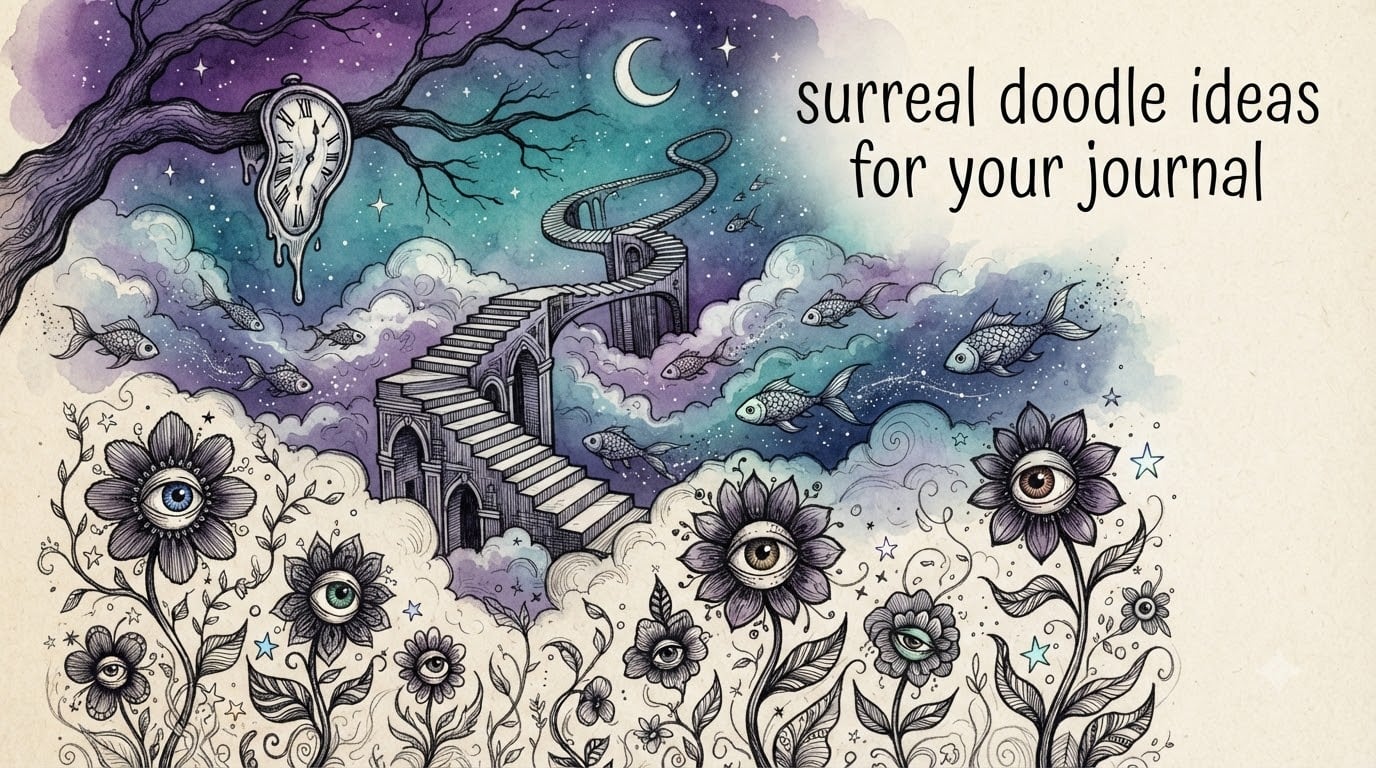
If you’ve ever stared at a blank journal page and wished for something more imaginative than flowers and mandalas, surreal doodle ideas might be exactly what you need. Surrealism takes ordinary objects and twists them into dream-like, mind-bending creations that make your journal pages truly unforgettable.
In this guide, I’ll share over 20 surreal doodle ideas for your journal that go beyond typical sketchbook prompts. You’ll learn specific techniques for creating impossible objects, melting forms, and unexpected combinations inspired by artists like Salvador Dali and Rene Magritte.
Whether you’re a complete beginner or an experienced artist looking for fresh inspiration, these surreal drawing prompts will transform how you approach art journaling in 2026.
Table of Contents
What Makes a Doodle Surreal?
Surrealism isn’t just about drawing “weird” things. It’s a specific art movement rooted in combining unexpected elements to create dream-like imagery that challenges reality.
A regular doodle might be a cute cat or a coffee cup. A surreal doodle takes that cat and gives it butterfly wings, places it upside down on a floating staircase, or shows it melting into a puddle of stars. The key is the unexpected combination.
Core Principles of Surreal Art
The surrealist movement, pioneered by Andre Breton’s 1924 manifesto, aimed to unlock the creative potential of the unconscious mind. In your journal, this translates to three main approaches:
Unexpected combinations: Place objects together that don’t logically belong—like a fish wearing a top hat riding a bicycle through clouds.
Impossible physics: Defy gravity, create optical illusions, or draw objects that couldn’t exist in real space—like staircases that go nowhere or water flowing upward.
Dream-like transformations: Show objects morphing into something else—melting clocks becoming rivers, faces dissolving into flowers, buildings transforming into tree trunks.
The difference between surreal and abstract art matters here. Abstract art removes recognizable forms entirely. Surreal art keeps recognizable objects but places them in impossible, dream-like scenarios.
Surreal Doodle Ideas for Your Journal
These surreal doodle prompts are organized by theme so you can choose what inspires you most. Each idea includes specific details to help you visualize the drawing before you start.
Dream-Like Objects and Melting Forms
The melting clock is perhaps the most iconic surreal image, thanks to Salvador Dali’s “The Persistence of Memory.” But you can apply this melting effect to almost any object.
Melting objects to try:
A melting staircase dripping into a pool of color
A candle whose wax forms a miniature landscape
An umbrella melting like ice cream in the sun
A melting book with words dripping off the pages
A clock melting over a tree branch (the classic Dali reference)
Stretching and distorting:
An impossibly long neck reaching toward the sky
Stairs that stretch and bend around corners that shouldn’t exist
A key that extends into an endless hallway
Fingers that grow into tree branches
When drawing melting objects, the key is maintaining enough of the original form that viewers recognize what it was. The melting effect should feel organic, not chaotic.
Impossible Architecture and Optical Illusions
Impossible structures are a cornerstone of surreal art. M.C. Escher’s work is the gold standard here, but you can create similar effects in your journal with simpler designs.
Impossible buildings:
A house with stairs that lead both up and down simultaneously
A door that opens to reveal a different season on the other side
Windows that show completely different scenes from each angle
A building that’s simultaneously interior and exterior
Penrose stairs—an endless loop of stairs going nowhere
Optical illusion doodles:
The Necker cube—two overlapping cubes that can be interpreted two ways
An impossible triangle (tribar) with three connected corners
Objects that appear to pop off the page using shading techniques
Two faces in profile that also form a vase shape (figure-ground illusion)
Start with pencil sketches for impossible architecture. These require precise angles and measurements to look convincing.
Unexpected Object Combinations
This is where your imagination gets truly free. The surrealist approach is to take objects from completely different contexts and combine them in ways that feel dream-like rather than random.
Nature meets technology:
A tree with cassette tapes growing as leaves
Flowers blooming from old rotary phone handsets
Birds with mechanical clockwork wings
A waterfall flowing from an open laptop screen
Animals in impossible scenarios:
An elephant standing on a floating cloud
Fish swimming through the air like birds
A cat whose tail transforms into a staircase
Butterflies emerging from an old book’s pages
A whale floating above a city like a blimp
Everyday objects with surreal twists:
A teacup containing a miniature ocean scene
Shoes that have grown roots and are sprouting flowers
A lightbulb containing a small universe with planets
An umbrella that collects stars instead of rain
The best unexpected combinations tell a small visual story. Think about what narrative connects your two objects.
Metamorphosis and Transformation
Dali was famous for showing one object gradually becoming something else. This technique creates movement and narrative in a single static image.
Transformation sequences:
A human face slowly becoming a mountain landscape
Letters of the alphabet transforming into animals
A piano that gradually becomes a skeleton key
An eye that morphs into a spiral galaxy
A hand reaching upward that dissolves into flying birds
Boundary dissolution:
A figure whose edges blur into a surrounding landscape
Objects that appear to be made of different materials (a glass tree, a fabric cloud)
Silhouettes filled with unexpected patterns or scenes
For metamorphosis doodles, try drawing the transformation across your journal page from left to right, showing the gradual change. This creates natural movement that guides the viewer’s eye.
Surreal Nature and Landscapes
Nature provides endless material for surreal art because it’s already filled with strange forms. The surreal approach amplifies these natural oddities.
Surreal landscapes:
A desert where the sand dunes are actually sleeping giants
A forest where the trees have human-like faces in their bark
An ocean where the waves are made of glass
A night sky where the stars are actually eyes watching you
Mountains that are actually stacked, frozen books
Surreal botanicals:
Flowers with eyeballs as their centers
Roots that grow upward into clouds
Leaves that contain tiny cityscapes within their veins
A cactus made entirely of keys
Surreal landscapes work especially well for full journal spreads. Use the entire page to create an immersive dream world.
Surreal Doodle Techniques and Tips
Having ideas is one thing—executing them effectively is another. These techniques will help you create convincing surreal art in your journal.
Creating Impossible Objects
Impossible objects are shapes that can’t exist in three-dimensional space but appear logical when drawn in two dimensions. They’re a signature surreal technique.
Step-by-step impossible triangle:
Draw an equilateral triangle outline
At each corner, extend three rectangular beams outward
Connect the beams so they appear to pass both in front of and behind each other
The key is the overlapping lines—each beam must appear to go both over and under its neighbor
Shade each beam consistently to maintain the illusion
The Penrose stairs technique:
Draw a staircase in perspective going upward
At the top, curve the stairs back down to the starting point
Make sure each step appears level even though the overall structure is impossible
Add a figure climbing the stairs for added surreal effect
Practice these on scrap paper first. The proportions need to be precise for the illusion to work.
Dream-Like Shading and Texture
Surreal art often has a particular soft, dream-like quality that sets it apart from realistic drawing. You can achieve this through specific shading techniques.
Soft gradient shading: Instead of hard shadows, use gradual tonal transitions. This creates the hazy quality of dreams where edges aren’t quite defined.
Stippling for surreal textures: Build up tone using tiny dots. This technique works especially well for creating fog, mist, or the quality of something dissolving.
Cross-hatching for impossible surfaces: Use parallel lines that cross at angles to create the illusion of surfaces that curve in impossible directions.
Blurred boundaries: Where objects meet, blend the edges rather than drawing hard lines. This creates the fluid, shifting quality of dreams.
Building Surreal Compositions
A surreal doodle needs more than a single weird object—it needs composition that draws the eye and creates visual logic within the dream world.
The anchor object technique: Start with one recognizable object as your anchor, then surround it with surreal elements. This gives viewers something familiar to hold onto while their brain processes the strangeness.
Scale manipulation: Make tiny objects enormous and enormous objects tiny. A giant butterfly next to a miniature house immediately signals surreal intent.
Gravity manipulation: Show objects floating, falling upward, or existing at impossible angles. This is one of the simplest ways to make any doodle surreal.
Context displacement: Place objects where they absolutely don’t belong—a submarine floating in a cup of coffee, a forest growing inside a shoe.
Color in Surreal Art
Color choices significantly impact how surreal your doodles feel. While you can use any medium, certain approaches create stronger surrealist effects.
Unexpected color combinations: Use colors that feel slightly “wrong”—a blue sun, green skin, purple grass. These subtle shifts create unease.
Monochromatic with one accent: Draw most of your doodle in one color family, then add a single vivid accent. A mostly gray drawing with a bright red melting clock has tremendous impact.
Gradient backgrounds: Create dream-like skies or backgrounds using smooth color gradients rather than realistic colors.
Black and white with dramatic contrast: High-contrast black and white work creates stark, bold surreal images reminiscent of graphic novels and etchings.
Best Supplies for Surreal Doodling
You don’t need expensive supplies to create surreal journal art, but certain tools make the techniques easier to execute.
Pens and Markers
Fine liner pens: Essential for precise impossible objects and detailed linework. Look for pens in multiple tip sizes—0.1mm for intricate details, 0.5mm for main lines, and 0.8mm for bold outlines.
Brush pens: Excellent for creating flowing, organic shapes like melting objects and dream-like clouds. The flexible tip allows for natural variation in line width.
Colored fine liners: Perfect for surreal details that need to stand out. Use them for eyes in flowers, tiny scenes within objects, and other surreal details.
Paper and Journals
Thick paper (minimum 120gsm): Surreal doodles often involve heavy shading and layering. Thin paper will ghost or bleed through.
Mixed media paper: If you plan to combine wet and dry media (like watercolor washes with pen doodles), choose paper specifically designed for mixed media.
Blank journals over lined: Surreal art needs space to breathe. Blank pages give you freedom to create compositions that span the entire page or work at any angle.
Additional Tools
Blending stumps or cotton swabs: Essential for creating the soft, dream-like shading that defines surreal art.
White gel pen: Perfect for adding highlights, stars, and small bright details over darker areas.
Pencils for planning: Always sketch impossible objects and complex compositions in pencil first. These structures require precise proportions.
Frequently Asked Questions
What is doodle journaling?
Doodle journaling is the practice of combining spontaneous drawings with written journal entries. Unlike formal art, doodle journaling emphasizes free expression and creativity over technical perfection. It’s used for stress relief, creative exploration, and adding visual interest to personal journals.
Do I need to be good at drawing to create surreal doodles?
Not at all. Surreal doodles embrace imperfection and unexpected results. Many famous surrealist works intentionally distort reality in ways that don’t require traditional drawing skill. Start with simple surreal concepts like floating objects or impossible shapes, and your skills will develop naturally.
What makes a doodle surreal versus just weird?
Surreal doodles follow specific principles from the surrealist art movement: dream-like imagery, unexpected combinations of recognizable objects, impossible physics, and visual paradoxes. A weird doodle might just be unusual, but a surreal doodle intentionally challenges reality in a cohesive way inspired by artists like Salvador Dali and Rene Magritte.
What pens are best for journal doodling?
Fine liner pens in multiple tip sizes work best for surreal doodling. Look for sets with 0.1mm, 0.3mm, and 0.5mm tips for varying detail levels. Brush pens are excellent for organic shapes and flowing forms. White gel pens are essential for adding highlights over dark areas.
How do I make my surreal doodles look more polished?
Focus on three techniques: consistent shading using stippling or cross-hatching, precise linework with fine liner pens, and intentional composition that guides the eye. Practice impossible objects separately before incorporating them into larger pieces. Also, using a white gel pen for final highlights adds a professional finishing touch.
Can surreal doodles work in a bullet journal?
Absolutely. Surreal doodles work beautifully as monthly cover pages, decorative borders, or themed inserts. You can use surreal elements to create unique habit trackers, mood trackers, or monthly spreads. Just keep functional elements (like calendar grids) separate from your surrealist artwork for readability.
Conclusion
Exploring surreal doodle ideas for your journal opens up a completely different creative dimension than typical sketchbook prompts. Instead of drawing what you see, you’re drawing what you imagine—and that shift in perspective transforms both your art and your journaling practice.
Start with one surreal concept that excites you most. Maybe it’s melting objects, impossible architecture, or unexpected combinations. Practice that technique until it feels natural, then move to the next. Over time, you’ll develop your own surrealist style that makes your journal pages genuinely unique.
The best surreal doodles come from giving yourself permission to be strange. Let your journal become a space where clocks melt, fish fly, and staircases lead to impossible places. That’s where the most interesting art lives.