
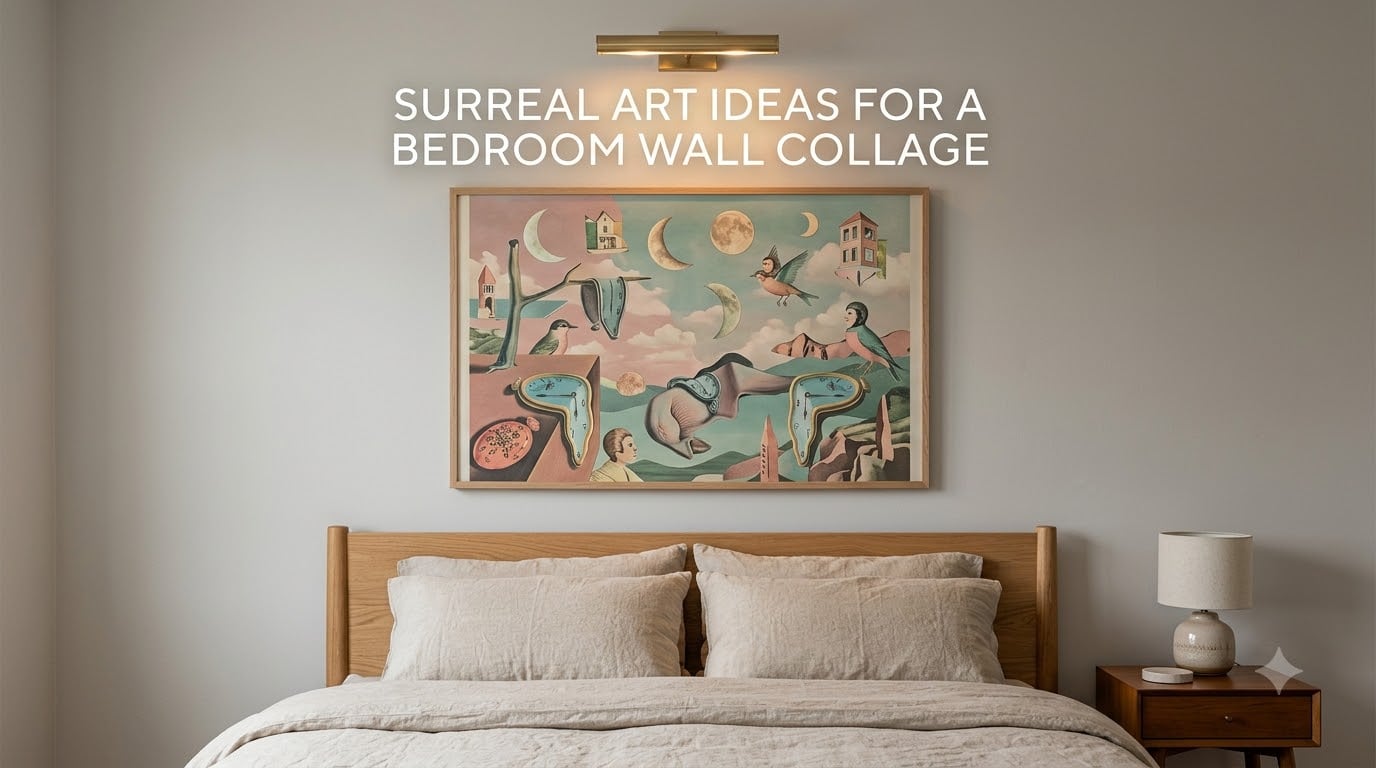
When I moved into my first apartment, the wall above my bed stared back at me for months. I wanted something personal, something that made the room feel like mine. That’s when I started exploring surreal art ideas for a bedroom wall collage, and the whole room shifted.
A surrealist collage is a mixed-media artwork that combines unexpected images, textures, and found materials to create dreamlike, thought-provoking compositions. It draws from the subconscious mind, dreams, and chance, the same ideas that drove Salvador Dali, René Magritte, Max Ernst, and Hannah Höch in the early 20th century. Today, you can take that same spirit and turn it into a wall collage that feels personal, weird, and inviting.
In this guide, I’ll walk you through what surrealist collage actually is, which artists to study for inspiration, the materials you need, and a step-by-step plan for building your own bedroom wall collage. We’ll also cover themes, color matching, sizing, framing, and lighting so the finished piece actually works in your space.
Table of Contents
What Is a Surrealist Collage?
A surrealist collage is a mixed-media artwork built by cutting, layering, and combining unrelated images and objects into a single dreamlike composition. The goal is to surprise the viewer by placing familiar things in unfamiliar contexts — a melting clock over a desert, an eye inside a leaf, a fish flying past a window.
Unlike a traditional poster or print, a collage is hands-on and personal. You choose every image, every scrap, every color. The juxtaposition of unrelated elements is what creates the “surreal” feeling. Reviewers and art teachers consistently describe the effect as thought-provoking, fantastical, and visually intriguing.
Surrealism and Bedroom Wall Decor: Why It Works
Bedrooms are the most personal rooms in a home. They’re the one space where you can fully express your taste without worrying about guests. That makes them perfect for surreal art.
Surreal imagery invites the mind to wander. Before sleep, your eyes drift across images of staircases leading nowhere, moons hanging over forests, and clouds shaped like furniture. That gentle visual play helps a bedroom feel calm, curious, and a little bit magical. A well-made surreal collage turns a flat wall into a small portal.
Famous Surrealist Artists Worth Studying for Bedroom Collages
You don’t need to copy these artists. You need to study how they think so your own collages feel intentional, not random.
Salvador Dali
Dali is famous for melting clocks, dreamlike landscapes, and impossible shadows. His signature move is precision: every detail is rendered crisply, which makes the bizarre subject even more unsettling. Borrow his crisp edges and careful lighting when cutting images for your collage.
René Magritte
Magritte used clean, simple compositions: a bowler hat, a green apple, a cloud filling a room. His power comes from clarity. Pick one idea per collage section and let it breathe. A floating rock, a window with a cloud inside, an apple where a moon should be.
Max Ernst
Ernst invented the collage novel and used Victorian engravings as raw material. His work shows how old, faded imagery can feel eerie when re-cut. Thrift store books and vintage magazines are perfect for this kind of aged, mysterious look.
Hannah Höch
Höch pioneered photomontage in the Dada movement. Her layered compositions feel bold, political, and rhythmic. Study her for rhythm — how shapes and faces repeat across a single panel like a visual beat.
Essential Materials and Tools for Your Surreal Collage
You can start with very little and build up over time. Here’s what I keep within arm’s reach when working on a new piece.
- Image sources: Old magazines, thrift store books, vintage encyclopedias, printed photographs, free online image banks, art books from the library.
- Cutting tools: Sharp scissors, a craft knife with replacement blades, and a self-healing cutting mat.
- Adhesives: Glue stick for paper, matte medium or Mod Podge for sealing, double-sided tape for testing layouts before committing.
- Backing surfaces: Thick cardstock, canvas boards, watercolor paper, or a corkboard if you want a flexible, swappable collage.
- Finishing tools: Ruler, pencil, tweezers for tiny pieces, and a soft brush to remove glue smudges.
- Optional extras: Colored pencils, ink, washi tape, fabric scraps, dried flowers, foil, or thread for texture.
One beginner tip: keep a “scrap envelope” for every project. Toss in every cut-off, leftover shape, and stray image. Those leftovers often become the most interesting pieces.
Step-by-Step Guide to Making a Surreal Bedroom Wall Collage
This is the workflow I use for every surreal bedroom collage I make. Follow these steps in order and you’ll avoid the most common beginner mistakes.
Step 1: Choose Your Wall and Measure
Pick the wall you want to fill. Measure its width and height. Note where the bed, door, and windows fall so you don’t block natural sightlines. For above-bed art, leave at least 6 to 10 inches between the top of the headboard and the bottom of your lowest piece.
Step 2: Pick a Concept or Mood
Decide on a feeling, not just a topic. “Calm dreams,” “soft chaos,” “underwater library,” “weather inside the room,” or “the moon as a roommate.” Write three to five words on a sticky note and tape it to the wall as your compass.
Step 3: Gather and Sort Your Images
Pull 50 to 80 images from magazines, books, and prints. Spread them on a table and sort into three piles: definite yes, maybe, and no. Trust the “yes” pile. If an image doesn’t fit your mood words, it doesn’t belong.
Step 4: Dry-Fit on the Floor
Lay your backing on the floor and arrange pieces without glue. Try different placements, flip shapes, and overlap edges. Take a photo of every layout you like so you can compare options. Dry-fitting saves you from ripping up dried glue later.
Step 5: Build Layers From Back to Front
Start with the largest background shapes — sky, ground, room interior. Add mid-layer elements like trees, furniture, or walls. Finish with the smallest, strangest focal points: the floating eye, the talking door, the fish in a teacup. Surrealism lives in the small details.
Step 6: Glue, Seal, and Let It Cure
Glue pieces down with a glue stick for paper or matte medium for everything else. Work in sections and press firmly to remove bubbles. Once dry, brush a thin coat of matte medium over the whole surface to seal it. Let it cure flat for several hours before hanging.
Step 7: Hang and Adjust
Hang the collage at eye level when you’re standing in the room, or 4 to 6 inches above headboard height if it goes over the bed. Step back. Sit on the bed. Squint. If anything pulls the eye uncomfortably, swap or trim.
Theme Ideas for Surreal Bedroom Wall Collages
The right theme keeps your collage from feeling scattered. These work especially well in bedrooms because they match the room’s natural mood of rest, dreams, and escape.
- Dreamy skies: Cloud textures, floating moons, drifting beds, soft pastel washes, and birds shaped like pillows.
- Nature fused with interiors: Plants growing through windows, tree trunks as lamp posts, rivers running across hardwood floors.
- Retro-futuristic: Mid-century colors, vintage rockets, old typewriters, cassette tapes, and chrome curves against starry backgrounds.
- Soft body horror: Eyes growing on vines, hands holding clouds, mouths opening in tree trunks. Surreal without being frightening.
- Architectural dreams: Impossible staircases, doors opening onto deserts, windows that show underwater worlds.
- Cosmic bedroom: Planets as bedside lamps, star maps replacing wallpaper, constellations forming familiar shapes.
Pick one theme per collage. Layering two themes is fine if they share a mood word — for example, “dreamy” skies plus “soft” interiors.
Color Scheme Tips: Matching Surreal Art to Your Bedroom
Surreal art can feel overwhelming if the colors fight your bedroom. The simplest rule: match the dominant tone, not every color. Pick three colors from your bedding or curtains and reuse those tones in your collage.
Cool bedrooms (blues, greens, grays) pair beautifully with surreal collages that lean silver, teal, and dusty rose. Warm bedrooms (terracotta, cream, mustard) work with surreal pieces in gold, rust, and muted ochre. Neutral bedrooms are the easiest — almost any surreal palette will land well.
Size, Spacing, and Layout Planning for Bedroom Walls
A surreal collage looks best when it owns its wall. Aim for the finished piece to cover about 60 to 75 percent of the wall space above the bed or sofa. Anything smaller feels like a postage stamp.
For a single collage on one wall, choose a backing that fits the available space. For a gallery-style layout with multiple surreal pieces, leave 2 to 3 inches between frames. Group odd numbers of pieces (three or five) for a more natural rhythm. Always lay out the full arrangement on the floor with paper templates before driving a single nail.
Framing and Display Options for Surreal Collages
How you display a surreal collage changes how it feels in the room.
- Float frames: Clean, modern, and let the collage edges show. Great for contemporary bedrooms.
- Deep shadow boxes: Allow you to include small three-dimensional objects like dried flowers, fabric, or paper folds. These feel like little dream rooms.
- Unframed canvas: Wrap the collage around a stretched canvas and leave the edges raw. Looks effortless and artsy.
- Clipboard or pin wall: If you like to swap pieces often, hang a large corkboard and pin collages with brass clips. Easy to refresh as your taste evolves.
Lighting Tips to Showcase Your Surreal Bedroom Wall
Surreal art lives or dies by its lighting. Harsh overhead light flattens the textures and washes out the colors. Aim for soft, directional light.
A picture light mounted 6 to 12 inches above the top of the frame creates a gentle wash that emphasizes texture and small details. Warm bulbs (around 2700K) make surreal scenes feel cozy rather than clinical. If you rent and can’t mount lights, a small LED picture light with a clamp or adhesive strip works just as well. Avoid fluorescent or daylight bulbs above surreal art — they kill the dream.
Common Mistakes to Avoid With Bedroom Wall Collages
I’ve made every one of these mistakes at some point. Save yourself the rework.
- Too many ideas: One collage, one mood. Adding five themes dilutes the impact.
- Glue before dry-fit: Always test the layout first. Glue is permanent.
- Ignoring the wall size: A tiny collage on a huge wall feels lost. Match the scale.
- Hanging too high: Bedroom art should sit close to eye level when you’re lying in bed, not above a mantle.
- Forgetting the seal coat: Without matte medium, paper yellows and edges curl within months.
Frequently Asked Questions
What is a surrealist collage?
A surrealist collage is a mixed-media artwork that combines unexpected images, textures, and found materials to create dreamlike, thought-provoking compositions. The collage technique pairs unrelated elements, like a clock and a desert or an eye and a leaf, so the finished piece feels dreamlike and visually intriguing.
How do I start making a surreal collage for my bedroom?
Begin by choosing a wall and measuring the space. Pick one mood word, gather 50 to 80 images from magazines and old books, and dry-fit pieces on the floor before gluing. Glue from the largest background shapes to the smallest focal details, seal with matte medium, and hang at eye level above the bed.
What materials do I need for a surreal bedroom wall collage?
You need image sources like magazines and vintage books, sharp scissors or a craft knife, glue stick or matte medium, a backing surface such as canvas board or thick cardstock, and a ruler with tweezers. Optional extras include washi tape, fabric scraps, dried flowers, and ink for added texture.
What themes work best for surreal bedroom wall collages?
Themes that match the bedroom mood work best. Dreamy skies, nature fused with interiors, retro-futuristic scenes, soft body-horror imagery, architectural dreams, and cosmic bedrooms all translate well. Pick one theme per collage and stick to it for visual clarity.
How should I light a surreal collage in the bedroom?
Use soft, directional light from a picture light mounted 6 to 12 inches above the frame. Warm bulbs around 2700K keep the dreamlike mood. Avoid fluorescent or daylight bulbs above surreal art, as they flatten textures and wash out colors.
Final Thoughts on Building Your Surreal Bedroom Wall Collage
A surreal bedroom wall collage is one of the few decor projects that gets more personal the longer you live with it. Start with a single mood word, gather more images than you think you need, dry-fit before you glue, and let the dreamlike quality of surrealism do the rest. Your bedroom will stop feeling like a box and start feeling like a place your mind actually wants to be.