
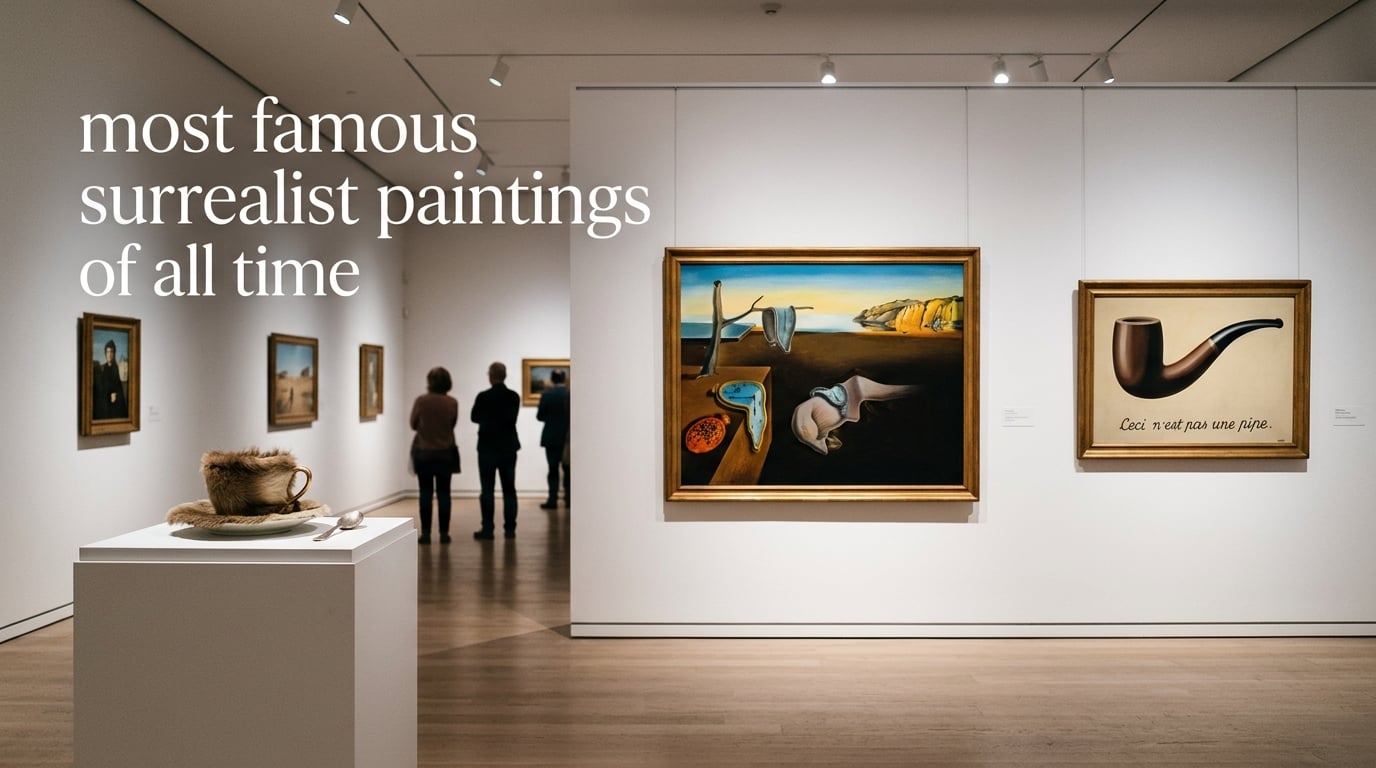
The most famous surrealist painting of all time is Salvador Dalí’s The Persistence of Memory (1931), with its melted clocks draped over a barren landscape. It is the image most people picture when they hear the word “surrealist,” and it has lived rent-free in the popular imagination for nearly a century. But Dalí’s masterpiece is just the doorway into a much wider gallery. The most famous surrealist paintings of all time span dozens of artists and a hundred years of dreamlike, impossible imagery that reshaped modern art.
I’ve spent years studying this movement, visiting the museums where these works hang, and reading the artists’ own letters and manifestos. In this guide, I want to walk you through the ten paintings that defined Surrealism, the techniques that made them possible, the women artists who have been historically overlooked, and where you can see the originals today.
Table of Contents
What Is Surrealism and Why These Paintings Still Matter
Surrealism is an art and cultural movement that emerged in 1920s Europe in the aftermath of World War I, where artists aimed to access the unconscious mind through dreamlike, illogical imagery. The movement was officially launched by French poet André Breton with his Surrealist Manifesto in 1924, building on Dada’s anti-rational energy and Sigmund Freud’s writings on dreams and the unconscious.
Surrealism matters because it broke art free from depicting the visible world. Before the movement, painting largely meant landscapes, portraits, and historical scenes. Surrealist painters asked a radical question: what if the most honest subject matter was the inside of your own mind? That single idea influenced abstract expressionism, pop art, film, literature, advertising, and every piece of conceptual art made since.
Three ideas anchor the movement. The first is the unconscious as a creative source. The second is the power of juxtaposition – placing unrelated objects together to spark new meaning. The third is freedom from rational control, what Breton called “psychic automatism.” Each of the most famous surrealist paintings uses at least one of these ideas, and the best ones fuse all three.
The 10 Most Famous Surrealist Paintings of All Time
The Persistence of Memory by Salvador Dalí (1931) is the single most famous surrealist painting ever made. The small canvas shows four soft, melting clocks draped over rocks, a branch, and a strange fleshy creature in a desolate Catalan landscape. Dalí painted it after a late-night experiment with Camembert cheese left melting on a plate, and the dreamlike sensation of time losing its rigidity stuck with him. Hanging in the Museum of Modern Art in New York, the work has become shorthand for “surreal” in everything from film to advertising. Its genius lies in making the viewer feel the unreliability of time itself.
The Treachery of Images by René Magritte (1929) hits you with a single sentence beneath a painted pipe: “Ceci n’est pas une pipe” – this is not a pipe. Magritte’s point was philosophical before it was artistic. The image of a pipe is not a pipe you can fill and smoke. The painting now hangs at the Los Angeles County Museum of Art, and it remains one of the most quoted works in twentieth-century philosophy classes. It forces you to confront the difference between representation and reality, a core surrealist obsession.
The Son of Man by René Magritte (1964) shows a man in a dark suit and bowler hat standing before a low wall, his face hidden behind a hovering green apple. Self-portraits in the series featured this same bowler-hatted figure, and Magritte said the apple momentarily hid the man’s face “from the spectator.” The painting lives in private collection but appears on posters, book covers, and album art worldwide. It captures a surrealist mood more than a literal scene: the idea that identity itself can be obscured by the everyday.
The Elephant Celebes by Max Ernst (1921) was finished a year before Breton wrote the Manifesto, yet it shows Surrealism’s core strangeness already in full bloom. A massive mechanical elephant – looking like a boiler on stilts – stands in a desert, with a fish-headed figure visible through its headless body and a nude woman trapped inside a hollow tube. Ernst built the painting’s strange texture by placing wood grain over the canvas and then scraping paint across it, a technique he called grattage. The painting is in the Tate Modern in London.
The Harlequin’s Carnival by Joan Miró (1924-25) explodes with biomorphic shapes, musical notes, cats, and stick figures in a Barcelona festival of the mind. Painted in Paris during the same year Breton published the Manifesto, the canvas shows Miró’s playful take on automatism – he let his hand move freely and then recognized forms within the resulting marks. The painting lives at the Albright-Knox Art Gallery in Buffalo, New York. It feels joyful rather than nightmarish, a reminder that Surrealism was not only about dark dreams.
Golconda by René Magritte (1954) fills the frame with dozens of identical bowler-hatted men floating through the air in front of a building, like rain falling upward. Magritte never explained the painting definitively, which is itself a surrealist move. Some read it as a satire of conformity in the modern workforce. Others see the men as a tribute to the everyday mystery of being human. Whatever the meaning, its repetition of identical figures has made it iconic in advertising and graphic design. The original is at the Menil Collection in Houston.
The Sleeping Gypsy by Henri Rousseau (1897) hangs at MoMA in New York and predates the movement, but Breton and his circle claimed Rousseau as the proto-surrealist after the fact. A lion crouches beside a sleeping mandolin-playing gypsy in a moonlit desert. The dreamlike stillness, the flat perspective, and the feeling of a private vision made the work a touchstone for later Surrealists. Rousseau, a self-taught toll collector, painted it decades before the movement had a name.
The Dream by Henri Rousseau (1910) – another Rousseau work later embraced by the Surrealists – shows a nude figure on a couch in a jungle filled with exotic plants, wild animals, and a snake charmer. The nude’s skin appears almost blue in the lamplight, as if she has wandered into her own subconscious. Rousseau painted it the year he died. The painting lives at MoMA and remains one of the most lyrical evocations of the dream state ever produced.
Mama, Papa is Wounded! by Leonora Carrington (1937) is a large, disturbing painting showing a wild horse galloping through a room while a female figure kneels over a fallen man in a green uniform. The title echoes her father’s last words to her after her breakdown. Carrington, a British-born artist who became part of the Surrealist circle in Paris, channeled her personal trauma into the work. The painting hangs in the Museo Nacional de Arte Moderno in Mexico City and has only recently begun to receive the recognition it deserves.
Object (Le Déjeuner en fourrure) by Meret Oppenheim (1936) is technically a sculpture – a fur-covered teacup, saucer, and spoon – but it operates as a painting for the mind. When Breton saw it on display, he declared: “You are no longer simply a Surrealist – you are a Surrealist object yourself.” The piece sits at MoMA and remains one of the movement’s most haunting images, mixing the comfort of breakfast with the strangeness of fur. Oppenheim was 22 years old when she created it.
Surrealist Techniques That Made These Paintings Possible
There are two main types of Surrealist art: automatism, where the artist suppresses conscious control to let the unconscious guide the hand, and dream imagery, where the artist paints directly from remembered or imagined dreams. Most famous surrealist paintings combine both. André Breton’s 1924 Manifesto defined the movement around psychic automatism, while later artists like Dalí leaned more heavily on dream hallucination.
Several techniques recur in the most famous surrealist paintings. Automatism meant writing or drawing without lifting the pen, letting shapes emerge that the conscious mind then elaborated into recognizable forms. André Masson used this method in the 1920s, and Joan Miró adapted it for his playful paintings. Frottage involved placing paper over textured surfaces and rubbing with graphite to create unexpected patterns, which Max Ernst then developed into finished paintings. Decalcomania meant pressing wet paint between surfaces to create organic, blobby shapes – Dalí used it for the rocks in The Persistence of Memory.
Other techniques include grattage (scraping paint across textured surfaces, used by Ernst), collage and photomontage (cutting and pasting images, used by Ernst and Magritte), and exquisite corpse (a group drawing game where each artist draws a section without seeing what came before). What unites all of these methods is the same impulse: to bypass the rational mind and let something else – the unconscious, chance, the unexpected – take over the canvas.
Women Surrealists Who Deserve More Recognition
Women surrealists have been historically overlooked in most lists of the most famous surrealist paintings, but their contributions were central to the movement. Leonora Carrington moved from Paris to Mexico to escape both the war and the dominance of male Surrealists, producing work like Mama, Papa is Wounded! that mixed autobiography, mythology, and witchcraft into a new feminine surrealist vocabulary. Her paintings now hang in major museums but rarely made it onto twentieth-century “top ten” lists.
Meret Oppenheim brought humor and bodily strangeness to the movement, and her fur-covered teacup remains one of the most reproduced surrealist objects ever made. Remedios Varo, a Spanish-born painter who worked in Mexico, painted alchemical interiors with long-haired women caught in mysterious domestic machines, images that have become cult favorites among younger artists. Frida Kahlo, often labeled a surrealist though she rejected the term, made self-portraits that mined personal pain with hallucinatory clarity. Each of these artists deserves a place in any honest ranking of the movement’s most important figures.
Where to See These Famous Surrealist Paintings Today
You can see The Persistence of Memory, The Treachery of Images, The Sleeping Gypsy, and The Dream all in the United States, but you need to visit different museums. The Persistence of Memory and The Dream hang in the Museum of Modern Art (MoMA) in New York. The Sleeping Gypsy is also at MoMA, in a nearby gallery. The Treachery of Images is at the Los Angeles County Museum of Art. The Elephant Celebes is at the Tate Modern in London. Golconda is at the Menil Collection in Houston. Mama, Papa is Wounded! is at the Museo Nacional de Arte Moderno in Mexico City.
If you can only visit one city for Surrealism, Paris is the strongest choice. The Centre Pompidou holds major works by Miró, Magritte, Ernst, and many others. Combined with a day trip to see Salvador Dalí’s work in Figueres, Spain (about four hours by train), you can see the core of the movement in a long weekend.
Frequently Asked Questions
What is surrealism in art?
Surrealism is an art and cultural movement that emerged in 1920s Europe after World War I. Led by André Breton’s 1924 Surrealist Manifesto, surrealist artists aimed to access the unconscious mind through dreamlike, illogical imagery, often using techniques like automatic writing and dream analysis.
Who is considered the father of Surrealism?
French poet André Breton is considered the father of Surrealism. He published the first Surrealist Manifesto in 1924, defined the movement’s core ideas, and led the Surrealist group in Paris through the 1930s.
What is the most famous surrealist painting?
Salvador Dalí’s The Persistence of Memory (1931), with its iconic melted clocks draped over a barren landscape, is the most famous surrealist painting of all time. It hangs at the Museum of Modern Art in New York.
What are the main techniques of Surrealism?
The two main techniques of Surrealism are automatism, where the artist suppresses conscious control to let the unconscious guide the hand, and dream imagery, where the artist paints directly from remembered or imagined dreams. Related methods include frottage, decalcomania, grattage, collage, and exquisite corpse.
Who are the most famous women surrealist artists?
The most famous women surrealist artists include Leonora Carrington, Meret Oppenheim, Remedios Varo, and Frida Kahlo. Carrington’s Mama, Papa is Wounded! and Oppenheim’s fur-covered teacup Object are among the most iconic surrealist works ever made.
Why was Salvador Dalí expelled from the Surrealist movement?
André Breton expelled Salvador Dalí from the Surrealist movement in 1934 partly because of Dalí’s alleged sympathy with Franco’s fascism, and partly due to personal disputes and Breton’s frustration with Dalí’s growing commercialism. Dalí continued to call himself a Surrealist, but the official group no longer recognized him.
The Surrealist Legacy and Where to Start Your Own Exploration
The most famous surrealist paintings of all time – Dalí’s melting clocks, Magritte’s pipe that is not a pipe, Carrington’s wounded horse, Oppenheim’s furry teacup – still work on viewers a hundred years after they were painted. They still surprise. They still make the everyday feel newly strange. That is the surrealist gift, and it has not aged.
If you want to go deeper, start with the Met and MoMA in New York, then plan a trip to the Centre Pompidou in Paris or the Dalí Theatre-Museum in Figueres. Read Breton’s 1924 Manifesto if you can find a translation, and look up Carrington, Varo, and Oppenheim alongside Dalí and Magritte. The movement is bigger than its most famous painting, and the paintings themselves reward slow looking. The strangeness is the point.