
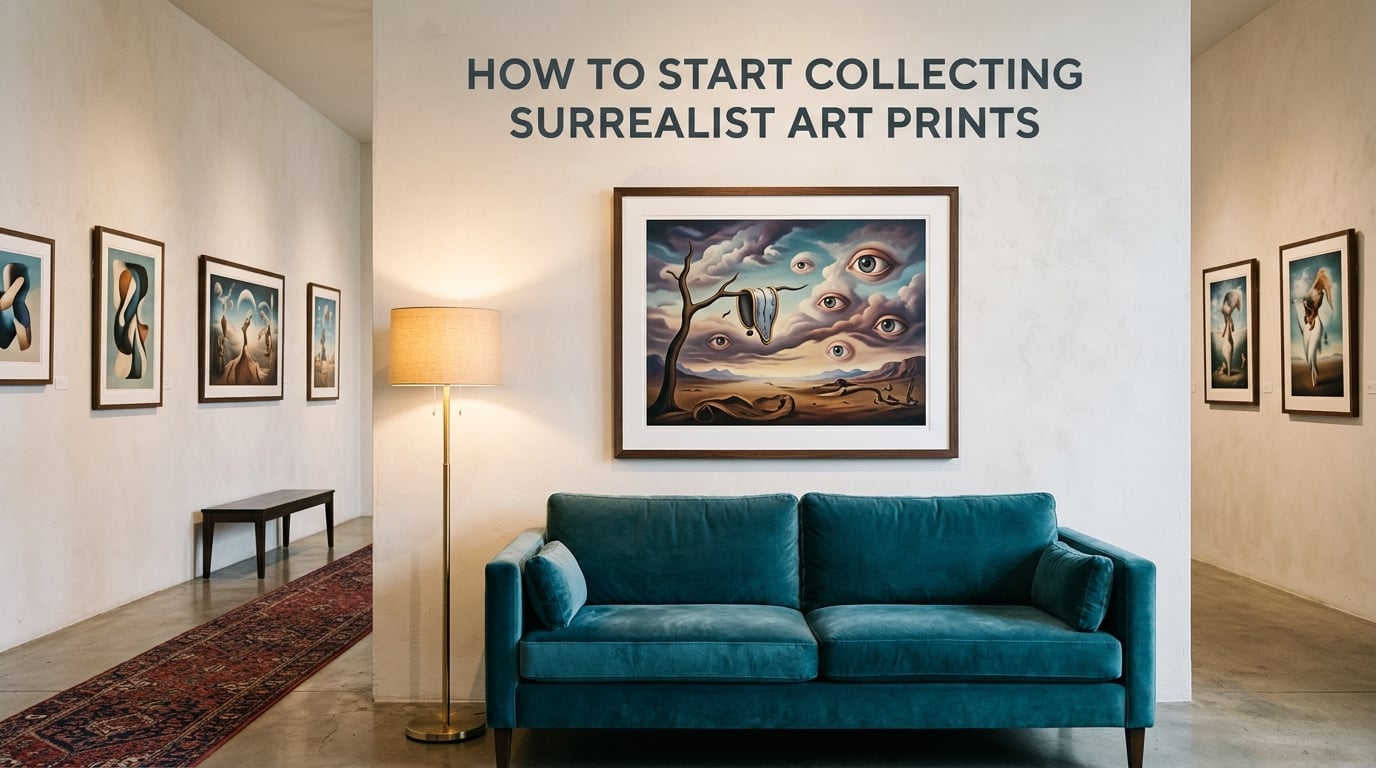
Walking into your first gallery and falling in love with a melting clock or a floating eyeball is one of those moments that sticks with you. If you have ever wondered how to start collecting surrealist art prints without a curator’s budget or an art history degree, you are in the right place. We have spent years visiting surrealist exhibitions, building our own collections, and talking with gallerists, and we are going to walk you through the entire journey.
This guide covers what surrealist art actually is, how to define your taste, how to set a budget that works, where to find authentic prints, and how to keep your new collection looking its best. By the end, you will know exactly how to make your first surrealist purchase with confidence.
Table of Contents
What Is Surrealist Art and Why Collect It
Surrealist art is a movement that uses dreamlike imagery, unexpected juxtapositions, and elements of the unconscious mind to create thought-provoking, fantastical works. Born in 1924 from the mind of writer Andre Breton, surrealism rejected rational thought in favor of dreams, instinct, and the absurd. The genre pulls from psychoanalysis, mythology, and personal symbolism to make images that feel both strange and deeply familiar.
The seven characteristics that define most surrealist art are dreamlike imagery, unexpected juxtapositions, exploration of the unconscious mind, symbolic or metaphorical content, distortion of reality, influence from Freudian psychology, and a sense of mystery or discomfort. When you walk into a room and see a lobster on a telephone or a face melting over a branch, you are looking at surrealism at work.
Collecting surrealist prints gives you access to this visual language without the seven-figure price tags of original paintings. Limited edition prints from contemporary surrealist artists often cost less than a mid-range dinner for two, yet they carry the same dreamlike power that makes the genre so beloved. Owning one turns a blank wall into a conversation piece.
Define Your Collecting Goals and Personal Taste
Before you buy anything, take an honest look at what pulls you in. Spend a weekend scrolling through surrealist art on Instagram, Pinterest, and museum websites. Save every image that makes you pause, even if you cannot explain why. After a week, look back at your saved folder and notice the patterns.
Ask yourself a few questions. Do you gravitate toward dark and moody imagery, or bright and playful scenes? Are you drawn to figures, abstract shapes, or hybrid creatures? Do you want pieces that whisper or pieces that shout? Answering these questions helps you build a coherent collection rather than a random assortment of prints that fight each other on the wall.
Think about where the art will live in your home. A massive surrealist canvas above a sofa makes a different statement than three small framed prints in a hallway nook. Your space, your light, and your daily routines all shape which works will actually bring you joy over time. Collect what you want to see every morning, not what looks impressive in a screenshot.
Set a Realistic Budget for Your Collection
One of the most useful frameworks new collectors learn is the 70/30 rule in art. Spend roughly 70 percent of your budget on works you genuinely love and 30 percent on pieces you believe have investment potential. This balance keeps your collection emotionally satisfying while leaving room for smart long-term plays.
Beginner surrealist prints span a wide range. Open edition digital prints from emerging artists can start very low, while signed limited editions from established names run higher. As a general starting tier, you can build a thoughtful five-piece collection with modest individual prints, then upgrade as your eye and budget grow. There is no shame in starting small.
Track every purchase in a simple spreadsheet including the artist, edition number, date, source, and what you paid. This habit pays off later for insurance, resale, and tax purposes. It also helps you see how your taste evolves over the first year, which is genuinely useful when deciding what to buy next.
Learn to Assess Print Quality and Authenticity
Understanding print terminology protects your wallet and your walls. A giclee print is a high-quality digital reproduction made with archival pigment inks on acid-free paper. A lithograph is created by pressing an image from a stone or metal plate, often by the artist themselves. A silkscreen or serigraph pushes ink through a mesh stencil, and an artist proof is a small number of prints pulled aside for the artist’s personal use, often marked A/P.
Original prints come straight from the artist or their authorized print shop and are usually numbered in pencil along the bottom edge. You will see a fraction like 23/100, meaning this is the 23rd print in an edition of 100. Lower edition numbers and smaller edition sizes generally command higher prices. Signed prints, where the artist has signed in pencil beside the number, carry more value and authenticity than unsigned ones.
Always ask for a certificate of authenticity with any serious purchase. This document should include the artist’s name, title of the work, edition number, medium, dimensions, date, and the issuing gallery or publisher. Provenance, the documented ownership history of the piece, matters too. Reputable sellers can trace a print back to its original release and any subsequent owners.
A practical checklist when evaluating any surrealist print: paper quality should feel substantial and acid-free, colors should look rich without oversaturation, edges should be clean and undamaged, and the print should be signed and numbered by the artist. If anything feels off, walk away. There are plenty of authentic surrealist prints out there waiting for you.
Where to Buy Surrealist Art Prints
Online marketplaces make surrealist collecting accessible from your couch. Established platforms like Saatchi Art, Artsy, and Etsy host thousands of surrealist prints from both emerging and established artists. Each platform has its own vibe, so spend time browsing before committing. Many also offer augmented reality previews that let you see the work on your own wall before buying.
Local galleries remain one of the best sources for serious collecting. Visit small galleries in your area, attend opening receptions, and build relationships with the staff. Gallery owners love talking about their artists and can alert you to new editions, studio visits, and fair appearances. Walking into a gallery feels intimidating at first, but most dealers are genuinely welcoming to curious beginners.
Art fairs, museum print shops, and university exhibitions are other goldmines. Affordable art fairs specifically cater to new collectors with price ceilings and wide selections. Major museum shops often stock high-quality surrealist prints from artists in their permanent collections. University MFA exhibitions offer first looks at emerging talent before their prices climb.
Auction houses like Christie’s, Sotheby’s, and Heritage run online-only print sales that fit smaller budgets. You can find authenticated surrealist prints here, though bidding can be competitive. Set a firm maximum before the sale starts and stick to it. Finally, do not overlook estate sales and specialty dealers who handle surrealist estates. These can yield museum-quality pieces at collector-friendly prices.
Key Surrealist Artists to Know as a New Collector
Learning the canon gives you a foundation, then you can branch into contemporary names. Salvador Dali, Rene Magritte, Max Ernst, Joan Miro, and Leonora Carrington define the historical surrealist movement. Their prints are widely available through major auction houses and authorized publishers, and studying their work helps you recognize the visual grammar of the genre.
Contemporary surrealist artists worth researching include Vladimir Stankovic, whose digital surrealism has built a devoted following, Ray Caesar, known for haunting digital portraits, and Tom Bagshaw, whose detailed figurative work blends fantasy and psychology. Rob Prior, Brian Kesinger, and Cyril Rolando also produce accessible prints that read clearly as surrealist while feeling current.
Follow these artists on Instagram, sign up for their mailing lists, and watch their print drops. Many release new limited editions just once or twice a year, and subscriber lists get first access. Following artists directly also helps you understand their practice, which makes owning their work more meaningful over the long haul.
Care and Preservation of Your Surrealist Prints
Surrealist prints reward careful handling. Always frame them behind UV-protective glass or acrylic, since ultraviolet light is the single biggest threat to ink longevity. Direct sunlight fades colors within months, even through standard window glass. Place framed prints on walls that never receive direct sun, or use museum glass for the pieces you love most.
Choose acid-free mat board and backing for any framed work. Standard cardboard releases acids that yellow paper and degrade ink over decades. Conservation-grade materials cost a little more upfront but extend print life by generations. If you are not framing yet, store prints flat in acid-free sleeves inside a dry, climate-stable drawer or archive box.
Humidity matters more than most beginners realize. Keep your collection in rooms with stable humidity between 40 and 55 percent. Avoid bathrooms, kitchens, and exterior walls where moisture swings. A basic hygrometer costs little and tells you whether your storage conditions are safe. For valuable pieces, climate-controlled display cases are worth the investment.
Never hang a print in direct contact with an exterior wall in winter, since cold walls can cause condensation inside the frame. Leave breathing room behind the frame with proper spacers, and inspect your collection once a year for any signs of foxing, fading, or warping. A little attention now prevents costly restoration later.
Styling Your Home With Surrealist Art
Surrealist prints shine when they get room to breathe. Hang larger pieces alone on a single wall, or anchor one above a sofa, bed, or console. Smaller prints look best grouped tightly in a gallery wall, ideally with consistent frame styles or a clear unifying theme. Eye level should fall roughly at the center of the artwork, which usually means 57 to 60 inches from the floor to the middle of the piece.
Think about contrast. A dark surrealist print pops against a pale wall, while a dreamlike pastel piece can glow against a moody deep green or navy. Let the art guide your room accents. Pull one color from each major print and echo it in a throw pillow, a vase, or a rug. This repetition makes the whole room feel intentional rather than decorated by accident.
Lighting matters more than most beginners expect. Recessed ceiling lights create glare on framed glass and wash out color. Picture lights, track lighting aimed at the wall, or simple LED art lights installed above each frame give prints the focused glow they deserve. Aim for warm 2700K to 3000K bulbs, which flatter most surrealist palettes.
Finally, rotate your collection seasonally. Prints that feel heavy in summer can energize a winter room, and bright dreamlike pieces can lift a gray February week. Keeping a small archive of unframed prints lets you swap pieces in and out, keeping your space alive and giving every piece in your collection its moment in the spotlight.
Frequently Asked Questions
What are the 7 characteristics of Surrealist art?
The seven characteristics that define surrealist art are dreamlike imagery, unexpected juxtapositions, exploration of the unconscious mind, symbolic or metaphorical content, distortion of reality, influence from Freudian psychology, and a sense of mystery or discomfort. Together these traits create the genre’s signature blend of beauty and unease.
What is the 70/30 rule in art?
The 70/30 rule in art advises collectors to spend roughly 70 percent of their budget on pieces they genuinely love and 30 percent on works they believe have strong investment potential. This balance keeps a collection emotionally rewarding while still building long-term value.
How do I start collecting surrealist art prints on a budget?
Start with open edition or smaller limited edition prints from emerging surrealist artists. Shop reputable online marketplaces, follow artists on social media for direct drops, and build your collection piece by piece rather than all at once. Tracking each purchase in a spreadsheet helps you stay on budget and see your taste develop over time.
Where can I buy authentic surrealist art prints online?
Reputable online sources for authentic surrealist prints include Saatchi Art, Artsy, museum print shops, and artist-run online stores. For higher-end pieces, auction houses like Christie’s, Sotheby’s, and Heritage run online print sales with authentication. Always request a certificate of authenticity before completing any serious purchase.
What is the difference between an original print and a giclee?
An original print is pulled by the artist or under their direct supervision using traditional methods like lithography, etching, or silkscreen, and is usually signed and numbered in pencil. A giclee is a high-quality digital reproduction made with archival pigment inks, often used for open editions. Original prints generally hold more value, but high-quality giclees offer the same visual impact at a lower cost.
Start Your Surrealist Collection Today
Learning how to start collecting surrealist art prints is less about money and more about attention. Define what pulls you in, set a budget you can sustain, learn the difference between original prints and reproductions, and source from sellers who can document provenance and authenticity. Care for each piece as if it will outlive you, because with the right handling it absolutely will.
The surrealist movement has always belonged to people who see the world a little differently. Your collection should reflect the way you see things, not the way a decorator or algorithm thinks you should. Trust your eye, start small, and keep going. In a few years, you will have a wall of dreamlike imagery that genuinely feels like yours.
Pick one surrealist print this month, even a small one, and put it on your wall. That first piece is the hardest and the most important. Once it is hanging, the rest of the journey writes itself.