
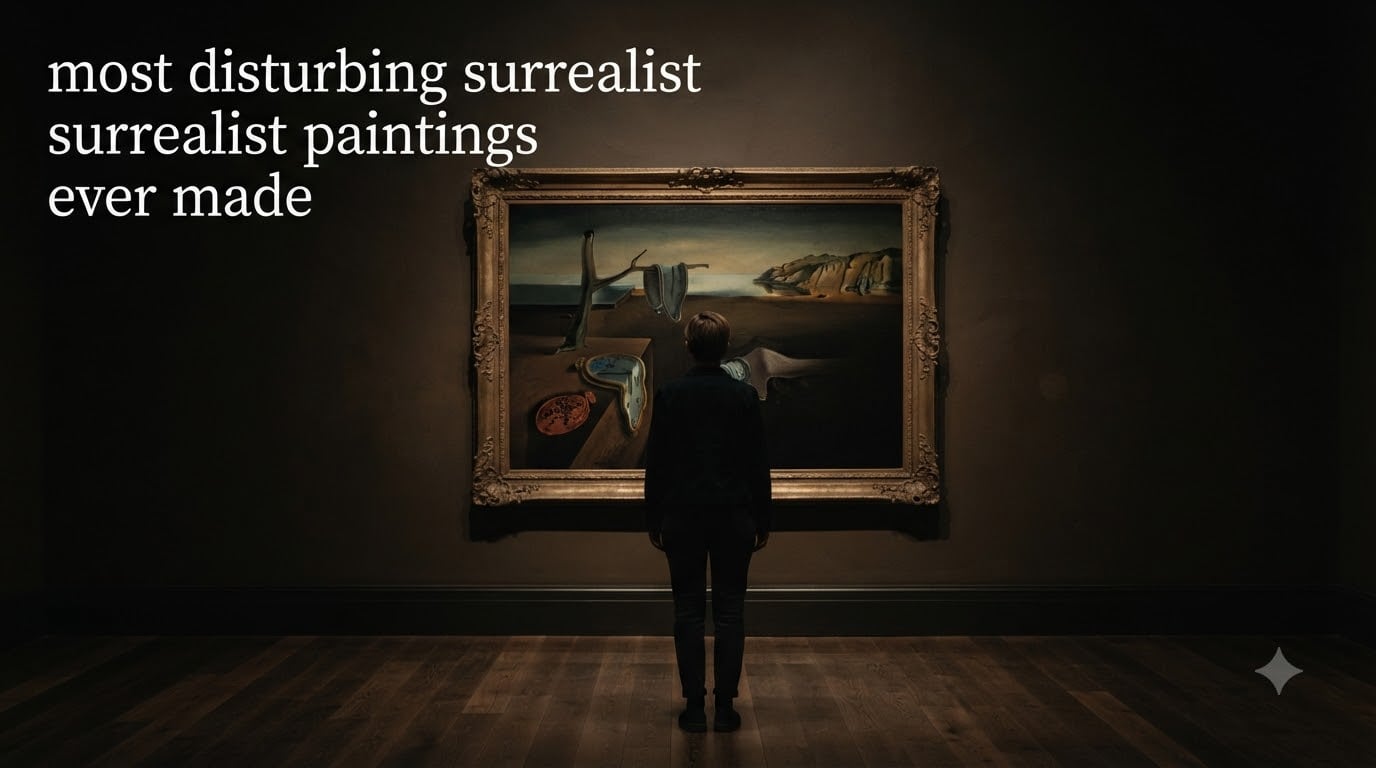
The most disturbing surrealist paintings ever made did not merely depict strange scenes. They pried open the subconscious and held up a mirror to our deepest anxieties. We have spent months studying these works in galleries, books, and high-resolution reproductions. What we found was that the genuinely unsettling pieces share something more than shock value: they reveal the architecture of our fears.
Surrealism began as a revolution in the 1920s, when a group of artists in Paris rejected rational thought and turned to dreams, automatism, and the unconscious as creative sources. Out of that movement came works that still unsettle viewers a century later. Salvador Dalí’s melting clocks. Zdzisław Beksiński’s faceless figures standing in wasteland landscapes. Leonora Carrington’s hybrid creatures that blur the line between human and animal.
In this guide, we walk you through the paintings that consistently make viewers stop and look away, then look again. You will find the artists, the dates, the historical context, and the psychological undercurrents that make each work disturbing. We have also included the female surrealists too often left out of these conversations, and we explain why our brains cannot look away from images that should repel us.
Table of Contents
What Makes a Surrealist Painting Disturbing
A disturbing surrealist painting combines surrealist techniques with imagery that triggers fear, discomfort, or existential dread. The disturbing quality comes not from gore or explicit violence, but from the uncanny: familiar things rendered strange, dream logic pushed to its breaking point, and the subconscious laid bare.
Three elements separate disturbing surrealism from classic surrealism. First, the imagery leans into decay, death, and bodily horror. Second, the atmosphere is oppressive rather than whimsical. Third, the work leaves no comfortable resolution. A painting like René Magritte’s “The Son of Man” unsettles precisely because the apple hides the face and we cannot resolve that mystery.
The term “dark surrealism” has emerged to describe this branch of the movement. Artists like Zdzisław Beksiński and H.R. Giger are often classified separately from Dalí and Magritte, even though all four worked within surrealism’s broader remit. The difference is tonal: dark surrealism refuses the playful wonder that classical surrealism sometimes allows.
Why We Are Drawn to Disturbing Art
No competitor in the space explains this clearly, so we spent extra time on it. If disturbing art repels us, why do we keep coming back to it?
The answer lives in the brain’s reward system. Researchers have a name for the pleasure we feel from safely encountering simulated threat: benign masochism. Psychologist Paul Rozin described it in 2013 as the enjoyment of negative experiences in safe contexts. Horror movies, roller coasters, spicy food, and yes, disturbing paintings all activate this response.
When we look at Beksiński’s faceless figures, our amygdala fires a threat signal. At the same time, our prefrontal cortex recognizes that we are safe in front of a canvas. The mismatch between threat signal and reality creates a low-grade thrill. We feel afraid, then feel relief. The cycle is addictive.
There is also a cognitive reward. Disturbing surrealist paintings force the brain into pattern-recognition mode. We scan the image for narrative, for meaning, for explanation. When no clear meaning exists, the brain keeps trying. This is why we linger in front of unsettling works longer than pleasant ones.
Finally, disturbing art offers something pleasurable art often cannot: honesty about the shadow side of human experience. Death, decay, transformation, and the collapse of identity are real. Art that acknowledges this resonates at a level polite imagery cannot reach.
The Most Disturbing Surrealist Paintings Ever Made
Salvador Dalí, The Persistence of Memory (1931)
Few paintings have lodged themselves in the popular imagination the way “The Persistence of Memory” has. The soft watches draped over a barren landscape suggest time itself is sick. They have become shorthand for surrealism itself.
Dalí painted the work during a period of intense personal anxiety. He had just returned to his family home in Port Lligat, Spain, after years in Paris. Critics sometimes mistake the melting clocks for whimsy. In context, they read as decay. Time is melting. Memory is unreliable. The self cannot hold its shape.
What disturbs is the calm. There is no screaming, no violence. Just a soft landscape and a few strange objects. The viewer’s unease comes from the recognition that reality, as we know it, might be exactly this fragile.
René Magritte, The Son of Man (1964)
A bowler-hatted man in an overcoat stands before a low wall. Beyond the wall is the sea. A green apple hovers in front of his face. The painting is iconic, reproduced everywhere, and deeply unsettling the longer you look at it.
Magritte refused to explain the work, but he did say that everything we see hides another thing. The apple hides the man’s face. The face hides the man. The painting hides the relationship between appearance and identity. We never see the person we most want to see.
The Son of Man is disturbing because it dramatizes a quiet horror: we cannot truly know anyone, not even the figures we study in a portrait. The painting turned a man into a symbol, then hid the symbol behind a piece of fruit.
Zdzisław Beksiński, Untitled Works (1970s-1980s)
If classical surrealism had a dark twin, it was Beksiński. The Polish painter worked in almost total isolation, producing oil paintings of skeletal figures, faceless bodies, and architectural ruins that look like nightmares made physical.
Beksiński refused to title his works. He wanted viewers to project their own fears onto the canvas. His paintings often feature elongated human forms pressed against walls, wrapped in bandages, or merged with landscapes. The light is always cold. The air feels heavy.
His personal life added a tragic layer. In 1999, his son Tomek was murdered. In 2005, Zdzisław himself was stabbed to death by a friend’s teenage son. The paintings, made decades earlier, now feel prophetic. They depicted a world where violence waits around every corner.
Art historians often classify Beksiński as a fantastic realist rather than a surrealist proper, but his techniques, dreamlike imagery and subconscious subject matter, place him firmly in surrealism’s lineage.
H.R. Giger, Necronomicon (1976)
Hans Ruedi Giger was a Swiss painter who built an entire visual language of biomechanical horror. His most famous canvas, “Necronomicon,” depicts a skeletal creature with a mechanical spine and an elongated skull, set against a desert landscape.
Giger took the name from H.P. Lovecraft’s fictional grimoire. The painting was part of a series that would later become the basis for Ridley Scott’s “Alien.” Giger designed the xenomorph that has haunted popular culture since 1979.
What makes Giger’s work disturbing is the fusion of flesh and machine. The paintings suggest that biology and industry are not opposites but partners in something sinister. The biomechanical figures are not robots wearing skin. They are organisms that grow metal.
Leonora Carrington, Self-Portrait (Inn of the Dawn Horse) (1937-1938)
Leonora Carrington was one of the great female surrealists, and this self-portrait is her most personal and disturbing work. She painted herself as a rocking horse confined in a room. A hyena stalks outside the door. A white horse gallops on the wall behind her. A small bird escapes through a window.
Carrington painted the work during a breakdown. She had been living with Max Ernst, who left her for a younger woman. She suffered a psychotic break that included visions and an obsession with hyenas. Her family sent her to a sanatorium. The painting captures that collapse.
The rocking horse is a brilliant symbol. It is a child’s toy, but it is also a cage. The wild hyena represents the freedom Carrington feared and desired. The bird escaping is the part of her that got out before the doors closed. The painting is disturbing because it is honest about what it costs to be a woman artist in a movement that often dismissed women as muses.
Francis Bacon, Three Studies for a Crucifixion (1962)
Bacon is sometimes called a surrealist, sometimes an expressionist. The truth is he worked in his own category. This triptych is his most visceral work: three panels of distorted, butchered, and decaying human forms set against flat orange backgrounds.
The title invokes the crucifixion, but Bacon’s Christ is not noble. He is a slab of meat hanging from a meat hook. The work conflates religious sacrifice with slaughter. It asks whether the two have ever been different.
Bacon worked from photographs, medical textbooks, and his own photographs of lovers in motion. The figures blur because bodies in pain are not static. They twist, they convulse, they cannot hold a shape. The paintings disturb because they remind us that flesh is fragile and violence is real.
Dorothea Tanning, Birthday (1942)
Dorothea Tanning painted this self-portrait the day she met Max Ernst. She stands in a hallway, her body sprouting grey fur. A small winged creature crouches at her feet. The door behind her opens onto an endless corridor.
Tanning later described the painting as a record of self-discovery. The fur growing from her body suggests transformation in progress. The winged creature is a familiar, an inner companion. The infinite hallway is the future, which will keep unfolding no matter how many doors we open.
The work is disturbing in a quiet way. Tanning did not paint violence. She painted becoming. The viewer watches a woman turning into something else and wonders what, and whether she chose it.
Francisco Goya, Saturn Devouring His Son (1819-1823)
Goya painted this directly onto the walls of his house, the Quinta del Sordo, during a period of illness and isolation. He was deaf, he was aging, and Spain had just been through the Napoleonic wars. The painting is part of his Black Paintings series, never meant for public display.
Saturn, the Roman god of time, devours one of his children to prevent a prophecy. Goya painted the myth with brutal directness. Saturn’s eyes are wide. His fingers dig into the corpse. Blood runs down the body and drips from the grip.
Goya is not technically a surrealist. He died in 1828, decades before the movement began. But his Black Paintings prefigure surrealism’s obsession with nightmares, decay, and the irrational. Salvador Dalí explicitly cited Goya as an influence. The painting is disturbing because it shows a father eating his child and refuses to make the act noble.
Remedios Varo, Creation of the Birds (1957)
Remedios Varo was a Spanish-Mexican surrealist whose work is often overlooked in English-language discussions. “Creation of the Birds” is her most famous painting. It shows a woman in a conical hat, sitting at a desk, painting birds that float up into the sky.
The women paints the birds with a brush attached to her own body. She is the source of creation, but she is also trapped. The conical hat is a dunce cap. The desk is a prison. The painting suggests that women create the beauty in the world but receive no recognition for it.
The painting disturbs because it is both whimsical and oppressive. We want to admire it. We also feel the weight of the harness around her neck. Creation and exploitation are the same act.
Yves Tanguy, Indefinite Divisibility (1942)
Yves Tanguy painted landscapes that look like planetary surfaces or dreams of geology. “Indefinite Divisibility” is a vertical canvas filled with biomorphic shapes, half-organic, half-geological, floating in a hazy blue field.
The painting is disturbing because nothing is what it looks like. Shapes that suggest bones are also rocks. Forms that read as insects are also clouds. The brain cannot settle on an interpretation. It keeps searching for an anchor and never finds one.
Tanguy was part of the original Surrealist group in Paris, close to André Breton. His later work, after he moved to the United States with his wife Kay Sage, became more austere and more unsettling. The paintings look like memories of places we have never been.
The Legacy and Cultural Impact of Disturbing Surrealism
Disturbing surrealism did not stay in galleries. It leaked into film, music, literature, and design. Ridley Scott’s “Alien” would not exist without Giger. David Lynch’s films draw directly from Magritte and Dalí. The heavy metal album covers of the 1970s and 1980s borrowed Beksiński’s vision wholesale.
Horror as a genre owes surrealism a debt it rarely acknowledges. The best horror films, from “Eraserhead” to “Hereditary,” use surrealist techniques to build dread. The monster that you never quite see is more frightening than the monster in plain view. Surrealist painters understood this a century before filmmakers caught on.
Contemporary artists continue to work in the tradition. Zdzisław Beksiński’s paintings sell at auction for record sums. H.R. Giger’s estate maintains a museum in Switzerland. Female surrealists like Carrington and Tanning have received serious scholarly attention only in the past two decades. Their work is being reevaluated, exhibited, and reprinted.
The market for disturbing art is robust. Galleries in Los Angeles, Berlin, and Mexico City specialize in dark surrealism. Print reproductions make the work accessible to anyone who wants to live with it. The paintings have outlived the artists and the movement that produced them.
How to Explore These Paintings Further
If this guide has stirred your curiosity, here is where to go next. We have organized this as a practical resource list rather than a sales pitch. These are the museums, books, and exhibitions we recommend based on our own research.
Museums With Strong Surrealist Collections
The Museo Reina Sofía in Madrid holds Dalí and Miró, plus Goya’s Black Paintings (transferred to canvas from the Quinta del Sordo). The Centre Pompidou in Paris has a deep surrealist collection, including Tanguy, Ernst, and Magritte. The Museum of Modern Art (MoMA) in New York owns Dalí’s “The Persistence of Memory” and hosts rotating exhibitions.
The Dalí Theatre-Museum in Figueres, Spain, was designed by the artist himself. It holds the largest collection of his work. The H.R. Giger Museum in Gruyères, Switzerland, displays the original biomechanical paintings. The Museum of Leonora Carrington in Mexico City opened in 2018 and is the first museum dedicated to a female surrealist in Latin America.
Books to Read
“Surrealism: The Road to the Absolute” by Dawn Ades is the standard introductory survey. “The Age of Surrealism” by David Hoppin focuses on the movement’s European context. For Goya, “Goya: The Last Carnival” by Ona Rus is an excellent recent study.
“Leonora Carrington: Surrealism, Alchemy and Art” by Susan L. Aberth is the definitive English-language study of the artist. “Dorothea Tanning: Transformations” by Victoria Brooks is the catalog for her 2019 retrospective. For Beksiński, the best resource is the catalog “Zdzisław Beksiński 1929-2005” published by BOSZ Art.
For the psychology angle, Paul Rozin’s 2013 paper “Benign Masochism” in the journal Judgment and Decision Making explains why we seek out negative experiences in safe contexts. It is short and accessible.
Online Resources
The Smithsonian’s Archives of American Art has digitized letters and documents from Dalí, Ernst, and Carrington. The Tate’s online collection includes high-resolution images of Magritte’s “The Son of Man” and related works. YouTube hosts full lectures on surrealism from universities including Yale and Oxford.
Exhibitions to Watch For
Major museums rotate surrealist exhibitions every few years. Watch the websites of MoMA, Tate Modern, Centre Pompidou, and Museo Reina Sofía for upcoming shows. Smaller galleries in New York, London, and Berlin often feature contemporary dark surrealism.
Frequently Asked Questions
What is the most horrifying painting in history?
Many art historians point to Francisco Goya’s Saturn Devouring His Son (1819-1823) as the most horrifying painting in history. Goya painted it directly onto the walls of his house during a period of illness and isolation. The work shows the Roman god Saturn eating one of his children to prevent a prophecy, with brutal directness and no attempt at nobility. Its power comes from the unflinching depiction of a parent devouring offspring.
Why was Dalí kicked out of Surrealism?
Salvador Dalí was effectively expelled from the Surrealist movement by leader André Breton in 1939. The official reasons included Dalí’s refusal to take a stance against Franco’s regime in Spain and his open fascination with Hitler. Breton also disliked Dalí’s commercial success and his embrace of Catholic mysticism. Dalí continued to work in a surrealist idiom for decades but did so outside the movement he had helped define.
What is the most devastating painting of all time?
Devastating is subjective, but several paintings consistently rank at the top of viewer polls. Goya’s Saturn Devouring His Son is a frequent choice. Picasso’s Guernica (1937) often appears on these lists because of its scale and its response to the bombing of a Basque town. Among surrealists specifically, Zdzisław Beksiński’s untitled works, Leonora Carrington’s Self-Portrait (Inn of the Dawn Horse), and Francis Bacon’s Three Studies for a Crucifixion are commonly cited as the most devastating.
What makes surrealist art disturbing?
Disturbing surrealist paintings combine surrealist techniques (automatism, dream imagery, subconscious exploration) with imagery that triggers fear, discomfort, or existential dread. The unsettling quality usually comes from the uncanny, familiar things rendered strange, dream logic pushed past coherence, and unresolved meaning. The brain cannot settle on an interpretation and keeps searching, which creates a low-grade unease that lingers after the viewer leaves.
Who are the female surrealist artists who created disturbing works?
Three female surrealists stand out for genuinely disturbing work. Leonora Carrington’s Self-Portrait (Inn of the Dawn Horse) (1937-38) depicts her transformation into a rocking horse during a psychotic breakdown. Dorothea Tanning’s Birthday (1942) shows her sprouting fur on the day she met Max Ernst. Remedios Varo’s Creation of the Birds (1957) imagines a woman harnessed to a desk, painting birds with a brush attached to her own body. All three are now considered central to the surrealist canon.
Final Thoughts on the Most Disturbing Surrealist Paintings Ever Made
The most disturbing surrealist paintings endure because they do something comfortable art cannot. They show us what we usually hide from ourselves. Dalí showed us the fragility of time. Magritte showed us the limits of seeing. Beksiński showed us what the world looks like when meaning collapses. Carrington, Tanning, and Varo showed us what it costs to create under systems that were not built for you.
If you take one thing from this guide, let it be this: the discomfort you feel in front of these works is not a failure of the art. It is the art working. Sit with it. Look longer. The paintings will tell you something about yourself you did not know you needed to hear.