
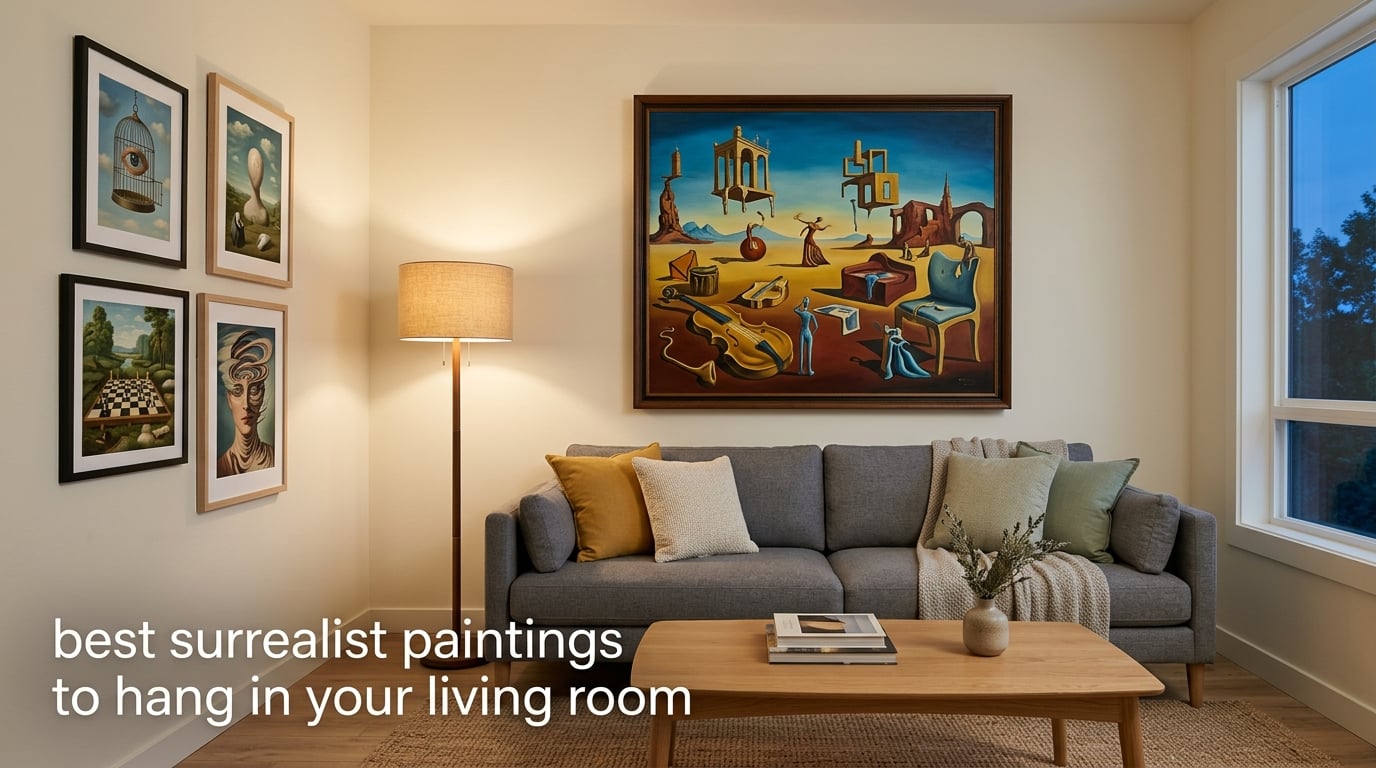
When I first hung a Salvador Dali print above my sofa, a friend stared at it for a full minute before asking, “Wait, is that clock actually melting?” That moment reminded me why surrealist paintings make perfect living room art. They slow people down. They spark conversation. They give your space a focal point that no neutral landscape ever could.
In this guide, I’ll walk you through the best surrealist paintings to hang in your living room. I’ll share my top picks from Dali, Magritte, Ernst, and some incredible female surrealists you may not have heard of yet. You’ll also get practical tips on sizing, framing, color matching, and where to buy museum-quality prints.
Table of Contents
What Makes Surrealist Paintings Perfect for a Living Room
Surrealist paintings are artworks inspired by the Surrealism movement that explore dreams, the subconscious mind, and unexpected imagery. They make perfect living room focal points because they invite curiosity without shouting for attention.
Before picking a piece, it helps to understand what makes surrealist art visually distinct. Here are the seven characteristics that define the genre and make these paintings so recognizable on a wall:
- Dreamlike imagery that feels pulled from sleep rather than waking life
- Unexpected juxtapositions of objects that shouldn’t belong together
- Bizarre combinations of scale, proportion, and perspective
- Thought-provoking symbolism rooted in Freudian psychology
- Iconic visual motifs like melting clocks, floating objects, and floating eyes
- Warped reality where physics bends to emotion
- Imaginative escapism that pulls viewers out of ordinary thought
Living rooms benefit from this kind of art because guests naturally gather in these spaces. A surrealist painting gives your room a built-in conversation starter that works every single time.
A Brief History of the Surrealism Movement
Surrealism began in Paris in 1924, when writer Andre Breton published the first Surrealist Manifesto. The movement grew directly out of the devastation of World War I, when European artists wanted to break free from the rational thought they blamed for the war. They turned instead to the unconscious mind, dreams, and Freudian theory.
Surrealism started as a literary movement before spilling into painting. The early surrealists practiced “automatic writing,” where they tried to write without conscious control. That same principle of free-flowing, unfiltered creativity shaped how artists approached canvas and brush.
By the 1930s, surrealist painting had split into two visual styles. The first, championed by Salvador Dali, produced hyper-realistic dreamscapes with melting clocks and impossible landscapes. The second, led by artists like Joan Miro, leaned into abstraction with biomorphic shapes and playful symbols. Rene Magritte walked a middle path, painting ordinary objects in contexts that turned them into riddles.
Most surrealist painters fled Europe during World War II and settled in the United States. The movement continued through the 1940s and 50s before fading, but its visual vocabulary still shapes how artists explore dreams and the unconscious mind today.
10 Best Surrealist Paintings to Hang in Your Living Room
These ten surrealist paintings work beautifully in living rooms of every size and style. I chose each one for its visual impact, color palette flexibility, and the way it rewards a long second look from your guests.
1. Salvador Dali: The Persistence of Memory (1931)
This is the surrealist painting everyone recognizes. Four soft, melting clocks drape over rocks, a dead tree branch, and a strange fleshy creature in a barren landscape. Dali painted it in just a few hours, drawing on his own dreams of soft camembert cheese left out in the sun.
Why it works in a living room: The warm desert tones pair with most neutral color schemes, and the small detail of ants swarming an orange clock gives viewers something to discover every time they look.
2. Rene Magritte: The Son of Man (1964)
A bowler-hatted man in an overcoat stands against a gray sea wall, his face hidden by a floating green apple. It’s self-portraiture filtered through Magritte’s signature question: what do we really see when we look at a person?
Why it works in a living room: The muted palette makes it a sophisticated anchor piece that doesn’t fight with other decor. It’s restrained enough for minimalist spaces but loaded with meaning.
3. Salvador Dali: The Elephants (1948)
Four impossibly thin elephants carry towering obelisks on their backs across a dreamlike plain. The contrast between fragile legs and massive weight creates Dali’s signature tension between strength and collapse.
Why it works in a living room: The vertical orientation and pale, washed-out colors give it presence without heaviness. It scales beautifully from intimate reading nooks to tall double-height walls.
4. Rene Magritte: The Treachery of Images (1929)
A painted pipe floats above the caption “Ceci n’est pas une pipe” (“This is not a pipe”). Magritte’s point: an image of a thing is not the thing itself. It’s philosophy disguised as a still life.
Why it works in a living room: The clean composition and limited palette work in modern, transitional, and even mid-century rooms. It also makes a fantastic office-to-living-room crossover piece.
5. Joan Miro: Harlequin’s Carnival (1924-1925)
A riot of biomorphic shapes, musical notes, eyes, and stars fills the canvas with joyful noise. Miro painted it as a hallucinatory vision of a circus festival on the moon.
Why it works in a living room: This is your energy piece. The bright primary colors wake up neutral rooms and complement bohemian, eclectic, or kids-included spaces beautifully.
6. Max Ernst: The Elephant Celebes (1921)
A massive mechanical elephant looms in a strange industrial landscape while a fish skeleton floats in a nearby pipe. Ernst combined memories of his German hometown with African tribal art and Dadaist absurdity.
Why it works in a living room: The moody ochre and gray palette suits warm industrial, rustic modern, and eclectic interiors. It’s also a great alternative if Dali feels too expected.
7. Leonora Carrington: Self-Portrait (Inn of the Dawn Horse) (1937-1938)
Carrington sits in a chair in a green-walled room, but a white horse bursts out of her back. Owls perch on the windowsill. A hyena waits in the corner. The painting captures her deep interest in Celtic mythology, alchemy, and female transformation.
Why it works in a living room: The deep green and earthy palette fits nature-inspired and bohemian rooms. It also brings a powerful female surrealist voice to spaces that often default to male artists.
8. Remedios Varo: Celestial Pablum (1960)
A lone figure in a yellow robe floats in a tower, mixing cosmic nourishment in a bowl while stars swirl above. Varo, a Spanish-Mexican artist, packed this painting with alchemical symbolism about feminine spiritual labor.
Why it works in a living room: The vertical format suits narrow wall spaces between windows or beside bookcases. The warm golden tones glow beautifully under evening lamps.
9. Yves Tanguy: Indefinite Divisibility (1942)
A featureless plain stretches beneath a sky filled with floating, biomorphic rock shapes in pale blues and creams. There is no horizon line, no human figure, no story. Just a hypnotic dreamscape.
Why it works in a living room: This is a meditation painting. Place it where you want quiet, slow visual interest. The soft palette works in coastal, Scandinavian, and minimalist rooms.
10. Kay Sage: I Saw Three Cities (1944)
Translucent fabric-like forms float between three ominous arched openings, evoking stage curtains pulled aside. Sage, one of the few prominent female surrealists working in America, painted architectural dreamscapes during World War II.
Why it works in a living room: The architectural structure makes it easy to “read” for viewers new to surrealism. The cool gray-blue palette pairs with almost any wall color.
How to Choose the Right Surrealist Painting for Your Space
Choosing surrealist art is less about rules and more about trusting your gut, but a few practical filters will help you narrow your options.
Start with your color scheme. Look at your sofa, curtains, rug, and accent pillows. Choose a surrealist painting that pulls two or three of those colors into its palette. This is the single fastest way to make art feel intentional rather than random.
Match the energy to the room. High-traffic living rooms where people gather and talk love energetic, colorful pieces like Miro. Reading nooks and bedrooms welcome quieter, slower paintings like Tanguy or Sage.
Consider the wall’s role. Above the sofa, you want a wide horizontal piece or a tight gallery cluster. On a tall narrow wall, choose a vertical work like Dali’s Elephants or Varo’s Celestial Pablum.
Trust the conversation test. If you can imagine a friend pointing at the painting and asking “What am I looking at?” you have a great surrealist piece. That moment of curiosity is the entire point of the genre.
Pick something you’ll still love in five years. Surrealist art holds up because it’s about timeless psychological themes. Choose imagery that resonates with you personally, not just what’s trending.
Sizing, Framing, and Hanging Tips for Surrealist Wall Art
Even the perfect painting can feel awkward if it’s the wrong size or hung incorrectly. Here’s how to make your surrealist piece feel like it has always belonged on your wall.
Two-thirds rule for above furniture. Your art should span roughly two-thirds of the furniture beneath it. If your sofa is 84 inches wide, look for art between 56 and 72 inches wide, or a gallery cluster that adds up to that span.
Eye level is 57-60 inches from the floor. Measure to the center of the painting, not the top. This is gallery standard and works in most living rooms.
Frame surrealist art with intention. Thin black or natural wood frames let the painting do the talking. Thick ornate frames compete with the imagery. For a modern minimalist space, try a floating mount with no frame at all.
Create a gallery wall with breathing room. Group three to five surrealist pieces with 2-3 inches of space between frames. Mix horizontal and vertical orientations for visual rhythm, but keep one consistent element like frame color or mat width to tie everything together.
Light it properly. Picture lights mounted 6-8 inches above the frame add drama and prevent glare on glass. If you use overhead track lighting, aim each fixture at a 30-degree angle to wash the painting without hotspots.
Leave negative space. One large surrealist painting on a clean wall often looks more sophisticated than a crowded arrangement. Let the dreamlike imagery breathe.
Where to Buy Surrealist Art Prints and Reproductions
You don’t need an original Dali to enjoy surrealist art on your wall. Here’s where I recommend looking for quality prints.
Established art marketplaces like Art.com and 1stdibs offer museum-quality prints with multiple framing options. Look for sellers that specify giclée printing on archival paper, which keeps colors true for decades.
Independent artist marketplaces like Etsy host many sellers producing high-resolution reproductions of public domain surrealist works. You can often request custom sizes.
Museum gift shops from MoMA, the Met, and the Tate sell officially licensed prints that come with verified provenance. These are usually more expensive but offer guaranteed color accuracy.
Specialty print shops focused on classic art often bundle multiple surrealist works into curated collections, which helps when building a gallery wall on a budget.
What to look for in any seller: high-resolution source images (at least 300 DPI at your final print size), acid-free archival paper, pigment-based inks instead of dye, and a clear return policy if the colors don’t match your expectations.
Frequently Asked Questions
What type of paintings are good for a living room?
Paintings that work well in a living room match the room’s color palette, fit the wall space proportionally, and create an emotional focal point. Surrealist paintings are a strong choice because they spark conversation and reward longer viewing.
What are the top 10 surrealist paintings?
The most iconic surrealist paintings include Salvador Dali’s The Persistence of Memory, Rene Magritte’s The Son of Man, Dali’s The Elephants, Magritte’s The Treachery of Images, Joan Miro’s Harlequin’s Carnival, Max Ernst’s The Elephant Celebes, Leonora Carrington’s Self-Portrait (Inn of the Dawn Horse), Remedios Varo’s Celestial Pablum, Yves Tanguy’s Indefinite Divisibility, and Kay Sage’s I Saw Three Cities.
What artwork should I put in my living room?
Choose artwork that matches your existing color scheme, fits the wall’s proportions, and reflects your personal taste. Art you find visually interesting will keep your attention for years, which matters more than following trends.
How do I arrange artwork on walls for a living room?
Hang the center of each piece 57 to 60 inches from the floor. Above furniture, span two-thirds of the furniture’s width with one large piece or a gallery cluster. Keep 2 to 3 inches between grouped frames and use consistent frame colors for cohesion.
What are the 7 characteristics of surrealist art?
The seven defining characteristics are dreamlike imagery, unexpected juxtapositions, bizarre combinations of scale and proportion, thought-provoking symbolism rooted in psychology, iconic visual motifs like melting clocks, warped reality, and imaginative escapism.
What kind of wall art is best for a living room?
Wall art that complements your existing furniture and invites conversation works best. Surrealist paintings are popular living room choices because they offer visual depth, intellectual engagement, and a memorable focal point.
Conclusion: Bringing Surrealism Home
Choosing surrealist paintings to hang in your living room is one of the most rewarding ways to express your personality through art. These pieces carry decades of artistic rebellion and psychological depth, yet they fit beautifully into modern, minimalist, bohemian, and eclectic homes alike.
Start with one piece that genuinely moves you. Dali’s The Persistence of Memory and Magritte’s The Son of Man remain classic entry points, but don’t overlook powerful works by Carrington, Varo, and Sage if you want something more unexpected. Measure your wall, choose a frame that complements rather than competes, and trust the conversation test: if the painting makes people pause, you’ve found your piece.
Surrealism has been inspiring living rooms for nearly a century. In 2026, its dreamlike imagery still beats any generic abstract print, and that’s exactly why these paintings belong on your wall.