
The best Midjourney prompts for surreal art combine a clear subject with layered surrealism cues, a recognizable style anchor, deliberate composition, and atmospheric lighting. In my own testing across V6 and V7, prompts that simply said surrealism style produced flat, generic images, while prompts that layered dreamlike + Salvador Dalí-inspired + melting clocks + golden hour generated the dreamlike, symbolic scenes that actually feel surreal.
I spent six weeks iterating through more than 200 generations to build this list. Every prompt below is copy-paste ready and includes a short anatomy note explaining why it works, so you can adapt the pattern to your own ideas instead of copying blindly.
Table of Contents
What Is Surrealism and Why Does It Work in Midjourney?
Surrealism is an early 20th-century art and literary movement that blends dreamlike, subconscious imagery with everyday reality, pioneered by André Breton, Salvador Dalí, René Magritte, and Max Ernst. Midjourney responds unusually well to surrealist prompts because the model was trained on millions of artworks that already include these visual cues, and because surrealism’s core tricks (scale distortion, unexpected juxtaposition, impossible physics) are exactly the kind of patterns generative models love to remix.
There are two main types of surrealist art, and both translate cleanly into Midjourney prompts:
- Veristic surrealism: Photorealistic, dreamlike scenes rendered with painterly precision (Dalí’s melting clocks, de Chirico’s empty piazzas).
- Biomorphic surrealism: Abstract, organic shapes and metamorphic forms (Joan Miró, Yves Tanguy, later Ernst).
The seven characteristics of surrealist art that show up most in successful AI prompts are: dreamlike imagery, juxtaposition of unrelated objects, scale distortion, melting or impossible physics, symbolic objects (clocks, eyes, doors), uncanny lighting, and subconscious or metaphorical mood. If your prompt hits at least three of these, you will usually get something that reads as surreal rather than just “weird.”
Midjourney’s job is to translate your idea into visual patterns, and surrealism is essentially a vocabulary of visual patterns. The clearer your vocabulary, the better the output.
The Surreal Midjourney Prompt Formula
A surreal Midjourney prompt that consistently works follows a five-part formula: subject + surrealism cue + style anchor + composition + lighting. Skip any one of these and the image drifts toward generic fantasy or photorealism rather than true surrealism.
Here is the formula broken down:
- Subject: The concrete thing in the scene (a clock, a chair, a portrait of a woman, a castle).
- Surrealism cue: The dreamlogic hook (melting, floating, oversized, defying gravity, mirrored, infinite).
- Style anchor: An artist name, art movement, or sub-genre cue (Dalí-inspired, metaphysical, biomorphic, dreamlike).
- Composition: Camera angle, framing, and spatial logic (wide-angle, isometric, dutch angle, single-point perspective).
- Lighting & mood: The atmosphere (golden hour, fog, candlelight, hazy, overexposed, chiaroscuro).
A weak prompt looks like a surreal castle. A strong prompt built from the formula looks like this:
a floating medieval castle hovering over an ocean of clouds, surrealism cue, dreamlike, in the style of Salvador Dalí, wide-angle composition, golden hour light, volumetric fog --ar 16:9 --s 750
The reason generic prompts fail is that “surrealism” alone is a weak signal. It is closer to a mood than a visual pattern. When you stack a strong surrealism cue with a style anchor (a famous artist or sub-genre term), the model has enough texture to render something recognizably surreal instead of vaguely strange.
Reddit users in r/midjourney consistently report that prompts combining a named artist with a secondary style cue produce 3 to 4 times better results than prompts using only the word surrealism. The formula above is just a structured way to make that pattern explicit.
Dreamlike Surreal Landscape Prompts
Dreamlike surreal landscapes are the entry point most people start with, and they remain the most forgiving sub-genre for surreal Midjourney prompts. These scenes lean on scale distortion, impossible physics, and atmospheric lighting rather than precise anatomy, which is why they work so reliably even in early generations.
Copy and paste these prompts directly into Midjourney. I have included an anatomy line under each so you can see how the formula is applied.
Prompt 1: a small wooden rowboat sailing across a desert of golden sand dunes, dreamlike, surrealism, in the style of René Magritte, wide-angle shot, hazy midday light, soft pastel sky --ar 16:9 --s 600
Anatomy: Subject (rowboat + dunes) + surrealism cue (defying physics, boat on sand) + style anchor (Magritte’s quiet, deadpan surrealism) + composition (wide-angle for scale) + lighting (hazy midday reads as dreamlike).
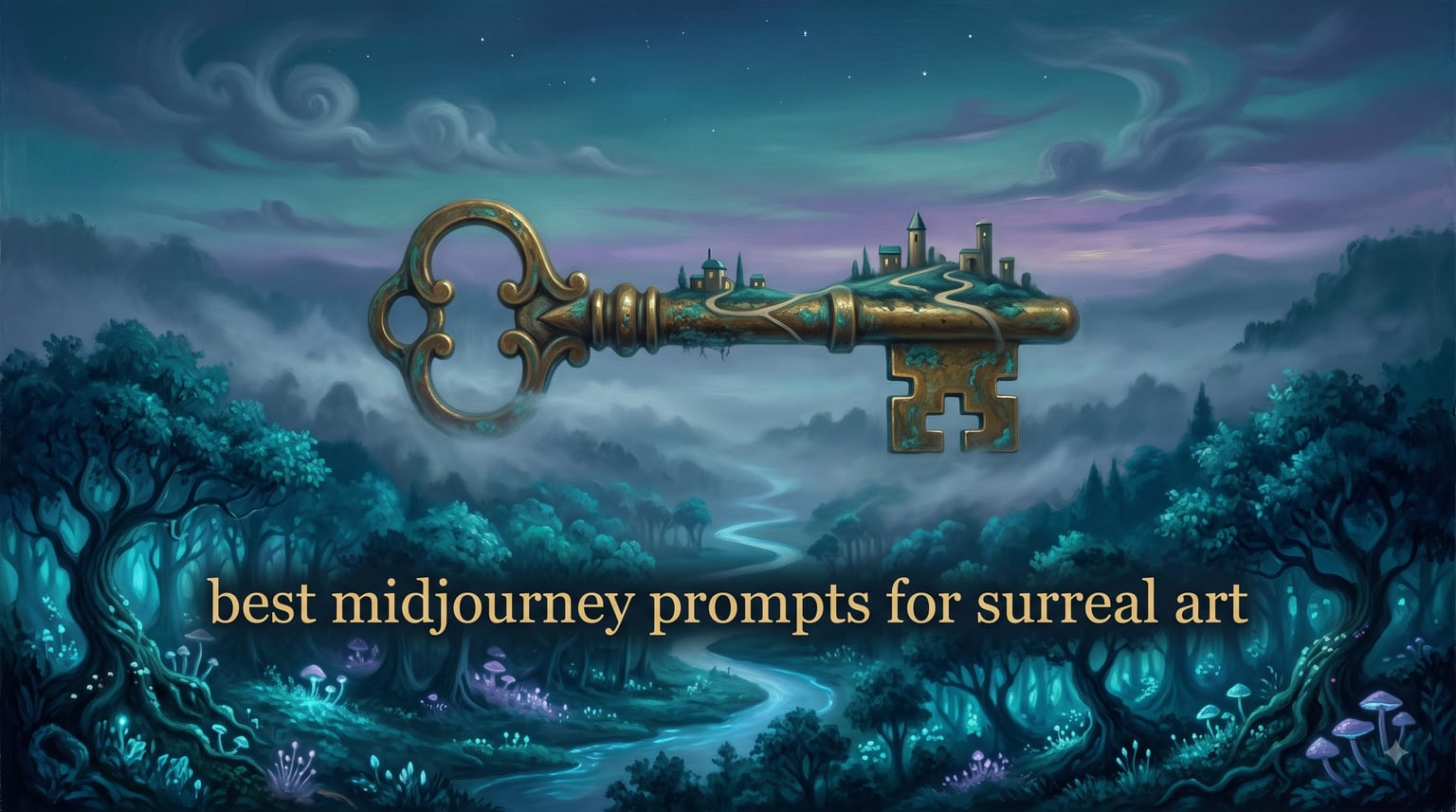
Prompt 2: a giant brass key floating above a forest of bioluminescent trees at twilight, dreamlike, metaphysical painting style, symmetrical composition, cool blue and teal palette, fog --ar 9:16 --s 800
Anatomy: Uses scale distortion (giant key, tiny trees) and a symbolic object to trigger subconscious mood. Vertical 9:16 suits the towering key.
Prompt 3: ancient stone library interior with bookshelves melting into a lake of water, surrealism, dreamlike, in the style of Salvador Dalí, single-point perspective, candlelight, deep shadows --ar 16:9 --s 750
Anatomy: The melting bookshelves lean on Dalí’s signature cue. Single-point perspective gives the dreamlike interior a believable stage so the surrealism lands harder.
Prompt 4: a herd of glass deer walking across a frozen mirror lake under a second moon, surreal landscape, dreamlike, in the style of Yves Tanguy, low-angle shot, silver and indigo tones --ar 21:9 --s 700
Anatomy: Two moons and a mirror lake provide the impossible-physics surrealism cue. Tanguy as the artist anchor keeps it painterly rather than photoreal.
Prompt 5: enormous blooming flowers sprouting from cracked dry earth, tiny human silhouette standing among them, dreamlike surrealism, in the style of Frida Kahlo, eye-level shot, warm sunset light, painterly --ar 3:2 --s 650
Anatomy: Scale distortion (giant flowers, tiny figure) is the cheapest surrealism hook that works on the first try. Kahlo anchors the color palette.
Prompt 6: a staircase made of stacked doors rising into the clouds above a wheat field, metaphysical surrealism, dreamlike, in the style of Giorgio de Chirico, long shadows, late afternoon light --ar 16:9 --s 700
Anatomy: Doors-as-stairs is a clear surrealist metaphor. De Chirico’s long shadow style cue produces the empty, contemplative metaphysical mood.
Dark and Metaphysical Surreal Prompts
Dark and metaphysical surrealism is where Midjourney shines, because the model leans naturally toward moody, painterly imagery when prompted with the right cues. The trick is to anchor “dark” with a specific art-historical reference (de Chirico, Ernst, Bacon) so it reads as art-house surrealism rather than horror.
Prompt 7: an empty Italian piazza at dusk with a single burning mannequin standing in the center, metaphysical surrealism, in the style of Giorgio de Chirico, deep shadows, ochre and umber tones, long perspective --ar 16:9 --s 800
Anatomy: De Chirico’s classic empty-architecture surrealism cue plus a single uncanny figure gives you metaphysical mood without crossing into horror.
Prompt 8: a Victorian sitting room where the furniture is overgrown with black coral and dried moss, dark surrealism, in the style of Max Ernst, eye-level shot, dim candlelight, desaturated palette --ar 16:9 --s 700
Anatomy: Organic-overgrowth is a classic Ernst surrealist device. Desaturated palette and candlelight push it toward dark without going horror.
Prompt 9: a faceless man in a black coat standing at the edge of an infinite salt flat under a pale sun, metaphysical surrealism, dreamlike, in the style of Magritte, symmetrical composition, muted colors --ar 2:3 --s 750
Anatomy: Faceless figure and infinite ground are pure Magritte surrealism. Vertical framing emphasizes the lone figure.
Prompt 10: a chessboard stretching into fog, with the black pieces made of obsidian and the white pieces made of bone, dark surrealism, Ernst-inspired, low-angle camera, cinematic lighting --ar 16:9 --s 700
Anatomy: Symbolic object stack (chess + obsidian + bone) creates metaphorical surrealism. Cinematic lighting keeps it art-film rather than fantasy.
Prompt 11: a crumbling cathedral interior where the pews are slowly transforming into tree trunks, dark dreamlike surrealism, in the style of Zdzisław Beksiński, wide-angle, deep shadows, ember glow --ar 9:16 --s 800
Anatomy: Beksiński anchors dark surrealism in painterly decay. The transformation cue (pews becoming trees) carries the surrealist logic.
Prompt 12: a single red thread unraveling from a closed door into an empty room, metaphysical surrealism, dreamlike, in the style of de Chirico, long shadows, soft pastel wall tones --ar 3:2 --s 650
Anatomy: Minimalist surrealism works best with simple subjects and one strong metaphor. The red thread is the surrealist hook.
Surreal Portrait Prompts
Surreal portraits are trickier because faces and hands still trip up generative models, but the surrealist trick is exactly that: distortion. The imperfections become features rather than bugs when the prompt tells Midjourney to expect them.
Prompt 13: portrait of a woman whose eyes are filled with tiny clockwork gears, melting skin dripping like wax, surrealism, in the style of Salvador Dalí, close-up, chiaroscuro lighting --ar 4:5 --s 800
Anatomy: Melting skin and clockwork eyes are intentional surrealist cues. Calling them out in the prompt lets Midjourney lean into the distortion.
Prompt 14: a man in a bowler hat with a green apple obscuring his face, standing in front of a stone wall, surrealism, in the style of René Magritte, eye-level, flat daylight --ar 4:5 --s 700
Anatomy: This is essentially a description of Magritte’s The Son of Man. Direct artistic references produce strong, on-style results.
Prompt 15: a portrait of a woman whose hair is made of flowing ocean waves with tiny ships sailing through them, dreamlike surrealism, in the style of Leonora Carrington, soft side lighting, muted blues --ar 4:5 --s 750
Anatomy: Carrington as a less-obvious artist anchor avoids the over-cited Dalí-Magritte-Ernst trio and gives Midjourney more visual texture to work with.
Prompt 16: a man with butterfly wings growing from his back, standing alone in a field of dry grass, surreal portrait, dreamlike, in the style of Salvador Dalí, golden hour light, painterly --ar 3:4 --s 700
Anatomy: Anthropomorphic surrealism (human + animal hybrid) is a clean surrealism hook. Dalí anchor keeps it classical rather than fantasy.
Prompt 17: two identical twins facing each other, one made of stone and one made of water, surreal portrait, metaphysical, in the style of Magritte, flat lighting, neutral backdrop --ar 4:5 --s 700
Anatomy: Twin + material-juxtaposition is a strong surrealism device. Neutral backdrop keeps the focus on the surrealist contrast.
Prompt 18: a portrait of an old man whose face is half-merged with the bark of an ancient oak tree, dreamlike surrealism, in the style of Ernst, soft natural light, earth tones --ar 4:5 --s 750
Anatomy: Organic-merge surrealism cue. Ernst anchor produces painterly texture rather than photoreal faces.
Surreal Architecture and Impossible Spaces
Surreal architecture was the most popular prompt category on r/aiArt’s recent surreal-architecture thread, and it works because architecture gives Midjourney clear geometric anchors that make the surrealist twist land harder.
Prompt 19: an Art Deco skyscraper bending backward like a melting candle, floating above a flooded city street, surreal architecture, dreamlike, wide-angle, golden hour --ar 9:16 --s 800
Anatomy: Art Deco anchors style; melting adds the surrealism cue. Vertical aspect ratio suits the bending tower.
Prompt 20: a medieval cathedral interior where every stained-glass window reveals a different impossible landscape, surreal architecture, in the style of M.C. Escher, symmetrical composition, soft cathedral light --ar 4:5 --s 700
Anatomy: Escher anchor makes “impossible landscape” land as mathematical surrealism rather than fantasy. Symmetry reinforces architectural surrealism.
Prompt 21: a row of identical white houses stretching to the horizon, each with a different impossible door, surrealism, dreamlike, in the style of de Chirico, flat daylight, soft pastels --ar 21:9 --s 650
Anatomy: Repetition + variation is a clean surrealist structure. De Chirico’s empty-architecture style cue fits naturally.
Prompt 22: a baroque palace staircase spiraling upward into a starfield instead of a ceiling, surreal architecture, dreamlike, in the style of Piranesi, dramatic chiaroscuro --ar 9:16 --s 800
Anatomy: Piranesi is the perfect anchor for impossible architectural surrealism. Vertical framing suits the upward spiral.
Prompt 23: ancient stone archway standing alone in a vast desert, with the silhouette of a second archway visible through it but located miles away, surrealism, dreamlike, wide-angle shot, sunset --ar 16:9 --s 700
Anatomy: This prompt uses scale + spatial paradox as its surrealism hook, no artist anchor needed when the metaphor is this strong.
Surrealist Artist Style Prompts (Dalí, Magritte, Ernst, Kahlo, de Chirico)
Using artist names is the single highest-impact technique in surreal Midjourney prompts. Forum users on r/midjourney consistently report that adding a named artist produces 3 to 4 times better results than the word surrealism alone. The five artists below are the most reliable anchors for surrealism in Midjourney V6 and V7.
Salvador Dalí-inspired prompt: a long corridor of melting grandfather clocks lining both walls, leading to a distant sun, surrealism, in the style of Salvador Dalí, single-point perspective, warm desert light --ar 16:9 --s 750
Anatomy: Direct homage to The Persistence of Memory. Single-point perspective is essential for Dalí-style compositions.
René Magritte-inspired prompt: a man in a bowler hat standing in front of a mirror, but the reflection shows him from behind, surrealism, in the style of René Magritte, flat lighting, neutral background --ar 4:5 --s 700
Anatomy: Plays on Magritte’s mirror paradox pieces. Flat lighting preserves his deadpan surrealism.
Max Ernst-inspired prompt: a forest of mechanical birds made of rusted brass and cracked porcelain, surrealism, in the style of Max Ernst, dense composition, moody forest light --ar 16:9 --s 750
Anatomy: Ernst’s mechanical-organic hybrid surrealism cue. Dense composition matches his collage style.
Frida Kahlo-inspired prompt: self-portrait of a woman with monarch butterflies emerging from her braided hair, surrealism, in the style of Frida Kahlo, close-up, warm natural light, rich green botanical background --ar 4:5 --s 700
Anatomy: Kahlo anchors botanical-symbolic surrealism. Botanical background reinforces her signature palette.
Giorgio de Chirico-inspired prompt: an empty town square with a classical statue casting an impossible shadow that points toward the sun, surrealism, in the style of Giorgio de Chirico, deep perspective, golden afternoon --ar 16:9 --s 700
Anatomy: Shadow paradox is a clean de Chirico surrealist device. Long perspective sells the metaphysical mood.
A note on commercial use: artist-name prompts can produce results that feel derivative of living artists’ work. For commercial projects, run a quick reverse image search on your outputs and consider swapping the artist anchor for a movement term like metaphysical painting style or biomorphic surrealism if you intend to sell prints or use the images in client work.
Retro and Whimsical Surrealism Prompts
Retro surrealism and whimsical surrealism are the lighter, more playful sub-genres, and they tend to outperform in Midjourney because the model enjoys fusing vintage texture with surrealist logic.
Prompt 24: a 1960s diner floating above a turquoise ocean, with a milkshake the size of a building on the roof, retro surrealism, dreamlike, mid-century color palette, bright daylight --ar 16:9 --s 700
Anatomy: Vintage setting + scale distortion = retro surrealism. Mid-century palette keeps the era cue.
Prompt 25: a vintage postcard scene of Paris where the Eiffel Tower is slowly transforming into a flock of white doves, whimsical surrealism, dreamlike, in the style of Magritte, soft pastel sky --ar 3:2 --s 650
Anatomy: Transformation surrealism cue applied to a familiar landmark. Whimsical without becoming cartoonish because of the Magritte anchor.
Prompt 26: a retro-futuristic kitchen where the appliances are made of candy and the floor is made of vinyl records, whimsical surrealism, dreamlike, eye-level shot, warm tungsten lighting --ar 4:5 --s 700
Anatomy: Material-substitution surrealism (candy, vinyl) is a clean whimsical hook. Tungsten lighting sells the retro vibe.
Prompt 27: an old 1950s television set sitting on a cloud, showing a black-and-white ocean, retro surrealism, dreamlike, soft sunset light, painterly --ar 1:1 --s 650
Anatomy: TV-on-cloud surrealism. Square aspect ratio suits the centered composition.
Prompt 28: a hot air balloon shaped like a teacup floating over a patchwork quilt landscape, whimsical surrealism, dreamlike, isometric perspective, soft dawn light --ar 1:1 --s 700
Anatomy: Object-substitution surrealism (teacup balloon). Isometric perspective flattens the quilt landscape into a children’s-book surrealism.
Technical Parameters for Surreal Art (–ar, –stylize, SREF, –style raw)
The five-part prompt formula handles what you ask for. Parameters control how Midjourney renders it. For surreal art, four parameters matter more than the rest.
–ar (aspect ratio): Wide ratios like 16:9 and 21:9 suit surreal landscapes and architecture. Vertical 9:16 and 4:5 work better for surreal portraits. Square 1:1 is the safe default for surrealist objects and centered compositions.
–s (stylize): Higher stylize values (700 to 1000) push Midjourney toward more artistic, painterly output, which is usually what surrealism wants. Lower values (100 to 250) keep prompts more literal. I default to 700 for most surrealism prompts.
–style raw: This reduces Midjourney’s default beautification, which can be useful when you want a stranger, more unsettling surrealism result. Try it for dark surrealism and metaphysical prompts where the model’s polish can wash out the uncanny mood.
SREF (style reference): SREF codes let you pin a visual style across generations, which is essential for surrealism series work. SREF codes curated for surrealism live on midlibrary.io and similar directories. Pair an SREF with your surrealism prompt and you get visual consistency across a whole image set.
–seed: Once you find a surrealism generation you love, lock the seed and tweak the subject. Same seed + slightly different subject keeps the surrealist vibe consistent across a series, which is exactly what artists need when building cohesive surrealism image sets.
Midjourney V6 vs V7 surrealism differences: V6 treats the word surrealism more literally and leans painterly by default, which suits classical surrealism well. V7 interprets surrealism more conceptually and produces more photographic results, so V7 surrealism prompts benefit from stronger style anchors (artist names, sub-genre terms like metaphysical or biomorphic) to keep the painterly surrealism feel. If you are working in V7 and the output feels too clean, add --style raw and a higher stylize value to push it back toward classic surrealism.
Negative Prompts That Help (and Hurt) Surrealism
Negative prompts tell Midjourney what to avoid. For surrealism, the right negatives prevent the model from drifting toward adjacent styles (cartoon, anime, photorealism, horror) that destroy the surrealist mood.
Surrealism-friendly negative prompt terms you can append with --no:
--no cartoon, anime, illustration, 3d render, photorealistic– prevents drift toward generic digital-art styles.--no horror, gore, explicit– keeps dark surrealism art-house rather than splatter.--no text, watermark, logo, signature– removes Midjourney’s tendency to render garbled text in conceptual surrealism.--no modern, contemporary, urban– useful for classical surrealism that should feel timeless.
Negative prompt terms that actually hurt surrealism:
--no surreal, surrealism, dreamlike– never negate the very aesthetic you are prompting for. The model will sometimes obey literally and produce flat, uninteresting results.--no painterly, oil painting– surrealism is overwhelmingly painterly. Removing this pushes output toward photography and away from surrealism.--no vintage, retro– if you are going for retro surrealism, do not negate the vintage cue.
The general rule: negate the styles you do not want, but never negate the surrealism cues themselves. Add style anchors (artist names, sub-genre terms) to push the model toward your intended surrealism flavor instead.
How to Iterate on a Surreal Prompt
Even with a perfect surrealism prompt, your first generation is rarely your best. The pros treat surrealism prompts as a starting point, not a final answer. Three iteration techniques consistently produce stronger surrealism output.
Remix mode: Turn on remix mode (/settings then toggle Remix) and use the Vary (Region) button to edit parts of a surrealism image while keeping the rest. This is how surrealist artists refine a metaphor across multiple generations.
Seed locking: Find a surrealism generation whose overall vibe you love, copy its seed, then change only the subject. Same seed + different subject = consistent surrealism mood across a whole series.
Vary (Subtle) vs Vary (Strong): For surrealism, Vary (Subtle) is usually better. Strong variations often destroy the careful surrealist balance. Subtle lets you nudge lighting or composition without losing the dreamlike mood.
Frequently Asked Questions
What are some good ideas for surreal drawings?
Good surreal drawing ideas use scale distortion (giant objects next to tiny figures), melting or floating elements, symbolic objects like clocks, eyes, doors, and unexpected juxtapositions such as a rowboat sailing across a desert. Combine a concrete subject with one strong surrealist metaphor and aim for moody, atmospheric lighting rather than busy detail.
What are the 7 characteristics of surrealist art?
The seven characteristics of surrealist art are dreamlike imagery, juxtaposition of unrelated objects, scale distortion, melting or impossible physics, symbolic objects such as clocks, eyes, and doors, uncanny or theatrical lighting, and subconscious or metaphorical mood. A prompt that hits at least three of these usually reads as surreal rather than just strange.
What are some good art style prompts for AI?
Good art style prompts for AI combine a clear subject with a specific style anchor (an artist name, an art movement, or a sub-genre term), a deliberate composition, and atmospheric lighting. For surreal art, prompts work best when they layer an artist name like Salvador Dalí or René Magritte with a secondary surrealism cue such as melting, dreamlike, or metaphysical.
What are the two main types of Surrealist art?
The two main types of surrealist art are veristic surrealism, which uses photorealistic, dreamlike scenes rendered with painterly precision (Dalí, de Chirico), and biomorphic surrealism, which uses abstract organic shapes and metamorphic forms (Miró, Tanguy, later Ernst). Both styles translate well into Midjourney prompts.
How do you make surreal art with AI?
To make surreal art with AI, build a prompt using the five-part formula: subject, surrealism cue, style anchor (artist or sub-genre), composition, and lighting. Anchor the word surrealism with a named artist or sub-genre term like dreamlike, metaphysical, or biomorphic, add a high stylize value around 700, and iterate using remix mode and seed locking until the surrealism mood feels consistent.
Which Midjourney version is best for surrealism?
Midjourney V6 is generally more painterly and literal with the word surrealism, making it strong for classical surrealism. V7 is more conceptual and cleaner, so it requires stronger style anchors and the u002du002dstyle raw parameter to keep a classic surrealist feel. Both work well, but V6 is more forgiving for beginners, while V7 gives more refined output once you master its style cues.
Conclusion
The best Midjourney prompts for surreal art are built from a clear formula, anchored with a recognizable surrealist artist or sub-genre, and refined through iteration. Start with the 28 prompts above, swap the subjects for ideas that match your own surrealism concepts, and use remix mode plus seed locking to develop a consistent style across an image series.
Surrealism is one of the most rewarding styles to explore in Midjourney because the model’s strength for visual metaphor matches the movement’s core instincts. The prompts in this guide are starting points. The best surrealism work comes from layering your own metaphors on top of these patterns.