
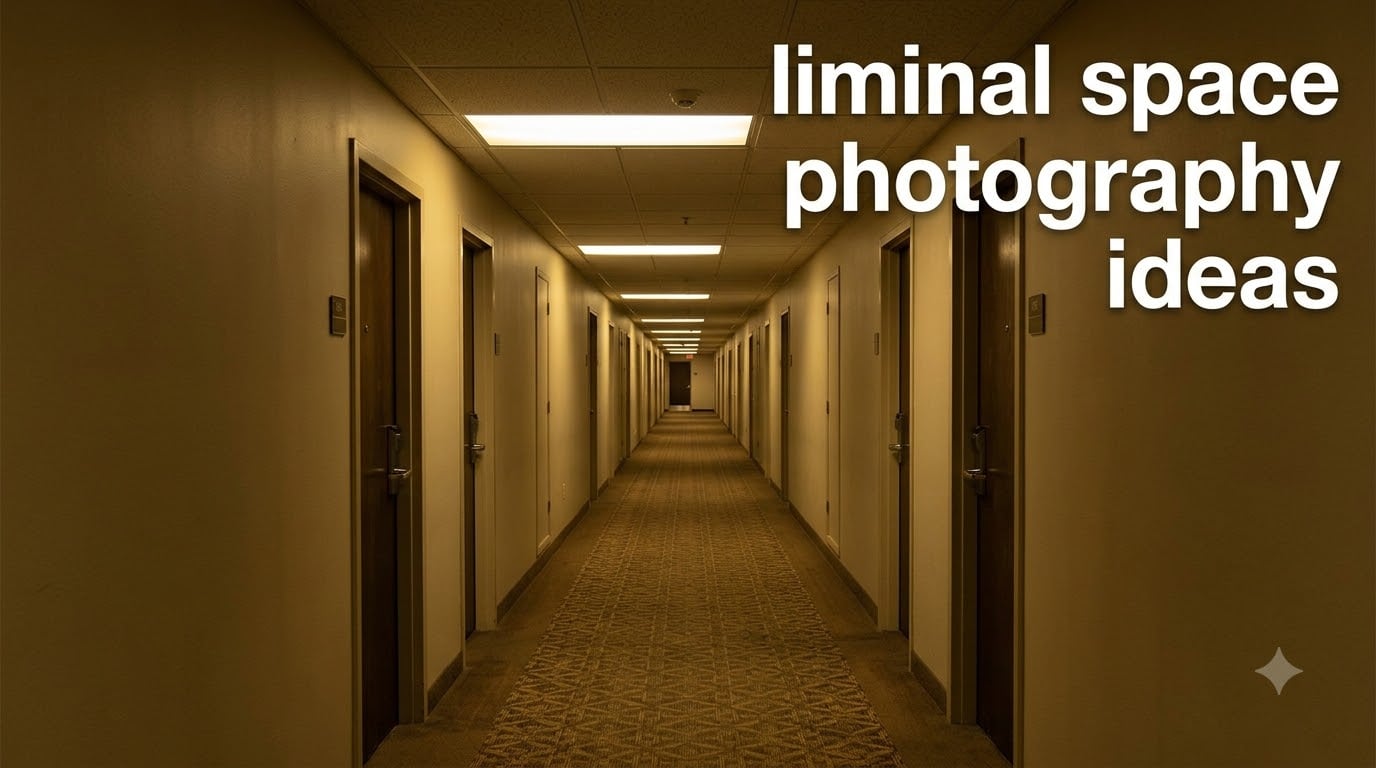
Liminal space photography captures transitional, empty places—hallways, malls, waiting rooms, and other in-between locations—whose absence of people creates an eerie, nostalgic, or dreamlike atmosphere. If you have ever walked through a deserted corridor late at night and felt something shift in the air, you already understand the pull of this aesthetic. This guide covers 50 liminal space photography ideas, camera settings, lighting techniques, editing workflows, and DIY setups you can try this weekend.
Table of Contents
What Is Liminal Space Photography?
Liminal space photography is an aesthetic movement rooted in the anthropological concept of liminality—the threshold between two states. In photography, it refers to images of transitional environments stripped of human presence: empty hotel corridors, fluorescent-lit office hallways after hours, abandoned mall atriums, and school classrooms during summer break.
The term gained mainstream traction through the Backrooms creepypasta, which originated on 4chan in 2019, and through communities like r/LiminalSpace on Reddit, which now boasts over 550,000 members. What defines a liminal photograph is not the location itself but the feeling it evokes: a familiar space rendered uncanny by emptiness.
Unlike street photography or architectural photography, liminal photography intentionally removes activity. The viewer is left alone in a place that was designed for crowds. That dissonance between purpose and presence is what makes the genre resonate so strongly, especially with Gen Z audiences navigating their own form of digital-age nostalgia.
Why Liminal Spaces Feel So Eerie
The eeriness of liminal spaces comes from a psychological phenomenon called kenopsia—the eerie atmosphere of a place that is usually bustling but is now abandoned. Our brains expect people, noise, and movement in these environments. When they are absent, something feels fundamentally wrong.
There are three psychological triggers at work:
- Familiarity without context: A hallway you have walked a thousand times looks alien when it is empty at 3 AM. The architecture is recognizable but the mood is not.
- Implied presence: Fluorescent lights buzzing, EXIT signs glowing, and thermostats humming suggest the space is alive—but no one is there. The mind fills in the missing people.
- Nostalgic dislocation: Many liminal spaces resemble 1990s and early 2000s architecture—Kmart aisles, Blockbuster stores, school gymnasiums. For millennials and Gen Z, these images trigger a specific, bittersweet memory of spaces that no longer exist in that form.
The COVID-19 pandemic amplified this aesthetic significantly. Empty airports, vacant shopping centers, and silent city streets made liminal photography feel less like an internet subculture and more like a shared lived experience.
Best Places and Locations to Find Liminal Spaces
You do not need to travel to an abandoned building to find liminal spaces. Some of the best locations are everyday places seen at the right time. Here are the most reliable categories:
Indoor Locations
- Hallways and corridors: Hotels, hospitals, office buildings, and apartment complexes during off-hours. The longer and more symmetrical, the better.
- Shopping malls: Visit early in the morning before stores open, or photograph the upper levels and parking structures that few people use.
- Theaters and cinemas: Empty screening rooms with rows of identical seats are quintessential liminal territory.
- Stairwells: Multi-level concrete stairwells with fluorescent lighting and no windows hit a very specific mood.
- Waiting rooms: Airports, doctor’s offices, and DMV lobbies all share that same liminal energy of waiting for something that never comes.
- Bowling alleys and arcades: These are particularly effective in the early morning or late at night when the machines are off and the lanes are empty.
- IKEA showrooms: The staged domesticity of a furniture showroom after hours creates an uncanny dollhouse effect that the liminal community loves.
Outdoor Locations
- Parking lots and parking garages: Multi-level garages with repeating concrete pillars are especially effective, particularly at dawn or dusk.
- Schools and campuses: Summer breaks and holiday weekends reveal these spaces stripped of their usual chaos.
- Gas stations at night: The harsh overhead lights against a dark sky create dramatic contrast.
- Playgrounds: Empty playgrounds at dusk, especially those with slightly worn equipment, hit a nostalgic nerve.
- Airports: Early morning terminals, long corridors between gates, and baggage claim areas with no luggage.
50 Liminal Space Photography Ideas and Prompts
These prompts are organized by category so you can pick based on what is available to you. Each one is designed to produce an image that feels authentically liminal.
Classic Liminal Indoor Scenes (1–15)
- A long hotel hallway at 2 AM with all room doors closed
- An empty hospital corridor with fluorescent lights and colored floor lines
- A shopping mall atrium photographed from the second floor, looking down
- A movie theater auditorium with no audience, just the empty red seats
- A school hallway during summer break with lockers lining both walls
- An office building lobby after business hours with security lights on
- A bowling alley at 5 AM with the lane lights off and scoring screens dark
- A laundromat at midnight with all machines idle and overhead lights buzzing
- A church nave with empty pews and sunlight through stained glass
- A subway platform late at night with no one waiting for the next train
- A convention center hallway between exhibit halls, completely vacant
- An empty gymnasium with polished floors reflecting the ceiling lights
- A library reading room at closing time with chairs pushed in
- An arcade with all machines powered down and overhead lights off
- A motel hallway with identical doors stretching to a vanishing point
Outdoor and Urban Liminal Scenes (16–25)
- A parking garage top level at dawn with a single vanishing-point corridor of pillars
- An empty playground at dusk with a swing mid-motion from a push you just gave it
- A gas station canopy at 3 AM with all pumps idle and overhead lights blazing
- A highway overpass looking down at an empty road with streetlights fading into fog
- A public pool area after closing with perfectly still water and no towels
- A small-town Main Street at 4 AM with all shops closed and one streetlight glowing
- An empty car wash tunnel with brushes and soap dispensers visible
- A sports stadium corridor with no game day activity
- An airport drop-off lane with no cars and automatic doors opening to no one
- A miniature golf course at closing time with artificial waterfalls still running
Nostalgic and Retro Liminal Scenes (26–35)
- A Kmart or Sears-style department store aisle with dated signage
- A Blockbuster-style video rental store with VHS tapes on shelves (or a recreation)
- A 1990s-style classroom with overhead projectors and globe on a shelf
- An old diner booth with checkered floors and jukebox, no customers
- A mall food court with empty tables and generic restaurant signage
- A roller skating rink with the disco ball off and lights on full
- A VHS-recorded living room with CRT TV, wood paneling, and carpet
- A fast-food restaurant interior from the late 1990s with plastic booths
- A Toys “R” Us-style toy aisle with neon price tags and wide aisles
- A video rental drop-off slot in a grocery store entrance
At-Home and DIY Liminal Setups (36–50)
- Your bathroom at 3 AM with only the nightlight or a single bulb on
- A hallway in your home photographed from floor level with all lights off except one at the far end
- Your laundry room with the washing machine door open and overhead fluorescent light on
- An empty bathtub with the shower curtain pulled halfway and water stains visible
- A garage with the door open to nothing but darkness outside
- A basement with exposed pipes and a single ceiling light
- A hotel-style room you recreate using matching lamps and generic bedding
- A children’s playroom at night with toys arranged but no child present
- A long corridor in any building shot with a wide-angle lens and centered framing
- An office cubicle farm after hours, even if it is your own workspace
- A stairwell in any building photographed looking down from the top
- A storage unit facility hallway with identical roll-up doors
- A parking lot shot from inside your car at 2 AM with the dome light on
- An empty elevator lobby with the floor indicator lit
- A kitchen at night with only the refrigerator light visible
Composition and Camera Tips for Liminal Photography
Getting the mood right depends as much on how you frame the shot as where you take it. The r/LiminalSpace community and experienced photographers consistently emphasize a few core principles.
Frame for Symmetry and Vanishing Points
Centered, symmetrical compositions are the backbone of liminal photography. Place your camera directly in the middle of a hallway, corridor, or aisle so both walls converge at a single vanishing point. This creates the feeling of being drawn into the space, which is exactly the unsettling pull you want.
Use leading lines aggressively. Floor tiles, ceiling beams, and wall edges should all converge toward the center of your frame. If the space has a door, window, or sign at the far end, center it.
Keep the Geometry Simple
Cluttered, geometrically complex spaces do not read as liminal. The r/LiminalSpace community specifically advises against rooms with too many objects or irregular shapes. Stick to clean lines, repeating patterns, and minimal furniture.
Choose the Right Camera Settings
For beginners with a phone camera, use the widest angle available and tap to focus on the vanishing point. For DSLR or mirrorless shooters:
- Aperture: f/5.6 to f/8 for deep focus across the entire scene
- ISO: Keep it low (100–400) to minimize noise, unless you want grain as an aesthetic choice
- Shutter speed: 1/60s or slower if the space is dim; use a tripod for long exposures
- White balance: Set to fluorescent or tungsten to preserve the cool, institutional light
- Focal length: 16mm to 35mm (full-frame equivalent) for that wide, immersive feel
A phone camera works perfectly well for liminal photography. The community values the mood of the image far more than technical quality. Some of the most upvoted posts on r/LiminalSpace are shot on older smartphones with visible compression artifacts—these actually enhance the nostalgic, early-internet aesthetic.
Lighting Techniques That Create the Liminal Mood
Lighting does most of the emotional work in liminal photography. The wrong light can make an otherwise perfect location feel ordinary.
Fluorescent Lighting
This is the gold standard for liminal photography. Buzzing overhead fluorescent tubes create a flat, slightly green or blue cast that feels institutional and unsettling. If a space has fluorescent lights, use them as your primary source. Do not add flash or supplementary lighting—it will ruin the sterile atmosphere.
Soft Natural Light
Early morning or overcast daylight filtering through windows can also work, especially in schools, churches, and airports. The key is evenness—avoid harsh direct sunlight, which creates dramatic shadows that pull attention away from the emptiness.
Off-Hours Timing
The best time to shoot liminal spaces is when they are genuinely empty:
- Late night (11 PM – 4 AM): For indoor public spaces, gas stations, and parking lots
- Early morning (5 AM – 7 AM): For malls, schools, and airports before activity begins
- Holiday closures: Christmas Day, Easter Sunday, and major holidays offer access to normally busy spaces in their emptiest state
Editing and Color Grading for the Liminal Look
Post-processing is where you seal the mood. The goal is to make the image feel slightly off—neither fully realistic nor heavily stylized. Here are the three most common liminal color palettes:
Warm Kodak Gold
This palette uses slightly desaturated warm tones with lifted blacks and a subtle yellow-orange cast. It mimics the look of expired Kodak Gold film and evokes 1990s family photo albums. In Lightroom, lower contrast by 15–20 points, add warmth to the white balance (+5 to +10), and lift the blacks in the tone curve.
Cool Fluorescent
A cooler palette with a green-blue tint that emphasizes the institutional feel of fluorescent-lit spaces. Desaturate reds and oranges slightly while boosting blues and greens. This is the look most associated with hospital hallways and office corridors.
VHS Grain
This palette adds visible film grain, slight blur, and compression artifacts to mimic the look of 1990s camcorder footage. It works best for nostalgic or domestic liminal scenes. Use a grain overlay at 30–50% opacity and reduce sharpness slightly.
In all cases, keep the edit subtle. The r/LiminalSpace community is strict about heavy-handed edits—strong glitch effects, vaporwave overlays, or obviously manipulated images get removed. The mood should come from the space itself, not from filters piled on top of it.
How to Create Liminal Photos at Home
You do not need access to abandoned malls or empty airports. Some of the most effective liminal photography comes from ordinary domestic spaces seen in a different light. Here is how to transform your own home into a liminal set:
The 3 AM Bathroom
Turn off all lights except a single nightlight or a small vanity bulb. The low, warm light against white tile and porcelain creates an immediately uncanny atmosphere. Shoot from the doorway looking in, centered on the mirror.
The Endless Hallway
If your home has a hallway longer than 10 feet, you have a liminal set. Turn on a single light source at the far end and leave the rest dark. Shoot from floor level with a wide-angle lens or your phone’s ultra-wide camera to exaggerate the length.
The Laundry Room
Fluorescent overhead light, white machines, concrete or linoleum floor—this room is practically designed for liminal photography. Open the washing machine door, leave a single basket on the floor, and shoot from the far corner.
The Parking Garage
If you have access to a residential or commercial parking garage, shoot on a level with minimal cars. The repeating concrete pillars, painted floor markings, and overhead fluorescent tubes create perfect liminal geometry. Early Sunday morning is the best time.
The Motel Room Recreation
Use generic lamps, white or beige bedding, and patterned carpet to recreate the look of a mid-range motel room. Pull the curtains closed so the only light comes from the room itself. The effect is a space that could be anywhere, which is the essence of liminality.
Common Mistakes to Avoid in Liminal Photography
The liminal photography community, especially r/LiminalSpace, has clear standards. Avoid these pitfalls to ensure your work resonates:
| Do | Do Not |
|---|---|
| Shoot empty spaces with no visible people | Include people, silhouettes, or figures—even distant ones |
| Use real photographs of real places | Submit AI-generated images (banned on r/LiminalSpace) |
| Keep edits subtle—slight grain, color shifts | Apply heavy glitch effects, vaporwave filters, or text overlays |
| Choose geometrically simple spaces | Shoot cluttered, visually complex rooms |
| Frame symmetrically with a clear vanishing point | Use Dutch angles or chaotic compositions |
| Capture transitional spaces (hallways, lobbies, corridors) | Photograph fully functional, populated spaces during business hours |
| Preserve the natural light of the environment | Use flash or add dramatic off-camera lighting |
The most common reason new photographers struggle with this genre is choosing spaces that are too interesting. A beige hallway is better than a colorful mural. A generic hotel lobby beats a historic cathedral. The eeriness comes from ordinariness, not from the exotic.
Frequently Asked Questions
What is liminal space photography?
Liminal space photography is an aesthetic movement that captures transitional, empty places—hallways, malls, waiting rooms, and other in-between locations—whose absence of people creates an eerie, nostalgic, or dreamlike atmosphere. The term comes from the anthropological concept of liminality, meaning the threshold between two states.
How do you make a photo look like a liminal space?
To make a photo look liminal, choose a geometrically simple transitional space like a hallway or lobby, shoot when it is completely empty, use centered symmetrical framing with a clear vanishing point, preserve the natural or fluorescent lighting, and apply a subtle color grade—either warm Kodak tones or cool fluorescent tints—without heavy effects.
Why is Gen Z obsessed with liminal spaces?
Gen Z resonates with liminal spaces because they evoke a specific form of nostalgia for 1990s and early 2000s architecture—malls, schools, video stores—that shaped childhood memories before the internet. The pandemic amplified this connection by making emptiness a shared lived experience, and platforms like TikTok and Reddit turned the aesthetic into a recognizable visual language.
What camera settings work best for liminal space photography?
Use an aperture of f/5.6 to f/8 for deep focus, ISO 100–400 to control noise, and a shutter speed of 1/60s or slower in dim spaces. Set white balance to fluorescent or tungsten to preserve institutional light. A focal length of 16–35mm (full-frame equivalent) gives the wide immersive look that defines the genre. Phone cameras work equally well—the mood matters more than technical specs.
Conclusion
Liminal space photography thrives on a simple contradiction: familiar architecture rendered unfamiliar by emptiness. Whether you are shooting a hotel hallway at 2 AM, a school corridor during summer break, or your own bathroom with a single nightlight, the principles remain the same—symmetry, stillness, and the absence of people. Start with the 50 liminal space photography ideas in this guide, pick two or three locations near you, and go out during off-hours. The best liminal photos come from ordinary places seen at the right moment.