
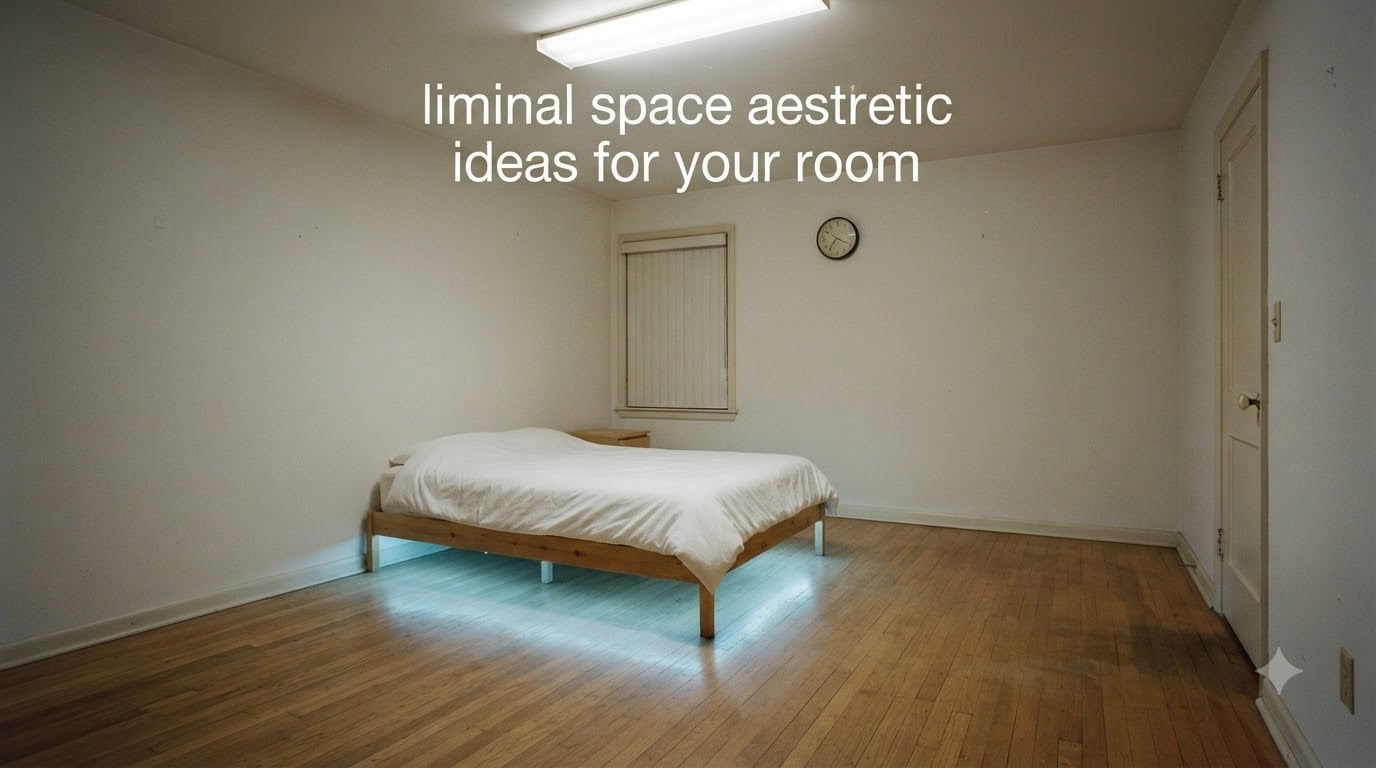
You know that strange feeling when you walk through an empty mall at 7 AM? Or find yourself in a hotel corridor where nobody else seems to exist? That eerie, nostalgic calm is the essence of the liminal space aesthetic, and bringing it into your room is easier than you think.
In this guide, I’ll walk you through exactly how to recreate the liminal space aesthetic in your own room, from the lighting and color palettes down to the small decor details that make it feel authentic. Whether you have a spacious bedroom or a cramped dorm, these ideas work.
Table of Contents
What Is the Liminal Space Aesthetic?
The liminal space aesthetic is a visual style built around empty, transitional places, think deserted hallways, vacant school corridors at night, or malls before anyone arrives. It evokes a soft, eerie nostalgia through fluorescent lighting, muted colors, and the uncanny feeling of being caught between one moment and the next.
The term “liminal” comes from the Latin word limen, meaning threshold. In anthropology, a liminal space is a place of transition, doorways, airports, waiting rooms, places you pass through but never truly inhabit. The aesthetic turns that transience into a visual mood that millions find deeply calming.
The phenomenon exploded in 2019 when a 4chan post about “The Backrooms”, an endless maze of empty office spaces with yellowed walls and buzzing fluorescent lights, went viral. That single creepypasta ignited an entire internet aesthetic. But the roots go deeper: Stanley Kubrick’s The Shining (1980) with its haunting Overlook Hotel corridors, and Stephen King’s The Langoliers (1995) with its abandoned airport, both planted the visual seeds decades earlier.
What separates liminal spaces from other eerie aesthetics is the mood: not horror, not darkness, but a quiet, almost peaceful emptiness. The Aesthetics Wiki community describes it as “soft, inviting emptiness” rather than stark terror.
How to Create a Liminal Space in Your Room (Step by Step)
Creating a liminal space is less about buying specific products and more about removing and replacing what already exists. Here is a proven process that works in any room size:
Step 1: Declutter aggressively. Liminal spaces are defined by emptiness. Strip your room down to the essentials, remove wall art, clear surfaces, and box up anything decorative. The goal is a room that looks like nobody has moved in yet.
Step 2: Neutralize the wall color. Paint or cover your walls in muted tones like off-white, cream, or a very desaturated beige. Bright colors break the spell immediately.
Step 3: Switch to cool, diffused lighting. Replace warm bulbs with cool white LEDs (4000K–5000K color temperature). Indirect lighting works best: LED strips behind furniture, floor lamps bouncing light off the ceiling, or a single overhead fluorescent-style panel.
Step 4: Choose sparse, anonymous furniture. A simple bed frame, one plain nightstand, a basic desk. Avoid anything with personality or character, liminal furniture should feel like it belongs in a waiting room.
Step 5: Emphasize length and emptiness. Position furniture to create long sight lines. If you have a hallway leading to your room, keep it unobstructed. The “transitional” feeling depends on the eye traveling through empty space.
Step 6: Add one or two eerie accent pieces. A retro clock, a single framed print of an empty swimming pool, a vintage lamp. These anchors signal the aesthetic without cluttering the room.
Step 7: Layer in soft ambient sound. This step gets overlooked, but it completes the experience. Play low drone music, distant mall ambiance recordings, or the classic “The Caretaker” album at barely audible volume.
Step 8: Photograph it. Take a photo of your finished room with slightly desaturated filter settings. If it looks like a place where time stopped, you nailed it.
The Liminal Space Color Palette (With Specific Tones)
Most guides describe liminal colors as “muted” or “desaturated,” which tells you almost nothing. Here are specific palette combinations that actually work, with the real-world tones you should look for:
Palette 1: Classic Backrooms — Yellowed off-white walls, mustard-tinted carpet, and warm fluorescent ceiling light. Think office beige with a 1990s cast. Hex reference: #E8DCC8 for walls, #C4A747 for carpet accents.
Palette 2: Dawn Corridor — Powder blue walls, cream trim, soft pink ambient glow from a window. This is the Lemon8 creator favorite and reads as dreamy rather than creepy. Hex reference: #B4C7D9 for walls, #F5E6D3 for trim, #D9A0A0 for light accents.
Palette 3: Poolcore Limbo — Aqua blue and white, inspired by indoor swimming pools and waterparks. Cool, chlorinated, and deeply nostalgic. Hex reference: #A8D8D0 for walls, #F0F0F0 for tile surfaces.
Palette 4: Haunted Office — Gray-white walls, gray carpet, bluish fluorescent overhead. This is the purest “eerie” version. Hex reference: #D3D3D3 for walls, #A8B0B8 for lighting cast.
Palette 5: Sage and Linoleum — Soft sage green paired with beige linoleum flooring. Retro school or hospital corridor feel. Hex reference: #B2C5B2 for walls, #D4C9A8 for floors.
The key rule: every palette should feel like it has been slightly washed out or faded, as though the room exists in a memory rather than the present.
Room-by-Room Liminal Makeover Ideas
Bedroom
The bedroom is the most popular room to transform and the one people search for most. Start by removing all wall decorations and replacing your bedding with solid white or cream. A single white bed against a blank wall reads as liminal immediately.
Swap your bedside lamp for a cool-toned LED strip along the headboard or under the bed frame. The light should glow upward or sideways, never directly at your face. Keep surfaces bare: one water glass, maybe a small retro alarm clock, nothing else.
For the floor, if you have hardwood, leave it bare. If carpet, a neutral beige or light gray works. Rugs should be avoided unless they are flat-weave and nearly invisible against the floor. Reddit’s r/LiminalSpace community consistently notes that the bedroom transformation works best when you resist the urge to add “just one more thing.”
Hallway and Transitional Spaces
Hallways are the most naturally liminal spaces in any home, and they need the least work. Remove anything on the walls, family photos, hooks, shelves. Paint or leave the walls a uniform off-white.
Add a single overhead light with a frosted globe cover. If your hallway has multiple doors, keep them all closed. The effect is a long, clean corridor that looks like it could continue forever, which is exactly the Backrooms feeling you want.
A runner rug in a neutral tone adds texture without personality. Avoid patterns. The hallway should feel like a place you walk through, never a destination.
Living Room
The living room is harder because it is a social space that needs to remain functional. The trick is to anchor the aesthetic in one zone rather than the entire room. Choose a single armchair or reading corner, strip the surrounding wall, and position a floor lamp with diffused cool light behind it.
If you want the full-room effect, switch your overhead light to a cool white bulb and minimize throw pillows and blankets. A single coffee table with nothing on it, facing a blank wall, creates a powerful liminal focal point. The Lemon8 creator behind one viral post describes it as “one armchair in an empty white room, lit from above,” and the comment section agrees that less is always more here.
Reading Nook
A reading nook can carry the liminal aesthetic beautifully because it is already a transitional space, a place between activities. Use a simple floor cushion or low chair, position it near a window with sheer curtains, and keep the surrounding area empty. The goal is a spot that feels like a quiet, in-between place where you exist outside normal time.
Liminal Space Aesthetic for Small Rooms and Budgets
You do not need a large space or a big budget to pull this off. In fact, small rooms often work better because emptiness is easier to achieve and more impactful in a tight space.
For dorm rooms and studio apartments: Remove everything from the walls, switch to white bedsheets, and add one LED light strip ($10–15) along the ceiling edge pointing upward. That single change transforms the mood. Use command strips instead of nails so you can take it all down when you move.
DIY on a budget: Print free liminal photography from Unsplash or Pexels (search “empty mall,” “deserted hallway,” or “abandoned corridor”) and frame them in basic dollar-store frames. A set of three prints on a blank wall costs under $10 and creates an instant focal point.
Rentals and temporary spaces: Stick-on wallpaper in a solid cream or off-white tone covers dated walls without damage. Cool-toned smart bulbs let you adjust the color temperature from your phone. Both are removable and reusable.
The honest truth from forum discussions is that the biggest barrier is not money, it is letting go of stuff. Liminal rooms require empty space. Box up your decorations for a month and see how the bare room feels before buying anything new.
Balancing Eerie and Cozy: Making It Livable
This is the question that comes up most in every liminal space community: how do you keep it from feeling like a horror movie set? The answer is texture and warmth beneath the surface coolness.
Use soft, high-quality bedding even if it is plain white. Add a plush throw at the foot of the bed. Keep the floor comfortable, bare wood or soft carpet, never cold tile in a bedroom. The eerie feeling comes from the emptiness and lighting, but the cozy feeling comes from what you actually touch.
Temperature matters too. A room that is physically warm but visually cool reads as inviting. A room that is both cold and visually cold just feels abandoned. Pair your cool-toned lighting with a space heater or warm HVAC setting.
The Aesthetics Wiki and Reddit communities consistently frame liminal spaces as “peaceful” and “reflective” rather than “scary.” If your room makes you want to curl up and read rather than run away, you have found the balance.
Liminal vs. Related Aesthetics: What Is the Difference?
Liminal space is often confused with several related internet aesthetics. Here is how they differ:
Dreamcore focuses on surreal, dream-like imagery with a softer, more whimsical tone. Where liminal is empty and quiet, dreamcore is populated with floating objects, distorted perspectives, and pastel skies. A dreamcore bedroom might have clouds painted on the ceiling; a liminal bedroom has bare white walls.
Weirdcore is the anxious sibling of dreamcore. It uses low-resolution imagery, unsettling text overlays, and distorted eyes. It leans into discomfort rather than calm. Liminal spaces are eerie but peaceful; weirdcore is intentionally disturbing.
Backrooms is technically a subcategory of liminal space, specifically the infinite maze of empty offices and storage rooms from the original creepypasta. Backrooms decor is more specific: yellow walls, damp carpet, buzzing fluorescent tubes, and water stains.
Poolcore focuses on indoor swimming pools, waterparks, and tiled aquatic spaces. It overlaps with liminal aesthetics in its emptiness and cool tones but adds chlorine-scented nostalgia and aqua blues.
Traumacore uses nostalgic childhood imagery, often 2000s-era, paired with darker psychological themes. It shares the nostalgic quality of liminal spaces but adds emotional weight and personal narrative.
Roomcore is the broadest category: any aesthetic centered on the feeling of a specific room. Liminal rooms are a type of roomcore, but roomcore also includes cozy cottage rooms, dark academia libraries, and cluttered maximalist spaces.
Why Gen Z Is Obsessed With Liminal Spaces
The liminal space aesthetic resonates deeply with Gen Z for a specific reason: it represents the world they remember from early childhood, 90s and early 2000s malls, arcades, waterparks, school corridors, captured at a moment when those places still existed. It is nostalgia for infrastructure that has largely disappeared.
The Backrooms phenomenon, born on 4chan and spread through YouTube and TikTok, gave this feeling a name and a visual language. But the obsession runs deeper than internet memes. Liminal spaces offer a form of digital escapism: a quiet, empty world free from the constant stimulation and social pressure that defines Gen Z’s online life.
There is also a psychological comfort in “in-between” places. Thresholds, waiting rooms, and empty corridors are spaces where nothing is expected of you. In a generation that feels constant pressure to perform, produce, and be visible, the appeal of a place where nothing happens is enormous.
The aesthetic has since expanded into real-world interior design, with Gen Z decorating bedrooms and apartments to recreate that frozen, peaceful feeling. It is not just a trend, it is a way of making your personal space feel like a refuge from the noise.
Frequently Asked Questions
Why is Gen Z obsessed with liminal spaces?
Gen Z connects liminal spaces with early childhood nostalgia for 90s and early 2000s environments like malls, arcades, and school corridors that have largely disappeared. The Backrooms phenomenon gave this feeling a visual name, and the aesthetic offers a form of digital escapism, a quiet, empty world free from constant social pressure and stimulation.
How to turn your room into aesthetic?
Start by removing all wall decorations and clutter, then switch to cool-toned diffused lighting around 4000K to 5000K color temperature. Replace bedding with solid white or cream, keep surfaces bare, and add one or two eerie accent pieces like a retro clock or empty-space photography. The key is restraint: every item you remove brings you closer to the look.
How to create a liminal space?
To create a liminal space, declutter aggressively until the room feels empty, paint walls in muted off-white or cream tones, switch to cool diffused overhead lighting, use sparse anonymous furniture, and emphasize long empty sight lines through the room. Add one or two nostalgic accent pieces and layer in soft ambient sound to complete the atmosphere.
Can you give me a list of liminal spaces?
Common liminal spaces include empty shopping malls, deserted school hallways, vacant hotel corridors, abandoned waterparks, quiet parking garages at night, airport terminals after hours, empty office buildings, hospital waiting rooms, basement recreation rooms, and indoor swimming pools with no swimmers. Any transitional space that feels frozen in time qualifies.
Wrapping Up: Your Liminal Space Starts With What You Remove
The liminal space aesthetic is not about buying the right products, it is about creating the feeling of a place caught between moments. Strip your room to its bones, layer in cool diffused light, and let the emptiness speak for itself.
Whether you are going for a classic Backrooms vibe with yellowed walls and buzzing fluorescents, or a softer Dawn Corridor feel with powder blue and pink glow, the principles are the same: remove clutter, neutralize color, and emphasize space. These liminal space aesthetic ideas for your room work at any budget and any room size.
Start with one zone, a corner, a hallway, even just your bedside table cleared of everything but a glass of water. Photograph it. If the photo looks like a place where time stopped, you are already there.