
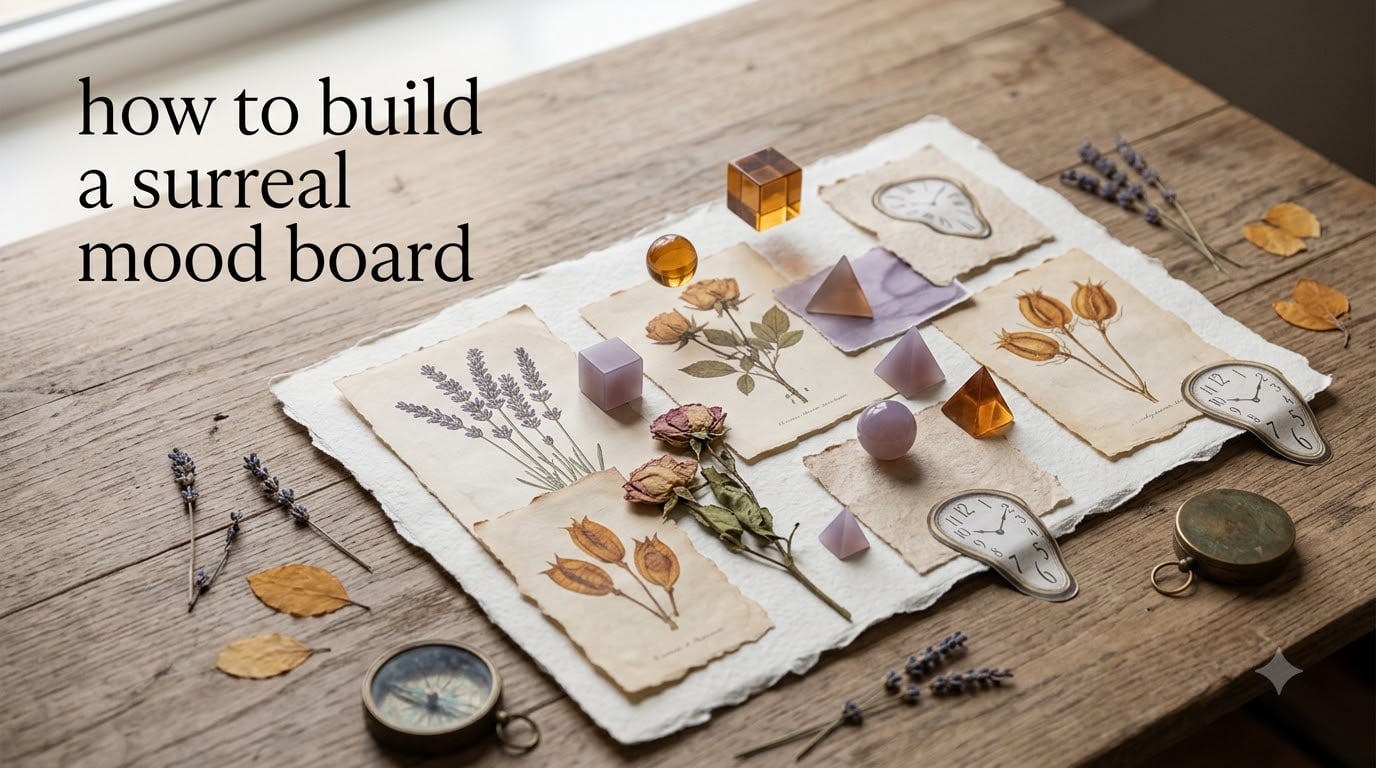
Surrealism grabs you by the collar and doesn’t let go. From Salvador Dalí’s melting clocks to René Magritte’s floating apples, the movement has shaped how we see the impossible made real. If you’ve ever wanted to channel that energy into a visual reference for your next art project, fashion collection, or creative writing piece, learning how to build a surreal mood board is exactly where to start.
A surreal mood board isn’t just a Pinterest dump — it’s a carefully curated collection of images, textures, colors, and symbols that captures dreamlike, irrational, and juxtapositional qualities. I’ve built dozens of these boards over the years, and the difference between a mediocre one and one that actually sparks creativity comes down to process. Surrealism as a design trend has only grown stronger in 2026, making this the perfect time to start. In this guide, I’ll walk you through every step, from that first flicker of inspiration to a polished board that feels like stepping into someone else’s dream.
Table of Contents
What Is a Surreal Mood Board?
A surreal mood board is a curated collection of images, textures, colors, and symbols that captures the dreamlike, irrational, and juxtapositional qualities of Surrealism to guide a creative project. Think of it as a visual manifesto that translates the subconscious into something you can see, touch, and build from.
Every strong surreal mood board shares these seven core elements:
- Juxtaposition — placing unrelated objects side by side to create unexpected meaning
- Dream imagery — scenes that feel pulled from sleep or memory rather than reality
- Distortion — warped proportions, melting forms, or impossible physics
- Unexpected scale — tiny elephants, enormous eyes, furniture that defies logic
- Color palette — a cohesive mood through muted tones, duotones, or jarring contrasts
- Texture — grain, patina, cracked surfaces, or ghostly smooth gradients
- Symbolism — recurring motifs like clocks, doors, staircases, eyes, and mannequins
These elements work together to create a board that doesn’t just look “weird” — it feels intentional. When someone looks at your mood board and gets a specific emotional response, you’ve nailed it.
How to Build a Surreal Mood Board: Step by Step
Building a surreal mood board follows a clear workflow. Skip a step and you’ll end up with a scattered Pinterest screenshot instead of a cohesive visual direction. Here’s the process that works every time.
Step 1: Start With a Dream Journal or Gut Feeling
Before you collect a single image, sit with a feeling. What kind of surreal world are you building? Artists in surreal collage Facebook groups say starting from a personal dream journal entry is the fastest path to a coherent board. Write down a recent dream, a recurring image from your imagination, or even just a color that’s been stuck in your head.
This gut feeling becomes your compass. Without it, you’ll pin everything that looks “surreal” and end up with chaos. With it, you’ll know exactly which images belong and which don’t.
Step 2: Gather Raw Visual Material
Now open Pinterest, Unsplash, or a stack of old magazines and start collecting. Pin 30 to 50 raw images that resonate with your starting feeling. Don’t overthink it — if something makes you pause, save it. This is the messy brainstorming phase, and it’s supposed to feel overwhelming.
Mix sources freely: vintage anatomy textbook scans, nature photography, film stills, architecture shots, and abstract textures all belong here. The goal is volume, not curation. You’ll refine later.
Step 3: Apply Surrealist Techniques to Curate
Now comes the surreal part. Take your 30-50 raw images and start filtering them through Surrealist principles. Ask yourself: which images create unexpected meaning when placed next to each other? Which ones distort reality? Which ones feel like they came from a dream? Forcing these questions onto your collection transforms it from a generic mood board into something genuinely surreal.
Step 4: Choose a Sub-Theme
Surrealism isn’t monolithic. Creative Market splits surreal mood boards into three distinct vibes, and this framework works beautifully:
- Dreamy Gradients — soft, ethereal, muted pastels with blurry edges and floating forms
- Urban Glitches — digital distortion, neon cracks, cyberpunk-surreal hybrids
- Dark Visions — heavy shadows, baroque drama, occult symbolism, gothic undertones
Pick one. Trying to blend all three into a single board dilutes the impact. You can always build separate boards for each sub-theme later.
Step 5: Build a Color Palette and Texture Story
Extract colors from your strongest images. Using HEX palettes from existing surreal art — say, pulling tones from a Magritte painting — helps avoid the “flat” look that beginners struggle with. Aim for 4-6 colors that work together, with one dominant tone and two or three accents.
Texture is equally important. Grain, cracked plaster, wet glass, velvet, rusted metal — these add a sensory dimension that flat digital images alone can’t achieve. If your board is all digital, overlaying subtle texture layers in Canva or Photoshop gives it the depth traditional surrealist paintings have.
Step 6: Compose and Arrange
Composition guides the eye. Place your strongest image (your focal point) slightly off-center — dead center feels static. Arrange supporting images so the viewer’s gaze travels in a deliberate path across the board. Leave breathing room between elements; a surreal mood board needs space for the eye to wander, just like a dream needs silence between its moments.
Step 7: Ruthlessly Cut to 7-12 Final Images
This is the hardest step and the most important. Several Pinterest power-users report that pinning 30-50 raw images and then cutting to 7-12 is the magic number for impact. Every image that doesn’t directly support your sub-theme, color palette, or emotional tone gets removed. If you’re hesitating over an image, that hesitation is your answer — cut it.
The final board should feel inevitable, like every image was always meant to be there together.
Surrealist Techniques to Use on Your Mood Board
Surrealism isn’t just an aesthetic — it’s a set of creative techniques developed over a century. Borrowing these for your mood board adds depth that generic “weird” boards lack.
Juxtaposition
The backbone of Surrealism. Juxtaposition means placing objects together that have no logical relationship — a fish wearing a top hat, a telephone inside a lobster. On a mood board, this translates to pairing images that create friction: a serene landscape next to industrial machinery, a child’s drawing beside a medical diagram. The tension is the point.
Scale Distortion
Make the small enormous and the large miniature. A tiny house floating in a giant teacup. A colossal eye peering through a keyhole. Scale distortion is one of the most instantly recognizable surrealist devices, and it works brilliantly as a compositional tool on mood boards. One oversized element surrounded by normal-sized ones creates immediate visual interest.
Frottage
Originally developed by Max Ernst, frottage involves placing paper over textured surfaces and rubbing with pencil or charcoal to create imprints. On a mood board, you can achieve this digitally by layering textured scans beneath your images — wood grain, brick patterns, fabric weave — creating a ghostly, tactile background that gives the board physical depth.
Decalcomania
This technique involves pressing paint between two surfaces and pulling them apart to create organic, unpredictable patterns. Think Rorschach blots meets dream landscapes. Digitally, you can mimic this by overlaying mirrored or blended texture layers, creating the kind of eerie symmetry that feels pulled from the subconscious.
Exquisite Corpse
A collaborative drawing game where each person adds to a figure without seeing what the previous person drew. For mood boards, this principle means combining fragments from unrelated sources — a vintage portrait head on a botanical body with architectural legs. The result feels unsettling and cohesive at the same time, which is pure Surrealism.
Dislocation
Taking objects out of their expected context. A staircase leading nowhere. A door opening onto the ocean. A clock draped over a tree branch. On your mood board, look for images that show familiar objects in unfamiliar settings. This dislocation is what makes surreal art feel like a dream — everything looks real, but nothing makes sense.
Surreal Mood Board Sub-Themes to Explore
Need a starting point? These five surreal sub-themes give you a clear direction while leaving room for personal interpretation.
Dreamy Gradients
Soft palettes — lavender, blush pink, powder blue, and muted gold — with blurry edges and floating forms. This sub-theme pulls from Dalí’s more ethereal works and contemporary vaporwave aesthetics. Think cotton-candy clouds, translucent figures, and everything looking like it’s underwater or half-remembered.
Urban Glitches
Digital distortion meets city life. Neon cracks in concrete, pixelated faces, fragmented architecture. This sub-theme leans into the technological uncanny — reality breaking down through screens and data. Palette: electric cyan, hot magenta, deep black, and silver.
Dark Visions
Heavy shadows, baroque drama, and gothic undertones. Dark Visions channels the more unsettling side of Surrealism — think Francisco Goya’s Black Paintings meets H.R. Giger’s biomechanical nightmares. Palette: deep burgundy, charcoal, bone white, and oxidized copper.
Dalí-Inspired Dreamscapes
The classic surreal landscape — endless deserts, melting objects, elephants on spider legs, burning giraffes. This sub-theme is faithful to Salvador Dalí’s visual language: warm amber tones, hyper-detailed textures against empty space, and objects that shouldn’t exist but feel strangely real. Palette: amber, sand, deep blue sky, and crimson accents.
Botanical Surrealism
Plants and flowers behaving impossibly — roots growing from eyes, vines wrapping around floating geometric shapes, oversized petals opening onto miniature cities. This sub-theme blends natural beauty with surreal distortion, and it’s especially popular for fashion and interior design mood boards. Palette: forest green, terracotta, ivory, and dusty rose.
Common Mood Board Mistakes to Avoid
I’ve seen the same errors come up again and again. Here’s what to watch out for:
- Over-cluttering. Beginners say their first boards look like “random Pinterest screenshots” rather than a unified vision. More images don’t mean more ideas — they mean less focus. Stick to 7-12 curated images.
- Copying Pinterest literally. Repinning existing surreal boards and calling it yours isn’t building a mood board. Use Pinterest as raw material, then apply your own Surrealist lens to curate something original.
- Ignoring a focal point. Without one strong anchor image, the board feels like it has no center of gravity. Pick your single most compelling image and build everything else around it.
- Clashing palettes. Surrealism thrives on contrast, but that doesn’t mean random colors thrown together. Even a “chaotic” board needs a cohesive color story to hold it together visually.
- Neglecting texture. Texture gives a mood board the third dimension that flat digital images can’t achieve. Without it, even the most surreal composition looks sterile and unfinished.
Tools for Building Your Surreal Mood Board
You don’t need expensive software to build a surreal mood board. Here’s what works best across different approaches:
Canva is the go-to for beginners and quick digital boards. It’s free, has drag-and-drop simplicity, and offers enough templates to get started. The limitation is that it lacks advanced layering and blending modes, so achieving deep surrealist texture effects requires workarounds.
Pinterest remains the strongest research and inspiration tool. Create a secret board, pin aggressively, then use it as your raw material pool. The algorithm will also start feeding you surreal content you wouldn’t have found on your own, which is genuinely useful for discovery.
Photoshop or GIMP gives you full control over layers, blending modes, and texture overlays. If you want to apply frottage or decalcomania digitally, you need this level of control. GIMP is free and handles most of what Photoshop does for mood board work.
Physical boards — magazines, fabric scraps, found objects, printed images on cork or foam — offer a tactile dimension no screen can match. The act of cutting and pasting by hand connects to the original Surrealist practice in a way digital tools can’t replicate. Many artists keep both: a physical board for the hands-on exploration and a digital version for sharing.
Frequently Asked Questions
What should a good mood board include?
A good mood board includes 7-12 carefully curated images, a cohesive color palette of 4-6 tones, varied textures, a clear focal point, and supporting elements that share a consistent mood or theme. For surreal mood boards specifically, add symbolism and at least one element of juxtaposition or scale distortion.
How many images should a surreal mood board have?
Between 7 and 12 images is the sweet spot. Pin 30-50 raw images during the research phase, then ruthlessly cut to the strongest 7-12 that support your sub-theme, color palette, and emotional tone. Fewer than 7 feels thin; more than 12 becomes cluttered.
Can I use a mood board for fashion or interior design?
Absolutely. Surreal mood boards are popular in fashion for editorial and avant-garde collection direction, and in interior design for creating rooms that feel dreamlike or otherworldly. The same building process applies — you just tailor your source images to fabrics, textures, and furniture instead of fine art.
What is the difference between a mood board and a collage?
A mood board is curated with intention — every image serves a specific purpose in communicating a direction or feeling. A collage is more about artistic expression and can be spontaneous or random. Mood boards are reference tools; collages are finished artworks. A surreal mood board borrows collage techniques but keeps the focus on guiding a project.
Where do surrealists get their ideas from?
Surrealists draw from dreams, the subconscious mind, automatic writing and drawing, found objects, and the unexpected juxtaposition of familiar things. For mood board building, dream journals are especially powerful — write down images from sleep and use them as your starting point for visual collection.
Conclusion
Knowing how to build a surreal mood board comes down to a repeatable process: start with a feeling, gather raw material, filter through Surrealist principles, choose a sub-theme, build a color and texture story, compose intentionally, and cut ruthlessly. The techniques — juxtaposition, scale distortion, frottage, dislocation — aren’t just art history trivia. They’re practical tools that transform a generic collection of images into something that genuinely channels the subconscious.
Start with a dream journal entry. Pin 30 images. Cut to 10. Pick a sub-theme. Extract a palette. Build your board. The surrealists didn’t wait for permission to explore the impossible, and neither should you.