
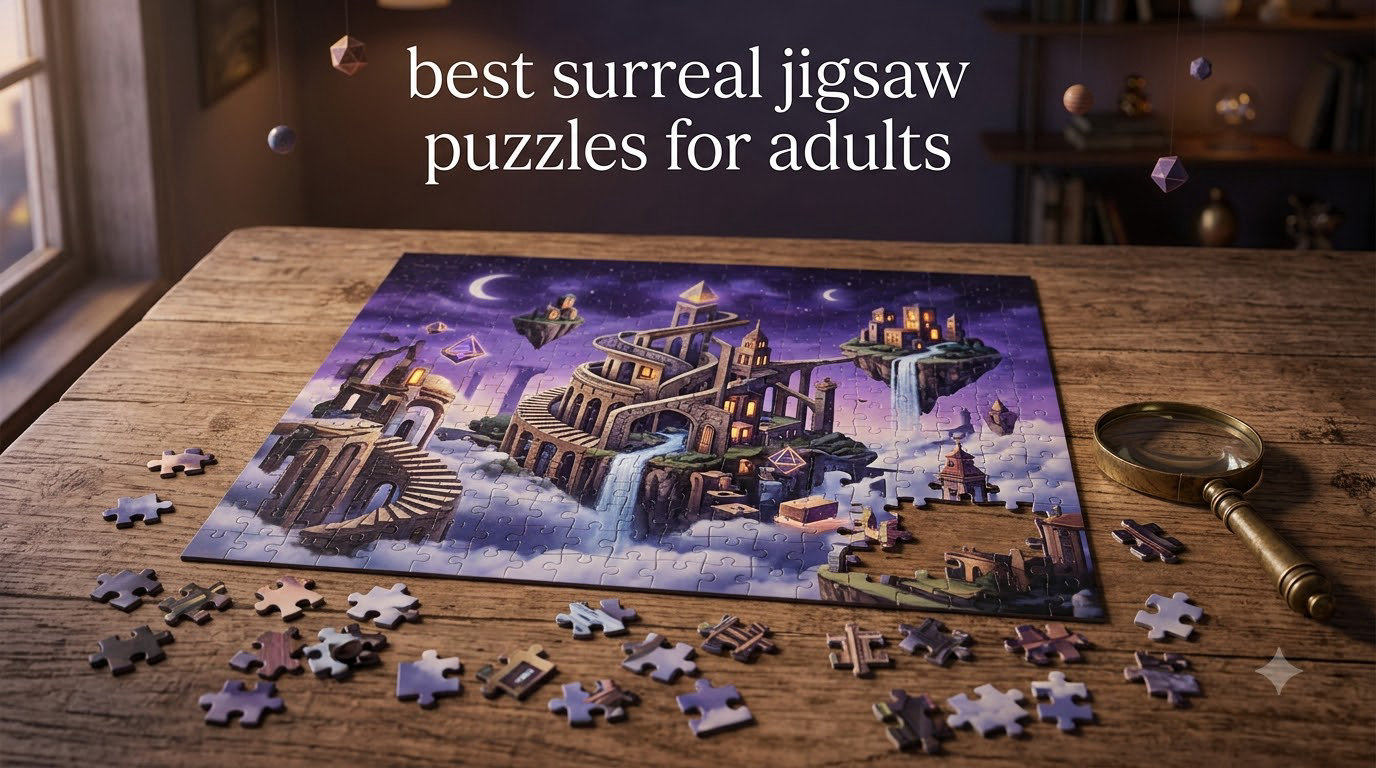
If you’ve ever found yourself staring at a melting clock on a desert landscape and thought “I want to spend 12 hours piecing that together,” you’re in the right place. Surreal jigsaw puzzles for adults combine the mind-bending imagery of 20th-century surrealism with the slow, meditative satisfaction of puzzling. They turn dreamlike art into a hands-on experience that engages your brain in two ways at once.
I started collecting surreal puzzles a few years ago after finishing a 1000-piece Magritte on a rainy weekend. What surprised me most wasn’t the challenge. It was how the imagery slowly started making sense piece by piece. Impossible windows aligned. Floating apples found their shadows. The art came alive through the assembly.
This guide covers the best surreal jigsaw puzzles for adults you can buy right now in 2026, from accessible 500-piece starter sets to marathon 2000-piece dream worlds. You’ll find detailed recommendations, artist spotlights, a difficulty rating system, and tips for choosing your next surreal obsession.
Table of Contents
Quick Picks: Best Surreal Jigsaw Puzzles for Adults
Short on time? Here are my top three recommendations across different experience levels:
Best Overall: Dream of Surrealism 1000 Piece Puzzle by Laurence King — A curated collage featuring Dali, Magritte, Ernst, and more surrealist masters. Excellent print quality, ribbon-cut pieces, and a vibrant color palette that keeps assembly engaging.
Best for Dali Fans: The Persistence of Memory 1000 Piece Puzzle — Melting clocks, barren landscapes, and that signature warm glow. Grafika produces this with museum-quality printing on premium stock.
Best for Beginners: Magritte’s Son of Man 500 Piece Puzzle by Eurographics — Recognizable bowler hat imagery makes sections easier to sort. Anti-glare matte finish reduces eye strain during long sessions.
What Makes a Puzzle Truly Surreal?
A surreal jigsaw puzzle features imagery inspired by the surrealist art movement — dreamlike scenes, impossible geometry, floating objects, and visual paradoxes that challenge your perception. The art movement began in 1924 when Andre Breton published the Surrealist Manifesto, and it has produced some of the most iconic imagery of the 20th century.
Surrealism translates beautifully to puzzles for three reasons. First, the imagery is densely packed with small details — a floating bowler hat, a melting clock, a green apple obscuring a face — giving you natural sorting anchors. Second, unusual color palettes break up sections in ways that traditional landscape puzzles don’t. Third, the inherent weirdness of the imagery creates conversation pieces once completed and framed.
The best surreal puzzles go beyond a single famous artwork. Curated collage puzzles mix multiple artists and styles, introducing you to the broader movement while you assemble. Single-artist puzzles let you focus deeply on one master’s vision and technique.
Key Visual Elements to Look For
Melting or distorted objects: Salvador Dali’s signature soft clocks and drooping forms create areas where piece shapes matter more than color matching.
Impossible architecture: Giorgio de Chirico’s empty plazas and Rene Magritte’s floating castles challenge your spatial reasoning.
Obscured faces: Magritte’s apples, cloths, and birds covering human faces force you to work with subtle skin-tone gradients.
Dreamlike scale shifts: Remedios Varo’s miniature worlds and Yves Tanguy’s bone-dust landscapes place tiny details next to vast empty spaces.
Top 12 Surreal Jigsaw Puzzles for Adults in 2026
After testing dozens of puzzles and cross-referencing community feedback from r/Jigsawpuzzles, here are the twelve surreal jigsaw puzzles that consistently deliver the best combination of art, quality, and assembly experience.
1. Dream of Surrealism 1000 Piece Puzzle (Laurence King)
This is the gateway surreal puzzle. Laurence King curated a vibrant collage featuring works from Dali, Magritte, Ernst, Leonora Carrington, and Dorothea Tanning in one cohesive design. The 1000-piece count is the sweet spot for adult puzzlers — challenging but finishable in a weekend.
The ribbon-cut pieces fit together with satisfying precision, and the matte finish prevents glare during long sessions. A full-size reference poster comes included, which experienced puzzlers know is essential for complex collage work. One Reddit user shared: “Really fun puzzle, finished it in two nights.”
Best for: First-time surreal puzzle buyers and anyone who wants a sampler of the movement.
2. The Persistence of Memory 1000 Piece Puzzle (Grafika)
Grafika’s reproduction of Dali’s most famous melting-clock painting is a masterclass in puzzle printing. The colors are rich and accurate to the original — those warm amber tones in the foreground against the cool blue cliffs require careful color sorting but reward you with a stunning finished piece.
The 1000 pieces are random-cut, meaning no two adjacent pieces share the same shape. This adds difficulty but also prevents the “trick piece” frustration of ribbon-cut puzzles. Expect 8-12 hours of assembly time.
Best for: Dali completists and anyone who appreciates fine art printing.
3. The Son of Man 500 Piece Puzzle (Eurographics)
Rene Magritte’s iconic painting of a man in a bowler hat with a floating green apple obscuring his face works brilliantly as a 500-piece puzzle. The recognizable subject matter and limited color palette make this approachable for beginners while still offering satisfying challenge.
Eurographics uses soy-based inks and recycled materials, and the pieces have a sturdy 2mm thickness. The anti-glare matte finish is a thoughtful touch for evening puzzling under lamps.
Best for: Surrealism beginners and casual puzzlers who want a recognizable masterpiece.
4. The Treachery of Images 1000 Piece Puzzle (Bluebird)
Bluebird’s reproduction of Magritte’s “Ceci n’est pas une pipe” (“This is not a pipe”) is a meta-masterpiece. You’re assembling a puzzle of a painting that claims not to be what it clearly is. Expect philosophical conversations while you sort the text and pipe imagery.
The minimalist design with cream background and bold black text makes sections easy to isolate. The 1000-piece count breaks down nicely into the text element, the pipe element, and the background.
Best for: Philosophy-loving puzzlers and Magritte fans.
5. The Elephant Celebes 1000 Piece Puzzle (Eurographics)
Max Ernst’s 1921 surrealist masterpiece features a giant elephant with a mechanical head standing in a desert landscape. The combination of organic and mechanical forms creates fascinating puzzle regions that require both color and shape matching.
Eurographics prints on linen-textured paper that feels premium and reduces glare. The included reference poster is large and detailed, which helps with the complex central figure.
Best for: Anyone interested in surrealism’s roots in Dada and collage.
6. Galileo’s Dream 1000 Piece Puzzle (Pomegranate)
Pomegranate publishes museum-quality art puzzles, and their reproduction of a composite surrealist scene inspired by Galileo’s astronomical observations is no exception. The piece features intricate starry backgrounds, floating figures, and architectural elements that reward patient assembly.
Pomegranate uses thick, sturdy pieces with a linen finish. The color reproduction is exceptional — deep blues, warm golds, and rich earth tones that stay vibrant under normal household lighting.
Best for: Astronomy lovers and detail-oriented puzzlers.
7. The Lovers 1000 Piece Puzzle (Clementoni)
Rene Magritte’s painting of two figures kissing with cloth draped over their faces is one of surrealism’s most haunting images. Clementoni’s reproduction captures the muted greens and shadowy atmosphere beautifully.
The 1000 pieces are precision-cut with a tight fit that experienced puzzlers appreciate. The reference poster is printed at full size with sharp detail, which matters for the subtle skin tones and fabric textures.
Best for: Couples puzzling together and Magritte enthusiasts.
8. Creation of the World 1000 Piece Puzzle (Eurographics)
Remedios Varo’s 1962 painting of a goddess-like figure spinning the universe from her own being is one of surrealism’s most beautiful images. Eurographics’ reproduction does justice to the original’s muted greens, soft pinks, and golden light.
The intricate background of spheres, threads, and architectural details creates satisfying puzzle sections. Expect 10-14 hours of assembly time.
Best for: Discovering lesser-known surrealist artists.
9. The Sleep of Reason Produces Monsters 1500 Piece Puzzle (Eurographics)
Francisco Goya’s 1799 etching predates the surrealist movement but influenced it profoundly. This 1500-piece puzzle features the dreamer surrounded by bats, owls, and shadowy creatures emerging from the darkness. The high-contrast black-and-white imagery is challenging but striking once completed.
The larger piece count rewards patience and methodical sorting. The matte finish reduces glare on the darker sections, which is essential for this predominantly monochrome design.
Best for: Nighttime puzzling sessions and anyone who enjoys dark, atmospheric imagery.
10. Mama, Papa is Wounded 1000 Piece Puzzle (Pomegranate)
Yves Tanguy’s 1927 surrealist landscape features organic, bone-like forms scattered across an alien terrain. The muted palette of beiges, soft blues, and dusty pinks creates a meditative assembly experience.
Pomegranate’s printing captures the subtle gradients that make Tanguy’s work so distinctive. The 1000 pieces break down into sky, ground, and the central biomorphic figures.
Best for: Fans of abstract surrealism and calm, focused puzzling.
11. Surrealist Painting 1000 Piece Puzzle (Laurence King)
Another collage option from Laurence King, this puzzle features multiple surrealist works arranged in a gallery wall format. It’s a great choice if you want exposure to several artists and styles in one puzzle. Recognizable works from Magritte, Dali, Delvaux, and others create natural assembly zones.
The gallery format means you can complete smaller works within the puzzle as mini-goals, which keeps motivation high during longer sessions.
Best for: Art history buffs and gallery-wall decorators.
12. The Eye of Silence 1500 Piece Puzzle (Eurographics)
Max Ernst’s surrealist landscape with an enormous eye emerging from architectural ruins is one of the movement’s most striking compositions. The 1500-piece count is a serious commitment, but the result is worth framing.
The combination of geometric architectural elements and organic sky textures creates a satisfying balance of structured and challenging sections. Plan for 15-20 hours of assembly time spread across multiple sessions.
Best for: Experienced puzzlers looking for a showpiece.
Artist Spotlights: Surrealist Masters Behind the Puzzles
Understanding the artists behind your puzzle transforms it from a hobby project into an art history lesson. Here are five surrealist masters whose work appears most often in puzzle form.
Salvador Dali (1904-1989)
The most commercially recognizable surrealist, Dali’s melting clocks, burning giraffes, and dream-logic landscapes appear on dozens of puzzles. His technical precision — those soft watches required extraordinary painting skill — translates to puzzles with rich color gradients and detailed textures.
Start with: The Persistence of Memory for the most famous imagery, or The Elephants for a less-crowded composition.
Rene Magritte (1898-1967)
The Belgian master’s bowler-hatted men, floating apples, and “this is not a pipe” wordplay puzzles remain culturally relevant more than 60 years after his death. His work appeals to logical thinkers who enjoy visual paradox.
Start with: The Son of Man for accessibility or The Treachery of Images for philosophical depth.
Max Ernst (1891-1976)
The German-French surrealist pioneered frottage and grattage techniques that produced dreamlike textures. His work feels older, stranger, and more primal than his peers.
Start with: The Elephant Celebes for mechanical surrealism or The Eye of Silence for atmospheric landscapes.
Remedios Varo (1908-1963)
The Spanish-Mexican surrealist created intricate, alchemical scenes of women in tower laboratories spinning threads of the universe. Her work is underrepresented in puzzles but absolutely worth seeking out.
Start with: Creation of the World for her most famous composition.
Yves Tanguy (1900-1955)
The French surrealist painted alien landscapes populated by biomorphic forms — neither quite objects nor creatures. His work is meditative and abstract, perfect for puzzlers who enjoy color-gradient challenges.
Start with: Mama, Papa is Wounded for his signature style.
How Difficult Are Surreal Jigsaw Puzzles?
Surreal puzzles range from beginner-friendly 500-piece sets to marathon 2000-piece epics. Difficulty depends on three factors: piece count, color complexity, and image distinction.
Beginner (500-750 pieces): Recognizable subjects with limited color palettes. Expect 4-8 hours. Great for casual puzzlers and date nights.
Intermediate (1000 pieces): The sweet spot for most adult puzzlers. Expect 8-14 hours depending on image complexity. Most surrealist puzzles fall in this range.
Advanced (1500 pieces): Requires sustained focus over multiple sessions. Expect 15-25 hours. Best for committed hobbyists.
Expert (2000+ pieces): Multi-day or multi-week projects. Expect 25-40+ hours. Reserved for serious puzzlers.
Surreal imagery often falls on the harder end within each piece count because dreamlike scenes have fewer natural landmarks than traditional landscapes. A 1000-piece surreal puzzle typically takes 20-30% longer to complete than a 1000-piece landscape puzzle.
Factors That Increase Difficulty
Similar color regions (Tanguy’s muted landscapes), repetitive textures (Dali’s desert backgrounds), and large areas of single colors (Magritte’s sky sections) all slow progress. Random-cut pieces add another layer of challenge compared to ribbon-cut designs where piece shapes follow predictable patterns.
Factors That Decrease Difficulty
Distinctive focal points (a floating bowler hat), high-contrast imagery (Goya’s black-and-white etchings), and reference posters with sharp color reproduction all make assembly smoother. Working under good lighting with a dedicated puzzle surface helps significantly.
Choosing the Right Piece Count for Your Skill Level
Piece count is the single biggest factor in how long a puzzle takes and how challenging it feels. Here’s how to match count to your experience and available time.
500 pieces: Best for beginners, casual puzzlers, and anyone wanting a weekend project. Most adults finish in 4-8 hours. Works well for family puzzling with mixed skill levels.
1000 pieces: The standard for adult puzzling. Expect 8-14 hours for surreal puzzles specifically. Most surrealist art puzzles are produced at this count because it’s the sweet spot for showing artwork detail without overwhelming assembly time.
1500 pieces: For puzzlers who find 1000-piece puzzles too quick. Expect 15-25 hours. Best for retirees, work-from-home puzzlers, and anyone wanting a multi-week project.
2000+ pieces: Serious hobby territory. Expect 25-40+ hours. These puzzles often become long-term projects displayed on dedicated tables.
Consider your available time honestly. A 2000-piece puzzle sitting half-finished on a dining table for three weeks creates household friction. A 1000-piece puzzle you finish in a weekend provides satisfaction without dominating your living space.
Where to Buy Surreal Jigsaw Puzzles
Surrealist art puzzles are available from several reliable sources, each with different strengths.
Amazon: The largest selection with customer reviews that help you gauge quality before buying. Most major brands (Laurence King, Eurographics, Grafika, Clementoni) have strong presence. Watch for third-party sellers with inconsistent quality.
Puzzle Warehouse: A specialty retailer focused entirely on jigsaw puzzles. Strong art puzzle category with curated surrealist selections. Their filtering by piece count, brand, and artist makes browsing easier than general marketplaces.
Jigsaw Puzzle UK: Carries 235,000+ puzzles including extensive surrealist art sections. Good option for European shoppers or anyone seeking less common brands.
Publisher Websites: Buying directly from Laurence King, Pomegranate, or Eurographics often gives access to exclusive editions and the full catalog. Many offer subscriptions or notification systems for new surreal puzzle releases.
Local Game Stores and Museums: Independent retailers often carry curated art puzzle selections. Museum gift shops sometimes stock puzzles featuring their collections, which occasionally include surrealist works.
Thrift Stores and Estate Sales: Vintage surrealist puzzles from the 1980s and 1990s turn up regularly at a fraction of retail. Quality varies wildly, so inspect pieces for wear and completeness before buying.
Best Brands for Surreal Art Puzzles
Brand matters more in art puzzles than in standard landscape designs. Print quality, piece thickness, and color accuracy vary significantly across publishers.
Laurence King Publishing
The gold standard for collage-style surrealist puzzles. Laurence King curates multi-artist designs that introduce you to the broader movement. Excellent printing, ribbon-cut pieces, and creative subject selection. Their Dream of Surrealism puzzle is the genre’s most popular entry point.
Eurographics
Known for consistent quality and environmentally conscious production (soy-based inks, recycled materials). Strong selection of single-artist surrealist puzzles. Anti-glare matte finish is a signature feature.
Grafika
Premium positioning with museum-quality printing. Tends toward famous single artworks like The Persistence of Memory. Random-cut pieces add challenge. Higher price point justified by exceptional color reproduction.
Pomegranate
Museum-affiliated publisher with exceptional art credentials. Thicker pieces and linen finish give a premium feel. Excellent catalog of lesser-known surrealist artists alongside famous names.
Clementoni
Italian publisher with strong printing quality and tight-fitting pieces. Good value for money. Strong selection of Magritte and Dali works.
Bluebird
Known for stylish, design-forward puzzle selections. Good choice for puzzles intended as display pieces after completion.
Ravensburger
The German giant isn’t a surrealist specialist, but their quality control and piece precision are industry-leading. Limited surrealist selection, but worth considering when they release relevant designs.
What to Look for When Buying a Surreal Puzzle
Beyond artist and piece count, several quality indicators separate excellent puzzles from frustrating ones.
Print Quality and Color Accuracy
Examine product photos carefully. Colors should match the original artwork as closely as possible. Faded or oversaturated prints indicate lower-quality reproduction. Reviews often mention when puzzle colors differ significantly from reference images.
Piece Thickness and Cut
Thicker pieces (2mm or more) feel more substantial and last longer if you disassemble and reuse. Random-cut pieces add challenge; ribbon-cut pieces assemble more predictably. Both styles have fans, and quality varies within each category.
Finish Type
Linen finish reduces glare and feels premium. Matte finish also reduces glare. Glossy finishes look vibrant but create reflection problems under direct lighting. For long sessions, matte or linen is significantly easier on your eyes.
Reference Poster Inclusion
Most quality puzzles include a full-size reference poster. This is essential for complex collage designs and single artworks with subtle color gradients. Puzzles without posters are harder to complete and offer less value.
Box Quality and Storage
A sturdy box with secure closure keeps pieces organized during multi-day projects. European brands tend to have stronger box construction. If you plan to complete and disassemble, the box’s durability matters for long-term storage.
Piece Fit Precision
Tight-fitting pieces stay together when you move sections during assembly. Loose-fitting pieces fall apart constantly, creating frustration. Reviews from experienced puzzlers often mention fit quality.
Assembly Tips for Complex Surreal Puzzles
Surrealist imagery presents unique challenges compared to traditional puzzle subjects. These strategies help.
Sort by color first. Surreal puzzles often have unusual color palettes that don’t match real-world expectations. Sort pieces into general color families before attempting sections.
Identify distinctive objects early. Floating apples, melting clocks, and bowler hats are natural focal points. Build these recognizable elements first to anchor your progress.
Work in sections. Don’t try to build the whole puzzle linearly. Complete distinct objects or regions, then connect them. Surreal puzzles reward this approach because sections often don’t connect obviously.
Use good lighting. Color matching matters more in surreal puzzles than in traditional designs. A bright, daylight-balanced lamp prevents eye strain and improves color discrimination.
Take breaks. Surreal imagery can create visual fatigue because your brain works harder to interpret unusual scenes. A 15-minute break every 90 minutes maintains focus and prevents the “I can’t see anything anymore” frustration.
Frame your finished puzzles. Surreal puzzles make excellent wall art. Puzzle glue and frames specifically sized for common dimensions are widely available. A well-framed surreal puzzle is a conversation piece that lasts years.
Surreal Jigsaw Puzzles as Gifts
Surreal puzzles make thoughtful gifts for several reasons. They’re accessible to non-puzzlers who appreciate art, they offer hours of engagement, and they introduce recipients to a cultural movement they might not otherwise explore.
For art lovers: Choose puzzles featuring artists they admire. Magritte for philosophers, Dali for drama, Ernst for abstraction.
For experienced puzzlers: Select 1500-2000 piece counts with random-cut pieces for added challenge.
For casual hobbyists: 500-1000 piece collage puzzles from Laurence King offer sampler experiences that don’t require deep art history knowledge.
For couples and families: Recognizable imagery (The Son of Man, The Persistence of Memory) invites collaboration and conversation during assembly.
For stress relief: Muted, atmospheric puzzles like Tanguy’s work offer meditative assembly without the visual intensity of more dramatic surrealist scenes.
Frequently Asked Questions
What are the best surreal jigsaw puzzles for adults?
The top surreal puzzles include Dream of Surrealism by Laurence King (1000 pieces), The Persistence of Memory by Grafika (1000 pieces), and The Son of Man by Eurographics (500 pieces). These offer strong print quality, engaging imagery, and appropriate challenge levels for adult puzzlers.
Where can I buy surrealist jigsaw puzzles?
Surreal puzzles are available on Amazon, Puzzle Warehouse, Jigsaw Puzzle UK, and directly from publisher websites like Laurence King, Pomegranate, and Eurographics. Local game stores, museum gift shops, and thrift stores also carry selections.
How difficult are surreal jigsaw puzzles compared to regular puzzles?
Surreal puzzles typically take 20-30% longer than traditional landscape puzzles at the same piece count. Dreamlike imagery has fewer natural landmarks, unusual color palettes make sorting harder, and random-cut pieces add complexity. A 1000-piece surreal puzzle usually requires 10-14 hours.
What piece count is best for adult jigsaw puzzles?
1000 pieces is the most popular count for adult puzzles, offering 8-14 hours of assembly time and a satisfying weekend project. Beginners should start with 500 pieces, while experienced puzzlers often prefer 1500-2000 pieces for longer-term projects.
Are surreal puzzles good gifts for art lovers?
Yes, surreal puzzles make excellent gifts for art lovers because they combine engagement with exposure to famous artworks. Choose puzzles featuring artists the recipient admires. A 1000-piece Laurence King collage or a single-artist Eurographics design works well for most recipients.
What brands make the best surreal art puzzles?
Laurence King leads for collage-style multi-artist puzzles. Eurographics excels at single-artist reproductions with matte finish. Pomegranate offers museum-quality printing. Grafika produces premium single artworks. Clementoni provides good value with strong color reproduction.
Final Thoughts on Choosing Your Next Surreal Puzzle
The best surreal jigsaw puzzles for adults transform famous artworks into hands-on experiences that engage your brain in two ways at once. My top recommendation remains the Dream of Surrealism by Laurence King for anyone new to the genre. It’s accessible, beautifully printed, and introduces you to multiple artists in one satisfying project.
For committed Dali fans, Grafika’s The Persistence of Memory offers museum-quality reproduction worth the premium. For beginners or casual puzzlers, Eurographics’ The Son of Man provides recognizable imagery at an approachable piece count.
Whatever you choose, surreal puzzles reward patience and curiosity. Set aside a weekend, clear your table, and let the dreamlike imagery emerge piece by piece. You’ll finish with a deeper appreciation for 20th-century art and a satisfying sense of accomplishment.