
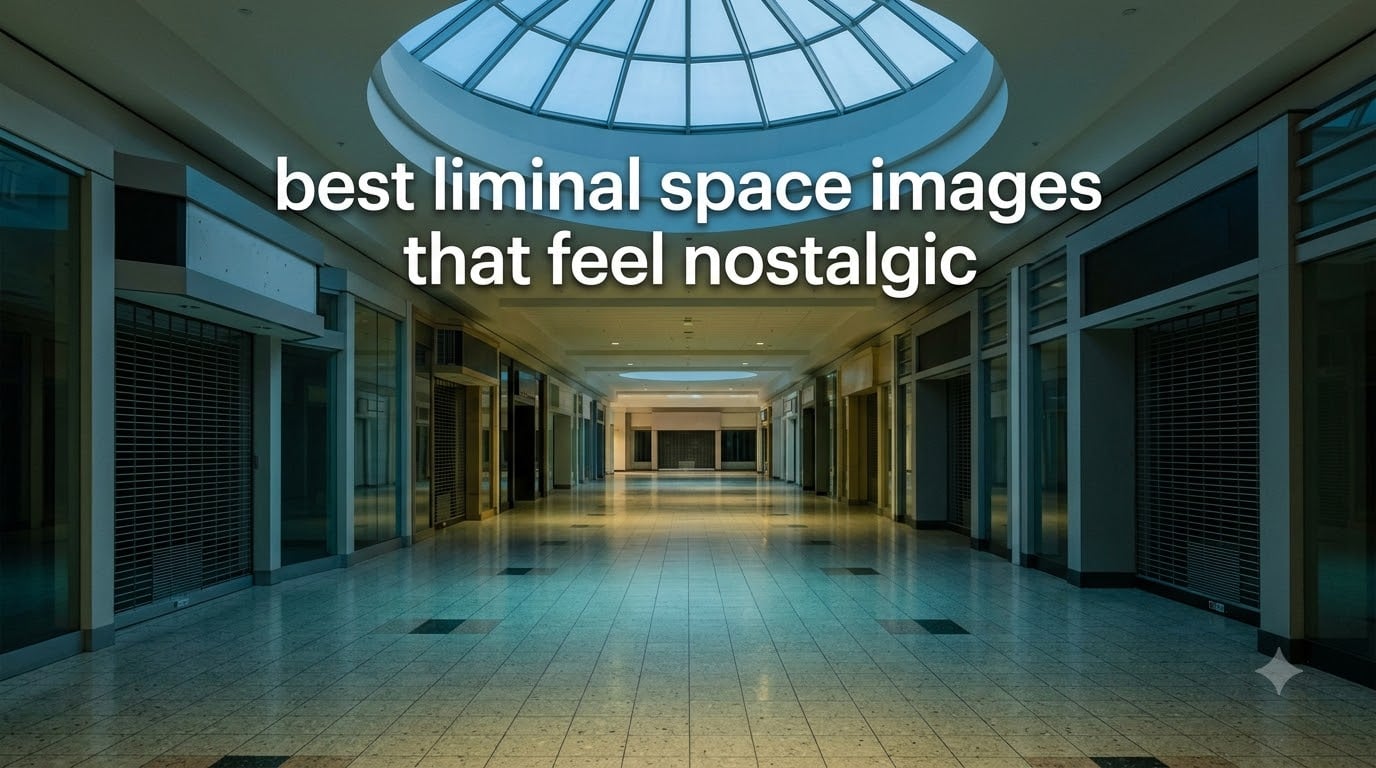
If you have ever scrolled past a photo of an empty mall at closing time and felt your chest tighten with a strange, sweet sadness, you already know what the best liminal space images that feel nostalgic can do. They give a visual shape to a feeling most of us struggle to name — that quiet, half-remembered ache of being somewhere between moments. This guide collects the images, explains the recipe behind them, and shows you how to capture your own.
I have been collecting liminal imagery for years — long before it had a hashtag. Some of my favorites live in an old folder on my laptop labeled simply quiet places. What I love about the aesthetic is its honesty. A liminal space image does not pretend to be anything. It is a hallway. It is a pool with the cover on. It is a Burger King at 6 a.m. And yet it feels like a memory you never actually had.
In this article we will walk through the visual recipe that makes these images nostalgic, group the strongest settings by mood, dive into the color and lighting cues that quietly trigger the feeling, and finish with a short guide for capturing your own. Let us start with the simplest question — what is a liminal space image, really?
Table of Contents
What Is a Liminal Space Image That Feels Nostalgic?
A liminal space image is a photograph of an empty, transitional place — a hallway, a mall, a hotel corridor, a school classroom, a public pool with the cover half-rolled — shown without the people you would expect to find there. When the setting feels familiar but strangely absent, the image triggers nostalgia, a gentle kind of sadness the internet calls kenopsia: the eerie, wistful atmosphere of a place that is usually full of people but is not right now.
The word liminal comes from the Latin limen, meaning threshold. Anthropologists Arnold van Gennep and later Victor Turner used liminality to describe the in-between phase of a rite of passage — the moment you have left one status but not yet entered the next. The internet co-opted the word around 2019 to describe places caught in the same in-between state: after-hours, between tenants, between seasons, between you arriving and you leaving.
What separates a nostalgic liminal image from just an empty room photo is the emotional residue. A bare conference room is empty. A bare conference room at 11 p.m. with the projector still warm, the chairs pushed back at odd angles, and one fluorescent tube buzzing is liminal. The nostalgia comes from the gap between what your memory expects and what the photo actually shows. Your mind fills in the people, the noise, the routine. And then it aches a little for them.
If you only take one thing from this guide, take this: the best liminal space images are not the most abandoned. They are the most familiar — places you have been a hundred times — photographed at the exact moment they have nothing to do.
What ‘Liminal’ Actually Means (and What It Does Not)
The internet uses liminal more loosely than anthropology does, and that confuses a lot of newcomers. In the original anthropological sense, liminality is the middle stage of a three-part ritual: separation, threshold, reincorporation. Think of a wedding rehearsal, a graduation ceremony, the first day of a new job. You are no longer who you were, but you are not yet who you will become.
The internet version borrows the word but points it at places instead of people. A liminal place is somewhere built for transition — a doorway, a waiting room, an airport gate, a corridor — caught in a moment when the transition is paused. There is no crowd. There is no event. There is only the architecture, waiting.
Three related terms are worth knowing because they appear constantly in this corner of the internet:
- Kenopsia — a coined word for the eerie, nostalgic atmosphere of an empty place that is usually full. Think of a mall at 7 a.m. before the stores open.
- Non-place — a term from anthropologist Marc Augé for spaces of transit like airports, hotel chains, and highways that have no identity of their own. Liminal images often photograph non-places.
- Heterotopia — Foucault’s idea of real places that function as something else, like a mirror or a cemetery. Subtler, but the concept overlaps.
What liminal does not mean: it is not just abandoned. Abandoned places (a ruined factory, a decaying asylum) belong to a different aesthetic, sometimes called urbex. Liminal spaces are usually functional, maintained, even clean — they just happen to be empty right now. That is the difference between a place that has been forgotten and a place that is simply waiting for the next group to arrive.
The Visual Recipe: What Makes a Liminal Image Feel Nostalgic
After staring at thousands of these images, I have noticed the same handful of ingredients showing up over and over. These are the visual cues that reliably push a photo from just empty to achingly nostalgic:
- Absence of people. This is non-negotiable. The feeling lives in the missing crowd.
- A transitional or in-between setting. Hallways, escalators, waiting rooms, lobbies, departures boards, stairwells. Places you pass through, not places you stay.
- Familiarity. The viewer has to recognize the place type. A generic empty room is not enough; an empty room that looks like your high school cafeteria is.
- Light that feels slightly off. A buzzing fluorescent tube, sodium-vapor streetlight through a window, the blue hour right before sunrise. Lighting the brain reads as closed.
- A warm and cool palette at the same time. Cool teals and blues outside, warm tungsten yellow inside. That temperature clash is a nostalgia trigger.
- A small sign of recent human use. A chair pushed back, a vending machine still lit, a shopping cart at an angle, footprints in a dusty pool deck. Proof people were just here.
- Slightly off composition. A vanishing point that is too long, a ceiling too low, a wall slightly too close. The frame should feel a little too intimate.
Stack three or four of these cues and the image starts to hum. Stack all seven and you have the kind of liminal photo that gets saved to a thousand Pinterest boards. The strongest nostalgic liminal images feel inevitable, almost composed — but they almost never are. They are happy accidents of timing and light.
One more thing worth saying: nostalgia in these images is rarely the warm, golden-haze kind. It is closer to what the Portuguese call saudade — a longing for something you cannot quite return to. That is the register the best images live in.
A Brief History of the Liminal Space Aesthetic
The aesthetic did not appear out of nowhere. It has a clear origin story, and knowing it helps you understand why the images hit so hard.
Around 2019, anonymous users on 4chan began posting photos of empty, weirdly familiar places with no people in them. The posts were captioned with single words like empty or liminal. The vibe was immediate. By mid-2019, an anonymous image of a yellow-beige office space with fluorescent lighting and endless beige carpet went viral and became known as The Backrooms. It spawned a wiki, creepypasta threads, and eventually a full horror genre.
Then came March 2020. The COVID-19 pandemic emptied the world overnight. Malls, airports, schools, hotels, office lobbies — the exact settings the liminal aesthetic had been quietly cataloguing — became actually empty, and stayed that way for months. The aesthetic stopped being a niche internet joke and became a way for millions of people to process what they were seeing outside their windows. The subreddit r/LiminalSpace grew from a small community to over 186,000 members during the pandemic years, and the imagery took on a heavier emotional charge.
By 2021–2022, TikTok had pushed liminal imagery into a new mode. Instead of single images, creators began pairing short loops of empty places with slowed, reverb-heavy tracks — vaporwave-adjacent beats, mallsoft, ambient piano. The format became a genre of its own, sometimes called liminal space videos. Researchers started paying attention: in 2022, the journal Frontiers in Psychology published a study by Diel and Lewis arguing that these empty-place images function as an uncanny valley of the built environment — the architectural cousin of the uncanny valley for faces.
Today in 2026 the aesthetic is older, gentler, and more curated. The clichés are well known. The strongest work has moved past the yellow Backrooms office and into more personal, quieter settings — your grandmother’s kitchen at 3 a.m., the laundromat at sunrise, the playground after the rain. That move, from horror to nostalgia, is what this guide is about.
A Curated Gallery of Nostalgic Liminal Images, Grouped by Mood
Most online galleries throw every liminal photo into one flat feed. That is a missed opportunity, because the nostalgic feeling lives in the mood. The same empty pool feels completely different under a July sun versus a November overcast. Here are six mood groups I return to when I want the feeling to hit a certain way. Each description is a prompt — you can almost see the photo from the words alone, which is how you know the mood is real.
Empty Places That Hum With Summer
Think of a public pool at noon in late July, the water turned over and still, the white concrete bleached, the lifeguard chair empty. Or a small-town main street at 2 p.m. on a weekday, the awnings down, the crosswalk buttons flashing for nobody. Or an ice cream parlor with the menu still lit and the formica counter wiped clean. These images trigger a very specific nostalgia: not a personal memory, but a generational one. Almost everyone has walked down a street like this. The feeling is warm, dry, faintly melancholy.
Hotels After Midnight
A long hotel corridor, doors closed, the carpet pattern stretching into a single vanishing point, a single ice machine humming at the far end. Maybe a hallway light is out. Maybe a Do Not Disturb sign hangs on one door. The gold-and-burgundy palette of older chain hotels is doing serious nostalgic work here. These images are quiet, slightly unsettling, and oddly tender — you can almost hear a television muffled behind one of those doors.
Malls at Closing Time
The food court chairs are up on the tables. The fountain is off. A single security guard walks the lower level in the far distance, more silhouette than person. The skylights are still letting in the last blue of evening. This is the canonical liminal space for an entire generation — the place where teenage birthdays and first jobs and after-school hangs all happened, now drained of every person who made it matter. Few settings produce a sharper nostalgia spike.
Classrooms at the Last Bell
Rows of desks in soft afternoon light. The chalkboard still has the last equation on it, half-erased. The clock reads 3:05. No coats on hooks, no chatter, no one. Schools are liminal by design — they exist to be filled and emptied on a schedule — and that built-in rhythm is exactly why a still classroom hits so hard. The image says: this place remembers what it is for, and right now it is not being itself.
Pools Closed for the Season
Above-ground pool, winter cover on, snow just starting to settle on the tarp. A suburban backyard, the chairs stacked in the corner, a single garden hose coiled on the patio. Or an empty community pool drained to a few inches of rainwater reflecting the bare trees. The seasonal pool is a small, perfect symbol of nostalgia: it carries the entire summer in its geometry and refuses to admit it.
Corridors, Stairwells and Waiting Rooms
This is the catch-all category and the most reliable. Any corridor will do, provided the lighting is honest and the place is genuinely empty. Stairwells with the rubber treads worn shiny. Vending machine alcoves with no one buying anything. Waiting rooms with the TV still showing a talk show to an empty row of blue plastic chairs. The simpler the architecture, the more the mood does the work.
Move through these six groups slowly. Each one is its own flavor of nostalgia. None of them is better than the others — they are different tools for different moods.
The Color and Lighting Recipe Behind the Nostalgia
If you have ever wondered why some liminal photos feel nostalgic and others just feel empty, the answer is almost always in the color and lighting. There is a small palette the brain reads as closed, paused, somewhere between, and learning to recognize it is half the fun.
- Muted teal and cyan. The blue side of things — pool water, fluorescent tubes, twilight sky through a window — reads as cool, distant, a little sad.
- Tungsten yellow and sodium orange. The warm side — streetlights, vending machines, old hallway bulbs — reads as still occupied. The two temperatures in the same frame is the trick.
- Sepia and faded film stock. A slight warm fade to the highlights pushes an image from now to then, even when nothing else has been changed.
- Golden hour that is almost over. The last ten minutes of golden hour, when the light is more orange than gold, is the most nostalgic time of day to shoot. Shadows are long, colors are warm, and the day is visibly leaving.
- Fluorescent white. Overhead fluorescent light, especially the slightly green-tinted kind, is the most liminal light there is. It is the light of waiting rooms and school corridors and convenience stores at 4 a.m.
- A single light source in a dark frame. A doorway at the end of a dark hall. A window in an empty warehouse. The brain locks onto the bright rectangle and reads it as somewhere to go.
When I am curating my own folder of liminal wallpapers, I look for two or three of these cues at once. An image with muted teal shadows, tungsten yellow highlights, and a single fluorescent tube overhead will almost always feel nostalgic. An image with one of those elements will sometimes feel nostalgic. An image with none of them will just feel empty.
Why Liminal Images Feel Nostalgic (and Sometimes Eerie)
The honest answer is that nobody fully knows. But the best current theory is the one Diel and Lewis proposed in 2022: empty, familiar places trigger the architectural equivalent of the uncanny valley. Your brain has a prediction for what a mall, a school, or a hotel corridor should look and feel like, and that prediction includes other people. When the people are missing, the prediction is violated just enough to feel weird — but not enough to feel dangerous. The result is a small, sustained cognitive itch.
Some researchers point to a related idea: liminal images activate autobiographical memory networks more strongly than busy images do. Without other people to anchor your attention, your mind is free to project your own people into the frame — the friends you had in high school, the cousin who worked at the mall, the aunt who always stayed in hotels with that exact carpet. The image becomes a Rorschach, and the nostalgia you feel is partly yours, not the photograph’s.
That is also why the same image can feel creepy to one person and comforting to another. If your own memories of the setting are warm — summer camp, family road trips — the emptiness reads as a gentle echo. If your memories of the setting are tense — a difficult school, a long hospital stay — the emptiness can read as a threat. Both responses are real, and both are valid. The aesthetic does not choose for you.
The pandemic added a layer that has not gone away. Many of the strongest liminal images from 2020–2022 are simply photographs of places the photographer was not allowed to enter. The emptiness carries the weight of stay-at-home orders, closed signs, and the strange quiet of a world on pause. Even now, years later, an empty airport still feels slightly forbidden.
Liminal Space vs Dreamcore, Weirdcore and Vaporwave
These four aesthetics are often used interchangeably online, and that does a disservice to each of them. They share a feeling but not a visual language. Here is how I tell them apart at a glance:
Liminal space. Real photos of empty, recognizable places. No surreal elements, no dream logic. The eeriness comes from absence alone.
Dreamcore. Real photos with soft focus, washed-out color, and a slightly unreal quality — often bedrooms, fields, or domestic interiors that feel half-remembered. Dreamcore leans more tender than eerie, and it is allowed to have people, as long as they look dreamy.
Weirdcore. Heavier surrealism. Strange text overlays, distorted images, intentionally off-kilter compositions. Weirdcore is uncomfortable on purpose; liminal space is uncomfortable by accident.
Vaporwave. A retrofuturist 1980s-and-1990s aesthetic with pink and teal palettes, Roman busts, palm trees, and Windows 95 glitches. Vaporwave is stylized and nostalgic for a specific consumer culture. Liminal space is more democratic — any empty place will do.
Quick rule of thumb: if the place could exist, it is liminal. If the place could exist but feels slightly wrong, it is dreamcore. If the place could not exist, it is weirdcore. If the place is a shopping mall from 1994, it is vaporwave.
How to Capture Your Own Nostalgic Liminal Photo
The good news is that you almost certainly already walk past liminal spaces every day. You just have to notice them. Here are five phone-photography tips that will get you most of the way to the look:
- Go at the edge of the day. The first hour after a place closes, or the last hour before it opens, is when it is at its emptiest and most honest. Golden hour and blue hour also do heavy nostalgic work.
- Frame for absence. Compose so the missing crowd is the subject. A long corridor where you expect to see people but do not. A food court where you expect noise but hear nothing. Hold the shot for a few seconds to be sure no one wanders into the frame.
- Use the existing light, do not add any. Do not turn on flash. The fluorescent hum, the vending-machine glow, the streetlight through the window — these are the lights that do the work. Your flash will undo all of it.
- Look for one small sign of recent use. A chair pushed back, a paper cup on a bench, footprints in dust. Without that sign, the image reads as abandoned. With it, the image reads as paused.
- Edit gently. Drop the saturation a little, lift the blacks slightly for that faded-film feel, and add a touch of warmth to the highlights. Stop before it looks filtered. The point is to feel like a memory, not a preset.
One bonus tip: if you are using a phone, switch to portrait mode for interiors but stick with the standard lens for corridors and pools — the wider field of view is what gives liminal images that stretched, slightly-too-much-space quality that drives the feeling.
Where to Find and Save More Nostalgic Liminal Images
Once you start looking, the imagery is everywhere. These are the corners of the internet where the strongest nostalgic liminal work tends to live:
- r/LiminalSpace on Reddit. The community actively filters out AI-generated images and posts a steady stream of real, photographed places. The Classic Liminal and Home flairs are best for nostalgia.
- Pinterest boards tagged liminal space. Useful for wallpaper-quality images and themed boards (summer pools, hotels, schools).
- The Backrooms wikis and forums. More horror-leaning, but the photography references are excellent and well-organized.
- Wallpaper apps. Apps like Zedge, Wallpaper Engine, and Walli have curated liminal collections — search liminal, kenopsia, or empty places.
- TikTok under #liminalspace. Best for short looping video, less useful for static wallpapers but unmatched for the music pairings.
- Twitter / X accounts like @SpaceLiminalBot that post a single liminal image per day.
A small caution worth repeating from the r/LiminalSpace sidebar: the community is strict about real photography. Many listicles recycle AI-generated liminal images that do not carry the same emotional weight because the brain can sense they were never a real place. When you save images for your own mood board, favor real photos whenever possible.
Music and Soundtracks That Pair With Liminal Space Videos
Liminal imagery and ambient music have been locked together since the early TikTok era. The right track can take a still image and turn it into a 15-second mood. A few reliable pairings:
- Lo-fi hip-hop and slowed pop. The default pairing — soft beats, reverb-heavy vocals, the feeling of a long commute.
- Mallsoft. A vaporwave subgenre built specifically around the sound of empty shopping malls — distant PA announcements, piped-in muzak, soft hums.
- Ambient piano. Solo piano pieces in minor keys. Especially effective over pools, classrooms, and hotel corridors.
- Field recordings. The actual ambient sound of the place — the fluorescent hum, the vending-machine thrum, distant footsteps — sometimes used unprocessed.
- Soundtracks from liminal-coded films. The Shining, Skinamarink, Severance, Synecdoche New York, Eternal Sunshine of the Spotless Mind.
My own favorite trick: take a still image, add a single ambient track, and loop it for ten seconds. The result will almost always feel more nostalgic than the image alone.
Frequently Asked Questions
What makes a liminal space image feel nostalgic?
A liminal space image feels nostalgic when it shows a familiar place you have been to many times — a mall, a hotel, a school — photographed at the exact moment it is empty of people. The nostalgia comes from the gap between what your memory expects (a crowd, noise, routine) and what the photo actually shows (the same place, paused). Add a slightly off light, a warm-and-cool palette, and one small sign of recent use and the feeling sharpens further.
What are the most common settings in nostalgic liminal space photos?
The most common settings are malls at closing time, hotel corridors after midnight, school classrooms with the lights still on, summer public pools with the covers on, suburban streets at golden hour, stairwells and escalators, waiting rooms, departure lounges, and empty playgrounds. Familiar, mundane, slightly worn places photograph best because the viewer already has a memory to project onto them.
Why do liminal spaces make people feel nostalgic?
Liminal spaces make people feel nostalgic because the absence of people lets the viewer’s mind fill in their own people — friends, family, strangers from years ago. Researchers Diel and Lewis described this in 2022 as an uncanny valley of the built environment, where familiar places without their usual crowds create a small, sustained sense of something missing. The pandemic made the feeling even stronger by emptying these places for real, not just in photos.
What is the difference between liminal space and liminality?
Liminality is an anthropological concept from Arnold van Gennep and later Victor Turner, describing the in-between phase of a rite of passage. Liminal space is an internet aesthetic that borrows the word to describe empty, transitional places — hallways, malls, airports — shown without the people who usually fill them. The two share a word but not a meaning.
How do you take a nostalgic liminal space photo?
To take a nostalgic liminal space photo, go at the edge of the day when the place is empty, frame for the absence of people, use only the existing light (no flash), look for one small sign of recent use like a pushed-back chair, and edit gently by dropping saturation and adding a touch of warmth. A standard wide lens, not portrait mode, gives corridors and pools the slightly stretched feel that drives the mood.
Where can I find liminal space images?
You can find liminal space images on r/LiminalSpace on Reddit, Pinterest boards tagged liminal space, the Backrooms wikis, wallpaper apps like Zedge and Walli, and TikTok under the hashtag liminalspace. For nostalgia specifically, look for community flairs like Classic Liminal and Home on Reddit, and favor real photographs over AI-generated renders whenever possible.
What is the liminal space aesthetic on TikTok?
The liminal space aesthetic on TikTok is a format in which creators pair short looping videos of empty, transitional places — malls, hotels, pools, corridors — with slowed, reverb-heavy tracks. The format usually runs 10 to 30 seconds and is designed to feel like a quiet memory. The most popular videos stack two or three empty-place clips over a single ambient or lo-fi track.
What does liminal actually mean?
Liminal means of or relating to a threshold. It comes from the Latin limen, meaning doorstep. In anthropology, liminality describes the middle stage of a rite of passage, between who you were and who you are becoming. In the internet aesthetic, liminal describes places caught in a similar in-between state, built for transition and temporarily empty.
Are liminal spaces creepy or comforting?
Liminal spaces can feel either creepy or comforting, depending on the viewer. The same empty hotel corridor can read as peaceful to someone with warm memories of travel and unsettling to someone with difficult ones. The aesthetic itself does not choose; it acts as a mirror for the memory you already carry into it.
What music goes with liminal space videos?
Music that pairs well with liminal space videos includes lo-fi hip-hop, slowed and reverbed pop, mallsoft (a vaporwave subgenre built around empty-mall soundscapes), ambient solo piano, and field recordings of the actual places. Soundtracks from liminal-coded films like The Shining, Skinamarink and Severance also work well.
Final Thoughts on the Beauty of Empty Places
The best liminal space images that feel nostalgic all share a small, quiet lesson: emptiness is not nothing. It is the space where memory lives. A mall with no one in it is still a mall — the chairs are still warm, the fountain still remembers its own sound. The image is just giving you a moment to notice.
If you take one thing from this guide, take the recipe: a familiar place, an in-between time, a real light, no people, and one small trace that people were just here. Stack those ingredients and you will get the feeling every time — whether you find the image, the video, or the moment on your own street tonight.
Start a folder. Save the ones that ache. And the next time you walk past an empty pool at sunset, or a corridor that no one is using, take the photo. Someone, somewhere, is about to recognize the feeling you caught.