
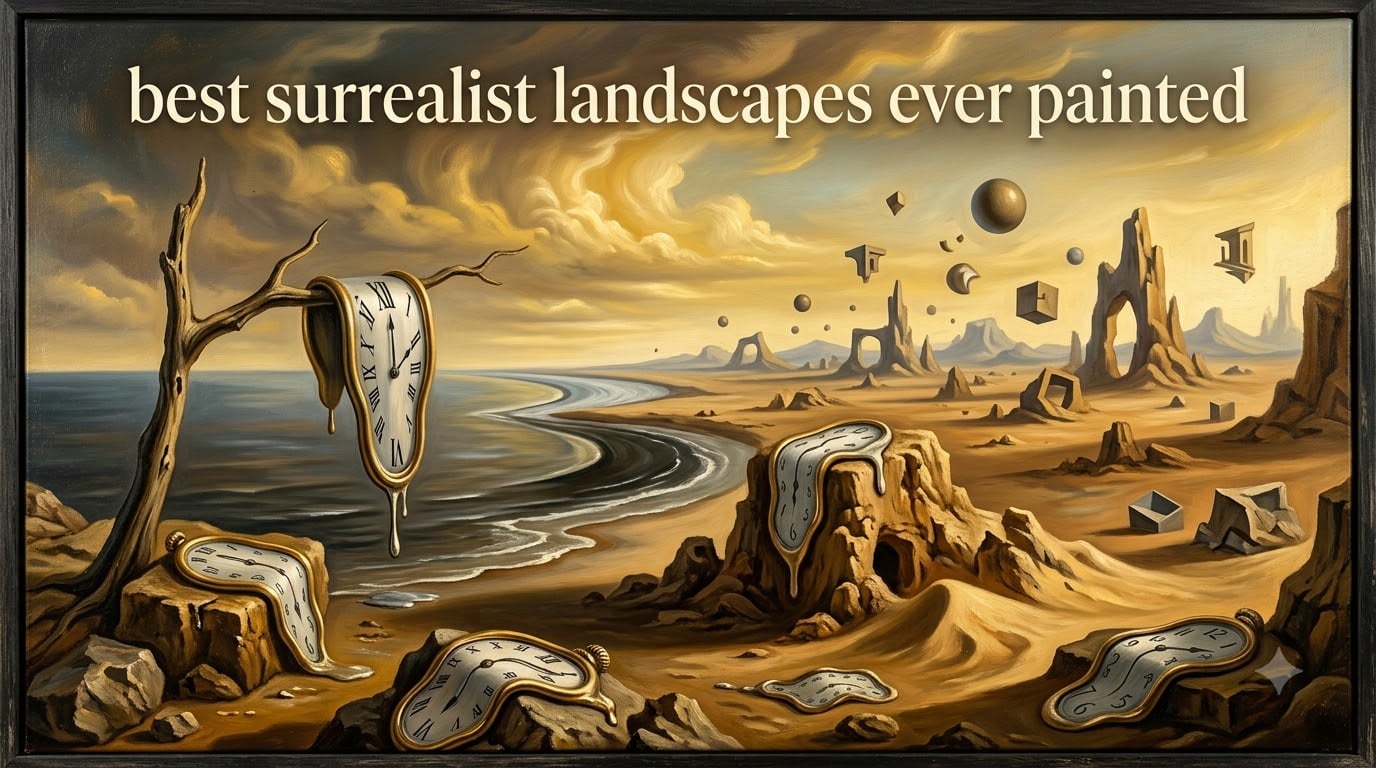
Surrealist landscapes occupy a unique place in art history. Unlike traditional landscapes painted from nature, they tap into the subconscious mind to create dreamlike, often impossible scenes. We’ve curated the best surrealist landscapes ever painted, spanning from the early 20th century to mid-century masterworks.
These paintings changed how we think about the natural world. Artists like Salvador Dali, Rene Magritte, and Leonora Carrington didn’t just paint what they saw outside — they painted what they felt inside. If you’ve ever woken from a dream with a vivid image burned into your memory, you already understand the pull of surrealist landscape art.
What follows is our definitive collection of the most iconic surrealist landscape paintings in history. Each one represents a different approach to turning the inner world into an outer vision.
Table of Contents
What Makes a Landscape Surrealist?
A surrealist landscape takes the familiar — horizons, skies, terrain — and distorts it through dream logic. The subconscious mind becomes the primary source of imagery rather than direct observation of nature.
Several key characteristics define this genre. Unexpected juxtapositions place objects together that have no rational connection. Distorted forms warp natural shapes into something unrecognizable yet strangely familiar. Non-naturalistic colors replace realistic palettes with tones drawn from emotion and memory.
Surrealist landscapes also tend to feature uncanny atmospheres — environments that feel both recognizable and alien. The viewer experiences a sense of disorientation, as though the rules of physics and logic have quietly dissolved. This is what separates a surrealist landscape from a mere fantasy painting: it feels psychologically real even when it looks impossible.
The Best Surrealist Landscapes Ever Painted
1. The Persistence of Memory – Salvador Dali (1931)
Salvador Dali’s melting clocks draped across a barren Catalan coastline became the defining image of Surrealism. Oil on canvas, measuring just 24 by 33 centimeters, this painting hangs in the Museum of Modern Art in New York.
The landscape itself is real — Port Lligat, where Dali lived and worked. But the soft, sagging watches transform it into a meditation on time and memory. Dali called his technique “hand-painted dream photographs,” and this painting proves why. The precision of the rendering makes the impossible feel tangible.
Ants cluster on one watch, suggesting decay. A fleshy, amorphous shape — often interpreted as a self-portrait — lies draped across the ground. The distant cliffs remain perfectly clear, anchoring the viewer in a recognizable place while the foreground dissolves into the logic of sleep.
2. The Empire of Light – Rene Magritte (1954)
Rene Magritte painted multiple versions of “The Empire of Light,” and each one challenges the viewer’s expectations about day and night. A sunlit blue sky floats above a dark, nocturnal street scene. Oil on canvas, the largest version measures nearly 200 by 150 centimeters and resides in the Peggy Guggenheim Collection in Venice.
The painting works through contradiction. The sky belongs to afternoon; the street belongs to midnight. A single streetlamp glows in the foreground, connecting the two incompatible realities. Magritte once said his paintings were visible thoughts, and this one visualizes the impossibility of holding two truths at once.
Unlike Dali’s melting forms, Magritte keeps everything crisp and realistic. The surrealism lies entirely in the juxtaposition of light and dark. It’s a landscape that shouldn’t exist — yet looks utterly convincing.
3. The Harlequin’s Carnival – Joan Miro (1924)
Joan Miro’s carnival scene is one of the earliest masterpieces of Surrealism. Oil on canvas, measuring 93 by 66 centimeters, it now hangs in the Albright-Knox Art Gallery in Buffalo, New York.
The painting teems with biomorphic forms — creatures that are half-human, half-abstract. Musical notes float through the air. A cat plays with a ball of yarn. Miro described this work as a hallucination he painted while watching the sunset through his studio window. The landscape is barely recognizable, dissolved into an ecosystem of living symbols.
Miro used automatism here, letting his hand move freely to access subconscious imagery. The result feels like a party happening inside someone’s mind — joyful, chaotic, and utterly unpredictable. This painting set the template for how surrealist landscapes could function as psychological spaces rather than physical ones.
4. Two Children Are Threatened by a Nightingale – Max Ernst (1924)
Max Ernst created this small oil-on-wood painting (69 by 57 centimeters, MoMA, New York) as a visual poem about childhood fears. A nightingale — normally a gentle bird — becomes menacing. Two figures flee while a gate swings open onto an impossible landscape.
Ernst pioneered frottage and decalcomania, techniques that let texture and chance guide the image. In this painting, the landscape feels like a stage set: the house perches on a rooftop, the fence leans at odd angles, and the sky presses down with claustrophobic intensity. A tiny knife is attached to the actual frame, blurring the boundary between painting and object.
The landscape in this work is intimate rather than expansive. Ernst compresses space to heighten the psychological tension. It’s a childhood memory warped by adult anxiety.
5. In the Third Sleep – Kay Sage (1944)
Kay Sage painted desolate, architectural landscapes that feel abandoned yet strangely elegant. “In the Third Sleep,” oil on canvas, hangs in the Smithsonian American Art Museum in Washington, D.C.
Sage’s landscapes are marked by towering, skeletal structures that resemble scaffolding or ruins. The horizon line stretches endlessly. There are no people, no vegetation — only geometry dissolving into mist. Her palette favors muted grays, ochres, and pale blues, giving each painting an atmosphere of profound stillness.
While Dali and Magritte received more attention during their lifetimes, Sage’s landscapes represent some of the most consistent and haunting work in the surrealist canon. She once said, “I wanted to paint the other side of the coin.” Her landscapes are the other side — quiet, empty, and deeply unsettling.
6. Green Tea (Vert-Galant) – Leonora Carrington (1942)
Leonora Carrington’s fantastical landscapes draw heavily on Celtic mythology, alchemy, and her own dreamscape cosmology. “Green Tea” features a surreal garden populated by hybrid creatures and mysterious rituals. Oil on canvas, it belongs to a private collection.
Carrington’s landscapes function as complete worlds with their own internal logic. Strange animals behave according to their own rules. Plant life grows in impossible configurations. The viewer enters not just a painting but a mythology. Carrington spent most of her adult life in Mexico, and her later work increasingly incorporated pre-Columbian symbolism alongside European surrealism.
Her landscapes stand apart because they are never empty — every square inch contains life, activity, and narrative. This density reflects her belief that the unconscious mind is not a void but a crowded, living ecosystem.
7. Armonia – Remedios Varo (1956)
Remedios Varo painted luminous, intricate landscapes that blur the line between science and magic. “Armonia” depicts a figure whose violin playing generates geometric forms that reshape the surrounding landscape. Oil on masonite, it is part of a Mexican private collection.
Varo trained as an engineer before becoming a painter, and her technical precision shows in every work. The architecture of her landscapes follows mathematical principles — spirals, tessellations, golden ratios. Yet the atmosphere is always dreamlike, even spiritual. Her figures are often solitary women engaged in acts of creation or transformation.
Varo’s landscapes are unique in surrealist art because they combine rigorous structure with genuine mystery. The world she paints makes sense on its own terms, even when it defies ours.
8. The Jungle – Wifredo Lam (1943)
Wifredo Lam’s monumental painting merges surrealist landscape with Afro-Cuban mythology. Oil on paper mounted on canvas, measuring 239 by 229 centimeters, it hangs in the Museum of Modern Art in New York.
The jungle in Lam’s painting is alive with hybrid figures — part human, part animal, part plant. Sugarcane stalks rise like columns. Faces emerge from foliage. The composition draws on Santeria symbolism and the experience of colonialism in Cuba. Lam studied with Picasso in Paris before returning to Havana, and his fusion of European surrealism with Caribbean visual traditions created something entirely new.
This is one of the largest surrealist landscape paintings in existence. Its scale demands that the viewer be absorbed into it, standing inside the jungle rather than observing it from a distance.
9. Indefinite Divisibility – Yves Tanguy (1942)
Yves Tanguy’s landscapes are characterized by barren, geological formations that seem to grow from the earth like bone. “Indefinite Divisibility,” oil on canvas, is housed in the Albright-Knox Art Gallery in Buffalo, New York.
Tanguy had no formal art training and claimed he decided to become a painter after seeing a Giorgio de Chirico painting in a gallery window. His landscapes feature hundreds of identical, spindly forms arranged across a flat plain. The sky is always overcast, the light always diffused. There is no focal point — the eye wanders endlessly across an alien terrain.
His technique was painstaking. Each form is rendered with smooth, invisible brushstrokes, giving the landscape a photographic clarity that makes its strangeness more disturbing. Tanguy’s worlds look like cross-sections of a planet we’ve never visited.
10. The Song of Love – Giorgio de Chirico (1914)
Giorgio de Chirico’s “The Song of Love” predates the official Surrealist movement by a decade, but its DNA is pure surrealism. Oil on canvas, 73 by 59 centimeters, it resides in the Museum of Modern Art in New York.
A classical bust, a rubber glove, and a green ball are pinned to a wall against a backdrop of a distant train and factory chimneys. The combination is nonsensical yet emotionally charged. De Chirico called this style “Metaphysical Art,” and the Surrealists — particularly Andre Breton — adopted him as a forefather.
The landscape in this painting is architectural and industrial, not natural. Deep shadows stretch across empty piazzas. Buildings recede at odd angles. The effect is one of profound alienation — a world drained of warmth and populated by mute objects. De Chirico showed the Surrealists that a landscape could be a state of mind.
Techniques Behind Surrealist Landscapes
Surrealist landscape painters developed specific methods to access subconscious imagery. These techniques set their work apart from traditional landscape painting and created entirely new visual possibilities.
Automatism was the foundational technique. Artists allowed their hands to move without conscious direction, trusting that the unconscious mind would guide the brush. Joan Miro and Andre Masson were early practitioners. The goal was to bypass rational thought and tap directly into raw creative impulse.
Frottage, invented by Max Ernst, involved placing paper over textured surfaces — wood grain, leaves, fabric — and rubbing with pencil or crayon. The resulting patterns suggested images that Ernst then developed into full paintings. This technique allowed chance to play a role in composition, introducing forms the artist would never have imagined deliberately.
Decalcomania involved pressing wet paint between two surfaces, then peeling them apart to create organic, unpredictable textures. Oscar Dominguez introduced the technique, and Ernst adopted it enthusiastically. The resulting patterns often resembled geological formations, underwater landscapes, or cellular structures — perfect raw material for surrealist environments.
Oil glazing allowed artists like Dali and Tanguy to achieve photographic smoothness. Multiple thin layers of oil paint built up translucent depth, making impossible objects look solid and real. This technical precision was crucial — the more realistically a surrealist landscape was rendered, the more disturbing its impossibility became.
Frequently Asked Questions
What is the most famous surrealist painting?
The Persistence of Memory by Salvador Dali (1931) is widely considered the most famous surrealist painting. Its melting clocks draped across a barren landscape have become the iconic image of the entire Surrealist movement.
What is the difference between surrealism and a surreal landscape?
Surrealism is the broader art movement founded by Andre Breton in 1924, encompassing painting, literature, film, and sculpture. A surreal landscape is a specific genre within surrealism that focuses on dreamlike depictions of natural or architectural environments inspired by the subconscious mind.
Who is the most famous surrealist landscape painter?
Salvador Dali is the most famous surrealist landscape painter overall, known for works like The Persistence of Memory. However, Rene Magritte, Yves Tanguy, and Kay Sage are equally important landscape-specific artists within the movement.
What are the characteristics of surrealist landscape paintings?
Surrealist landscapes feature distorted forms, unexpected juxtapositions of objects, non-naturalistic colors, dreamlike atmospheres, and imagery drawn from the subconscious mind rather than direct observation of nature.
What techniques do surrealist painters use for landscapes?
Key techniques include automatism (painting without conscious control), frottage (rubbing textured surfaces), decalcomania (pressing wet paint between surfaces), and oil glazing for photorealistic rendering of impossible subjects.
Where can I see surrealist landscape paintings?
Major collections include the Museum of Modern Art in New York (Dali, Ernst, Lam, de Chirico), the Peggy Guggenheim Collection in Venice (Magritte), and the Albright-Knox Art Gallery in Buffalo (Miro, Tanguy). Many surrealist landscapes are also held in private collections and rotate through major museum exhibitions.
How did surrealism change landscape painting?
Surrealism transformed landscape painting by proving that landscapes could represent psychological states rather than physical places. Instead of painting from nature, surrealist artists painted from the subconscious, introducing dream imagery, impossible geometry, and emotional symbolism into a genre previously dominated by realistic observation.
Conclusion
The best surrealist landscapes ever painted represent some of the most ambitious experiments in art history. From Dali’s melting clocks to Lam’s Caribbean jungle, these artists proved that the landscape genre had no boundaries. They replaced the observer’s eye with the dreamer’s mind and created worlds that still feel alive and strange nearly a century later.
Whether you’re visiting a museum or studying art at home, these ten paintings are essential viewing. Each one offers a different window into the subconscious — and together, they form a complete map of the surrealist imagination. The landscape was never the same after these artists finished with it.