
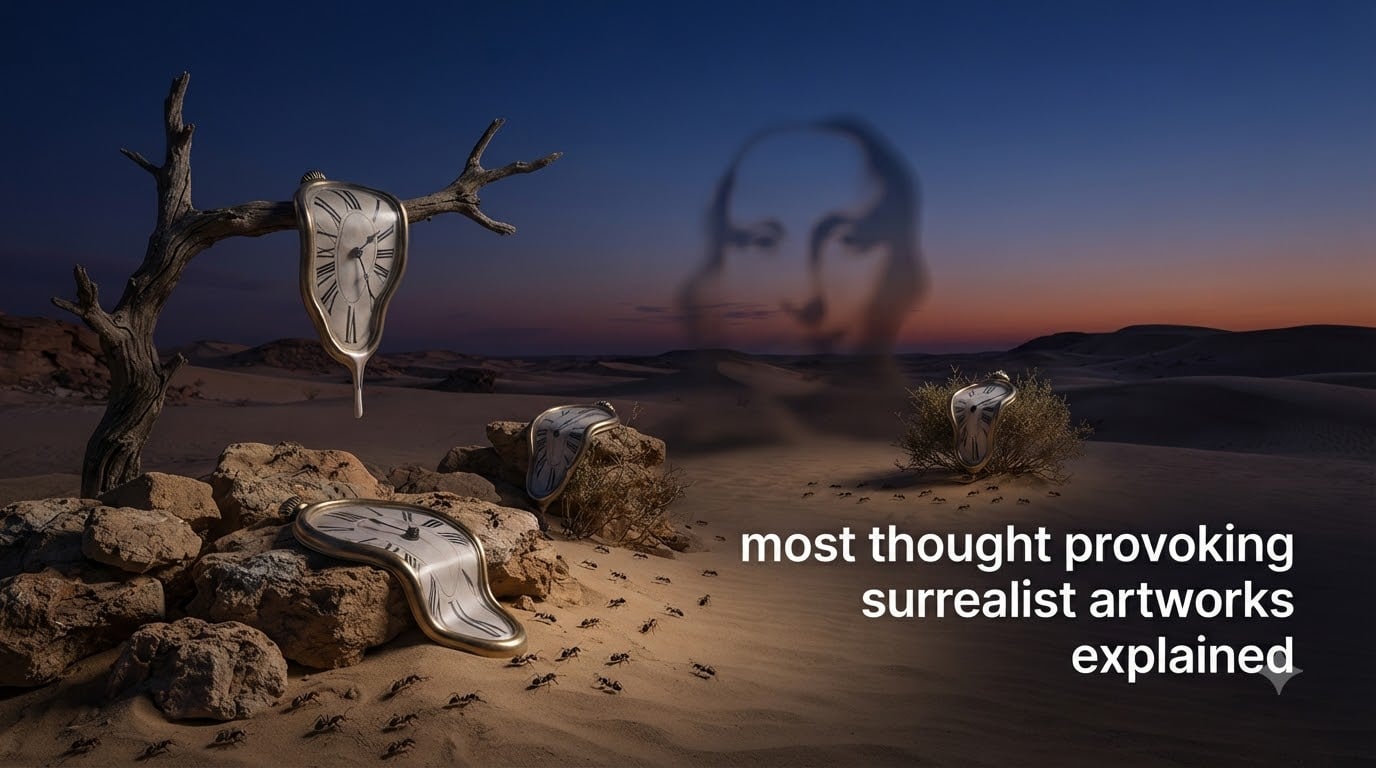
Surrealist paintings stop you mid-scroll. They twist familiar objects into impossible arrangements, pair the beautiful with the grotesque, and leave you staring at the wall for longer than you planned. That lingering unease is not accidental. Every melting clock, lobster telephone, and masked figure was engineered to bypass your rational mind and speak directly to the subconscious.
In this guide, we walk through the most thought-provoking surrealist artworks and explain what each one actually means. You will learn the hidden symbolism, the psychological context, and the biographical forces that made these paintings impossible to forget. Whether you discovered surrealism through a museum poster or a David Lynch film, this breakdown gives you the tools to read these works the way their creators intended.
Table of Contents
What Is Surrealism?
Surrealism is a 20th-century art and literary movement founded by André Breton in Paris in 1924. It sought to unleash the creative power of the unconscious mind by translating dreams, fantasies, and irrational impulses into visual and written imagery. Breton defined it as psychic automatism, a process of expressing thought in its purest form, free from the control of reason, morality, or aesthetics.
The movement grew directly out of Dada’s anti-art rebellion, but where Dada was nihilistic, Surrealism was constructive. Breton and his circle believed the unconscious held truths that rational society suppressed. They drew heavily on Sigmund Freud’s psychoanalytic theories, particularly his work on dream interpretation, repression, and the uncanny (das Unheimliche), that unsettling feeling when something familiar becomes strange.
Paris in the 1920s was the movement’s epicenter, but surrealism quickly spread across Europe, the Americas, and beyond. Salvador Dalí brought Spanish flamboyance. René Magritte brought Belgian philosophical precision. Leonora Carrington, Remedios Varo, and Dorothea Tanning brought female perspectives the male founders often sidelined. By the 1940s, surrealism had become a truly global phenomenon, and its influence on film, advertising, psychology, and contemporary art remains enormous.
The Most Thought-Provoking Surrealist Artworks Explained
What follows is not simply a list of famous paintings. Each artwork below was chosen because it continues to provoke questions, unsettle viewers, and resist easy interpretation decades after its creation. We break down the visual language, the hidden symbolism, and the psychological reasons these works stay lodged in your memory.
1. The Persistence of Memory — Salvador Dalí (1931)
This small oil painting, just 24 by 33 centimeters, is arguably the most recognized surrealist image in the world. Soft pocket watches drape over a barren Catalan landscape, melting across a tree branch, a blocky platform, and a fleshy, amorphous form that resembles a distorted self-portrait. Ants cluster on one watch face. The scene is lit by a cold, amber twilight.
Dalí painted this during what he called his paranoiac-critical method, a self-induced hallucinatory state in which he trained his mind to see multiple images within a single form. The melting clocks represent the fluidity and irrelevance of objective time in the dream state. Dalí himself said the idea came while looking at a piece of Camembert cheese melting in the sun, proof that even the mundane becomes profound when the unconscious takes over.
The painting provokes because it attacks one of our deepest assumptions: that time is fixed and reliable. Seeing clocks liquefy triggers a quiet existential anxiety. The ants suggest decay. The barren landscape suggests isolation. It is a meditation on mortality dressed up as a dream.
2. The Treachery of Images — René Magritte (1929)
Magritte paints a single, realistic pipe against a plain background. Below it, in neat cursive, he writes: “Ceci n’est pas une pipe” (This is not a pipe). The painting is instantly disorienting because, of course, it looks exactly like a pipe. But Magritte is right. It is a painting of a pipe. You cannot smoke it. You cannot fill it with tobacco. It is a representation, not the thing itself.
This work is the most accessible entry point into Magritte’s lifelong obsession with the gap between language, images, and reality. He was deeply influenced by the philosophy of language and spent decades questioning whether pictures and words can ever truly represent the objects they claim to describe.
Why does it stay with you? Because Magritte forces you to confront a problem you solve unconsciously every day. Every time you look at a photograph and say “that is my friend,” you are making the same leap the painting exposes. The pipe is a trap that makes you aware of how much your mind takes on faith.
3. Self-Portrait (Inn of the Dawn Horse) — Leonora Carrington (1937–38)
A young woman sits in an armchair, staring directly at the viewer with an expression that is simultaneously defiant and haunted. She wears jodhpurs and a velvet jacket. Behind her, a white rocking horse floats. A hyena crouches at her feet, mirroring her posture. Through a window, a white horse gallops freely across a distant landscape.
Carrington painted this when she was just 19 years old and involved in a turbulent relationship with Max Ernst, who was 26 years her senior. The white horse symbolizes freedom and her childhood self. The hyena represents her wild, untamed identity. The rocking horse is trapped, suspended, much like Carrington felt in her relationship with Ernst. After fleeing from him during the chaos of World War II, Carrington suffered a nervous breakdown and was committed to a mental asylum in Spain, an experience that permanently shaped her art.
This painting resonates because it captures a moment of self-possession under duress. Carrington’s gaze is not pleading. It is a challenge. She paints herself as someone who sees her own cage and is already calculating her escape.
4. Harlequin’s Carnival — Joan Miró (1924–25)
A riot of biomorphic shapes, floating eyes, ladders, and strange creatures fills the canvas. A harlequin figure with a moustache and a diamond-patterned costume stands at the center, surrounded by musical notes, a cat licking a plate, and mysterious objects that seem to pulse with their own energy. The background is a warm ochre that gives the chaos an almost cozy feeling.
Miró described this painting as a record of his hallucinations during periods of hunger. The carnival setting represents the unleashed subconscious, a place where rational rules do not apply and every object is alive. The ladders symbolize escape and transcendence. The eye, a recurring motif in Miró’s work, suggests both observation and the artist’s desire to see beyond surface reality.
What makes this painting thought-provoking is its deceptive cheerfulness. At first glance, it looks playful, even childlike. But the more you look, the more you notice the tension: the harlequin is trapped in a cycle of performance, the creatures are both amusing and menacing, and the overall effect is a controlled chaos that mirrors the way the mind works when freed from logic.
5. Ubu Imperator — Max Ernst (1923)
A rotund, mechanical figure with a pointed nose and a spiraling body stands on a barren plain. Its arms are raised in a gesture that could be triumph or surrender. The figure is based on Père Ubu, the grotesque, power-hungry protagonist of Alfred Jarry’s 1896 play Ubu Roi. Ernst transforms this literary anti-hero into something between a child’s toy and a military dictator.
Ernst was a German veteran of World War I. He saw the mechanized slaughter of trench warfare firsthand, and his art is saturated with the trauma of that experience. Ubu Imperator is a portrait of absurd authority, a figure who commands nothing, built from nothing, yet insists on power. The spiral form suggests both instability and the cyclical nature of tyranny.
This painting provokes because it reduces the concept of power to a cartoon. Ernst strips authority of its dignity and reveals the grotesque emptiness underneath. In a century defined by dictators, the image feels prophetic and darkly comic simultaneously.
6. Celestial Pablum — Remedios Varo (1958)
A tall, hooded figure sits in a tower, spinning thread from a crescent moon. Below, small figures in a courtyard receive drops of luminous liquid from above. The scene has the quality of an illuminated medieval manuscript, precise, luminous, and deeply strange. Varo, a Spanish-Mexican artist who fled Europe during World War II, created a body of work that blends alchemy, science, and feminine mysticism.
The moon thread represents creative nourishment, ideas fed from the heavens down to the earthbound masses. The solitary figure in the tower is both an artist and a priestess, distributing celestial knowledge. Varo was fascinated by the idea that creativity itself is a form of spiritual sustenance, and she frequently depicted women as alchemists and scientists in control of cosmic forces.
This painting stays with you because it presents a vision of feminine creative power that is neither passive nor decorative. Varo’s women are engineers of reality. The painting offers a quiet alternative to the aggressive machismo that sometimes characterized male surrealism.
7. Eine Kleine Nachtmusik — Dorothea Tanning (1943)
A hotel corridor stretches into infinity. A massive sunflower, its petals dark and bruised, lies across the floor. A young girl with red hair stands at the far end, her dress torn, her posture rigid. Another girl lies on the ground nearby. The title references Mozart’s serenade, but the atmosphere is closer to a nightmare.
Tanning painted this after visiting New York and being struck by the eerie anonymity of hotel hallways. The sunflower, a symbol that recurs throughout her work, represents both beauty and overwhelming, almost violent, growth. The children are not innocent here. They inhabit a space where the domestic and the terrifying overlap.
What makes this painting disturbing is its ambiguity. Nothing explicitly violent has happened, yet the composition radiates threat. Tanning understood that the most unsettling images are the ones where you cannot identify the source of danger. The corridor becomes a metaphor for the passage from childhood into a world that is not safe.
8. The Song of Love — Giorgio de Chirico (1914)
A classical Greek head sculpture is mounted on a wall next to a rubber surgeon’s glove. Below them, a green ball sits on the edge of a platform. Behind the arrangement, a locomotive passes through an archway. The lighting is sharp and theatrical, casting long, unnatural shadows across a deserted Italian piazza.
De Chirico painted this years before Breton’s manifesto, making him a proto-surrealist whose work directly inspired Dalí, Magritte, and Ernst. The juxtaposition of the classical head (representing high culture and reason) with the everyday rubber glove (representing the body and manual labor) creates a collision of meaning that the rational mind cannot resolve. The distant train adds an industrial, melancholic note.
It provokes because it presents familiar objects stripped of their normal context. The glove hanging next to ancient marble is absurd, but it is also strangely beautiful. De Chirico was painting the feeling of disorientation that comes when the ordinary suddenly becomes mysterious, a sensation Freud called the uncanny.
9. I Saw Three Cities — Kay Sage (1944)
Tower-like structures rise from a barren, ochre landscape. They resemble both architectural ruins and geological formations, half-built, half-decayed. The sky is a flat, oppressive expanse. There are no people. The forms have an eerie stability, as if they have always existed and will continue to exist long after humanity is gone.
Sage, an American who spent most of her life in France, developed a distinctive visual language built around architectural forms and desolate landscapes. Her cities are not real places. They are mental landscapes, projections of a psyche processing displacement, war, and solitude. During World War II, Sage and her husband Yves Tanguy fled to the United States, and the trauma of exile permeates her work.
This painting lingers because of its absolute stillness. There is no drama, no movement, no narrative. Just structures that might be monuments or tombs, standing in silence. It is a painting about the end of things, but delivered without sentimentality, which makes it all the more affecting.
10. Indefinite Divisibility — Yves Tanguy (1942)
Smooth, bone-like forms rise from a flat, amber ground. They multiply toward the horizon, growing smaller and more numerous as they recede, creating an impossible sense of infinite scale. The objects are organic but unidentifiable, neither plant nor animal nor mineral. The horizon line is crisp and endless.
Tanguy was largely self-taught and developed his visual vocabulary through intense study of mineralogy and biology. His paintings depict landscapes that exist only in the mind, but they are rendered with such precise, almost scientific detail that they feel documentary. The title, Indefinite Divisibility, references the philosophical concept that matter can be divided infinitely, a idea that was being tested in particle physics at the time.
What makes this painting thought-provoking is its scale. Tanguy forces you to contemplate infinity within a confined canvas. The endless repetition of forms creates a meditative, almost hypnotic effect. It is a painting that makes the viewer feel small, not through grandeur, but through quiet, relentless multiplication.
Why Surrealism Stays With You
Surrealism’s psychological power comes from its use of symbols that operate below conscious recognition. The movement borrowed from Freudian psychoanalysis to create imagery that speaks to the unconscious mind before the rational mind can intervene. Certain motifs appear again and again across different artists because they tap into universal psychological archetypes.
Clocks and watches represent our anxiety about time and mortality. Mirrors symbolize the self and the fractured nature of identity. Birds often stand for the soul or death, as in Max Ernst’s frequent use of his alter ego Loplop, a bird-headed figure. Horses represent freedom and untamed instinct, which is why Carrington paints them galloping beyond her reach. Lobsters carry erotic connotations, which is why Dalí attached one to a telephone. Eggs symbolize birth, potential, and the sealed container of the unconscious itself.
The techniques surrealists developed to access these symbols are equally important. Automatism, letting the hand move without conscious direction, was the foundational method. Dalí’s paranoiac-critical method involved deliberately cultivating hallucinations. Max Ernst pioneered frottage (rubbing pencil over textured surfaces) and decalcomania (pressing wet paint between surfaces) to generate chance patterns that the artist then developed into images. Each technique was designed to circumvent the rational censor in the artist’s mind.
Today, surrealism’s influence extends far beyond gallery walls. Filmmakers like David Lynch, Guillermo del Toro, and Stanley Kubrick built careers on surrealist visual language. Advertising borrows surrealist juxtaposition constantly. Art therapists use surrealist techniques to help patients access and process unconscious material. The movement’s core insight, that reality is not fixed and the mind contains worlds we have barely begun to explore, remains as provocative as it was in 1924.
Frequently Asked Questions
What is the meaning of Surrealism in paintings?
Surrealism in paintings refers to imagery drawn from the unconscious mind, dreams, and irrational impulses rather than observed reality. Surrealist painters used techniques like automatism and the paranoiac-critical method to bypass rational thought and reveal hidden psychological truths through unexpected juxtapositions of familiar objects.
What is the most famous surrealist painting?
Salvador Dalí’s The Persistence of Memory (1931) is widely considered the most famous surrealist painting. Its melting clocks draped over a barren Catalan landscape have become the defining image of the movement and one of the most reproduced artworks of the 20th century.
What are the 7 characteristics of surrealist art?
The seven key characteristics of surrealist art are: dreamlike imagery, unexpected juxtapositions of unrelated objects, automatism or spontaneous creation, symbolic and archetypal motifs, rejection of rational logic, exploration of the unconscious mind, and techniques borrowed from psychoanalysis such as free association and dream interpretation.
What are the five common themes of Surrealism?
The five common themes of Surrealism are: dreams and the unconscious mind, desire and eroticism, mortality and decay, identity and the fragmented self, and the uncanny or the feeling of strangeness within the familiar. These themes recur across artists and decades because they tap into universal aspects of human psychology.
Conclusion
The most thought-provoking surrealist artworks explained above are not simply historical curiosities. They are ongoing experiments in perception, each one asking you to look at the world differently. Surrealism endures because the questions it raises, about time, identity, desire, and the nature of reality, have never been answered. If these paintings have sparked your curiosity, spend time with them in person at museums like MoMA, the Tate, or the Dalí Theatre-Museum. The reproductions you see online cannot capture the scale, texture, and emotional weight of standing before the real thing.