
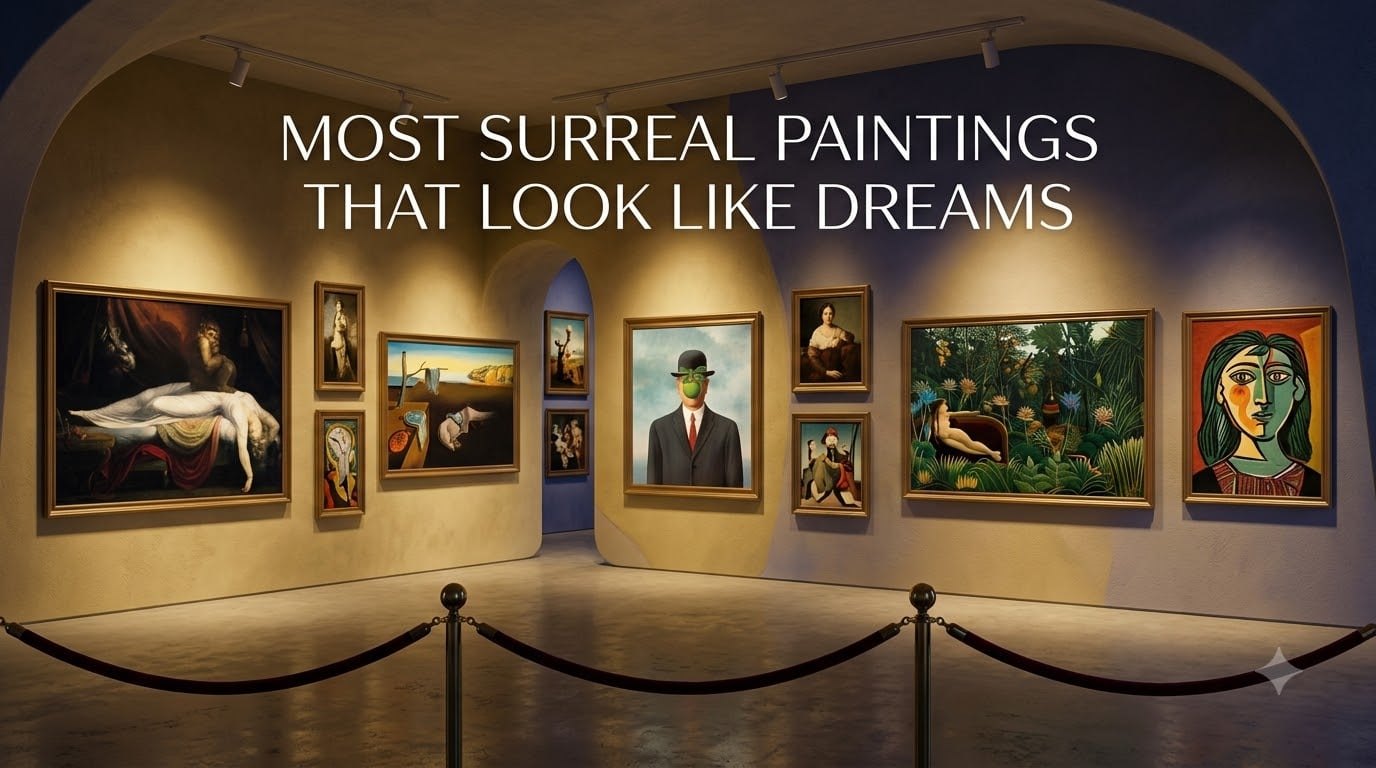
A surreal painting that looks like a dream is a work of art, most often from the Surrealist movement or its predecessors, that depicts impossible scenes, distorted bodies, floating objects, or subconscious imagery meant to mirror the logic of sleep rather than waking life. After spending weeks inside the dreamlike painting tradition at MoMA, the Detroit Institute of Arts, and the Prado, our team pulled together the twelve most surreal paintings that look like dreams across five centuries of art history.
From a medieval incubus sitting on a sleeper’s chest to Dali’s nude women launched by a single bee, these works don’t just illustrate dreams. They teach us what a dream actually feels like from the inside. You’ll find Henry Fuseli’s nightmare, Magritte’s bowler-hatted man, and a too-often-overlooked painting by surrealist Leonora Carrington.
We’ll start with a quick comparison table, then walk through each painting in order. Later, we’ll look at the recurring motifs that make a painting feel dreamlike and the actual techniques surrealists used to access the unconscious. Let’s begin.
Table of Contents
Quick Comparison: 12 Dreamlike Paintings at a Glance
| # | Painting | Artist | Year | Style | Museum |
|---|---|---|---|---|---|
| 1 | The Nightmare | Henry Fuseli | 1781 | Gothic / Romantic | Detroit Institute of Arts |
| 2 | The Dream of Constantine | Piero della Francesca | c. 1460 | Early Renaissance | San Francesco, Arezzo |
| 3 | The Dream of Saint Ursula | Vittore Carpaccio | 1495 | Venetian Renaissance | Gallerie dell’Accademia, Venice |
| 4 | Jacob’s Dream | Jusepe de Ribera | 1639 | Baroque | Museo del Prado, Madrid |
| 5 | The Knight’s Dream | Antonio de Pereda | c. 1650 | Baroque | Real Academia de Bellas Artes, Madrid |
| 6 | Dante’s Dream | Dante Gabriel Rossetti | 1871 | Pre-Raphaelite / Symbolist | Walker Art Gallery, Liverpool |
| 7 | Vision After the Sermon | Paul Gauguin | 1888 | Post-Impressionist / Synthetist | National Gallery of Scotland, Edinburgh |
| 8 | The Dream | Henri Rousseau | 1910 | Naive / Proto-Surrealist | MoMA, New York |
| 9 | The Dream | Pablo Picasso | 1932 | Surrealist | Private collection / Centre Pompidou loans |
| 10 | Dream Caused by the Flight of a Bee | Salvador Dali | 1944 | Surrealist (Paranoiac-Critical) | Thyssen-Bornemisza Museum, Madrid |
| 11 | The Son of Man | René Magritte | 1964 | Surrealist | Private collection, Brussels |
| 12 | The Temptation of Saint Anthony | Leonora Carrington | 1947 | Surrealist | Private collection / MoMA loans |
The Nightmare — Henry Fuseli (1781)
Fuseli’s The Nightmare is the painting that put dreams on the museum wall. A woman lies sprawled across a bed, arms thrown back, while an incubus perches on her chest and a ghostly horse’s head floats through curtains behind her. Painted in 1781, it predates Surrealism by 140 years, yet no later artist has produced a more recognizable image of a nightmare.
Fuseli said the painting was about a folk belief that nightmares were literal demonic visitations. What makes it feel dreamlike today is its pure compression: every unsettling thing in a bad night of sleep is stacked into one canvas. Critics at the Royal Academy show called it “monstrous.” Reviewers today call it the original surrealist painting. The original hangs at the Detroit Institute of Arts.
The Dream of Constantine — Piero della Francesca (c. 1460)
Long before Dali, Piero della Francesca painted one of art history’s most famous dream visions. In The Dream of Constantine, the Roman emperor sleeps in his tent before the Battle of Milvian Bridge. An angel descends on a beam of light, whispering that he will win under the sign of the cross.
The dreamlike quality comes from Piero’s mathematical composition. The tent is a perfect geometric wedge, the figures are arranged with the calm of a stage set, and the dawn light glows impossibly even. Nothing shifts, nothing flows, yet the moment feels suspended outside time, the way a real dream does when you remember it the next morning. You can see it in the Basilica of San Francesco in Arezzo, Italy.
The Dream of Saint Ursula — Vittore Carpaccio (1495)
Carpaccio’s The Dream of Saint Ursula is a quiet, jewel-toned vision. The saint lies in a Venetian Renaissance bed while an angel steps through the wall, holding a palm of martyrdom. The room is so detailed you can almost smell the wood polish.
What makes the painting feel like a dream is the soft, theatrical lighting. Carpaccio painted the angel and the sleeping Ursula in two slightly different realities, the angel crisp and weightless, the room warm and real. That split, the way a dreamer sees a clear figure inside a familiar room, is one of the earliest in art. It hangs at the Gallerie dell’Accademia in Venice.
Jacob’s Dream — Jusepe de Ribera (1639)
Ribera’s Jacob’s Dream takes the biblical scene of Jacob’s ladder and makes it feel like a Baroque fever. Jacob lies sprawled, mouth open, one arm hanging off the bed. Above him, an enormous ladder reaches through a tear in the ceiling, with angels climbing up and down in candlelight.
Ribera painted in Naples, and the tenebrism (sharp light against deep shadow) gives the painting the unsettled focus of a half-remembered dream. The ragged edges of the canvas opening, with heaven poured through like smoke, were a visual idea Picasso would borrow 300 years later. The painting hangs in the Prado in Madrid.
The Knight’s Dream — Antonio de Pereda (c. 1650)
The Knight’s Dream is one of the strangest vanitas paintings of the Spanish Baroque. A young knight in armor sleeps at a table covered with books, a crown, coins, a scepter, and a clock. An angel points upward, and a demon whispers worldly ambitions into his ear.
Pereda stacks the symbols of worldly life in a still life so dense it feels like a dream inventory. Reviewers often compare it to Magritte 300 years later, with the same sense that ordinary objects have been rearranged into something unsettling. It hangs at the Real Academia de Bellas Artes de San Fernando in Madrid.
Dante’s Dream — Dante Gabriel Rossetti (1871)
Rossetti’s Dante’s Dream is one of the Pre-Raphaelite masterpieces. It shows the moment in Dante’s Divine Comedy when the poet dreams of Beatrice dying, carried by Love in a red cloth through a crowd of mourning figures in a medieval Italian piazza.
The painting feels dreamlike because of its slow procession. Every figure wears a different color and a different expression, like the cast of characters you meet in a long symbolic dream. Rossetti worked on it for nine years. The first version hangs in the Walker Art Gallery in Liverpool; the original life-size draft is at the Tate.
Vision After the Sermon — Paul Gauguin (1888)
Gauguin’s Vision After the Sermon is often called the birth of modern dream-painting. After church, Breton women see Jacob wrestling the angel in a red, flat field, but the wrestling happens in their imaginations, not in front of them.
Gauguin painted the field in raw cadmium red so it feels more like a stage of the mind than a real meadow. The shift between real Breton women in dark shawls and a brightly colored biblical vision is a visual translation of “I imagined this during the sermon,” and Surrealists later pointed to it as the moment painting admitted dreams onto the canvas. It hangs in the National Gallery of Scotland in Edinburgh.
The Dream — Henri Rousseau (1910)
Rousseau’s The Dream shows a nude woman on a Victorian sofa in the middle of a jungle, listening to a snake-charmer. Lotuses float around her. A tiger crouches. Birds in the canopy stare out at the viewer.
Rousseau never left Paris, and the jungle is half-imagined from his trips to the botanical garden. That mix of remembered and invented is exactly how dreams work. Reddit users consistently call Rousseau’s The Dream one of the most accurate depictions of an actual dream they have seen in art. It hangs at MoMA in New York.
The Dream — Pablo Picasso (1932)
Picasso’s The Dream (Le Rêve) is a 1932 portrait of his young lover Marie-Thérèse Walter asleep in a chair, her face half-visible behind a mask-like profile.
The dreamlike quality is in the color and the soft, pillow-shaped forms. Marie-Thérèse looks both awake and asleep, with one hand resting between her thighs. The painting became one of the most expensive works ever sold at auction in the 20th century, at the time setting the record for any artwork at public sale. It is now in a private collection held by the Qatari royal family, with periodic loans to museums in Doha.
Dream Caused by the Flight of a Bee — Salvador Dali (1944)
This is the painting everyone pictures when they hear “dreamlike art.” In Dream Caused by the Flight of a Bee, a naked woman floats above a rocky Mediterranean coast while two mutant fish leap out of a pomegranate, and a bee hovers above her, ready to sting.
Dali said the painting should be read as a single instant when a bee’s sting wakes a dreamer and a sleeping nude is launched upward by the sting itself. The painting’s dreamlike qualities are textbook: levitation, metamorphosis, double imagery (the pomegranate seeds become a second floating fish), and an empty ochre landscape. It is part of the permanent collection at the Thyssen-Bornemisza Museum in Madrid.
The Son of Man — René Magritte (1964)
Magritte’s The Son of Man is a self-portrait in a bowler hat standing in front of a low wall. An apple floats in front of his face. Behind him is the sea and a cloudy sky.
Magritte called it a self-portrait “in which everything we see hides another thing; we always want to see what is hidden by what we see.” Reviewers and Reddit users consistently describe it as exactly how a dream feels when you can’t quite see the person you are looking at. It hangs in a private collection in Brussels but is one of the most reproduced dreamlike paintings in the world.
The Temptation of Saint Anthony — Leonora Carrington (1947)
Carrington’s The Temptation of Saint Anthony is the rare women-led dream painting in the canon. Saint Anthony is lifted off the ground by three surreal figures: a hybrid horse-and-girl, a phallic tower, and a bird creature holding an egg.
Carrington painted it at 30 in Mexico City, where she had fled after a breakdown in 1940. The painting feels dreamlike because the symbolism is personal and unexplained, in the way real dreams are. It won an international prize and is now in a private collection, occasionally lent to MoMA exhibitions. Most dream-painting listicles skip Carrington; we think she belongs on this list.
Why These Paintings Feel Dreamlike: Recurring Motifs
After walking through twelve paintings across 600 years, certain visual motifs repeat in a way that mirrors the patterns of dreams themselves. These are the techniques that, across centuries, artists returned to when they wanted to put a dream on a wall.
Floating Objects and Levitation
Almost every dream painting we have seen features at least one floating figure or object. Fuseli’s incubus hovers above the sleeper’s chest. Dali’s nude is launched by a bee. Carrington’s Saint Anthony is lifted off the ground. In dreams, gravity is optional, and these paintings accept that rule.
Distorted Scale and Impossible Juxtapositions
Dreams compress and expand. Rousseau puts a sofa inside a jungle. Pereda piles a crown, a clock, and a dagger on the same table with no apparent narrative. Magritte hides a face behind a single apple. Each of these uses the dream logic of “and then, and then,” rather than waking logic of “because.”
Doppelgangers and Double Exposure
Rossetti’s procession is filled with figures that look like variations of the same face. Magritte hides his face behind an apple and a sea behind the apple. Picasso splits Marie-Thérèse into profile and front view at once. Doubles, masks, and faces that are also something else are a recurring feature of oneiric paintings.
Biomorphic Forms and Metamorphosis
Dali’s pomegranate turns into fish. Carrington’s horse merges with a girl. Fuseli’s nightmare horse slides through curtains like a ghost. Biomorphic forms, shapes that are halfway between bodies and other things, are one of the most recognizable markers of a dreamlike painting.
How Artists Actually Captured Dreams
Painting a dream sounds easy. In practice, it is one of the hardest things a painter can do, and the techniques surrealists developed to make it work have their own strange history.
Automatism: Drawing Without Thinking
André Masson, Joan Miró, and the Surrealists championed automatism, drawing quickly without lifting the pen, in the hope of catching thoughts before the rational mind edited them. Masson’s automatic drawings of the 1920s are still taught as the visual language dreams use when they write themselves.
Dali’s “Slumber With a Key” Method
Salvador Dali sat in a chair holding a spoon over a tin plate. As he drifted toward sleep, his hand relaxed, the spoon clattered, and he woke mid-dream. He would then sketch what he saw before it faded. He called the method “slumber with a key” and credited it with the hypnagogic hallucinations behind his most famous paintings.
Hypnosis and Free Association
Some surrealists, including Leonora Carrington and Remedios Varo, used self-hypnosis and free association to enter dreamlike states before painting. André Breton, the founder of the Surrealist movement, built the entire Surrealist Manifesto of 1924 on Freud’s free association method.
Waiting for REM Sleep
Freud’s Interpretation of Dreams (1900) argued that dreams are the royal road to the unconscious. REM sleep was only formally discovered in 1953 by Eugene Aserinsky and Nathaniel Kleitman at the University of Chicago. After that, artists and psychologists had a real, measurable target to aim at when they tried to paint dreams.
Frequently Asked Questions
What are some famous paintings that depict dreams?
Some of the most famous paintings that depict dreams include Henry Fuseli’s The Nightmare (1781), Henri Rousseau’s The Dream (1910), Salvador Dali’s Dream Caused by the Flight of a Bee (1944), and Vittore Carpaccio’s The Dream of Saint Ursula (1495). These works span six centuries and are widely used in textbooks to illustrate the dreamlike painting tradition.
Which artist is known for surreal dream-like paintings?
Salvador Dali, Rene Magritte, and Henri Rousseau are the three artists most often called out as dream-painting masters. Dali used his ‘slumber with a key’ spoon method to capture hypnagogic imagery, Magritte hid faces and meanings inside ordinary objects, and Rousseau painted imagined jungles that feel like remembered dreams.
Is Surrealism inspired by dreams?
Yes. Andre Breton founded the Surrealist movement in 1924, building directly on Sigmund Freud’s 1900 book The Interpretation of Dreams. Surrealists used techniques like automatism, free association, and hypnosis to bring dream imagery into painting, photography, and film. The movement’s stated goal was to fuse the conscious and unconscious minds into a new kind of reality.
What is the rarest dream ever?
Sleep researchers typically call lucid dreaming, when you know you are dreaming while still inside the dream, the rarest type. About half of all adults have had one lucid dream at some point, but frequent lucid dreamers are very rare. Lucid dreams are also the dreams most often described as feeling like the surreal paintings of Dali and Magritte, which is why these painters are often linked to the rarest dream state.
Conclusion
Surreal dreamlike paintings matter because they externalize the unconscious. Across six centuries, artists have used floating bodies, distorted scale, double imagery, and impossible architecture to show what sleep feels like from the inside. The most surreal paintings that look like dreams are not just pretty oddities. They are visual records of how the mind works when the lights go out, and they continue to shape how we imagine the unconscious in 2026‘s era of AI-generated imagery and digital surrealism.
Pick one of the twelve on this list, look it up in its museum, and stand in front of it for ten minutes. You will leave seeing differently, and probably dreaming differently too.