
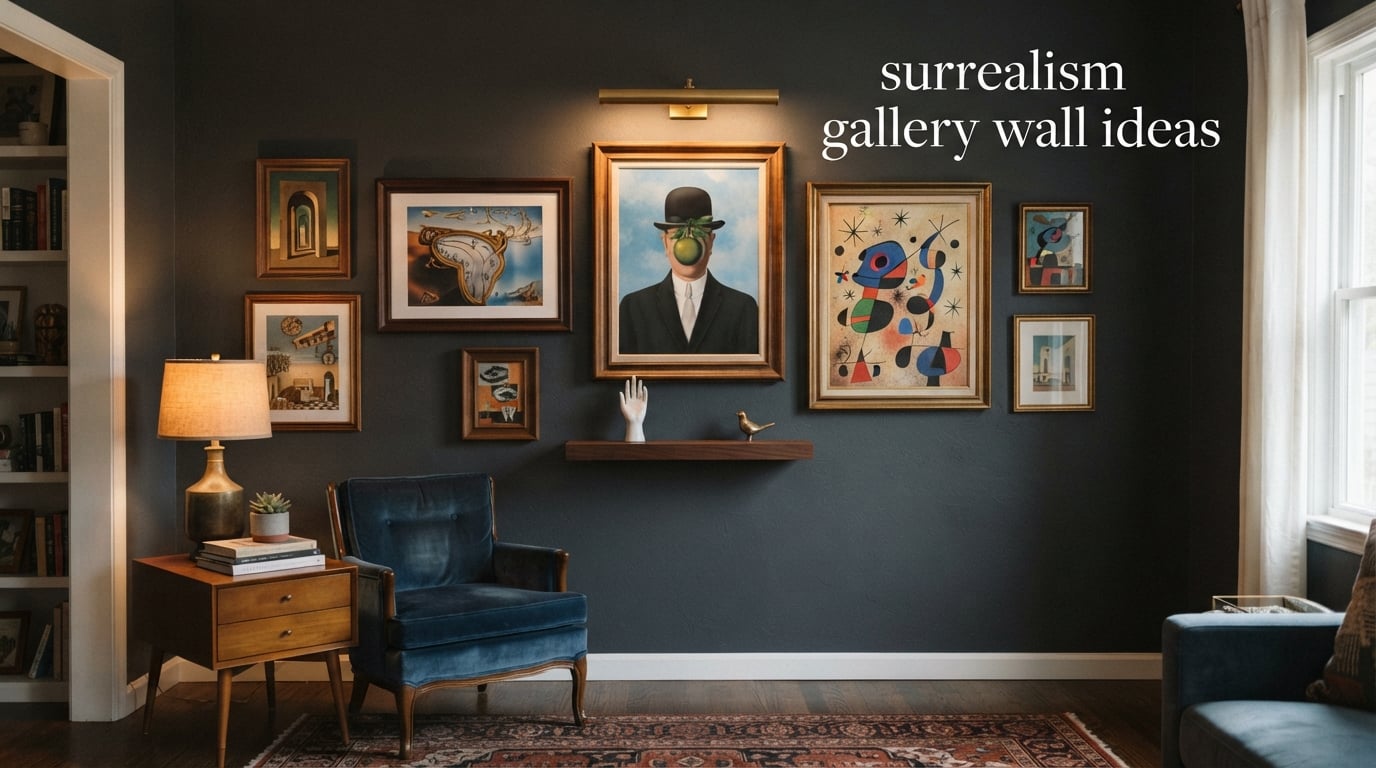
Gallery walls are not out of style in 2026 — they have simply evolved. The collected, personality-rich gallery wall is now the most-pinned aesthetic on Pinterest, and surrealist gallery wall ideas lead the pack because they turn a blank wall into a dreamlike, conversation-starting portal. I have spent the last three months collecting surrealist prints, sketching layouts on my living room floor, and testing arrangements with seven different artists. This guide shares what actually works when you build a surrealist art display from scratch.
You will learn how to define the surrealist look, which artists pair beautifully together, seven layout ideas with real measurements, color palettes that make surrealist art sing, where to find affordable prints, and the mistakes I made so you do not have to. By the end, you will have a complete plan to build your own surrealism gallery wall at home.
Table of Contents
What Is a Surrealist Gallery Wall?
A surrealist gallery wall is a curated display of dreamlike, imaginative artwork arranged to evoke the feeling of walking into a painting. It blends Magritte clouds, Dali melting clocks, Ernst forests, and modern surrealist prints with unexpected objects to create a wall that feels alive.
What makes a surrealist gallery wall different from a regular gallery wall is the intent. A regular gallery wall might showcase family photos, travel prints, or botanical art. A surrealist gallery wall, by contrast, treats the wall itself as a dreamscape. The pieces do not just decorate — they provoke, confuse, and invite the viewer to look twice. A floating hat, an eye in the sky, an impossibly long staircase — these are the kinds of visual puzzles that anchor the surrealist style.
Definition box: Surrealism is an early 20th-century art movement founded by Andre Breton in 1924 that sought to unlock the power of the unconscious mind. In gallery wall form, it translates into dream imagery, optical illusions, unexpected juxtapositions, and an emotional rather than literal approach to subject matter.
The surrealist gallery wall draws on the same instincts as the broader maximalist gallery wall trend that has dominated Pinterest for the past two years — layered, collected, slightly chaotic, deeply personal. But it adds a specific mood: wonder, mystery, and a touch of the absurd. I find that surrealist walls feel more cohesive than generic maximalist walls because the dreamlike theme acts as a unifying thread.
How surrealist walls differ from other gallery walls
Three differences stand out. First, the subject matter leans toward fantasy, dreams, and the subconscious rather than realistic portraits or landscapes. Second, surrealist walls often mix flat prints with three-dimensional objects — a taxidermy bird, a porcelain hand, an antique key — to blur the line between art and decor. Third, the color palette tends to be either dreamy pastels or boldly saturated jewel tones, with very little middle ground. These traits give surrealist gallery walls a signature atmosphere that distinguishes them from traditional or even maximalist gallery walls.
7 Surrealist Artists to Feature in Your Gallery Wall
The artists you choose will define the personality of your wall. I always recommend mixing two or three classic surrealists with one or two modern or female surrealists for a wall that feels both timeless and current. Here are seven artists I have come back to again and again while building my own collection.
1. Rene Magritte — the master of optical illusion
Magritte is the safest starting point for any surrealist gallery wall. His bowler-hatted men, floating apples, and cloud-framed skies read clearly even at thumbnail size, which makes them ideal for dense salon-style arrangements. I lean on Magritte prints as anchor pieces because they ground the wall in recognizable surrealism without overwhelming the viewer.
2. Salvador Dali — the dramatic dreamer
Dali’s melting timepieces and impossible landscapes bring theatrical energy. Use one large Dali print as the focal point, then surround it with smaller Magritte or Ernst works to balance the drama. The persistence of memory-style prints work especially well in living rooms above a sofa.
3. Max Ernst — the texture innovator
Ernst’s frottage and grattage techniques create richly textured forests, birds, and imaginary creatures. His work adds visual depth to a gallery wall and pairs naturally with Miro because both artists experimented with surface. I love an Ernst forest print next to a Miro constellation — the contrast feels like a conversation.
4. Joan Miro — the color liberator
Miro’s playful primary-colored shapes are the perfect counterweight to Magritte’s quieter compositions. A bright Miro print injects energy and keeps the wall from feeling too dark or moody. Miro is also one of the most affordable classic surrealists to source as a print.
5. Frida Kahlo — the surrealist self-portraitist
While Kahlo did not call herself a surrealist, Breton famously declared her a surrealist, and her self-portraits fit beautifully into a surrealist gallery wall. Her floral crowns, unibrow portraits, and thorny necklaces bring intimacy and emotional weight. I pair one Kahlo self-portrait with three abstract surrealist works to keep the wall from feeling biographical.
6. Yves Tanguy — the dream cartographer
Tanguy’s endless, alien landscapes are perfect for filling the gaps in floor-to-ceiling arrangements. His work reads as soft, atmospheric, and slightly unsettling — exactly the surrealist mood you want threading through the wall. Tanguy prints are also widely available in public domain archives.
7. Leonora Carrington and Remedios Varo — the magical realists
Carrington and Varo were part of the women-led surrealist movement in Mexico during the 1940s and 1950s. Their paintings feature witches, alchemists, owls, and mysterious interiors. Including one of these artists signals a deeper engagement with surrealism beyond the obvious Dali-Magritte-Miro trio, and it adds a feminist layer to the wall that I love.
Pairing tip from my own wall: Magritte + Miro + Carrington is my favorite trio. The first anchors with quiet illusion, the second energizes with color, and the third adds narrative mystery. Try this combination if you feel stuck choosing artists.
7 Surrealism Gallery Wall Layout Ideas to Try
Layout is where most people stall. I have tested every major arrangement on my own walls and on the walls of friends, and these seven layouts are the ones that consistently feel surrealist rather than generic. Each layout works with any art style, but surrealist prints tend to shine in the more layered and asymmetrical arrangements.
1. Salon-style surrealist hang
The salon-style hang is the maximalist classic: frames cover the wall from edge to edge with no visible wall between them. For surrealist art, this works beautifully because the dreamlike subject matter creates cohesion even when the frames are wildly different. Start with the largest piece at eye level, then build outward in organic clusters. Keep 2 to 3 inches of space between frames — that is the classic gallery wall rule of spacing that designers cite over and over. My own salon wall has 27 frames and feels intentional rather than chaotic because every piece shares the surrealist theme.
2. Grid layout with surrealist subjects
A grid layout — four, six, or nine frames in perfectly aligned rows — turns surrealist art into a museum display. This works best when the prints share a similar color palette and frame style. I recommend a 3×3 grid of Magritte cloud prints in identical black frames for a stunning hallway installation. The repetition creates a meditative, almost wallpaper-like effect that feels distinctly surrealist.
3. Organic diagonal flow
An organic diagonal layout places a large anchor piece in the upper left and trails smaller pieces down toward the lower right, like falling leaves. This layout feels naturally surrealist because the diagonal motion suggests gravity-bending dreams. I use this layout above a sofa where the eye naturally travels from upper left to lower right while sitting.
4. Floor-to-ceiling surrealist wall
The floor-to-ceiling layout turns an entire wall into art. Start with a console table or low bench and stack frames from floor to ceiling, mixing small and large pieces. This layout only works with surrealist art that can hold its own at any height — Tanguy landscapes, Ernst forests, and Carrington interiors are ideal. Avoid putting tiny detailed prints at eye level because viewers will crouch awkwardly to see them.
5. Symmetrical pair with one disruptor
Hang two identical or visually matched surrealist prints at the same level, then add one unusual piece — a taxidermy bird, an antique mirror, a single Dali print — between or beside them. The symmetry creates order and the disruptor creates the surrealist surprise. This layout works beautifully in formal living rooms where you want the wall to feel composed but not boring.
6. The staircase climb
Follow the rise of a staircase with a series of surrealist prints, stepping each frame up and to the right along the angle of the stairs. Keep the spacing consistent — usually 4 to 6 inches measured along the stair angle. This layout is one of my favorite applications for surrealist art because the climbing motion itself feels dreamlike.
7. Mixed-media with 3D objects
This is the most distinctly surrealist layout of all. Mix flat framed prints with three-dimensional objects: a porcelain hand holding a tiny frame, a small shelf with an antique key, a mounted bird casting a shadow over a Magritte cloud print. Reddit’s r/maximalism community regularly praises this approach because it makes gallery walls feel collected rather than cluttered. The 3D elements are what transform a normal gallery wall into a surrealist one.
Quick layout rule of thumb: Lay every frame on the floor first, photograph the arrangement from above, then transfer to the wall using painter’s tape outlines. I cannot overstate how much time this saves compared to hanging frame by frame. The floor-taping method is the single most cited hack across every gallery wall guide I have read.
Color Palettes That Make Surrealist Art Sing
Color is the invisible thread holding your surrealist gallery wall together. Pick one of these four palettes before you buy a single print, and your wall will feel cohesive even if every frame is different.
Palette 1: Dreamy pastels
Soft pinks, powder blues, butter yellows, and cream whites mirror the soft-focus lighting of classical surrealist paintings. This palette works beautifully in bedrooms and feminine living rooms. Pair it with gold or thin brass frames for a romantic surrealist look. Magritte’s cloud series, Miró’s lighter compositions, and Carrington’s interiors all thrive in this palette.
Palette 2: Bold jewel tones
Deep emerald, sapphire, ruby, and mustard yellow create the dramatic mood of classic surrealist paintings. This palette suits formal dining rooms and moody living rooms. Dali, Ernst, and Kahlo prints look especially striking against jewel-toned walls or in jewel-toned mat boards. Use black or dark wood frames to keep the drama cohesive.
Palette 3: Monochrome surrealist
Black, white, and one accent color (often red or yellow) creates a stark, gallery-style installation. This palette is ideal for modern apartments and home offices where you want the art to feel curated rather than cozy. Magritte’s high-contrast compositions and Tanguy’s grayscale landscapes shine in monochrome setups.
Palette 4: Vintage earth tones
Faded terracotta, ochre, sage green, and dusty rose evoke the patina of mid-century surrealist book illustrations. This palette works perfectly with vintage thrifted frames and looks beautiful in hallways, entryways, and reading nooks. Vintage Kahlo prints and 1940s surrealist magazine covers feel right at home here.
Quick cohesion test: Photograph all your chosen prints and prints against a single neutral background. If they feel like a collection rather than a pile, the palette is working. If they feel random, swap out the weakest two for prints that share the dominant hue.
Where to Find Surrealist Art Prints (Affordable + Legit)
The best part about building a surrealist gallery wall in 2026 is how affordable surrealist prints have become. Most classic surrealist works are now in the public domain, which means you can legally download high-resolution scans from museum archives and print them yourself. Here are the five sources I use most.
Etsy digital downloads
Etsy is the fastest way to source a complete surrealist gallery wall in a single afternoon. Search for “surrealist art prints” or “Magritte printable” and you will find curated bundles of 5 to 20 prints at small price points. Most sellers offer instant download, multiple size options, and matching color grades so the prints look cohesive on your wall. I built my first surrealist gallery wall entirely from Etsy downloads.
Museum open-access archives
The Met, MoMA, the Art Institute of Chicago, and the Rijksmuseum all publish high-resolution public domain images of surrealist works. You can download them, print them on archival paper, and frame them like museum reproductions. This is the most affordable route and the most legitimate, since you are working directly from museum scans.
Vintage markets and thrift stores
Real vintage surrealist prints — especially 1960s and 1970s surrealist exhibition posters — turn up at estate sales, antique malls, and thrift stores. The patina of an original vintage print adds an authenticity that digital downloads cannot match. I have found Kahlo exhibition posters and Dali lithographs at thrift stores for a fraction of the cost of new prints.
Local art school exhibitions
Art school students often work in surrealist and magical realist styles. Buying directly from a student exhibition supports emerging artists and gets you original surrealist work at accessible prices. Check university gallery calendars each season for thesis shows and juried exhibitions.
Print subscription services
Services like Poster Store, Desenio, and JUNIQE curate rotating surrealist print collections. They handle the printing, framing, and shipping so you can focus on layout. Quality is consistent and the curated collections help you avoid the analysis paralysis of choosing individual prints.
Budget tip: Mix two digital downloads with one vintage find and one museum archive print. This combination keeps the wall affordable while adding the patina and authenticity that purely digital walls often lack.
Surrealism Gallery Wall Ideas by Room
The best surrealist gallery walls feel intentional to the space they live in. Here are four room-specific ideas I have tested or seen executed well.
Living room: above the sofa
Above the sofa is the most-viewed spot in most homes. Use a horizontal anchor piece — a wide Magritte cloudscape or a long Ernst forest — and build outward with vertical Miró and Carrington prints. Keep the bottom edge of the lowest frame 6 to 10 inches above the sofa back for breathing room.
Bedroom: above the headboard
Bedrooms call for softer palettes and more intimate subjects. A 3-piece horizontal set of Miró star prints or a single oversized Kahlo self-portrait works beautifully above the headboard. Avoid high-drama Dali pieces in bedrooms because they can feel restless at night.
Hallway: floor-to-ceiling narrow column
Hallways are perfect for vertical surrealist arrangements. Stack 5 to 7 frames in a single column from waist height to ceiling, mixing small and medium prints. The narrow column creates a tunnel-like effect that feels distinctly dreamlike as you walk past.
Home office: behind the monitor
A single large surrealist print behind your monitor creates a focal point that appears in every video call. Pick something with strong vertical or horizontal composition that frames your head nicely. Magritte’s empire of light series works especially well for this.
Common Gallery Wall Mistakes (and How to Avoid Them)
I have made every gallery wall mistake in the book. Here are the four I see most often and how to dodge them.
Mistake 1: Hanging too high
The center of your gallery wall should sit at 57 to 60 inches from the floor — the standard museum eye level. Anything higher feels like the art is floating away from the viewer. Use a laser level and a tape measure. I hang one frame, stand back, adjust, then build outward from that anchor.
Mistake 2: Too many small frames, not enough anchors
A wall full of small frames feels busy without feeling intentional. Pick at least one large anchor piece — 24×36 inches or bigger — to ground the composition. The anchor can be a single Magritte cloudscape, a wide Ernst forest, or even an oversized mirror paired with surrealist prints.
Mistake 3: Identical frames everywhere
Twenty matching frames read as a corporate office, not a surrealist gallery wall. Mix two or three frame styles: thin black, warm wood, and brass or gold. Keep the mat colors consistent — white or off-white throughout — so the frames themselves become the varied element.
Mistake 4: Skipping the floor layout
Skipping the floor layout is the mistake I see most often. Lay every frame on the floor, move them around until the composition feels right, then photograph the layout from above. Use painter’s tape to outline each frame on the wall before you start hammering. This single step saves hours of re-hanging.
Mistake 5: Ignoring wall color
White walls are the safe default but they flatten surrealist art. A deep moody color — charcoal, navy, forest green, or even terracotta — makes surrealist prints glow. If you cannot paint the wall, use a colored mat board behind every print. I switched to dark charcoal mat boards on my own wall and the difference was dramatic.
Mistake 6: Forgetting lighting
Surrealist art rewards careful lighting. Picture lights above each frame, a directional spotlight on the anchor piece, or a wall washer across the whole wall all dramatically change how surrealist prints read. Avoid overhead room lighting alone — it casts shadows under the frames and flattens the dreamlike quality of the work.
Frame Selection for Surrealist Prints
Frames are the supporting cast of your surrealist gallery wall. They should never compete with the art. Three approaches consistently work with surrealist art.
Approach 1: Thin black frames everywhere
Thin black frames create a uniform museum-quality look that lets the surrealist art speak. This works especially well for monochrome and bold jewel tone palettes. Choose matte black metal or wood with a 0.5 to 1 inch face width.
Approach 2: Warm wood frames with white mats
Warm wood frames (walnut, oak, or vintage mid-century tones) with white mat boards create a softer, more collected look. This approach suits dreamy pastel and vintage earth tone palettes. Vary the wood tones slightly — one lighter, one darker, one mid-tone — for visual rhythm.
Approach 3: Mixed metals and woods
Mix brass, black, and wood frames across the wall. This is the most eclectic approach and works best with organic or floor-to-ceiling layouts. Keep the mat boards consistent (white or off-white) so the frame variety feels intentional rather than chaotic.
Frame rule of thumb: Mat boards should be 2 to 3 inches on all sides for prints under 16×20 inches, and 3 to 4 inches for larger prints. Wider mat boards give surrealist art room to breathe and feel more gallery-like.
DIY Surrealist Art Ideas for a Personal Touch
Adding one or two original pieces to a surrealist gallery wall makes it feel deeply personal. Here are four DIY approaches I have tried or seen work well.
Photograph your own surrealist scenes
Stage small scenes on your kitchen table — a melting clock over an apple, a miniature forest of broccoli — and photograph them in soft window light. Print the photos at 8×10 or 11×14 inches and frame them alongside your art prints. These originals give the wall a personal anchor that viewers always notice.
Combine vintage book illustrations
Thrift stores and estate sales often yield old surrealist book anthologies. Cut out or carefully remove the illustrations, mat them in matching white boards, and frame them as a series. The yellowed paper adds instant vintage patina and a sense of discovery.
Paint a single abstract surrealist canvas
You do not need to copy Magritte to add a surrealist piece. Paint an abstract dreamscape in your palette colors — swirls of dreamy pastels, geometric shapes in jewel tones, or organic forms in monochrome. Even a small 8×10 original adds the personal touch that elevates a print-only wall.
Curate found objects as art
Mount a small shelf between two framed prints and place a meaningful object on it — an antique key, a porcelain hand, a single dried flower in a tiny vase. These objects act as three-dimensional surrealist pieces and they tie the wall to your life.
Frequently Asked Questions
Are gallery walls out of style in 2026?
No — gallery walls are very much in style in 2026. The trend has evolved from formal symmetrical grids toward collected, salon-style, and maximalist arrangements. Surrealist gallery walls in particular are surging because they add personality and visual storytelling that single pieces cannot match.
What is the rule for gallery walls?
The most cited rule for gallery walls is to keep 2 to 3 inches of space between frames and hang the center of the arrangement at 57 to 60 inches from the floor (standard eye level). Always lay out your frames on the floor first and trace them onto the wall with painter’s tape before hammering any nails.
What are some cool ideas for a surrealist gallery wall?
Try mixing Magritte illusion prints with Miró color prints and Carrington narrative pieces, then arrange them in a salon-style hang. Add a small shelf with a 3D object like a porcelain hand or antique key. Use a dreamy pastel or bold jewel tone palette to tie everything together.
What are common gallery wall mistakes?
The four most common gallery wall mistakes are hanging too high, using too many small frames without an anchor, using identical frames throughout, and skipping the floor layout. Always anchor with one large piece, mix 2-3 frame styles, and lay out on the floor before hanging.
Final Thoughts: Build the Surrealist Wall You Actually Want to Live With
A surrealism gallery wall is one of the most personal design projects you can take on. It asks you to choose art that moves you, arrange it in a way that tells a story, and live with the result every single day. The best surrealist gallery walls are not the most expensive or the most curated — they are the ones that feel collected, lived-in, and unmistakably yours.
Start small if you feel overwhelmed. Pick one artist, one layout, and one palette. Buy three or four prints, lay them out on the floor, and hang them above your sofa or desk. Add pieces slowly over the next few months. By next year you will have a surrealist gallery wall that grew with you and that no catalog or template could have built for you.
For more inspiration on bringing surrealist aesthetics into your home, bookmark our guide to surrealist art and decor on One Surrealist A Day. The dreamlike wall of your imagination is closer than you think.