
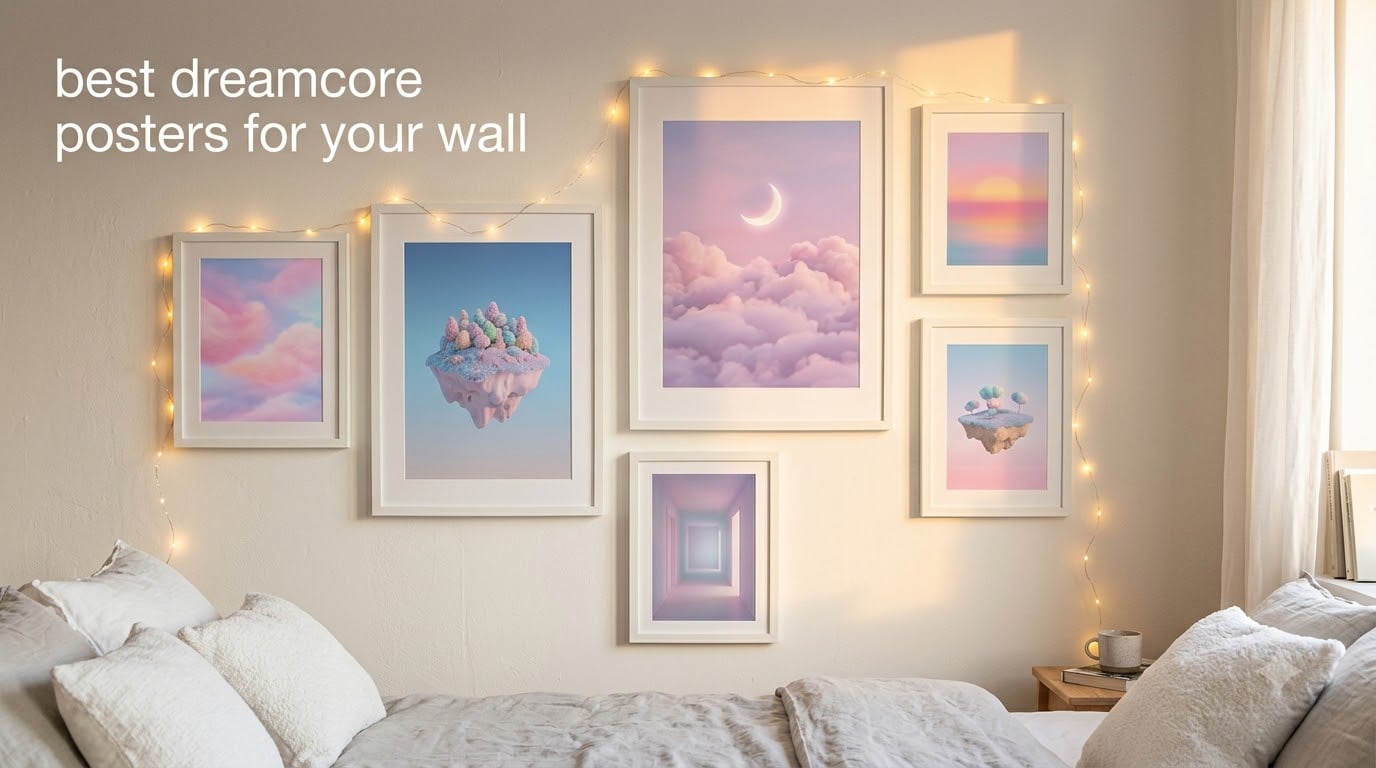
If you’ve ever scrolled through Pinterest at midnight and saved a hazy pastel cloud floating over an empty hallway, you’ve already met dreamcore. It’s the internet-born aesthetic that turns half-remembered dreams into wall art, and right now it’s one of the most-requested decor styles for bedrooms, dorms, and creative studios.
I’ve spent the last few months collecting dreamcore posters, testing different formats, and talking with indie artists who actually make this stuff. This guide covers everything I wish someone had told me before I started: what dreamcore really is, which motifs work where, where to find posters that don’t look like AI sludge, and how to arrange them so your wall feels dreamy instead of cluttered.
Table of Contents
What Is the Dreamcore Aesthetic?
Dreamcore is an internet aesthetic built around hazy, surreal imagery — pastel clouds, empty hallways, floating objects, and soft low-fi visuals — designed to evoke the strange, comforting feeling of half-remembered dreams. Think of it as the visual language of that moment when you’re half-asleep and everything feels soft, familiar, and slightly impossible.
The aesthetic lives on Tumblr, TikTok, Reddit’s r/LiminalSpace, and Pinterest boards with thousands of saves. It borrows heavily from early-2000s internet nostalgia, low-fidelity digital photography, and surrealist painting, then filters all of it through a pastel haze.
What separates dreamcore from related aesthetics is the mood. Weirdcore feels unsettling, liminal space feels empty, backrooms feel anxious. Dreamcore feels like a dream you don’t want to wake up from.
The look has three core ingredients. First, a pastel or muted color palette: dusty pinks, baby blues, lavender, cream, soft peach. Second, dream-logic motifs: clouds indoors, floating islands, levitating furniture, surreal eyes. Third, a soft, slightly blurry or low-fi quality — almost like a photo taken on an old digital camera at golden hour.
When dreamcore moved from screens to walls (as posters, prints, and tapestries), it became one of the fastest-growing indie decor trends. Etsy searches for “dreamcore wall art” jumped sharply in 2024 and have stayed strong through 2026.
Why Dreamcore Posters Work on Your Wall
Dreamcore posters work because they don’t just decorate — they set a mood. A single dreamcore print can change how a room feels the moment you walk in, which is why this aesthetic has become a favorite for bedrooms, dorm rooms, and creative spaces.
There’s a real psychological reason dreamcore feels comforting. The aesthetic mirrors the visual texture of REM sleep — soft focus, familiar-but-wrong spaces, warm light, and a sense that time has slowed down. Hanging dreamcore art on your wall invites that same calm, slightly floaty state into your waking space.
It’s also one of the easiest aesthetics to live with. Unlike bold maximalist posters that demand attention, dreamcore pieces sit quietly in the background and let the room breathe. They pair well with string lights, sheer curtains, and secondhand furniture, which is why the indie and alt decor crowd has adopted them so fast.
Another reason dreamcore posters travel well: they translate across almost any room type. A floating-island print looks at home above a bed, behind a desk, or in a reading nook. The aesthetic is flexible enough to fit a teen bedroom, a college dorm, a creative studio, or even a home office without feeling out of place.
Popular Dreamcore Poster Motifs
Dreamcore has a recognizable visual vocabulary. Once you know the recurring motifs, you start spotting them everywhere — on indie artist shops, in Pinterest dreamcore decor boards, and in curated image dumps on r/LiminalSpace. Here are the most popular dreamcore poster motifs people actually hang on their walls.
Pastel Clouds and Holographic Skies
Soft pastel clouds — often pink, lavender, or peach — are the single most iconic dreamcore motif. Holographic cloud posters add a subtle iridescent shimmer that catches light beautifully when hung near a window. These are the safest first dreamcore poster to buy because they pair with almost any color scheme.
Empty Hallways and Liminal Interiors
Long, empty hallways — sometimes with faded carpet, sometimes with industrial lighting — are a dreamcore staple. They evoke the feeling of being somewhere familiar but slightly off, like a school or hotel at 3 a.m. Hallway posters work especially well in offices and creative studios because they create a quiet, contemplative focal point.
Floating Islands and Levitating Objects
Floating islands, levitating furniture, and suspended objects are dream-logic made visible. These motifs feel whimsical without being childish, which is why they show up so often in teen bedroom and dorm decor. A single floating-island print above a bed reads as gentle and otherworldly.
Surreal Eyes and Glowing Figures
Surreal eyes — often large, softly glowing, or impossibly detailed — are a dreamcore motif with weirdercore crossover. Glowing humanoid figures (sometimes faceless, sometimes translucent) are also common. These pieces add a slightly eerie edge and work well as accent posters in a curated gallery wall.
Backrooms and Yellow-Tinted Spaces
Backrooms — those endless, beige, fluorescent-lit office spaces from internet horror — have become a dreamcore-adjacent motif. When filtered through pastel editing, they feel less creepy and more surreal. Backrooms posters are popular in gaming setups and alt-decor bedrooms.
Twilight Castles, Crystal Caves, and Celestial Spires
Fantasy-leaning motifs — twilight castles floating in pink skies, crystal caves, celestial spires — are dreamcore’s softer cousins. They borrow from cottagecore and ethereal aesthetics but keep dreamcore’s muted palette. These pieces fit beautifully in reading nooks and bedrooms with a romantic or mystical mood.
Low-Fi Nostalgic Scenes
Low-fidelity imagery — grainy photos of empty malls, dated wallpaper, old CRT TVs, faded VHS stills — is dreamcore’s love letter to early-internet nostalgia. These posters feel like a memory you’ve half-forgotten, which is exactly the point. They’re a favorite for nostalgiacore fans.
Related Aesthetics You Should Know
Dreamcore sits inside a whole family of “soft internet aesthetics,” and the borders between them are blurry. If you’re building a dreamcore wall, you’ll probably end up mixing in pieces from these related looks. Here’s how dreamcore differs from its closest cousins.
Dreamcore vs Weirdcore
Dreamcore is comforting and dreamy. Weirdcore is unsettling and disorienting. Weirdcore uses the same low-fi, surreal imagery — empty spaces, distorted figures, weird text — but with an eerie, anxious edge. If dreamcore is a soft pillow, weirdcore is the same pillow in a haunted hotel.
Dreamcore vs Liminal Space
Liminal space focuses on transitional, empty places — airports at night, empty malls, deserted playgrounds. It overlaps heavily with dreamcore but tends to feel emptier and more melancholic. Liminal space posters work well alongside dreamcore prints when you want a quieter, more contemplative wall.
Dreamcore vs Backrooms
Backrooms are a specific sub-aesthetic of liminal space: endless yellow-beige office rooms with buzzing fluorescent lights. They’re dreamcore-adjacent but feel more claustrophobic and horror-coded. Backrooms posters are a popular choice for gaming rooms and alt-decor setups.
Dreamcore vs Vaporwave
Vaporwave is dreamcore’s retro-futurist cousin: neon pinks, purples, glitchy grids, Greek statues, and Windows 95 aesthetics. Vaporwave feels more synthetic and 80s-nostalgic, while dreamcore feels softer and more natural. They share a love of pastel palettes, which is why they mix surprisingly well on the same wall.
Dreamcore vs Nostalgiacore and Y2K
Nostalgiacore romanticizes a specific past era — usually the 1990s or early 2000s — through faded photos, old tech, and dated interiors. Y2K is its more sparkly, maximalist cousin. Both share dreamcore’s love of low-fi imagery but lean harder into pop culture references. A dreamcore wall with one or two nostalgiacore pieces feels cohesive, not chaotic.
Where to Find Dreamcore Posters
Most dreamcore posters come from independent artist marketplaces rather than big-box stores. That’s part of the appeal — buying dreamcore art means supporting indie creators, and you’ll find far more variety than anywhere else. Here are the main places to shop, with what each one does best.
Etsy
Etsy is the single best source for dreamcore posters, especially if you want digital downloads. Thousands of indie artists sell pastel cloud prints, hallway scenes, and floating-island art, often as instant downloads starting around a couple of dollars. Etsy also has the strongest selection of poster bundles if you want a coordinated set.
The trade-off: quality varies widely. Always check the listing’s resolution (at least 300 DPI for 18×24 prints), read reviews, and look at customer photos when available.
Redbubble
Redbubble is the go-to for paper posters, canvas prints, and tapestries from named independent artists. You’ll find hundreds of dreamcore prints with strong tagging — weirdcore, liminal space, vaporwave, y2k — which makes it easy to explore sub-aesthetics. Redbubble’s framing quality is reliable, and artists are credited directly on each listing, which I personally appreciate.
Redbubble also offers bundles themed by concept — strawberry dreamscapes, sunset clouds, liminal views — which are perfect for a coordinated gallery wall.
Displate
Displate specializes in metal prints. If you want a premium, durable dreamcore poster that won’t bend or fade, Displate is the move. Metal prints have a subtle sheen that makes pastel colors glow, and they mount with magnets — no nails, no frame needed. They’re more expensive than paper, but they last.
The Displate catalog skews more toward sci-fi and surreal dreamcore (think glowing eyes, futuristic hallways) than soft pastel clouds, so it’s worth browsing with a clear motif in mind.
TeePublic and Zazzle
TeePublic and Zazzle round out the indie marketplace list with smaller but well-curated dreamcore selections. TeePublic leans toward graphic, illustration-heavy posters, while Zazzle offers more customization (you can often tweak size, frame, and paper type). Both are worth checking for specific motifs you can’t find elsewhere.
Format Comparison
Here’s a quick comparison of the four main dreamcore poster formats so you can pick what fits your space and budget.
| Format | Best For | Durability | Vibe |
|---|---|---|---|
| Digital Download | Trying out dreamcore affordably, custom print sizes | Depends on where you print it | DIY, flexible |
| Paper Print | Classic poster look, gallery walls, framing | Moderate (can fade in sunlight) | Soft, traditional |
| Metal Print | Long-lasting statement piece, modern rooms | Excellent (scratch- and fade-resistant) | Sleek, luminous |
| Canvas | Textured, painterly feel; no frame needed | Good (avoid damp areas) | Warm, artistic |
If you’re just starting out, grab one or two digital downloads to test how dreamcore feels in your space before committing to more expensive formats.
How to Choose the Right Dreamcore Poster
With thousands of options on Etsy and Redbubble alone, picking the right dreamcore poster is more about curation than shopping. Here’s how I narrow it down when I’m building a wall.
Start With One Anchor Motif
Don’t try to represent every dreamcore motif on one wall. Pick one motif that matches the mood you want — pastel clouds for calm, hallways for contemplative, floating islands for whimsical — and build the wall around it. A gallery wall with five different dreamcore motifs can feel chaotic; one motif, repeated in different sizes and frames, feels intentional.
Match the Color Palette to Your Room
Dreamcore has a recognizable pastel palette, but it ranges from icy lavender to warm peach. Pull the dominant color from your existing bedding, curtains, or rug, then choose posters that echo it. If your room is mostly neutrals, go bolder with the posters. If your room already has color, choose muted dreamcore pieces that won’t fight with it.
Pick the Right Size
Posters almost always arrive smaller than expected. For above a bed, aim for 18×24 or larger; for a dorm wall or small bedroom nook, 13×19 or 11×17 works well. Digital downloads are the easiest way to print at any size you want, which is one of their biggest advantages.
Check the Resolution
If you’re buying a digital download, the listing should specify 300 DPI at your target print size. Anything less and the poster will look blurry when printed at 18×24. This is the most common complaint I’ve seen from buyers on Reddit: cheap digital downloads that look great at 4×6 but fall apart at poster size.
Look for Artist Credit and Reviews
Independent artist attribution is one of dreamcore’s best trust signals. Listings that name the artist, show their other work, and have substantial reviews are almost always a safer bet than anonymous dropshipped listings. Take two minutes to click through to the artist’s shop — you’ll get a much better feel for whether their style fits your wall.
How to Style a Dreamcore Gallery Wall
Dreamcore posters look best when arranged with intention. Here’s the step-by-step process I use every time I style a dreamcore wall, from layout to final frame.
Step 1: Lay Everything Out on the Floor First
Before you make a single hole in the wall, arrange your posters on the floor in the exact layout you want. This saves time, prevents mistakes, and lets you experiment with spacing without commitment. Aim for 2 to 3 inches between frames for a clean gallery feel.
Step 2: Choose One Hero Piece
Every dreamcore gallery wall needs a focal point — usually the largest, boldest, or most colorful poster. Hang it at eye level (around 57 to 60 inches from the floor to the center of the poster) and build the rest of the arrangement outward from there.
Step 3: Mix Sizes for Visual Rhythm
A wall of identical-size posters looks like a grid, not a gallery. Mix one large piece (18×24 or bigger) with two or three medium prints (13×19) and one or two smaller accents (8×10 or 11×14). The variation in size is what makes the wall feel curated rather than mass-produced.
Step 4: Keep the Frame Style Consistent
For dreamcore, thin black, white, or natural wood frames all work — just pick one and stick with it across the wall. Mismatched frames are the fastest way to make a gallery wall feel chaotic. If you want variety, change the matting color instead of the frame.
Step 5: Use Soft Lighting
Dreamcore posters look best under warm, soft light. String lights, fairy lights, or a small picture light above the hero piece add to the dreamy mood. Avoid harsh overhead lighting — it kills the pastel palette and makes everything look flat.
Step 6: Add Negative Space
Resist the urge to fill every inch of wall. Dreamcore is about softness and breathing room, so leave some empty space around the arrangement. A few well-placed posters with breathing room beats a packed wall every time.
Step 7: Step Back and Adjust
After hanging, live with the wall for a day or two before deciding it’s final. Look at it at different times of day, in different lighting, and from different angles. Move pieces by half an inch if something feels off. The best gallery walls are tweaked, not rushed.
Room-by-Room Dreamcore Poster Ideas
Different dreamcore motifs feel different in different rooms. Here’s a quick guide to help you match motifs to spaces.
| Motif | Best Room | Why It Works |
|---|---|---|
| Pastel clouds | Bedroom | Soft, calming, ideal above the bed |
| Empty hallways | Home office | Quiet, contemplative focal point |
| Floating islands | Dorm room | Whimsical, personal, fits small walls |
| Backrooms | Gaming setup | On-aesthetic for alt-decor and streamer rooms |
| Surreal eyes | Creative studio | Adds intrigue without dominating the wall |
| Twilight castles | Reading nook | Romantic, soft, perfect for a quiet corner |
| Low-fi nostalgic scenes | Living room | Conversation-starting, indie-friendly |
| Holographic clouds | Hallway or entryway | Catches natural light, sets the mood as you enter |
Frequently Asked Questions
What is the dreamcore aesthetic?
Dreamcore is an internet aesthetic built around hazy, surreal imagery — pastel clouds, empty hallways, floating objects, and soft low-fi visuals — designed to evoke the strange, comforting feeling of half-remembered dreams. It borrows from early-2000s internet nostalgia, surrealism, and soft pastel color palettes, and translates especially well into wall art for bedrooms, dorms, and creative studios.
Why is dreamcore so comforting?
Dreamcore mirrors the visual texture of REM sleep — soft focus, familiar-but-wrong spaces, warm light, and slow, dream-like scenes. Hanging dreamcore posters invites that calm, slightly floaty state into your waking space, which is why so many people use it in bedrooms and reading nooks where they want to relax.
How do I make a poster look good on my wall?
Lay the arrangement out on the floor first, choose one hero poster at eye level, mix sizes for visual rhythm, keep frame style consistent, add soft warm lighting, and leave some negative space around the wall. The best dreamcore gallery walls feel intentional and a little under-decorated rather than packed.
What are some of the coolest dreamcore posters?
The most popular dreamcore poster motifs are pastel clouds and holographic skies, empty hallways and liminal interiors, floating islands, surreal eyes, backrooms, twilight castles, crystal caves, and low-fi nostalgic scenes from the early internet era. Pastel clouds are the easiest first buy because they pair with almost any room.
What is the difference between dreamcore and weirdcore?
Dreamcore is comforting and dreamy, while weirdcore uses similar low-fi, surreal imagery with an unsettling, anxious edge. Weirdcore focuses on distorted figures, weird text, and eerie spaces. Dreamcore softens those same elements into pastel palettes and gentler scenes that feel like a memory rather than a nightmare.
Where can I buy dreamcore posters?
The best marketplaces for dreamcore posters are Etsy (strong digital download and bundle selection), Redbubble (named independent artists, paper and canvas), Displate (premium metal prints), and TeePublic and Zazzle (smaller curated catalogs). For most people, starting with one or two Etsy digital downloads is the easiest, most affordable way to test the aesthetic.
Final Thoughts
The best dreamcore posters for your wall aren’t the most expensive or the most popular — they’re the ones that match the mood you actually want to live in. Start with one anchor motif, choose a color palette that fits your room, and let the wall breathe. Dreamcore is meant to feel like a soft place to land, not a packed gallery.
Pick one poster you love this week, hang it somewhere you see every day, and let the rest of the wall grow from there.