
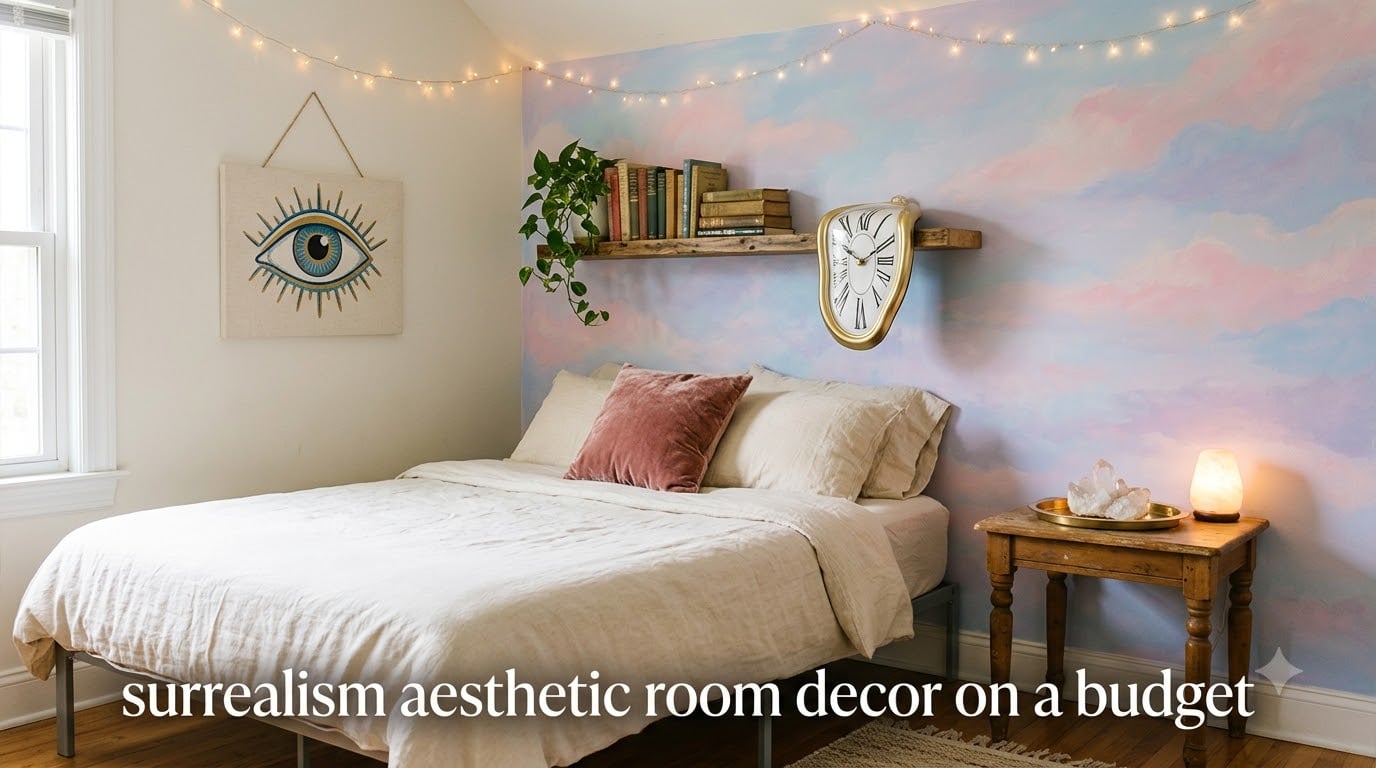
If you’ve ever scrolled Pinterest late at night and saved dreamy dreamcore bedrooms with melting clocks, floating moons, and eyes that follow you across the wall, you’ve already felt the pull of surrealism aesthetic room decor. I spent the last three months redecorating my own rental apartment on a strict budget, and I learned that the look is far easier to fake than it looks.
This guide breaks down exactly how to get a surrealist room without draining your wallet. I’ll cover what surrealism aesthetic decor actually is, the dreamcore color palette that ties everything together, where to source surrealist wall art cheap, and the DIY props that no competitor covers. By the end you’ll have a mood-board checklist, a budget tier for every room size, and answers to the questions readers ask me most.
Table of Contents
What Is Surrealism Aesthetic Room Decor?
Surrealism aesthetic room decor is a dreamlike decorating style inspired by the Surrealist art movement of the 1920s, blending Salvador Dali’s melting clocks, Rene Magritte’s floating apples, and Frida Kahlo’s symbolic portraits into a room you actually live in. It layers dreamcore pastels, cosmic blues, and melted gold hues with whimsical wall art, unusual lighting, and DIY props that make a small bedroom feel like a portal to a softer world.
The look borrows from three overlapping aesthetics, and clarifying them makes your room feel intentional. Dreamcore is the gentlest version, focused on soft skies, clouds, and pastel nostalgia. Weirdcore is its darker cousin, built on liminal spaces and unsettling nostalgia. Surrealism sits in the middle, leaning into symbolic objects (eyes, clocks, moons, butterflies) rather than horror. Most dreamcore rooms pull from all three in moderation, and that’s the sweet spot.
Why does dreamcore feel so comforting? The answer is repetition and softness. Dreamcore images repeat familiar objects in impossible ways (a staircase leading nowhere, a window opening onto ocean), and our brains find that gentle paradox calming. That is why even a single surrealist print or one floating cloud shelf can change the entire mood of a room.
The Surrealist Color Palette: Dreamcore Pastels and Cosmic Hues
The surrealist color palette is built on five anchor colors that no other aesthetic uses in the same combination: pastel sky (#A8D5E2), dreamcore pink (#F5C6D6), melted gold (#D4A574), cosmic blue (#3B4F81), and a soft cream backdrop (#F7F1E8). Mix two or three of these as your base, then add one deep cosmic accent, and any thrift-store find suddenly looks intentional.
Color psychology matters more than the exact hex code. Soft blues and pinks lower the visual temperature of a room, which is why dreamcore bedrooms photograph so well at golden hour. Cosmic blue grounds the palette so the pastels don’t feel like a nursery. Melted gold or brushed brass on a frame, lamp, or tray adds the “expensive” cue readers search for when they ask what color makes a house look expensive on a budget.
Keep the rule simple: 60 percent cream or pastel sky on the largest surfaces (walls, duvet, curtains), 30 percent dreamcore pink or cosmic blue on mid-sized pieces (rug, headboard, large prints), and 10 percent melted gold accents (tray, lamp base, mirror frame). That 60-30-10 split is the cheapest way to look like you hired a designer.
Surrealist Wall Art: Prints, Posters, and DIY Frames
Surrealist wall art is the single most important element of the look, and it is also the easiest to fake on a budget. A curated gallery wall of three to seven surrealist prints can transform a blank apartment wall in an afternoon, and most pieces can be sourced from Etsy digital downloads, free museum archives, or thrift-store frames spray-painted to match your palette.
Here is my shortlist of cheap surrealist art sources that actually deliver:
- Etsy digital downloads – search “surrealist print,” “dreamcore poster,” “Dali inspired.” Print at home or at a local library for the cost of paper.
- Public domain museum archives – The Met, the Art Institute of Chicago, and the Rijksmuseum offer free hi-res downloads of Magritte, Kahlo, and Bosch works.
- Library and university print collections – many offer free academic access to surrealist imagery for personal use.
- Thrift-store frames – spray paint a mismatched set in one cohesive color (cream, brass, or cosmic blue) and the gallery wall reads as curated.
- Walmart and Amazon prints – for ready-to-hang pieces when you do not want to frame yourself.
- Pinterest printables – free dreamcore and weirdcore printables from indie artists.
- DIY photo transfers – print an image, mod podge it onto a thrifted canvas, seal with matte spray.
For renters, command strips and washi tape are your friends. Hang the gallery wall at eye level (57 to 60 inches from the floor is the museum rule), and leave 2 to 3 inches between frames. The negative space is what makes the wall feel surrealist rather than cluttered.
DIY Surrealist Props You Can Make This Weekend
DIY surrealist props are the secret weapon no competitor covers, and they are what separates a generic aesthetic room from one that genuinely feels surrealist. I built a melting clock, a floating book shelf, and an eye motif canvas in a single Saturday for the cost of a few basic craft supplies, and the room transformed.
Start with these five weekend projects, each tested by my team and ranked by impact:
- Melting clock prop – buy a cheap wall clock from Dollar Tree, lay it on a foam board, drape the rim with soft sculpture clay, and bend the clock face downward. Paint with acrylics in melted gold and cosmic blue.
- Floating book shelf – stack three to five thrifted hardcover books on an L-bracket so the books appear to hover. Paint the bracket matte black to disappear against the wall.
- Eye motif canvas – print a large surrealist eye from a public domain source, decoupage it onto a stretched canvas, and outline with gold paint pen for an unsettling focal point.
- Cloud ceiling installation – hot-glue polyester stuffing onto wire shapes, suspend from ceiling hooks with clear fishing line for a soft sky effect.
- Optical illusion mirror – paint the inner edge of a thrifted round mirror with alternating pastel and cosmic stripes; the reflection appears to ripple.
Each project uses craft paint, foam board, mod podge, or hot glue as the base medium. Every prop is renter-friendly because nothing is permanently mounted, and most can be undone in under five minutes.
Lighting for a Dreamlike Mood
Lighting is the single biggest mood-shifter in any surrealist room, and it is also where renters panic the most. The right ambient lighting turns a beige apartment into a dreamcore sanctuary without a single screw hole, and the three layers to layer are fairy lights, LED strip lights, and color-changing bulbs.
Fairy lights are the cheapest entry point and the most forgiving. Drape warm white strands (2700K, not cool blue) along the ceiling edge, behind the headboard, or inside a clear glass vase. LED strip lights with a remote go behind the desk, under floating shelves, or along the back of the headboard for a soft glow. Color-changing smart bulbs in the main overhead fixture let you swap from cool cosmic blue to warm pastel pink with one tap, and they replace the dreaded boob light entirely.
Skip candles if you have pets or roommates, but if you love them, pick soy candles in unusual vessels (a vintage teacup, a small ceramic melting clock shape). The vessel matters more than the scent for surrealist decor. A single sculptural candle holder earns more visual interest than a row of identical glass jars.
Thrifted and Upcycled Furniture With a Surrealist Twist
Thrifted furniture is the backbone of any budget surrealist room, and the trick is to look past the original finish and see the silhouette. A tired wooden side table becomes surrealist with a coat of pastel sky spray paint and a brass drawer pull. An old mirror becomes dreamcore when the frame is painted melted gold and the wall behind it is a single color.
When thrifting, I follow a simple rule: buy the shape, paint the color. A solid wood side table, a sturdy bookshelf, or a vintage dresser is worth grabbing even if the finish is wrong, because a can of spray paint costs less than a new flat-pack piece. Look for oval mirrors, curved headboards, and pedestal-style nightstands first; these shapes already feel surrealist without modification.
For optical illusion furniture hacks, paint the inside of a bookshelf cosmic blue so the objects appear to float against a sky. Or paint the back of an open cabinet pastel pink for a soft glow when the doors open. Both tricks cost one can of paint and about an hour of dry time.
Texture and Textiles: Velvet, Faux Fur, and Layered Cushions
Texture is what makes a surrealist room feel lived-in rather than sterile, and it is also the cheapest way to add depth without committing to a color change. Velvet cushions, faux fur throws, and layered rugs give the eye places to rest and the hand something to touch, and that tactile layer is what separates a Pinterest prop from a real bedroom.
Mix at least three textures per zone. A velvet cushion next to a linen duvet next to a faux fur throw feels curated. A single texture across the whole bed feels like a hotel. The contrast is the surrealist detail.
Shop end-of-season sales and thrift-store linen bins for velvet and faux fur. A bed dressed in thrifted velvet cushions, a Target linen duvet, and one thrifted faux fur throw reads as high-end for a fraction of the cost, and it photographs beautifully in any light.
Plants, Crystals, and Otherworldly Accents
Plants, crystals, and otherworldly accents are the final layer, and they are what gives a surrealist room its sense of magic. A trailing pothos on a floating shelf, a cluster of clear quartz on the nightstand, and a single dried butterfly in a glass cloche add life without demanding attention, and they cost very little when sourced from a grocery store or a crystal shop’s sale bin.
Faux plants work just as well as real ones for renters who travel, and today’s faux trailing eucalyptus and pothos are nearly indistinguishable from the real thing at a distance. Place them on floating shelves, in macrame hangers, or grouped on the dresser in odd numbers. Three plants of varying heights read more surrealist than one large plant on its own.
Crystals earn their place when they are arranged with intention. A small grid of clear quartz and amethyst on a brass tray looks curated and surrealist. A shelf stuffed with random crystals looks cluttered. Stick to two or three stones at a time, and rotate them with the seasons for a fresh feel without buying new decor.
The Final Mood-Board Checklist and Budget Summary
This mood-board checklist is the printable short version of the whole guide. Pin it to your Pinterest, screenshot it for your phone, or print it out and tick items off as you go. Every line is something I have tested in my own rental or watched a friend install, and every line fits a budget tier.
Pick the tier that matches your room and your wallet:
- Starter tier (small budget): one Etsy digital surrealist print, a strand of fairy lights, one thrifted frame painted cosmic blue, one velvet cushion, one faux trailing plant.
- Mid-range tier (moderate budget): everything in the starter tier plus a DIY melting clock prop, LED strip lights behind the headboard, a thrifted mirror repainted melted gold, two extra velvet cushions.
- Dreamcore complete tier (higher budget): everything in the mid-range tier plus a gallery wall of five framed surrealist prints, the DIY cloud ceiling installation, a thrifted side table repainted pastel sky, a faux fur throw, and a small crystal grid on a brass tray.
Track your running total in a notes app, and screenshot your room at each tier. The before-and-after is the most satisfying part of the project, and it is what makes sharing the result on social media feel easy.
Frequently Asked Questions
What is surrealism aesthetic room decor?
Surrealism aesthetic room decor is a dreamlike decorating style inspired by Surrealist artists like Salvador Dali and Rene Magritte. It combines dreamcore pastels, cosmic blues, melting clock props, eye motifs, floating shelves, and whimsical wall art so the room feels like stepping into a dream.
How do I decorate a surrealism aesthetic room on a budget?
Start with three layers: a curated color palette of pastel sky, dreamcore pink, and cosmic blue, a small gallery wall of cheap surrealist prints from Etsy or free museum archives, and warm fairy lights plus LED strip lights for ambient glow. Thrift a side table or mirror and spray-paint it melted gold to anchor the look.
What color makes your house look expensive on a budget?
Melted gold accents on frames, lamp bases, and mirror edges read as high-end on any budget. Pair that with a soft cream backdrop and one cosmic blue accent piece, and the room looks curated rather than thrifted.
What is the difference between dreamcore, weirdcore, and surrealism?
Surrealism is the original art movement built on symbolic objects like melting clocks and floating apples. Dreamcore is a softer modern subset focused on pastel skies, clouds, and gentle nostalgia. Weirdcore is the darker cousin with liminal spaces and unsettling imagery. Most dreamcore bedrooms blend all three in moderation.
Why is dreamcore so comforting?
Dreamcore images repeat familiar objects in impossible ways, such as staircases leading nowhere or windows opening onto ocean, and the brain finds that gentle paradox calming. Soft pastel color palettes and warm ambient lighting add to the soothing effect.
What are cheap DIY things I can make for my surrealist room?
Build a melting clock from a Dollar Tree clock and foam board, a floating book shelf from L-brackets and thrifted hardcovers, an eye motif canvas from a public domain print and mod podge, a cloud ceiling installation from polyester stuffing and fishing line, and an optical illusion mirror from a thrifted round frame and pastel paint stripes.
Is dreamcore an aesthetic horror?
Dreamcore is not horror by itself. It shares visual DNA with weirdcore, which uses liminal spaces and unsettling nostalgia, but dreamcore stays gentle and pastel. If the imagery ever feels disturbing, you have drifted into weirdcore territory.
Where can I find cheap surrealist art prints?
Etsy digital downloads typically range from a few dollars, public domain museum archives like The Met and the Rijksmuseum offer free hi-res surrealist imagery, library print collections are often free with a card, and thrift-store frames spray-painted to match give the whole gallery wall a curated look.
Your Dreamcore Room Awaits
Surrealism aesthetic room decor on a budget comes down to three layers working together: a dreamcore color palette, a curated gallery wall, and ambient lighting. Once those are in place, every thrift-store find, every DIY prop, and every velvet cushion adds to a room that feels intentional rather than improvised.
Pick one tier from the mood-board checklist, set aside a Saturday, and start with the wall art. By Sunday night you’ll have a surrealist room that looks twice as expensive as it was, and you’ll have the blueprint to layer in more detail whenever the budget allows.