
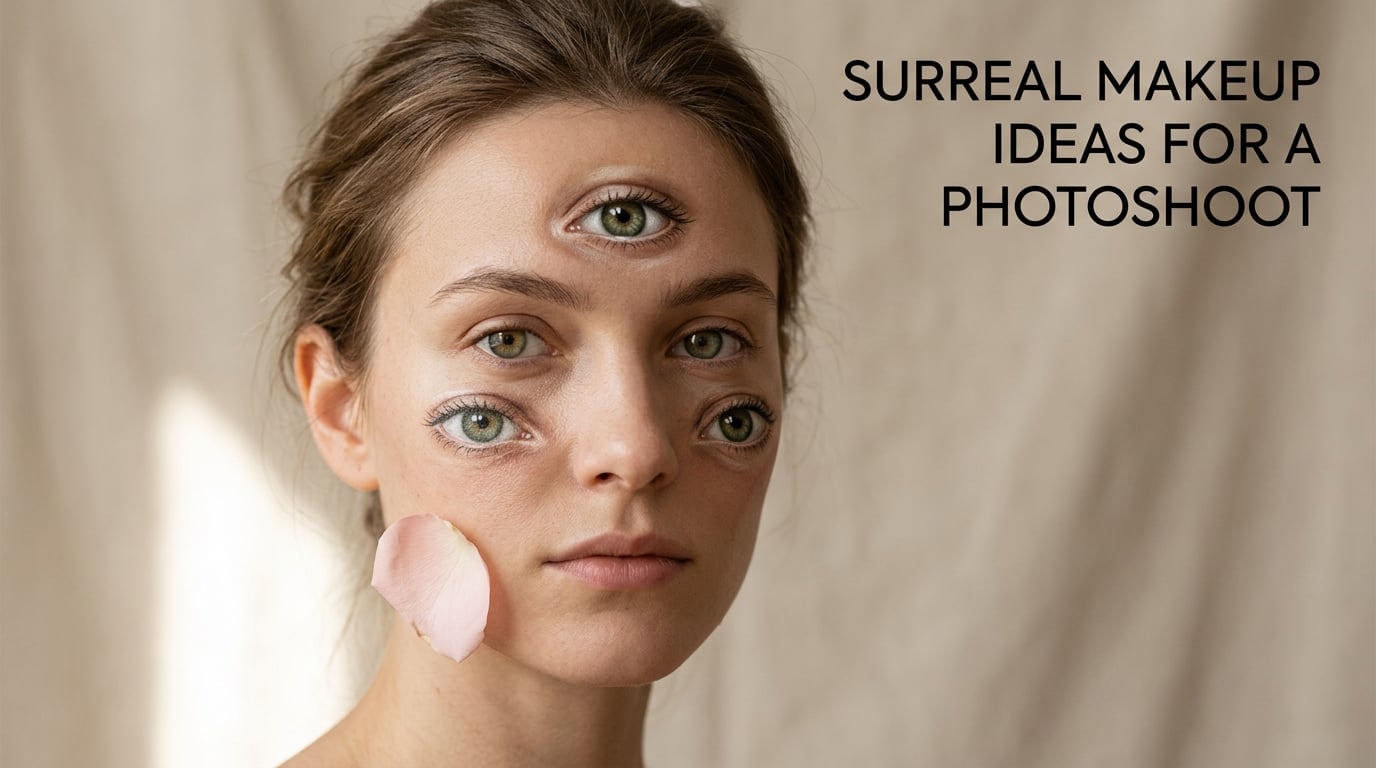
Surreal makeup ideas for a photoshoot turn an ordinary camera session into a frame pulled straight from a dream. I’ve spent the last two years building editorial looks with makeup artists for surrealist portrait shoots, and the single biggest lesson is this: surreal makeup isn’t about wearing more product, it’s about wearing product in places the camera has never seen it before. This guide walks you through what surreal makeup actually is, ten specific looks you can photograph this month, the techniques that make them survive the lens, and the lighting and collaboration tips that bring the whole concept together.
If you’ve been hunting for surreal makeup inspiration on Pinterest, scrolling through Mimi Choi’s Instagram, or trying to recreate a Magritte painting on a friend’s face, you’re in the right place. I’m covering the ideas, the application, and the on-set decisions that turn a clever concept into a final image worth printing.
Table of Contents
What Is Surreal Makeup and Where Did It Come From?
Surreal makeup is a style of face and body painting that borrows the visual language of the surrealist art movement to create dreamlike, otherworldly, or impossible effects on a human subject. It uses optical illusions, distorted proportions, unexpected color placement, and trompe l’oeil techniques to make a real face read as a living painting on camera.
The roots go back to the 1920s surrealist movement led by André Breton, with painters like Salvador Dalí and René Magritte creating images where eyes floated in empty skies, apples hovered over faces, and bodies morphed into landscapes. By the 1960s and 70s, those same visual ideas started showing up on editorial covers and music photography. Today, artists like Mimi Choi, Raoul Alejandre, and Dain Yoon have pushed surreal makeup into a standalone genre — sometimes called optical illusion makeup or face mapping — that lives on Instagram, TikTok, and the pages of magazines like Vogue and Dazed.
What separates surreal makeup from fantasy or theatrical makeup is the commitment to a single impossible idea per look. The makeup doesn’t just decorate the face; it argues that reality is a little broken in this one specific way, and then the photograph captures that broken logic as fact.
10 Surreal Makeup Ideas for a Photoshoot
Below are ten surreal makeup ideas I’ve either shot myself or watched being built on set. Each one is photographed well with standard camera gear, and each one has a clear visual hook your photographer can light and frame around. Treat these as starting points — the best surreal looks always add one personal twist.
1. Floating Eyes (Dalí Homage)
Paint three to five extra eyes around the natural eyes, on the forehead, cheeks, and temples, in realistic skin tones so they read as real when the camera focuses. The pose works best when the model tilts their head slightly so the extra eyes catch the light at the same angle as the real ones. Pull inspiration directly from Magritte’s The False Mirror if you want a museum-ready reference.
2. Cracked Porcelain Face
Use a thin black liner or face paint to draw a fractured porcelain pattern across the forehead, cheeks, and chin. Fill the negative space between the cracks with a pale matte foundation to mimic aged china. Keep lighting soft and slightly overhead so the shadows in the cracks have actual depth. This look photographs brilliantly in black and white.
3. Floral Face Fusion
Glue dried flowers, leaves, or petals directly onto one side of the face using skin-safe adhesive, then blend the edges of the petals into the skin with foundation. The illusion works because the flowers appear to grow out of the model’s cheek and jaw. It pairs well with botanical backdrops and natural light.
4. Two Faces in One
Split the face down the middle and paint each half as a different identity — one half natural and soft, the other half skeletal, alien, or covered in jewels. The hard line down the center is the surreal element. Use a flat brush and concealer to keep the dividing line crisp because any softness in that seam ruins the trick on camera.
5. Melted Wax Skin
Draw long vertical drips from the eyes, cheekbones, and chin in a slightly darker skin tone or a contrasting color, then blend the tops so they appear to be melting off the bone. This is the look Dali’s The Persistence of Memory keeps asking for. Photograph it under hard directional light so the drips have visible shadow.
6. Pixelation Glitch
Use small square stencils and face paint to render one section of the face as blocky 8-bit pixels in unexpected colors. Confine the pixelation to a square patch on the cheek or forehead so it reads as a “broken” section of an otherwise normal face. Keep the surrounding skin totally matte and even.
7. Third Eye on the Forehead
Paint a large, hyper-realistic eye in the center of the forehead, complete with iris detail, lashes, and tear duct shading. This is one of the easiest surreal ideas to execute but it has the strongest impact when the model’s natural eyes look directly into the camera. A simple beauty dish and minimal background keep the focus on the eye.
8. Geometric Face Mapping
Divide the face into geometric sections — diamonds, triangles, hexagons — and fill each one with a different color or pattern while keeping the model’s natural features untouched inside the shapes. Think Piet Mondrian meets beauty photography. The crisp edges are what sell the surreal quality, so use tape or a liner brush with a steady hand.
9. Butterfly or Moth Mandala
Build a symmetrical butterfly or moth across the model’s face using the nose as the body and the eyes as part of the wing pattern. Extend the wings past the eyebrows and down the cheeks. Black and white photography emphasizes the symmetry, while color photography lets the wing patterns pop.
10. Liquid Gold or Silver Pour
Paint the face as if liquid metal is pouring from the eyes, mouth, or hairline, with the drips extending down the neck and shoulders. Use metallic pigments for the wet look and a flat matte base on the dry areas to maximize contrast. This is one of the most high-fashion surreal looks and it photographs best against a dark backdrop with a focused key light.
Techniques for Making Surreal Makeup Photograph Well
The camera eats makeup differently than the human eye, and the gap between those two perceptions is where most surreal looks fail. Here are the techniques I always push for on set.
Go 30% heavier than you think you need. Forum threads on r/MakeupAddiction and r/nextfuckinglevel all repeat the same advice from working artists: apply roughly a third more product than everyday makeup. Cameras flatten dimension, so colors that read as bold in person often look pastel in a photo.
Reach for matte over shimmer. Shimmer and metallic pigments cause hotspots and flashback under flash photography. Save shimmer for looks specifically designed around UV or blacklight, where it becomes the point of the image rather than a flaw.
Avoid SPF in the base. Sunscreen ingredients, especially zinc oxide, reflect flash and create the ghostly white cast you see in bad event photos. Use SPF-free primer and foundation for the areas that will be photographed up close.
Layer for opacity, not texture. Build color in thin layers with a sponge or dense brush rather than trying to get full coverage in one swipe. Heavy single applications crease, cake, and settle into fine lines on camera.
Set everything twice. Lock the base with translucent setting powder, then mist with setting spray. Long shoots generate heat and sweat, and surreal makeup rarely forgives a mid-session smudge.
Take a test shot every 15 minutes. On a tethered laptop if possible. The camera shows you what the lens sees, which is often very different from what the mirror shows.
Lighting and Color Theory for Surreal Looks
Lighting is half the surreal effect. The same painted face can read as elegant editorial or as haunted horror depending on where you place the key light. Hard light from one side emphasizes texture in cracked or melted looks, while soft frontal light flattens geometric and pixelated designs so they read as graphic shapes.
Color theory matters more in surreal makeup than in almost any other style of photography. Complementary pairs like teal and coral, or violet and yellow, create the visual tension that makes a surreal image feel slightly wrong in a way the viewer can’t quite name. Analogous palettes (blue, green, teal) feel dreamlike and soft, while monochromatic color pops (everything in shades of one unusual color like chartreuse or lavender) feel editorial and high fashion.
For UV and blacklight photography, swap standard pigments for fluorescent face paints. The blacklight makes any neon color glow while everything else falls to black, which turns a single painted design into a floating element on the face. This is one of the easiest ways to make a surreal image look technically impressive without needing advanced Photoshop.
Tools and Products You Need for Surreal Makeup
You don’t need a professional kit to start. The artists I’ve worked with all agree on a core set of tools that covers 90% of surreal looks.
- Water-activated face paint: brands like Mehron, Ben Nye, and Wolfe offer dense pigments in solid pans that you activate with a wet brush. They photograph well, blend cleanly, and stay put for hours.
- Liquid pigments and airbrush colors: for full-coverage base coats in unusual shades, brands like Make Up For Ever and MAC’s primary reds and blues give you clean color without the chalkiness of cheap drugstore paint.
- Fine detail brushes: a set of 0 to 2 sized liner brushes for the small elements like cracks, lashes on extra eyes, and pixel grids.
- Flat-edge brushes and tape: for crisp lines in geometric looks. Any painter’s tape that doesn’t pull skin works as a stencil.
- Skin-safe adhesive: spirit gum or medical-grade adhesive for attaching dried flowers, rhinestones, or small props to the face.
- Setting powder and setting spray: for locking everything down. Theatrical brands like Ben Nye Final Seal are designed for long shoots and hot lights.
- Waterproof mascara and liner: even when the look doesn’t call for traditional eye makeup, waterproof formulas keep sweat and tears from breaking the design during a long shoot.
How to Work With Your Photographer on a Surreal Concept
The biggest surreal makeup mistakes I see happen before anyone picks up a brush. The makeup artist and the photographer haven’t agreed on a concept, so the artist paints one idea and the photographer lights for another. The fix is a short pre-shoot conversation.
Build a shared mood board with 5 to 10 reference images. Pin them in a folder both you and the photographer can see. Make sure the board includes the lighting style, the background, the pose, and the makeup finish, not just a single face. The clearer the references, the less gets lost in translation on set.
Talk about scope before the shoot. A cracked porcelain face takes about 90 minutes to paint well. A third-eye forehead piece takes 20. If your photographer has only booked an hour of makeup time, plan a look that fits the clock rather than running out of time on the harder look and improvising something weaker.
Schedule a test shot after the makeup is finished but before you commit to the full shoot. Look at the test on a real screen (not the camera’s tiny preview) and decide if any element of the design needs to be pushed harder. Makeup that reads clearly on the camera screen is the only kind that will read in the final image.
Common Mistakes to Avoid With Surreal Makeup Photography
A few pitfalls come up over and over on surreal shoots. Skipping them saves you from a reshoot.
Using SPF or shimmer near the eyes. Both cause flashback under flash photography. The eyes are the focal point of most surreal looks, and a hot white spot there ruins the illusion.
Choosing colors that vanish on camera. Pastel pinks, light beiges, and dusty mauves look like a wash of nothing once the lens flattens them. Push colors at least two shades deeper than you would for an in-person look.
Painting too far from the face. Surreal makeup works because it happens on the face. Designs that drift onto the neck and shoulders without a clear reason to be there break the focal hierarchy.
Skipping blush. It surprises people, but blush mutes faster on camera than almost any other product. Apply more than you think the model needs, then check on the test shot.
Ignoring the model’s comfort. Long shoots with heavy prosthetic work, glued-on flowers, or full-face paint can strain skin. Build in breaks and have removal products ready so the model’s face doesn’t get irritated partway through the session.
Frequently Asked Questions
What is surreal makeup?
Surreal makeup is artistic face and body painting that creates dreamlike, otherworldly, or impossible effects on a human subject. It borrows visual ideas from the surrealist art movement, including optical illusions, distorted proportions, and unexpected color placement, and is designed to photograph dramatically.
What are some good makeup ideas for a photoshoot?
Strong surreal makeup ideas for a photoshoot include floating eyes painted around the natural eyes, cracked porcelain skin patterns, dried flowers fused into one side of the face, and liquid metal pours dripping from the eyes or lips. Pushing colors two shades deeper than everyday makeup helps each look read clearly on camera.
How should you do your makeup for a photoshoot?
Start with a smooth SPF-free base, apply makeup roughly 30 percent heavier than everyday, favor matte finishes over shimmer, and set the look with both powder and spray. Take a test photo every 15 minutes so you can adjust intensity before the final shoot.
What kind of makeup looks good in photos?
Matte, fully pigmented makeup looks good in photos. Avoid SPF and shimmer around the eyes to prevent flashback, deepen color choices beyond everyday wear, and use blush more generously than feels natural in person. Waterproof formulas hold up better during long shoots.
Can beginners do surreal makeup for photos?
Yes. Beginners can start with simple surreal ideas like a third eye on the forehead or floating eyes painted around the natural eyes. Use water-activated face paint, a few liner brushes, and a steady hand, then rely on the camera to verify the design instead of the mirror.
How does surreal makeup photograph differently than it looks in person?
Surreal makeup photographs flatter and softer than it looks in person, so colors must be pushed deeper and lines drawn slightly thicker. Cameras also struggle with shimmer and SPF, which create bright flashback spots, and they mute blush faster than the eye sees it.
Conclusion: Bringing Surreal Makeup Ideas to Life
The best surreal makeup ideas for a photoshoot aren’t the most complex ones — they’re the ones that commit to a single impossible idea and follow it all the way through to the final image. Pick one concept from the list above, build a mood board with your photographer, push the colors two shades deeper than feels right, and shoot test frames before you commit to the full session.
Surreal makeup rewards experimentation. The ideas in this guide are starting points, and the strongest work in this genre always adds one personal twist — your own color palette, your own prop, your own strange logic. Treat each shoot as a collaboration between the paint, the face, and the lens, and you’ll start producing images that look pulled from a dream rather than a tutorial.
For more surrealist inspiration and art photography ideas, keep exploring One Surrealist A Day and try turning one of these looks into your next portfolio piece.