
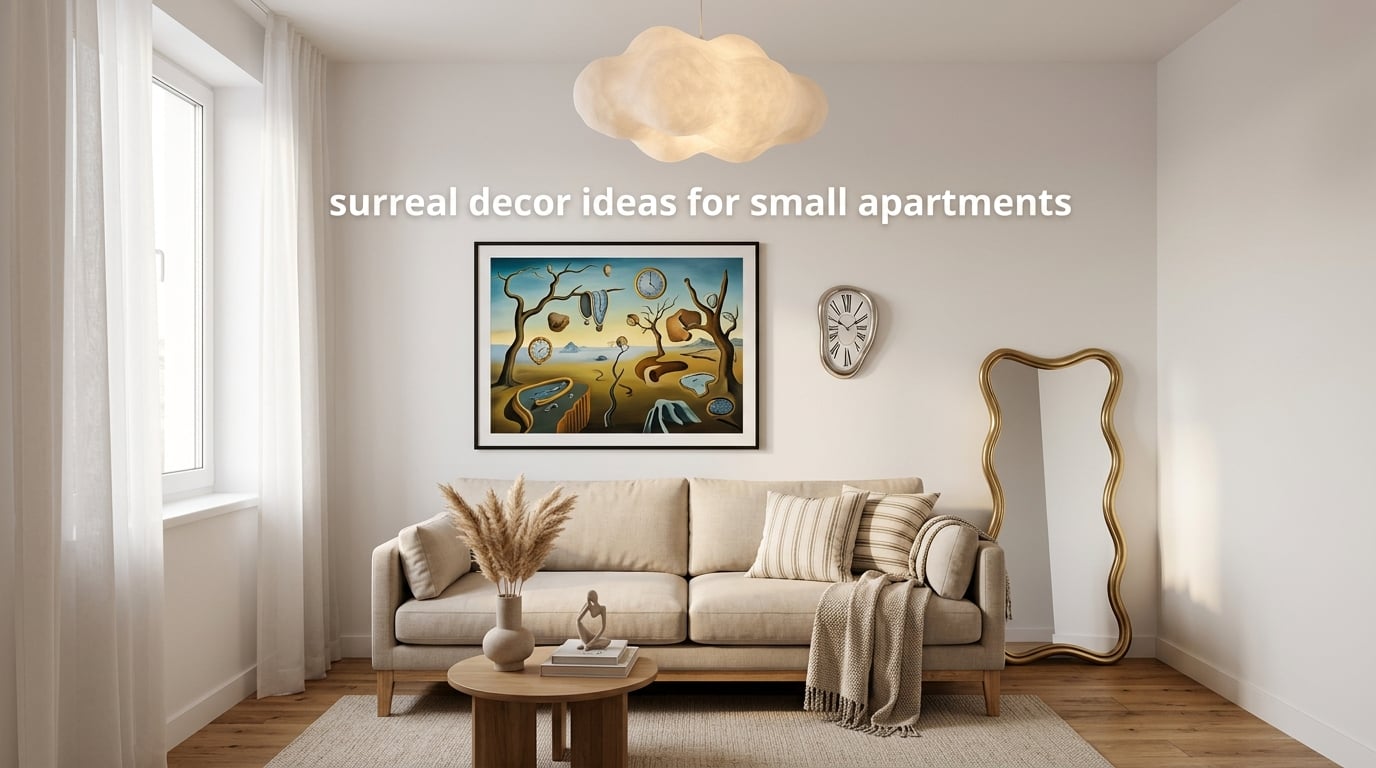
Surreal decor ideas for small apartments are style choices that bring dreamlike, whimsical, and unexpected elements into a compact room – usually through one or two bold focal points layered on a calm neutral base. Think a melting-clock mirror, a Dali-inspired art print, a cloud-shaped lamp, or curvy sculptural furniture that makes a small space feel personal and a little bit magical. In 2026, this approach is everywhere because it solves a real problem: most mass-market apartments look identical, and one well-chosen surrealist accent breaks that sameness without crowding the room.
I have spent the last few months helping renters, studio dwellers, and small-bedroom owners style spaces in this exact way. What I have learned is that surrealism in a small apartment is not about cramming the room with oddities – it is about choosing restraint, scale, and a single moment of wonder. This guide gives you the rules, the room-by-room playbook, the renter-friendly shortcuts, and the mistakes to avoid so your small apartment feels like a gallery, not a circus.
Table of Contents
What Surreal Decor Means in 2026
Surreal decor is a home-decor style inspired by the 1920s Surrealist art movement – the work of Salvador Dali, Rene Magritte, Joan Miro, and later Elsa Schiaparelli – that brings dreamlike, whimsical, and unexpected elements into a room through unusual shapes, optical-illusion art, bold color, and sculptural or “gravity-defying” furniture and accessories.
The style is having a real moment in 2026. Pinterest Predicts flagged surrealist interiors as a breakout trend, and Schiaparelli’s surrealist couture keeps trickling into mainstream fashion. Suddenly the floating clock, the eye motif, the melting object, and the curvy candlestick look less “weird uncle’s house” and more “considered art moment.”
For a small apartment, that translation matters. The Surrealist Manifesto was about making the everyday feel strange. In a 400-square-foot rental, that promise is more useful than ever – you do not have room for clutter, but you do have room for one unforgettable focal point.
The four pillars of surrealist decor
Every surrealist interior leans on the same building blocks. Knowing them makes shopping and styling much faster.
- Dreamlike imagery: clouds, eyes, melting forms, celestial motifs, creatures from folklore.
- Unexpected pairings: antique chairs next to neon lamps, classical busts next to cloud cushions.
- Optical illusion and trompe l’oeil: walls that appear to peel back, mirrors that warp space, rugs that “float.”
- Sculptural, gravity-defying form: curvy candlesticks, wavy mirrors, biomorphic vases, cloud-like light fixtures.
Why Surrealism Works Beautifully in Small Apartments
Surrealism and small apartments are a natural fit, and most guides miss this. The movement was built on tricks of the eye, scale, and perspective – all of which are the exact tools interior designers use to make tiny rooms feel larger.
Illusion does the heavy lifting
Trompe l’oeil art – literally “deceives the eye” – has been used for centuries to make flat walls look like open windows, arches, or sky. A single trompe l’oeil print on a small apartment wall makes the room feel like it opens onto somewhere else. That is space you did not have a minute ago.
Oversized art shrinks walls – in a good way
Counter-intuitively, one large surrealist painting makes a small room feel bigger. When the eye lands on a single oversized piece, walls recede. A grid of tiny frames does the opposite – it chops the wall into small pieces and shrinks the room.
A single focal point beats five small ones
Small apartments punish visual clutter. Surrealism’s obsession with one bizarre focal point (a melting-clock mirror, a giant eye print) is exactly the right discipline. You get personality without the chaos.
10 Surreal Decor Ideas for Small Apartments
Here is the core list – ten specific, small-apartment-tested surrealist decor ideas that give you personality without overwhelming your space. Pick two or three; do not use all ten.
- One oversized surrealist art print. A single Dali, Magritte, or contemporary surrealist print above the sofa or bed. The room now has a focal point, not a wall.
- A melting-clock or melting-clock-style mirror. The Dali reference is unmistakable, and a wall mirror in any shape pulls in light. Perfect above a console in an entryway.
- A cloud-shaped or biomorphic light fixture. A pendant lamp that reads as a cloud, a moon, or a wave. Replace your boring flush-mount with this and the ceiling becomes art.
- Curvy candlesticks in brass or ceramic. A pair on the dining table, the mantel, or the bathroom vanity. Tiny footprint, large surrealist energy.
- A hand-shaped or surrealist vase. Filled with a single branch, a dried flower, or nothing at all. Sculptural even when empty.
- A wavy or asymmetric mirror. Mirrors expand small apartments – giving one a curvy, melted silhouette doubles the trick.
- Fantasy-creature wall art. A friendly whale floating over the bed, a celestial moth in the hallway, a flock of eyes in the study. Whimsy that still feels calm.
- Trompe l’oeil peel-back wallpaper (or a removable mural). One wall that looks like it opens onto a sky, a forest, or a library. The room is now bigger and weirder.
- A sculptural floor lamp. A giant Anglepoise, a leaning arc lamp, or a lamp whose shade looks like a balloon. Adds vertical surrealism without eating floor space.
- Quirky textiles with surrealist prints. A cushion with melting clocks, a throw with celestial eyes, a rug with a giant fruit. Soft, low-commitment, easy to swap.
Surrealism by Room: Living Room, Bedroom, Kitchen, Bathroom and Entryway
No competitor I have read breaks surrealism down by room, but renters ask me about specific rooms constantly. Here is how I would handle each one.
Living room
Pick one wall. Put one oversized surrealist print or a peel-back mural on it. Everything else stays neutral. Add a sculptural floor lamp in a corner and you have a living room that feels intentional without buying a sectional.
Bedroom
Keep the bed area visually quiet – surrealism belongs above the headboard, not on it. A wavy mirror or a celestial-eye print framed in simple black does the job. Soft surrealist textiles (a melting-clock cushion, an eye-motif throw) warm the room.
Kitchen
Small kitchens forgive almost nothing except one surrealist object on the counter: a hand-shaped vase with a single stem, a pair of curvy brass candlesticks, or a fruit-shaped bowl. Skip the wallpaper – steam and surrealism do not mix.
Bathroom
Bathrooms love a wavy or asymmetric mirror – the steam and the curves play beautifully together. One surrealist print in a waterproof frame, and a curvy candle on the sink, finishes the room.
Entryway
The entryway is the cheapest room to make surrealist. A peel-and-stick mural on the back of the door, a melting-clock mirror, and a small console with one sculptural object. Guests see the personality the moment they walk in.
6 Surrealist Techniques Adapted to Small Spaces
Surrealism has a real toolkit, and six techniques translate directly to small-apartment decor. Use these like a menu.
- Play with scale. Put one oversized object in a small room. A giant fruit bowl on a tiny side table, a huge eye print over a narrow console. The mismatch is the magic.
- Play with perspective. Trompe l’oeil murals, peel-back wallpapers, and rugs that “float” off the floor all trick the eye into reading more depth than is there.
- Pair the classical with the bizarre. A vintage bust next to a neon lamp. An antique chair holding a cloud cushion. Old plus odd is the surrealist sweet spot.
- Use trompe l’oeil. Wallpaper or prints that imitate architecture, sky, marble, or peeled-back surfaces. One piece can re-imagine the entire room.
- Use unexpected objects as art. A hand-shaped vase is a sculpture that also holds flowers. A melting clock is a clock that also is art. Function plus weird is the brief.
- Embrace gravity-defying forms. Floating shelves shaped like clouds, lamps that look like balloons, candles that curl upward. Let the objects pretend physics is optional.
5 Small-Apartment Rules of Restraint
Surrealism without restraint becomes a theme park. These five rules keep your small apartment looking like a gallery, not a circus tent.
- One or two statement pieces maximum per room. A single melting-clock mirror, a single oversized print, or a single sculptural lamp. Not all three.
- Leave at least 60 percent of walls clear. Small apartments breathe when walls are empty. The one print you do hang will hit harder.
- Anchor surrealism in one corner. Pick a corner, put the whimsical object there, leave the rest of the room calm. The corner becomes a destination.
- Keep the palette to three colors plus the surreal accent. Neutrals plus one bold color and one accent metallic (brass works). The accent can be your surreal object.
- Match the scale of the surreal piece to the wall, not the room. A tiny print on a huge wall looks lost; a huge print on a tiny wall makes the wall recede. Always size to the surface.
Renter-Friendly Surrealist Decor: No Drill, No Paint, No Damage
Most renters tell me they feel locked out of bold decor. They are not. Here is how to go surrealist without losing your security deposit.
- Removable wallpaper and murals. Peel-and-stick surrealist murals (clouds, peeling walls, forest skies) install in an afternoon and come off clean.
- Command strips and damage-free hooks. Most framed surrealist prints under 5 pounds hang with a strip, no drill needed. Use two strips per side for safety.
- Floor mirrors leaning against the wall. A wavy full-length mirror leaning in a corner is surrealist, expands the room, and leaves zero holes.
- Lamps instead of overhead fixtures. A sculptural floor lamp or a cloud pendant plugged into a wall outlet skips any ceiling work.
- Tapestries and textiles as art. A surrealist tapestry pinned with a few small nails (or command strips) is softer than a print and equally dramatic.
DIY and Budget Surrealist Decor Ideas
You do not need a lot of money to go surrealist. Some of my favorite client wins cost almost nothing.
- Download digital surrealist prints. Etsy, independent artists on Instagram, and library archives (Magritte is public domain in many countries) all sell downloadable prints. Print at a local shop, frame in an inexpensive frame.
- Upcycle a thrift store mirror. Buy a plain round mirror, glue a wavy wooden frame (cut from a yard of plywood), paint it bold. Done.
- DIY cloud lamp. A paper lantern, glue, polyester stuffing, and a clever hour of crafting gives you a cloud pendant for a fraction of the retail price.
- Curvy candlesticks from clay. Air-dry clay, a candle, and a hand-modeled shape. Bake, paint gold, place three on a tray.
- Repaint a thrifted object. A plain vase in matte black with one curvy stripe in brass. Suddenly surrealist.
Mistakes to Avoid When Styling Surrealism in a Small Apartment
These are the five mistakes I see every week in client apartments – and they are all easy to fix.
- Over-cluttering. The single biggest small-apartment sin. One statement piece, three accent objects, done.
- Theme-park surrealism. A room where everything is bizarre feels exhausting. Mix bizarre with calm so the bizarre lands.
- Mismatched scales. Tiny surrealist objects in a tiny room become dust. At least one piece should be oversized.
- Color chaos. Surrealist decor often comes in saturated colors. Pick one palette or your room will fight itself.
- Forgetting sight lines. In a small apartment, the surreal piece should sit where your eye lands when you enter – not behind the door, not blocked by a coat rack.
Surrealist Masters to Know: A Mini Glossary
You do not need an art history degree, but knowing four names helps you shop with confidence and explain your taste to anyone who asks.
- Salvador Dali (1904-1989): Spanish surrealist, painter of melting clocks and absurd dreamscapes. The “melting clock” reference in this guide is his.
- Rene Magritte (1898-1967): Belgian surrealist, painter of apples in bowler hats, pipes that are “not pipes,” and clouds shaped like bread. Master of the quiet, brain-tickling image.
- Joan Miro (1893-1983): Spanish-Catalan surrealist known for playful biomorphic forms and primary color – perfect for a small living room or a child’s reading nook.
- Elsa Schiaparelli (1890-1973): Italian fashion designer who collaborated with Dali; her lobster dress, shoe-hat, and shocking-pink are why surrealist decor is back in fashion now.
Frequently Asked Questions
What are some good decor ideas for a small apartment?
Start with a calm neutral base and add one or two whimsical, surrealist focal points – an oversized Dali-inspired print, a wavy mirror, a cloud-shaped lamp, or curvy sculptural furniture. Use vertical space with tall mirrors and floor lamps, leave at least 60 percent of walls clear, and choose one bold accent color instead of several competing ones. Layer soft surrealist textiles (cushions, throws, rugs) to add warmth without crowding the room.
What is the 3-5-7 rule in decorating?
The 3-5-7 rule is a grouping guideline: arrange decor objects in odd-numbered clusters of 3, 5, or 7 because odd groupings read as more visually interesting and balanced than even ones. Use it when styling a coffee table, a mantel, or a console – choose one dominant object and surround it with two or four supporting pieces.
How to make a small apartment look luxurious?
Pick a tight three-color palette, layer textures (linen, velvet, brass, ceramic), use one oversized mirror or art print to anchor each room, hide clutter behind closed storage, and add at least one sculptural lamp. Light matters as much as color – use a mix of warm overhead, table, and floor lighting rather than relying on a single ceiling fixture.
What are the current trends for small apartments in 2026?
In 2026, the strongest small-apartment trends are surrealist accents (one whimsical focal point on a calm base), trompe l’oeil murals and peel-back wallpaper, curvy sculptural furniture, layered textiles for warmth, vertical lighting like cloud pendants and floor lamps, and renter-friendly removable wallpaper. Whimsigoth and joycore aesthetics also continue to grow, both blending naturally with surrealist decor.
What is the 70/30 rule in decorating?
The 70/30 rule means roughly 70 percent of a room uses one dominant style, color, or material, and 30 percent contrasts with it. In a small surrealist apartment, that means about 70 percent calm neutral base (white walls, beige sofa, simple flooring) and 30 percent whimsical accent (one oversized surrealist print, one sculptural lamp, a few curvy objects). The 30 percent is what makes the room memorable.
What are 6 Surrealist techniques?
The six classic Surrealist techniques most useful for small-apartment decor are: playing with scale (one oversized object in a small room), playing with perspective (trompe l’oeil murals and floating rugs), pairing the classical with the bizarre (antique plus neon), trompe l’oeil (wallpaper that imitates architecture or sky), using unexpected objects as art (a hand-shaped vase that is also a sculpture), and embracing gravity-defying forms (cloud lamps, melting clocks, floating shelves).
Final Thoughts: Bringing Surreal Decor Ideas to Your Small Apartment
Surreal decor ideas for small apartments work because the style was built for restraint, illusion, and one unforgettable moment – the exact brief of a compact home. Pick a single room, choose one or two pieces from the list above, and let the rest of the space breathe. A melting-clock mirror in the entryway, an oversized surrealist print above the sofa, a cloud pendant over the dining table – any one of those is enough to shift the entire feeling of your apartment.
Start small. One piece this week. Then live with it for a few days. If your eye keeps landing on it and smiling, you have found your surrealist accent – and the rest of the room will follow.