
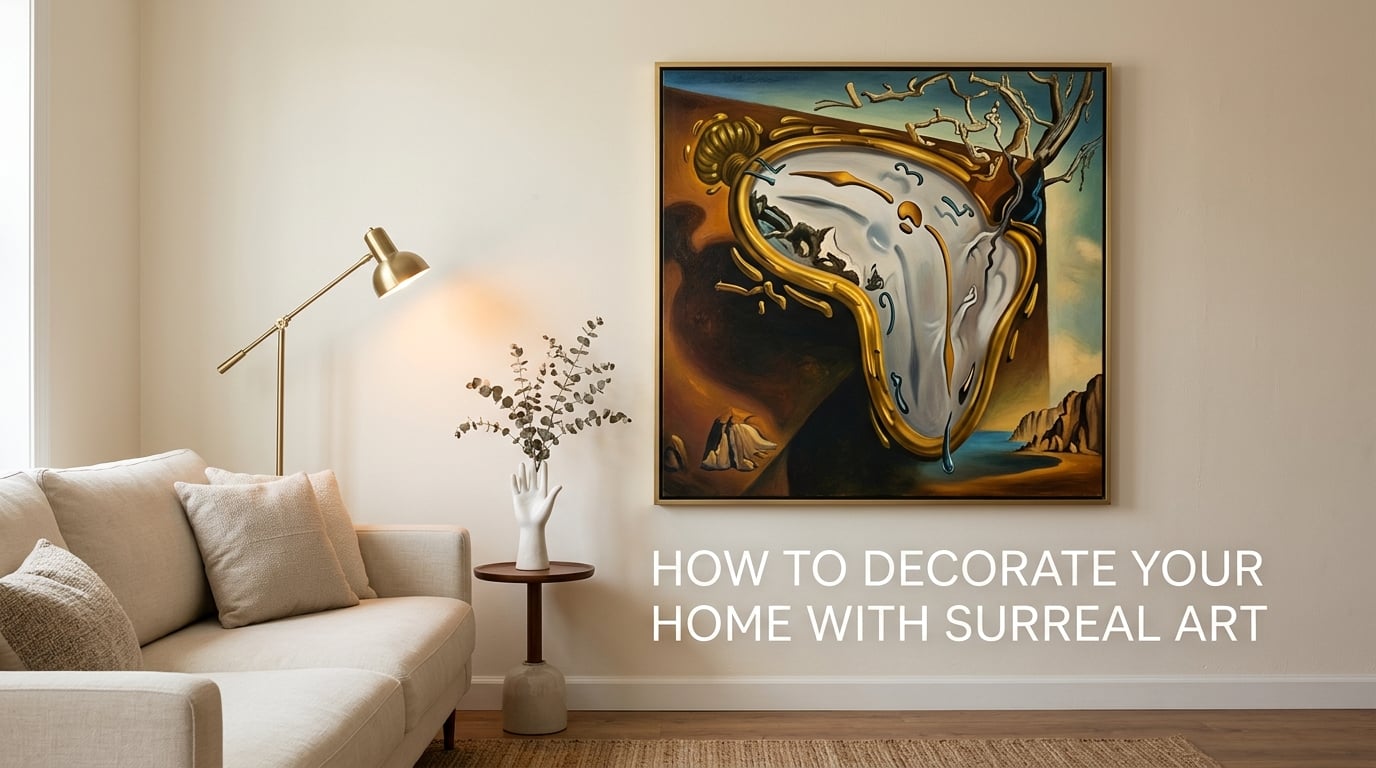
Decorating your home with surreal art is one of the most rewarding ways to turn a forgettable room into a personal dream. In this guide, our team walks through the history, principles, color palettes, room-by-room ideas, sourcing tips, and styling rules that make surrealist home decor feel intentional rather than chaotic.
Surrealism is having a moment. Post-pandemic living pushed many of us toward interiors that feel emotional and imaginative, and surreal wall art does that better than almost any other style. Read on to learn how to bring the dreamlike into your own space without overdoing it.
Table of Contents
What Is Surrealist Home Decor and Where Did It Begin?
Surrealist home decor is an interior style inspired by the early 20th-century Surrealism art movement. It blends reality with the fantastical through unexpected juxtapositions, scale play, dreamlike imagery, and bold symbolism, so that rooms feel like living works of art rather than catalog showrooms.
The movement was officially born in 1924, when French writer André Breton published the Surrealist Manifesto. Surrealism grew out of the chaos of the First World War and drew heavily on Freudian ideas about the unconscious mind, dreams, and irrational thought. Breton and his circle wanted to free creativity from rational control.
From that manifesto a constellation of artists emerged, and most living-room surrealism today traces back to a small handful of names.
- Salvador Dalí brought us melting clocks (Persistence of Memory, 1931) and the Mae West Lips sofa.
- René Magritte gave us floating apples, bowler hats, and the famous apple-faced man in The Son of Man (1964).
- Max Ernst experimented with frottage and collage to create unsettling forest scenes like The Elephant Celebes (1921).
- Leonora Carrington filled her Monkton House with alchemical symbols, biomorphic creatures, and dreamlike murals.
If a piece of decor in your home makes you stop and wonder “why?”, you are standing inside the Surrealist tradition.
The Core Principles That Make Decor Feel Surreal
Surrealist decor works by using the brain’s love of contrast. You take one or two surprising elements and let them dominate while the rest of the room stays calm.
The seven characteristics of surrealist art give us a clean checklist for any room:
- Unexpected juxtaposition – placing two unrelated objects next to each other so the mind has to bridge the gap.
- Scale play – rendering a familiar object enormous or tiny, like a giant hand-shaped vase on a side table.
- Dislocation – removing an object from where it belongs, such as a chandelier resting on a floor or a clock draped over a branch.
- Trompe l’oeil – “deceives the eye” with painted illusions, from clouds on a ceiling to a window that opens onto an impossible landscape.
- Biomorphic forms – soft, organic shapes inspired by plants, eggs, and bodies, the Mae West Lips sofa being the canonical example.
- Symbolic objects – eggs for birth, melting clocks for time, apples for temptation, eyes for surveillance.
- Subconscious imagery – dreamlike, irrational scenes that feel familiar but cannot be fully explained.
You do not need all seven in one room. Pick two or three and you will already feel the shift from “nicely decorated” to “slightly strange, in a good way.”
Surrealist Color Palettes Worth Copying
Color is the fastest way to invite the dreamlike into a room. Three named palettes show up over and over in surrealist interiors, and each one sets a different emotional tone.
| Palette | Key Colors | Textures and Materials | Best Rooms |
|---|---|---|---|
| Soft Dreamscape | Mellow pink, dusty lavender, cloud white, faded gold | Velvet, brushed brass, plaster walls, sheer linen | Bedroom, reading nook, nursery |
| High Contrast Pop | Electric blue, acid yellow, crimson, jet black | Gloss lacquer, polished marble, neon tubing | Living room focal wall, dining room, studio |
| Retro Future | Burnt orange, avocado, cream, deep teal | Walnut, boucle, ceramic, smoked glass | Home office, hallway, mid-century style homes |
Pick one palette, then repeat its colors three times across the room. That repetition is what stops the look from feeling like a gallery and turns it into a home.
How to Decorate Your Home with Surreal Art: A Room-by-Room Guide
The most reliable way to decorate your home with surreal art is to start one room at a time. A single surreal moment per space is usually plenty.
Living Room: Anchor With a Focal Wall
The living room carries the most visual weight in a home, so it deserves the boldest surreal gesture. Choose one wall as a focal wall and hang a single oversized surreal piece, or commission an artist to paint a mural directly on the plaster.
Above the sofa is the classic placement. Aim for artwork that is roughly two-thirds the width of the sofa and centered at 57 inches from the floor (eye level for most adults). A giant eye motif, a cloud-scape, or a single floating object photograph all work beautifully here.
Bedroom: Soft Dreams, Subtle Surreal
The bedroom should feel like sleep, not a museum. Lean into the Soft Dreamscape palette and choose pieces with low visual noise – a moon print above the headboard, a hand-shaped vase on the nightstand, or a small trompe l’oeil shelf that looks like a window into a forest.
Above the headboard, hang a single horizontal piece about 8 to 12 inches above the mattress top. Anything busier than one focal image and the room starts to feel restless.
Entryway and Hallway: One Surreal Object on a Plinth
Entryways are tiny but psychologically huge. A single surreal object on a small pedestal, a floating cloud light fixture, or a framed Magritte-style apple print at the end of a hallway, will set the tone the moment someone walks in.
Hallways are perfect for a “narrow micro gallery” – three to five small surreal prints running down one wall, evenly spaced.
Home Office: A Conversation-Starting Piece
A surreal piece in a home office primes the mind for unusual thinking. We recommend one mid-sized surreal print above the desk, ideally one that includes a clock, book, or hand motif – subjects that quietly nod to the work being done at the desk.
Gallery Wall Layouts and the 3-5-7 Rule
The 3-5-7 rule in decorating is a way to keep gallery walls from feeling random. You group artworks in odd-numbered clusters (3, 5, or 7 pieces), because odd numbers create visual movement and avoid the symmetrical, static feel of even groupings.
Three practical layouts to try:
- Asymmetric cloud. Five or seven frames of different sizes clustered tightly together, with about 2 inches of space between each. This is the most “surreal” of the layouts because nothing lines up.
- Linear grid. Three or five matching frames in a straight row, perfect for narrow hallways or above a sofa.
- Salon-style cluster. Nine or more frames, mixing surreal art with portraits, photography, and text prints to evoke a 19th-century salon wall.
Whichever layout you pick, lay the frames on the floor first and photograph them before any nails go into the wall. The best surreal walls are arranged, not improvised.
Lighting, Frames, and the 70/30 Rule for Balance
The 70/30 rule in art is a balance guideline: roughly 70 percent of a room should feel calm and cohesive, and 30 percent can carry the bold, surreal gesture. Following this ratio is what stops a surreal room from tipping into chaotic.
Three levers help you stay on the right side of that ratio:
- Frame selection. A thin black or natural oak frame lets the artwork breathe and reads as “gallery.” An ornate gilded frame pushes the same image toward “boudoir surrealism,” the Carrington feel. Pick one frame family and stick with it across the wall.
- Lighting drama. Aim each picture light at the surreal piece from about 30 degrees off-axis. Add one colored bulb (warm amber for Soft Dreamscape, cool magenta for High Contrast Pop) and the room reads as staged, not just decorated.
- Matting. A wide white mat on a small surreal print is the easiest way to elevate an affordable Etsy find into something that feels intentional.
When in doubt, remove one piece. A surreal room with breathing room always reads as more confident than a wall packed edge to edge.
Where to Source Original and Affordable Surreal Art
Most readers worry about finding surreal art that does not feel mass-produced. Here is the honest sourcing map our team uses.
- Etsy and Artfinder are the best places to find original surrealist pieces from independent artists. Budget prints run low, originals run higher, and you can message the artist directly about commissions.
- Saatchi Art curates original surreal paintings and many offer interest-free payments.
- Society6 and Desenio carry open-edition surreal prints at print-friendly prices, great for the Soft Dreamscape palette and renter-friendly frames.
- Charity prints (Art for Causes, WWF artist editions, PangeaSeed) are a quietly surreal way to own limited-edition work from known artists while supporting conservation.
- Local gallery open calls and Instagram hashtags like #surrealism and #surrealart often surface emerging artists before they appear in any marketplace.
If even the cheapest print feels too generic, turn your own photographs surreal. Double-exposure apps and levitation photo tutorials can produce genuinely strange images of your own hands, pets, or living room, then frame them in floating frames for a personal surreal wall.
Mixing Surrealism with Maximalist, Minimalist, and Art Deco Styles
Surrealism is unusually friendly with other styles because it behaves more like an accent than a base. Here is how the three most common pairings work.
Maximalist surrealism. Layer pattern on pattern, then hang a giant surreal piece as the exclamation point. Think jewel-tone walls, dense gallery walls, and one Mae West Lips replica in the corner.
Minimalist surrealism. Keep the walls pale, the furniture clean, and let a single surreal object do all the work. A giant hand-shaped vase on a white plinth is a complete room in one move.
Art Deco surrealism. Pair chrome, black lacquer, and fan motifs with surrealist prints. Dalí himself designed for the Art Deco world, and the two styles share a love of geometry and glamour.
Common Mistakes to Avoid with Surrealist Decor
After seeing hundreds of surreal rooms, our team has watched the same five mistakes show up again and again.
- Hanging surreal art too high. Most pieces look awkward above 65 inches. Center the work at standing eye level instead.
- Mixing too many styles in one wall. A surreal print next to a “Live Laugh Love” sign kills the dream fast.
- Buying low-resolution prints. A blurry surreal piece looks kitsch. Always check the DPI before ordering.
- Forgetting lighting. A surreal piece in shadow looks like clutter. Light it, or move it.
- Ignoring scale. Tiny surreal prints on a tall wall get lost. Go bigger than you think.
Forum readers on Reddit’s r/HomeDecorating regularly worry that surreal art will make guests uncomfortable. In practice, tasteful surrealism is almost always a conversation starter, not a red flag. The rooms that read as “weird” are the ones that ignore the 70/30 rule, not the ones that include a single strange object.
Surrealist Decor for Renters and Small Spaces
Renters can absolutely run a surreal wall without risking their deposit. Repositionable picture hanging strips, freestanding easels, leaning frames on shelves, and over-the-door hooks all let you hang surreal art without a single nail. In small apartments, one oversized surreal print on the largest uninterrupted wall will do more work than ten small pieces scattered around. Pick the room you use most, identify the biggest empty wall, and commit to one surreal moment there.
Frequently Asked Questions
What is the 70/30 rule in art?
The 70/30 rule in art is a balance guideline that suggests roughly 70 percent of a room should feel calm and cohesive, while 30 percent carries the bold, surreal, or unexpected gesture. Following this ratio keeps surrealist decor from feeling chaotic while still giving the room personality.
What is the 3-5-7 rule in decorating?
The 3-5-7 rule in decorating is a gallery-wall layout principle. You group artworks in odd-numbered clusters of three, five, or seven pieces, because odd numbers create visual movement and avoid the static feel of even groupings. It works especially well for surreal wall art where variety matters more than symmetry.
What are the 7 characteristics of surrealist art?
The seven characteristics of surrealist art are: unexpected juxtaposition, scale play, dislocation, trompe l’oeil, biomorphic forms, symbolic objects, and subconscious imagery. Picking two or three of these characteristics for one room is enough to make the space feel surreal without overwhelming the design.
How can I decorate my home with artwork?
To decorate your home with artwork, start by choosing one room and one focal wall. Pick artwork that fits the 70/30 rule (70 percent calm, 30 percent bold), hang it at standing eye level, light it from about 30 degrees off-axis, and repeat one or two colors from the piece across the rest of the room.
Will surreal art make guests uncomfortable?
Surreal art rarely makes guests uncomfortable when you follow the 70/30 rule. A single surreal piece in an otherwise calm room is almost always a conversation starter. Rooms that read as weird are usually ones that ignore the balance ratio, not ones that include one strange object.
Final Thoughts: Designing a Room That Feels Like a Dream
Learning how to decorate your home with surreal art is really about giving yourself permission to break the safe template. Pick one room, one focal wall, one or two surreal characteristics, and one named palette. Then add a single piece you genuinely love, light it well, and stop there. Our team has watched this approach turn neutral rooms into personal dream spaces, and we hope it does the same for yours in 2026 and beyond.