
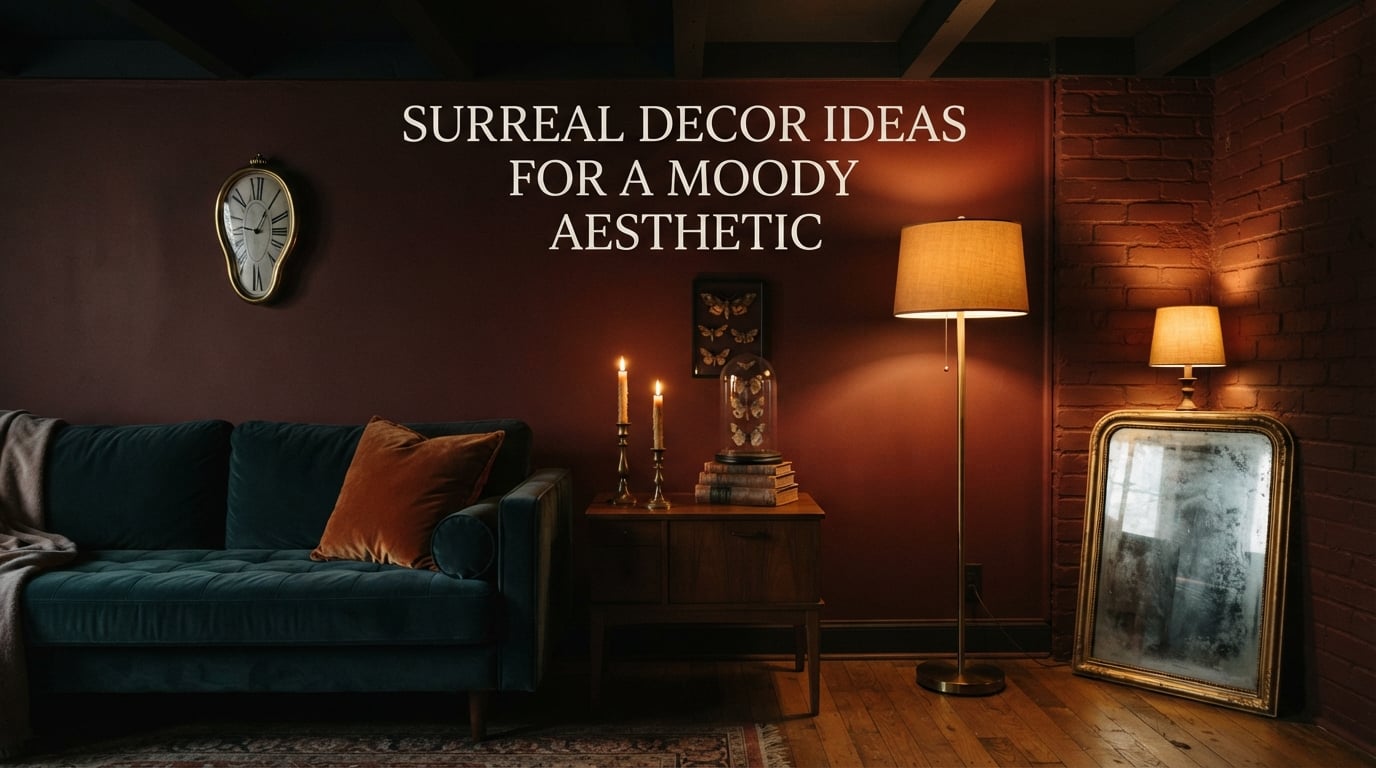
I still remember the first time I tried a moody room and ended up with what my friend called “a goth cave that swallowed the sofa.” Surreal decor for a moody aesthetic is meant to fix exactly that problem.
This style blends surrealist art motifs, like melting clocks, eye imagery, scale distortion, and odd pairings, with a dark-and-moody color palette of navy, oxblood, forest green, and charcoal. The result should feel like a still-life or a dream, never like a dim basement.
In this guide I will walk you through 10 surreal decor ideas for a moody aesthetic, the exact paint colors designers reach for, lighting tricks that create real shadow play, and the 3-5-7 styling rule that prevents the cave look. By the end you will know how to start small (even in a rental) and build a room that feels intentional, theatrical, and warm.
Table of Contents
What Is Surreal Decor for a Moody Aesthetic?
Surreal decor for a moody aesthetic is the deliberate blending of surrealist art motifs (melting clocks, floating shelves, eye imagery, scale distortion, odd pairings, anthropomorphic objects) with a dark-and-moody color palette of oxblood, midnight navy, forest green, charcoal, and plum, finished with low, warm, theatrical lighting. The aim is a room that reads like a dream or a still-life rather than a flat black box.
Surrealism as an art movement started in 1924 with André Breton’s manifesto, and Salvador Dalí’s melting clocks in The Persistence of Memory (1931) became its most recognizable symbol. Those clocks represent the relativity of time, the way memory softens hard edges, and the dream-state where solid things drip. In a room, a single melting clock on a deep navy wall does the same work as a serious oil painting: it stops the eye.
Other names for this aesthetic that you will see online: whimsigoth (whimsical + gothic), dark academia, Romantic Gothic, and curated maximalism. They share the same instinct: dark color, layered texture, one theatrical object, soft warm light.
10 Surreal Decor Ideas for a Moody Aesthetic
Here are the 10 ideas I recommend starting with, ordered from “easiest weekend project” to “full room reset.” Pick two or three and build out from there.
- Color-drench one wall in oxblood or midnight navy. Paint the wall, the trim, the ceiling return, and any built-ins the same deep color. Color drenching is the cheat code Reddit keeps upvoting for moody rooms because it removes the harsh line where wall meets ceiling and makes the room feel like a velvet jewelry box.
- Replace overhead lighting with layered warm sources. Put a 2200K amber bulb in a floor lamp by the sofa, a brass sconce at eye level by the door, and a beeswax candle on the coffee table. The room should glow from at least three different heights, never blast from above.
- Hang a Dalí-inspired melting clock as the focal piece. One clock, centered on the deepest wall, slightly off-center from the sofa. It is the easiest surrealist anchor because it reads instantly and is widely available on Etsy and Amazon.
- Build a vignette of moths and apothecary jars. Group three to five objects on a tray: a moth specimen under a cloche, two amber apothecary jars, a brass key, a stack of cloth-bound books. This is the “curio cabinet” gesture that makes a moody room feel collected, not decorated.
- Style a foggy antique mirror. Aged mercury glass or a slightly tarnished gilt mirror bounces warm light and adds the soft distortion Dalí loved. Lean it against the wall rather than hanging it for that “just arrived” feeling.
- Add a cloud lamp or a floating shelf that defies expectations. A floating shelf with no visible brackets, or a cloud-shaped lamp (Richard Clarkson’s design or a budget dupe) brings the literal dream-element of “weightless things” into the room.
- Mix velvet, walnut, and brass textures. One velvet pillow, one walnut side table, one brass lamp or picture frame. Texture layering is what lifts a dark room out of “looks cheap” and into “looks expensive.” Without it, even great paint reads flat.
- Use trompe-l’oeil wallpaper on a ceiling. A faded library mural, an aged plaster pattern, or a hand-painted cloud ceiling. When you look up and see something strange, the whole room shifts into surrealist register.
- Display eye motif art or surrealist prints. One large eye painting, a Magritte bowler-hat print, or a vintage anatomy plate. Group them salon-style on one dark wall or float a single oversized eye above the fireplace for full Magritte energy.
- Cluster candelabras and beeswax candles for drama. Three brass candlesticks of different heights, unscented beeswax tapers, lit only when you are home. Real flame is the original “theatrical lighting” and beats any smart bulb for warmth.
The Moody Color Palette: Colors That Make a Home Look Expensive
The moody color palette typically includes oxblood, midnight navy, forest green, charcoal black, plum, espresso brown, deep teal, and moss green. These deep, saturated hues read as expensive because they echo the colors of velvet curtains, old leather book covers, and patinated brass, three things our brains associate with heritage interiors.
Here are the named paint hues designers reach for in 2026:
- Oxblood / burgundy: Farrow and Ball “Preference Red,” Benjamin Moore “Caliente,” Sherwin-Williams “Rock Bottom.” Pairs with walnut and antique brass.
- Midnight navy: Farrow and Ball “Hague Blue,” Benjamin Moore “Hale Navy.” Reads almost black but is kinder in low light.
- Forest / moss green: Farrow and Ball “Studio Green,” Benjamin Moore “Caldwell Green.” The dark-academia favorite.
- Charcoal black: Farrow and Ball “Off-Black,” Sherwin-Williams “Iron Ore.” A softer alternative to true black.
- Plum: Farrow and Ball “Pelt,” Benjamin Moore “Kalamata.” For a more romantic, velvet-cape mood.
- Deep teal: Farrow and Ball “Inchyra Blue,” Benjamin Moore “Dark Harbor.” Bridges moody and coastal-surreal.
For a renter or anyone not ready to commit: try one feature wall first, or use a removable peel-and-stick wallpaper in the same color family. The Reddit consensus is consistent: “try one wall before committing to four.”
Surrealist Anchor Pieces: Beyond the Melting Clock
Surrealist anchor pieces are the one or two signature objects that carry the surrealist narrative of a room so the rest of the styling can stay quietly moody. The Dalí melting clock is the obvious choice, but the surrealist visual vocabulary is much wider.
Expand your anchor-piece vocabulary with these motifs:
- Magritte references: a single oversized eye painting, a bowler-hat silhouette print, an apple on a brass pedestal (a nod to The Son of Man), or a “Ceci n’est pas une pipe” canvas.
- Moth and butterfly specimens: under glass cloches or framed in deep shadow boxes. Moths, not butterflies, because they read nocturnal and gothic.
- Anthropomorphic vases: vessels shaped like faces, hands, or torsos. Etsy and independent ceramicists do these well.
- Cloud lamps: the Richard Clarkson “Cloud” design, or a budget-friendly dupe from Amazon, brings literal weather into the room.
- Floating shelves with no visible brackets: books and objects that appear to hover. Use hidden bracket hardware or a thick wood plank with concealed cleats.
- Trompe-l’oeil wallpaper: aged library shelves, faded frescoes, painted marble columns, or a sky-and-clouds mural. The eye believes what it sees long enough to be charmed.
- Eye motif art: oversized single-eye paintings, vintage ophthalmology charts, or Victorian-era “lover’s eye” miniatures.
- Scale-distortion objects: an enormous key on the bookshelf, an outsized hand-shaped ring dish, a tiny throne as a plant stand.
- Foggy or cracked mirrors: mercury glass, foxed antique glass, or a deliberately crackled mirror. Reflection plus distortion equals dream-logic.
- Taxidermy moth decor and natural specimens: ethically sourced, framed butterflies, pressed botanicals, or a single moth under a dome. Surrealism loved the cabinet-of-curiosity gesture.
You do not need every motif. The rule of thumb from forums and stylists alike is: one anchor piece carries the whole room. Choose the one that speaks loudest to you and let the rest of the palette stay quiet.
Lighting for a Surreal Moody Room: Shadow Play and Gobo Tricks
Lighting for a surreal moody room should be warm (2200K to 2400K), low, layered across at least three heights, and intentionally dramatic so that shadows do as much storytelling as the objects themselves. Overhead light is the enemy of this aesthetic because it flattens everything it touches.
Start with these four lighting moves:
- Kill the overhead. If you cannot remove the ceiling fixture, swap the bulb for the dimmest, warmest one you can find and never turn it on. Use it as a backup only.
- Layer three sources at three heights. A floor lamp low by the reading chair, a table lamp mid-height on a side table, a sconce or candle high on the wall. This is what gives a moody room its “glow from within” quality.
- Use a gobo or cookie for shadow play. A “gobo” is a stencil you place over a lamp to throw a pattern (branches, leaves, arches) onto the wall. You can buy a metal gobo for a few dollars or cut your own from black cardboard. Point a warm floor lamp through it onto an empty wall for instant Dalí energy.
- Add real flame. Three beeswax tapers on a brass candelabra, or a single fat pillar candle on the mantel. Real flame flickers in a way no LED ever quite matches.
Other tricks worth knowing: amber Edison bulbs in clear glass jars (a budget gobo), battery-operated beeswax tapers if you live in a rental, and dimmer switches on every wired source. Aim for the room to feel dim at 7 p.m. and quietly luminous at 9 p.m., that is the rhythm moody rooms live by.
The 3-5-7 Rule and How to Build a Vignette
The 3-5-7 rule of decorating says that odd-numbered groupings of objects (three, five, or seven items) read as more visually pleasing and natural than even-numbered groupings because the eye cannot easily pair them up and so keeps moving. It is the simplest styling trick to lift a moody room from “things on a shelf” to “curated vignette.”
For a surreal moody aesthetic, the 3-5-7 rule works best when you mix heights, materials, and one surrealist object. Try this on a mantel or side table:
- Group of 3: one tall (a candlestick or small vase), one medium (a clock or framed print), one short (a brass dish or moth under cloche).
- Group of 5: add a stack of two cloth-bound books and a small sculptural object, like a hand-shaped ring holder or an oversize key.
- Group of 7: complete the vignette with one more textural item (a small bowl of dried botanicals) and one final odd element (an apothecary jar with something odd inside).
The triad rule inside the 3-5-7: vary heights in a roughly triangular pattern, tallest in back, shortest in front, off-center so the vignette feels “found” rather than staged.
Room-by-Room Variations on the Surreal Moody Look
The surreal moody aesthetic adapts to each room differently. Here is how I would think about the main four.
Living room. Go deepest on color here, because it is the room people gather in and you want drama. Oxblood or midnight navy on one wall, walnut and brass furniture, a velvet sofa in oxblood or deep teal, a Dalí melting clock above the fireplace, layered warm lamps instead of overhead light.
Bedroom. Soften the palette by one step: plum, moss green, or deep teal rather than full oxblood. Use color drenching to make the room feel like the inside of a velvet jewelry box. Cluster candles on the dresser (battery-operated is fine), keep lighting low and warm, and add one surreal anchor (eye art, moth specimen, cloud lamp).
Study or home office. Lean dark-academia: forest green or charcoal walls, walnut desk, brass lamp with a warm bulb, a Magritte or Dalí print above the desk, a moth under glass on a stack of books. The goal is “wizard’s library,” not “corporate corner office.”
Dining room. This is where candelabras and gobo shadow play shine. A long walnut table, brass candelabras as the centerpiece, a deep moody wall behind, and a single oversized surrealist print or antique mirror as the focal point. The flickering candlelight does most of the styling work for you.
Renters and white-wall rooms. You can still pull this look. Lean a tall floor mirror against the wall, add a large tapestry or removable wallpaper to one accent wall, layer in your warm lamps and surrealist art, and use rich textiles (velvet throw, wool rug, brass candle holders) to do the heavy lifting that paint would normally do.
Common Mistakes to Avoid in a Moody Surreal Room
These are the failure modes I have seen most often, including the ones Reddit threads keep flagging.
- The cave look. Too much black, too little warm light, no texture variety. Fix: add three warm light sources at three heights and at least three different textures (velvet, brass, walnut, boucle, leather).
- The cheap look. Flat dark paint with no layering reads as a dorm-room Halloween set. Fix: use color drenching, add patina, mix at least one vintage or antique object into the vignette.
- The kitschy look. Too many “surreal” objects at once (melted clock, talking cactus, LED neon sign all in one room) reads as a themed restaurant. Fix: one anchor piece, the rest of the styling stays quietly moody.
- Skipping warm light. Cool white bulbs in a dark room read as institutional. Fix: every bulb 2200K to 2400K, ideally on a dimmer.
- Going monochrome black. All-black rooms feel heavy and depressing. Fix: introduce one or two accent colors (oxblood, brass, plum) so the eye has somewhere to land.
- Forgetting the eye line. Surrealist art hung too high or too small gets lost on a dark wall. Fix: hang statement art at seated eye level, roughly 145 cm to the center.
The single most common phrase I see in moody-decor Reddit threads is “I loved the idea but feared getting swallowed by the color.” The cure is almost always the same: layer texture, layer warm light, and pick one anchor object that tells the story for you.
Frequently Asked Questions
What is moody decor called?
Moody decor is also called dark and moody interior design, dark academia, whimsigoth, Romantic Gothic, and curated maximalism. All of these styles share a deep color palette, layered warm lighting, and rich textures like velvet, walnut, and brass.
What is the 3-5-7 rule of decorating?
The 3-5-7 rule of decorating says that odd-numbered groupings of objects (three, five, or seven items) read as more visually pleasing and natural than even-numbered groupings because the eye cannot easily pair them up and so keeps moving. Apply it when styling shelves, mantels, and coffee-table vignettes.
What color makes a house look expensive?
Deep, saturated colors tend to make a home look expensive. The most-cited examples are oxblood, midnight navy, forest green, charcoal black, plum, espresso brown, and deep teal. These hues echo the tones of velvet, leather book covers, and patinated brass, which our brains associate with heritage interiors.
What do the melting clocks in Dali’s painting represent?
In Salvador Dalí’s 1931 painting The Persistence of Memory, the melting clocks represent the relativity of time, the way memory softens hard edges, and the dream-state where solid objects can drip and lose their shape. In home decor, a Dalí-inspired melting clock carries that same dreamlike, time-bending feeling into a room.
How do I make a dark room not feel cave-like?
To keep a dark room from feeling cave-like, add three warm light sources at three different heights (floor lamp, table lamp, sconce or candle), use color drenching instead of flat black, layer at least three different textures (velvet, brass, walnut, boucle, leather), and choose a deep hue like oxblood or navy rather than pure black.
What are some cool surrealist ideas for a bedroom?
Cool surrealist ideas for a bedroom include color-drenching the walls and ceiling in plum or deep teal, hanging a Magritte-style oversized eye or bowler-hat print above the bed, styling a foggy antique mirror, clustering brass candelabras on the dresser, floating shelves with no visible brackets, and adding one cloud lamp or moth-under-cloche as the surreal anchor piece.
Bring the Surreal Moody Aesthetic Home in 2026
Surreal decor ideas for a moody aesthetic really come down to a simple foundation: one deep, color-drenched wall, three warm light sources at three different heights, three textures (velvet, walnut, brass), and one surreal anchor piece that tells the story for you. Everything else is supporting cast.
Start small. Pick one wall, one light source, and one anchor object. Live with it for a week. If the room still feels like a cave, layer in another texture. If it feels too quiet, add the second anchor piece. The best surreal moody rooms in 2026 look collected rather than decorated, which means building slowly is a feature, not a bug.