
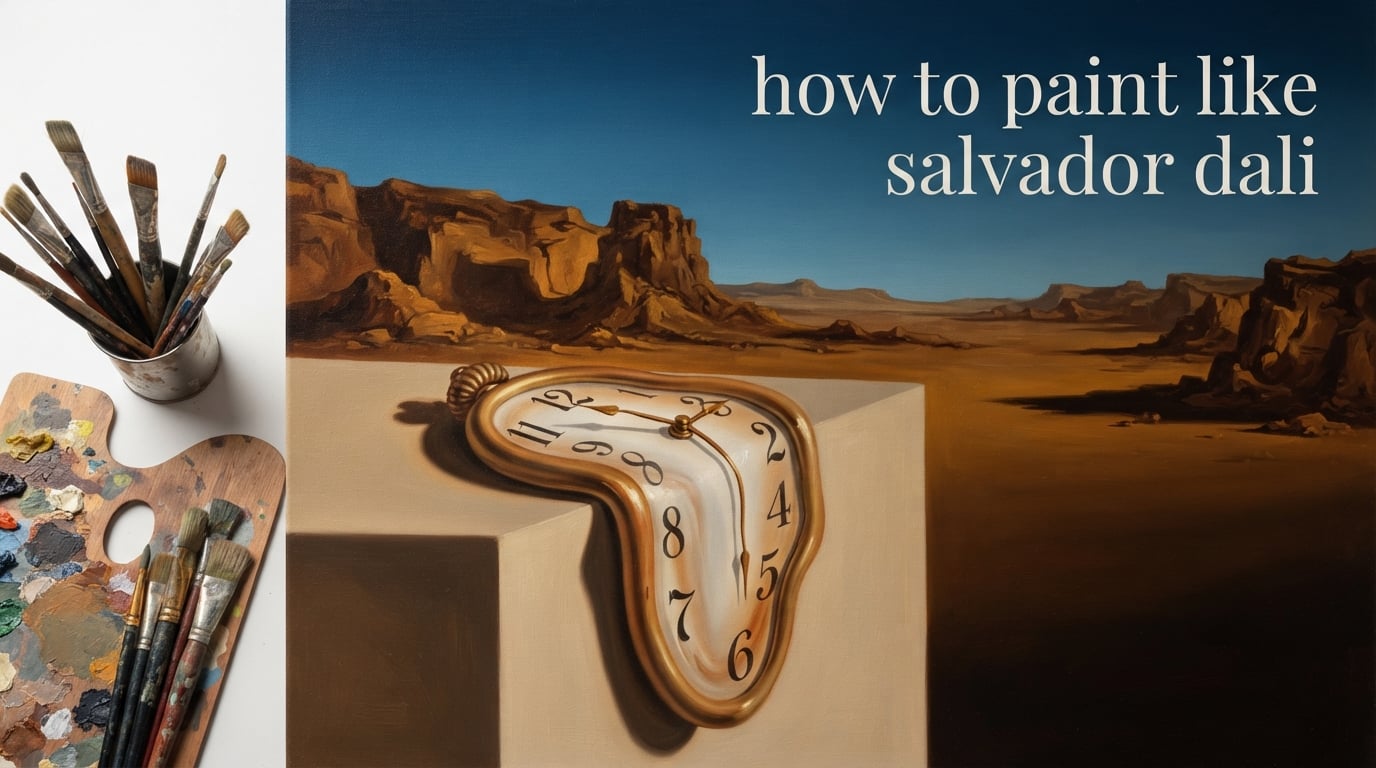
If you have ever wanted to know how to paint like Salvador Dalí, you are in the right place. In this guide, I will walk you through the exact method Dalí used to build his dreamlike paintings, from the oil paint and fine brushes he chose to the self-induced dream state that powered his strangest images. You do not need to be a trained draftsman to start. You need curiosity, patience, and a willingness to let go of logical thinking for an hour.
By the end of this article, you will understand Dalí’s paranoiac-critical method, the materials he worked with, his signature color palette, and a step-by-step painting process you can repeat at home. I have also included a technical breakdown of The Persistence of Memory, a list of common mistakes beginners make, and a few exercises that will sharpen your surrealist eye within a single afternoon.
Table of Contents
What Is Surrealist Painting in the Style of Dalí?
Surrealist painting in the style of Dalí is a hyperreal approach to dreamlike imagery. It pairs painstakingly rendered classical detail with impossible, melted, or distorted subjects – melting clocks draped over olive branches, elephants on stilts, faces hidden inside rocks.
Salvador Dalí (1904-1989) was a Catalan painter who joined the Surrealist movement in Paris in the late 1920s. Where other Surrealists like Joan Miró leaned into abstract automatism, Dalí chose what the critic André Breton later called “paranoiac” hyperrealism. His images look photographic at first glance, then slowly reveal something unsettling underneath.
Three traits define the look. First, hyperreal rendering: every rock, shadow, and reflection is painted with Renaissance-level craft. Second, dreamlike subject matter: familiar objects are warped, doubled, or paired with unrelated things to create visual tension. Third, vast empty landscapes, often inspired by the Catalan coastline near Cadaqués, where Dalí spent most of his summers.
Understanding the Paranoiac-Critical Method
The paranoiac-critical method is the self-induced dreamlike state Dalí used to access the subconscious parts of his mind. He described it as “a spontaneous method of irrational knowledge based on the critical and systematic objectivity of the associations and interpretations of delirious phenomena.” In plain language, he would stare at an object until it transformed into something else, then paint both versions at once.
This is what gives Dalí’s work its famous double images. In Metamorphosis of Narcissus, a figure on a hillside becomes a hand holding an egg, which becomes a flower. None of those images are imposed on the painting. They emerge from his method of looking.
To practice it yourself, pick a single object – a chair, a portrait, a bowl of fruit – and stare at it for several minutes. Do not analyze it. Let your peripheral vision blur, and wait for the shape to “become” something else. When it does, sketch the second image quickly before the association fades. Dalí claimed he would sometimes hold a metal plate over his face at the edge of sleep to spark these hallucinations, but a quiet room and patient observation work just as well for most painters.
The paranoiac-critical method is closely related to automatism, the Surrealist technique of letting the hand move without conscious control. The key difference is that Dalí stayed critically engaged. He never let the image run away from him. He observed, then painted, then observed again.
What You Will Need to Paint Like Dalí
To paint like Salvador Dalí, you need oil paint, fine-bristle brushes, a primed canvas, linseed oil, and patience. Dalí worked almost exclusively in oil on canvas, and he favored slow-drying linseed-oil-based paints because they gave him time to blend and rework edges.
Here is the short materials list our team recommends for a first Dalí-style study.
- Oil paints: Titanium white, ivory black, cadmium yellow, cadmium red, ultramarine blue, burnt sienna, raw umber, and yellow ochre. These eight colors cover every tone in The Persistence of Memory.
- Medium: Linseed oil to slow drying and smooth brushwork. Dalí’s own paint was linseed-based for exactly this reason.
- Brushes: A range of fine-bristle rounds and flats. Sizes 0, 2, 4, and 8 cover most detail work, with a wide soft brush for blending skies.
- Canvas: Pre-primed linen or cotton, lightly toned with a warm gray ground. Dalí often started on a primed beige ground.
- Palette and solvent: A wooden palette plus odorless mineral spirits for cleaning.
- Reference: A printed photo of a real landscape, object, or portrait. You will paint the real thing first, then distort it.
You can absolutely start with a small canvas – 8 by 10 inches is ideal for a first study. The technique matters far more than the size.
The Dalí Color Palette
Dalí’s color palette is rooted in the warm earth tones of Catalonia. His skies are saturated cobalt and ultramarine. His shadows are burnt sienna and raw umber. His highlights lean toward titanium white mixed with a touch of cadmium yellow, which gives them the soft golden glow you see in The Persistence of Memory.
If you mix titanium white with a small amount of yellow ochre, you get the warm cream tone Dalí used for the melted clock faces. Add a hint of burnt sienna for the darker folds. For the cliffs in the background, mix raw umber with ultramarine blue and a touch of ivory black until you reach a deep, dusty violet.
The most important habit is to mix your colors on the palette rather than reaching for a pre-mixed tube. Dalí’s paintings feel alive because the gradients inside a single clock face move through five or six custom-mixed tones. That range only happens when you blend by hand.
How to Paint Like Salvador Dalí: Step by Step
The following process combines Dalí’s real technique with a workflow that beginners can actually finish in a single weekend. Block out three to four hours. Take breaks. Layering oil paint is slow by design.
Step 1: Choose a Real Subject First
Pick one familiar object and set it on a table near a window. Photograph it from a slightly low angle so the horizon line falls low in the frame. Dalí always painted the real thing first. The dreamlike distortion comes second.
Step 2: Sketch in a Dreamlike Composition
Using a soft pencil, lightly sketch your composition onto the toned canvas. Do not aim for a perfect drawing. Aim for placement. Where does the object sit? Where is the horizon? Where will the shadows fall?
This is the moment to apply the paranoiac-critical method. Stare at the object until your mind offers a second image – a melting shape, a doubled outline, a hidden face. Add it lightly to the sketch as well.
Step 3: Block In the Base Layers
Mix a darker version of your base colors and block in the major shapes with thin paint. Do not worry about detail yet. You are establishing the relationship between object, ground, and sky. Dalí’s early layers are surprisingly loose.
Step 4: Glaze for Hyperreal Depth
Once the base is dry, mix a transparent layer using linseed oil and a small amount of pigment. Glazing is what gives Dalí’s paintings their luminous depth. Apply the glaze with a wide soft brush, then blend with a clean dry brush while it is still wet.
Build three to five thin glazes rather than one thick layer. This is the single biggest difference between amateur oil painting and the hyperreal Dalí look.
Step 5: Add Fine Detail with Small Brushes
Switch to your smallest brushes for the final pass. Render the texture of the object, the cast shadow, and any surreal element you sketched in step two. Take your time. Dalí spent weeks on a single canvas.
Step 6: Distort and Double
In the last hour, exaggerate the surreal element. Let the clock sag lower, let the shadow bend further, let the doubled face emerge more clearly. Sign the painting once the surface is dry to the touch.
Breaking Down The Persistence of Memory
The Persistence of Memory (1931) is the best Dalí painting to study first, because it contains almost every technique you just learned in one small frame. The canvas is only about 9 by 13 inches, yet it includes hyperreal rock textures, atmospheric perspective in the background cliffs, melting pocket watches, and a doubled face in the center.
The composition is split in two. The left and middle show the soft, draped clocks resting on a brown platform. The right opens into a vast empty landscape with cliffs, sea, and sky. That empty landscape is the emotional anchor – it is why the melting clocks feel quiet rather than scary.
Look at the lower-left cliff face. The shadowed crevices are raw umber and burnt sienna. The sunlit edges are titanium white with a touch of yellow ochre. The melted clock face is the same cream tone, painted with feathered glazes to suggest drape rather than rigid metal.
If you want a first study, copy just the central draped clock and the platform beneath it. You will practice glazing, fine-bristle detail, and the warm cream palette in a single sitting.
Common Mistakes to Avoid
Most beginners reach for surreal subject matter before they have built a hyperreal base. Dalí’s strangest images work because the craftsmanship underneath is classical. If you skip the slow painting, the surreal element looks cartoonish.
Another frequent mistake is over-saturating the colors. Dalí used rich hues, but he balanced them with vast neutral zones. Leave real breathing room in your composition. Empty space is part of the dreamlike feeling.
Finally, do not rush the glazing. Thicker paint does not equal faster finish. Dalí’s luminous shadows come from five or six thin transparent layers, not one heavy coat. Give each glaze time to dry before the next.
Practical Exercises to Sharpen Your Surrealist Eye
These three exercises come straight from Dalí’s own writings and the Surrealist circle around him. Try one this week.
- Automatic drawing (10 minutes): Set a timer. Without lifting your pencil, draw whatever comes into your head. Do not judge it. The goal is to quiet the censoring mind.
- Dream journaling (5 minutes a morning): Keep a notebook by your bed. The instant you wake, write or sketch the first image you remember. Dalí treated this as raw material for the studio.
- Frottage: Place a sheet of paper over a textured surface – wood grain, a leaf, rough fabric – and rub with the side of a soft pencil. Use the pattern as a starting point for a surreal composition.
None of these exercises require oil paint. They train the paranoid-critical eye you will bring into the studio.
Frequently Asked Questions
What type of paint did Salvador Dalí use?
Dalí worked almost exclusively in oil paint, specifically linseed-oil-based formulas that dried slowly and allowed him to blend edges over hours. He painted on primed linen and cotton canvases with a slightly toned ground.
What painting style did Salvador Dalí use?
Dalí used a style often called paranoid-critical hyperrealism. He painted dreamlike imagery – melting clocks, doubled faces, vast Catalan landscapes – with the meticulous, photo-real craft of a Renaissance master.
What techniques did Salvador Dalí use in his art?
His core techniques were the paranoiac-critical method, hyperreal oil painting with thin glazes, atmospheric perspective for distant landscapes, classical composition borrowed from Vermeer and Raphael, and visual juxtaposition of unrelated objects to create dreamlike tension.
What are 6 techniques used in Surrealism?
The six most common Surrealist techniques are automatism, the paranoiac-critical method, frottage, collage, decalcomania, and exquisite corpse. Each unlocks a different way to bypass conscious control and reach subconscious material.
How to paint like a surrealist?
Start by painting a familiar object as realistically as you can in oil paint. Then introduce a surreal distortion – a melting clock, a doubled face, an unexpected shadow – using the paranoiac-critical method of staring until your mind produces a second image.
What was Salvador Dalí’s paranoiac-critical method?
It was Dalí’s self-styled technique for accessing the subconscious. He induced a calm, hallucinatory state, stared at an object until it transformed into something else in his mind, and painted both versions together to create double images and dreamlike associations.
Why was Dalí kicked out of Surrealism?
Dalí was effectively expelled from the official Surrealist group in 1937. André Breton and other leaders accused him of favoring money and fame over the movement’s revolutionary politics, and of sympathizing with the Franco regime in Spain.
How did Salvador Dalí make himself hallucinate?
Dalí described sitting in a chair with a metal plate on his face at the edge of sleep, then snapping awake to capture the first hallucination. He also stared at objects for long stretches, practiced dream journaling every morning, and occasionally used what he called ‘sleep of extreme exhaustion.’
Conclusion
Learning how to paint like Salvador Dalí is less about copying his strangest images and more about adopting his method. Paint the real world first with classical care, then let the paranoiac-critical method open a door to dreamlike distortion. Mix your own colors, glaze in thin transparent layers, and leave real empty space for the eye to rest.
Pick one small canvas this week. Block out two hours. Follow the six-step process above and finish a single draped-clock study in the spirit of The Persistence of Memory. Once you have built that hyperreal base, the surreal distortion becomes almost effortless. That is the gift of Dalí’s approach: a repeatable, beginner-friendly path into one of the most recognizable visual languages of the 2026 art world.