
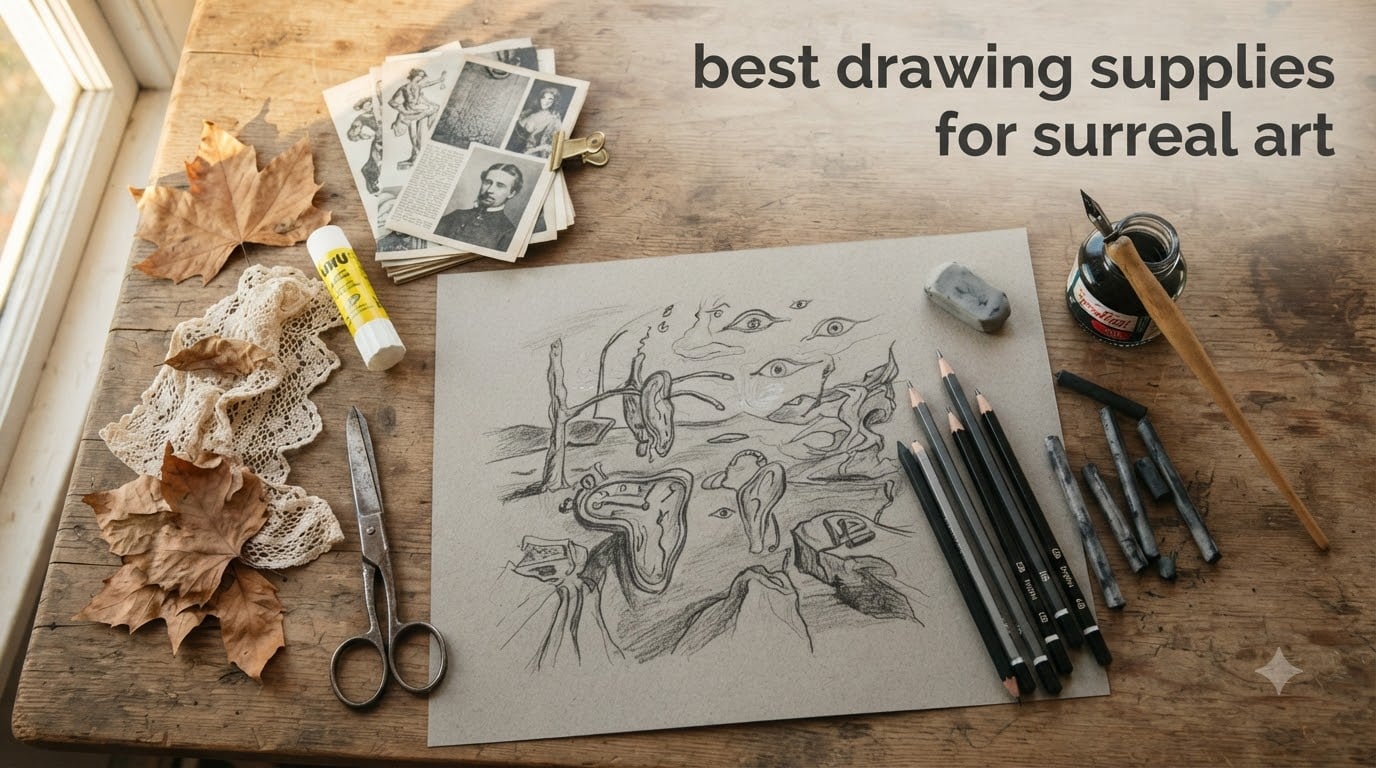
Surrealist drawing is a genre of visual art that uses unusual juxtapositions, dreamlike imagery, and automatism (letting the unconscious guide the hand) to depict scenes that defy logic and reality. If you have ever stared at a melting Dalí clock or a floating Magritte eye and wondered how the line work got there, the answer almost always lives in the materials. The right pencil hardness, the right charcoal, the right paper tooth, and the right ink will pull a surrealist idea out of your head and onto the page faster than any amount of technique alone.
Our team has spent years collecting graphite shavings, vine charcoal dust, and ink fingerprints while testing the supplies that actually unlock techniques like automatic drawing, frottage, decalcomania, and fumage. We also read through the surrealist techniques reference on Wikipedia and threads on r/surrealism and r/ArtistLounge to confirm what practicing artists reach for. This guide pulls that research together into one place: the best drawing supplies for surreal art, mapped to the techniques they enable.
Inside, you will find ten core supply categories, a medium-by-technique reference table, artist material spotlights, and three surrealist starter kits at budget, mid-range, and professional levels. Whether you are sketching dreams at your kitchen table or building a long-form mixed-media surrealist practice, this is the kit list.
Table of Contents
Top 10 Drawing Supplies for Surrealist Art (At a Glance)
- Graphite pencil set (HB to 9B) – the foundation for sketching, automatic drawing, and tonal studies.
- Vine and compressed charcoal – dramatic value, deep blacks, and the soft marks that make frottage and fumage possible.
- Charcoal pencils (soft and white) – controlled dark and highlight marks without the mess of loose charcoal.
- Kneaded eraser plus a vinyl eraser – dreamlike soft highlights and crisp corrections on toned paper.
- Heavyweight toned drawing paper (gray or tan) – a single sheet supports both shadow and highlight, which is the surrealist shortcut.
- Smooth Bristol or hot-press paper – the surface for ink and fineliner automatic drawing.
- India ink and a dip pen or brush – fluid, hypnotic line work for bulletism and pure automatism.
- Fineliners in three weights (0.05, 0.1, 0.3) – precise line variations for surrealist details and crosshatching.
- Colored pencils (Polychromos or Luminance) – lightfast color rendering for surrealist dreamscapes.
- Collage materials: magazines, scissors, glue stick, and a bone folder – the heart of cubomania, photomontage, and exquisite corpse.
Keep that list close. We will unpack every category, map each to a surrealist technique, and recommend specific product types below.
Medium by Surrealist Technique: A Reference Table
This is the comparison most guides skip. Each surrealist technique depends on a small set of materials, and buying the wrong one blocks the method before you ever lift a pencil. Use the table below to plan what to buy for the kind of surrealist work you want to make.
| Surrealist Technique | Primary Medium | Supporting Supplies | Best Paper |
|---|---|---|---|
| Automatic drawing | Graphite (soft) or charcoal pencil | Blending stump, fixative | Smooth Bristol or heavyweight drawing paper |
| Frottage | Vine or compressed charcoal | Objects with texture (wood, leaves, lace) | Thin paper laid over the object |
| Decalcomania | Gouache, ink, or wet paint | Plastic sheet, palette knife | Heavy watercolor paper or board |
| Fumage | Candle or kerosene lamp soot | Fixative spray, kneaded eraser | Hot-press paper or Bristol |
| Parsemage | Ink or watercolor droplets | Sprinkling brush, fine brush | Any absorbent drawing paper |
| Grattage | Oil, gouache, or ink layer | Scraper, palette knife, comb | Sturdy paper or canvas board |
| Bulletism | Liquid India ink | Rifled gun or paintbrush flicked at canvas | Absorbent paper |
| Exquisite corpse | Collage or pencil and paper folds | Single sheet folded into thirds | Sketch paper or newsprint |
| Cubomania | Magazine clippings | Scissors, glue stick | Cardstock backing |
| Paranoiac-critical method | Any drawing medium | Reference photos, sketch journal | Sketchbook or toned paper |
Once you see how tightly each technique is tied to its material, the kit list almost builds itself.
Graphite Pencils: The Foundation of Surrealist Sketching
Graphite pencils are the first surrealist supply you should buy. A wide tonal range from HB through 9B gives you both light sketching lines and velvety blacks that read as shadow or void.
We recommend a starter set that spans at least HB, 2B, 4B, 6B, and 9B. Softer grades (6B and 9B) are where surrealist drawing lives, because they smudge easily and let your hand move fast during automatic drawing sessions. Salvador Dalí used graphite alongside his ink and paint work for the many preparatory drawings that led up to paintings like The Persistence of Memory, and André Masson relied almost entirely on graphite and ink for his automatist drawings of the 1920s.
What to look for in a surrealist graphite pencil
- A wide hardness range – at minimum HB to 6B, ideally 9B.
- Woodless or thick graphite sleeves – useful for broad, sweeping automatic marks.
- Sharpeners and sanding pads – soft graphite loses a point quickly and a sandpaper pad lets you re-point mid-drawing.
A common beginner mistake is buying only HB and 2B pencils. That range is too narrow for surrealist work, where the contrast between soft shadow and crisp white space carries the dreamlike feeling. Buy the wide range up front.
Charcoal: Drama, Depth, and Frottage
Charcoal is the surrealist medium for shadow. Vine charcoal gives you the soft, smoky edges you see in Dalí’s later drawings; compressed charcoal delivers the dense, matte black that Max Ernst used to push his frottage rubbings into dramatic surrealist landscapes.
Buy both vine and compressed, plus charcoal pencils in soft and white. Charcoal pencils give you the smudge-able quality of charcoal with the precision of a pencil, which matters when you want a controlled line that still feels hand-drawn.
Charcoal types at a glance
- Vine charcoal – soft, light, easy to erase. Best for blocking in large surrealist shapes and for laying the first layer of a frottage.
- Compressed charcoal – dense, dark, harder to erase. Best for the deepest shadows and for Ernst-style frottage where you want high contrast.
- Charcoal pencil (soft and white) – the controlled version. White charcoal pencils are essential for highlights on toned paper.
- Charcoal powder – bulk material for large-scale fumage and for loading blending stumps.
If you are choosing only one charcoal type to start, choose vine. It is forgiving, erasable, and lets you learn how charcoal moves before committing to the deeper blacks of compressed. Forum artists on r/ArtistLounge consistently recommend vine for beginners and adding compressed once you understand pressure control.
Erasers and Subtractive Tools for Dreamlike Highlights
Erasers in surrealist drawing are not just for fixing mistakes. They are how you create the highlights that make a drawing feel dreamlike, especially on toned paper where the white of the page is already partly hidden by the gray.
You need at least three erasers in your kit. The kneaded eraser is the soft, pliable eraser you mold into shapes to lift graphite or charcoal in soft, feathery highlights. The vinyl (plastic) eraser cuts crisp lines and removes unwanted marks cleanly. The gum eraser crumbles as it erases, which is great for lifting charcoal across a large area without smearing.
Why each eraser matters
- Kneaded eraser – the most important surrealist eraser. Pinch it to a point to pull highlights out of charcoal, or flatten it to lift broad passages.
- Vinyl eraser – sharp, clean corrections, especially for fineliner and ink work.
- Gum eraser – crumbly texture that lifts charcoal dust without smearing.
- Electric eraser – optional but powerful for tiny, precise highlights in detailed surrealist work.
Forum discussions on r/surrealism consistently call the kneaded eraser the single most important surrealist eraser. Buy at least one spare, because they wear out and pick up graphite quickly.
Surrealist Drawing Papers: Smooth, Textured, and Toned
Paper is the silent partner in every surrealist drawing. Smooth Bristol paper gives you clean ink lines. Textured drawing paper grabs charcoal for deep, velvety blacks. Toned paper (gray or tan) is the surrealist shortcut: a single sheet where both shadow and highlight have somewhere to live.
For most surrealist work we recommend a heavyweight drawing paper around 100 lb (160 gsm) or heavier. Thinner paper buckles under wet media like ink washes or gouache, which is one of the frustrations forum users keep reporting when they try decalcomania on cheap sketch paper.
Paper types and where they shine
- Smooth Bristol or hot-press paper – the surface for ink, fineliner, and any technique where you want clean lines.
- Heavyweight drawing paper with light tooth – the all-purpose surface for graphite and charcoal.
- Toned paper (gray or tan) – the surrealist favorite. Use charcoal for shadows and a white charcoal pencil for highlights.
- Newsprint – cheap and disposable, ideal for automatic drawing practice and exquisite corpse games.
Toned paper deserves a quick workflow demo. Draw with compressed charcoal for shadows, then switch to a white charcoal pencil for highlights. The mid-tone gray of the paper becomes your middle value, and you only need to push to black or to white. This is how artists like Ithell Colquhoun built her parsemage and grattage works, and how many contemporary surrealists shortcut their way to high-contrast dreamscapes.
Inks, Pens, and Automatic Drawing
Ink is where surrealist drawing gets fluid. India ink is the standard: waterproof, deeply black, and permanent once dry. Sumi ink is a softer Japanese ink that gives slightly grayer, more atmospheric lines and is friendlier for brush work. Both belong in a surrealist kit.
André Masson painted his first automatic drawings in ink in 1923, and the dripping, looping lines of those drawings set the visual language for decades of surrealist ink work after him. Man Ray pushed the technique further into what he called rayographs, and Joan Miró used ink alongside gouache and pastel for many of his biomorphic forms.
Pen and ink choices
- Dip pen with India ink – the classic surrealist tool for automatic drawing. Variable line weight as you press.
- Fineliners in multiple weights – precise, consistent lines. Buy 0.05, 0.1, and 0.3 for tonal range.
- Brush pens – a hybrid that gives you brush-like variation without a separate ink bottle.
- Sumi ink and a sumi brush – softer, more absorbent marks; good for brush-loaded bulletism experiments.
For your first ink setup, buy a bottle of India ink, a dip pen with a couple of nibs, and one black fineliner in 0.1. That is enough to start automatic drawing sessions where you set a timer, let your hand move freely, and build surrealist imagery without conscious planning.
Colored Pencils for Surrealist Color Worlds
When surrealist work needs color, colored pencils are the most controllable medium. Wax-based pencils like Prismacolor Premier lay down opaque, blendable color fast. Oil-based pencils like Faber-Castell Polychromos keep a sharper point and are lightfast enough for finished surrealist pieces that will be displayed or sold. Caran d’Ache Luminance sits at the top of the range for artists who want the highest pigment load and lightfastness.
Leonora Carrington worked in colored pencil alongside her surrealist paintings, often using the medium for preparatory drawings that fed into her larger oil compositions. Remedios Varo used colored pencil for small, jewel-like surrealist works where fine detail mattered more than large color fields.
What to look for
- Lightfast rating – important if you want the work to survive years of display.
- Pigment load – higher load means richer color with less layering.
- Blendability – wax-based pencils blend more easily; oil-based pencils layer more cleanly.
- Point retention – oil-based pencils keep a point longer, which matters for detailed surrealist work.
Buy a starter set of at least 24 colors in either Polychromos or Prismacolor, then add individual open-stock pencils as your work demands specific hues. A surrealist palette tends to lean toward unexpected, slightly off-key colors, which is why a wide range matters more than picking the “right” set.
Mixed Media for Decalcomania, Grattage, and Fumage
Mixed media is where surrealist drawing crosses into painting. Gouache is the most useful single medium here: opaque, water-based, fast-drying, and re-wettable, which makes it perfect for decalcomania (pressing wet gouache between two surfaces to transfer crackled patterns). Watercolor works for parsemage and ink-wash passages. Soft pastel adds atmospheric color that mixes naturally with charcoal.
Max Ernst developed decalcomania in the 1930s as a way to push his work beyond conscious control, and the crackled, organic textures he produced became a surrealist signature. Grattage is his other landmark technique: paint a layer, let it dry, then scrape into it to reveal the surface below. Both techniques depend on materials that behave a specific way under pressure.
Mixed media essentials
- Gouache (a basic primary set) – the decalcomania workhorse. Opaque and fast-drying.
- Watercolor (tube or pan set) – for parsemage washes and atmospheric color.
- Soft pastels (a small set of earth tones and brights) – layered over charcoal for tonal drawings with color.
- Palette knife, scraper, and an old comb – the tools for grattage.
- A plastic sheet or acetate – for pressing between paper layers during decalcomania.
A common beginner mistake here is using student-grade gouache for decalcomania. The pigment load is too thin and the medium never fully cracks. Buy artist-grade gouache if you can.
Collage, Ephemera, and the Exquisite Corpse
Collage is half of surrealism. From Max Ernst’s Victorian novel collages to the magazine-and-scissors cubomania of the 1930s, surrealist artists have always cut things up and reassembled them. You need almost nothing to start: a stack of magazines, a sharp pair of scissors, a glue stick, and a bone folder or the back of a spoon to press the collage flat.
Exquisite corpse is the most famous surrealist collage game. Fold a sheet of paper into three sections, the first person draws a head, the second draws a torso without seeing the head, the third draws the legs, then unfold. The result is always a little uncanny, which is the whole point. This game is also a fast way to learn what surrealist composition feels like before committing to a longer drawing.
Collage kit checklist
- Sharp scissors and a craft knife – clean cuts matter when the edges show.
- Glue stick (acid-free) – archival glue prevents the work from yellowing.
- Bone folder or burnishing tool – to press glued pieces flat without bubbles.
- Magazines, newspapers, vintage books, sheet music – the visual raw material.
- A selection of cardstock backings – sturdy enough to support heavy collage.
Salvador Dalí and Luis Buñuel famously kicked off surrealist cinema by cutting up magazines and arranging the clippings into dreamlike sequences for Un Chien Andalou. The same scissors-and-glue approach still works for still images.
Workspace, Storage, and Reference
A surrealist drawing session can last hours because the techniques like automatic drawing and decalcomania reward staying inside the process. Your workspace should support that. A drawing board at table height, a chair you can sit in for a long time, and good directional light (a north-facing window or a daylight LED panel) make a real difference over the weeks and months of surrealist practice.
Storage matters too. Charcoal and pastel drawings need fixative spray to survive being moved or stacked. Finished surrealist works should be stored flat in a portfolio or between sheets of glassine. Fragile mixed-media pieces with collage should never be sealed in plastic for long, because trapped moisture can damage the paper.
Workspace and storage essentials
- Drawing board or large sketchbook – a hard surface supports wet media and heavy mark-making.
- Fixative spray (workable and final) – workable fixative lets you keep drawing over a fixed layer; final fixative seals the finished piece.
- Portfolio or flat file – for storing finished surrealist work without bending or smudging.
- Glassine sheets – archival interleaving for charcoal and pastel drawings.
- Reference library: art books, magazines, Pinterest mood boards – surrealist reference is half of the practice.
For mood boarding specifically, Pinterest is the tool most working surrealists reach for. Build private boards for dream imagery, vintage objects, body parts, animals, and architectural fragments. The collage of references becomes its own kind of automatic drawing.
Digital Surrealism: A Brief Appendix
Digital tools have their own surrealist tradition. Man Ray experimented with photography and rayographs; contemporary surrealists use Procreate, Photoshop, and AI image generators to push the genre further. You do not need a digital setup to make surrealist work, but if you already draw on an iPad, the techniques translate directly.
A minimal digital surrealist kit is a stylus, a drawing app with layered brushes (Procreate or Photoshop on iPad, Krita on desktop), and a mood board app. The automatic drawing principle is identical: turn off the conscious mind, let the stylus move, build from the marks you find.
Digital essentials
- Pressure-sensitive stylus – so lines have variable weight.
- Layered drawing app – so you can build automatic marks underneath a more deliberate drawing.
- Brush packs that mimic charcoal, ink, and pencil – digital media can simulate the traditional ones well.
Treat the digital tools as an extension of the same kit list above, not a replacement for it. The supply categories are the same; only the medium shifts.
Surrealist Starter Kits: Budget, Mid-Range, and Professional
Use these three kits as a starting point. You can always add more later. The goal of a starter kit is to give you one usable tool in every category so you can try every technique without buying anything twice.
Budget kit (essentials only)
- One graphite pencil set (HB to 6B)
- One pack of vine charcoal and one compressed charcoal stick
- One kneaded eraser and one vinyl eraser
- One pad of heavyweight drawing paper (50 sheets)
- One black fineliner (0.1)
- One bottle of India ink and a basic dip pen
- Scissors, glue stick, and a stack of old magazines
Mid-range kit
- Graphite set extended to 9B plus a woodless graphite stick
- Vine and compressed charcoal plus a set of charcoal pencils (soft and white)
- Kneaded eraser, vinyl eraser, gum eraser, and an electric eraser
- Smooth Bristol pad plus a toned gray paper pad
- Fineliners in 0.05, 0.1, and 0.3
- India ink plus sumi ink and a sumi brush
- A 24-color Polychromos or Prismacolor set
- Collage supplies plus a bone folder
- A small gouache primary set
- Fixative spray (workable and final)
Professional kit
- Multiple graphite pencil grades plus woodless graphite and a graphite powder
- Full charcoal range: vine, compressed, charcoal pencils, charcoal powder, white charcoal pencil
- All four eraser types plus an electric eraser with replacement eraser sticks
- Stocked paper library: Bristol, hot-press watercolor paper, heavyweight drawing paper, toned gray paper, toned tan paper, newsprint for practice
- Dip pens in multiple nib sizes plus fineliners in 0.03 to 0.5
- India ink (black and a selection of colors), sumi ink, and acrylic ink
- Full 72-color or larger Polychromos or Luminance set
- Gouache primary set plus a soft pastel set in earth tones and a few brights
- Full collage kit with archival glue, bone folder, and cutting mat
- Workspace: drawing board, daylight LED, portfolio, flat file, glassine sheets
- Digital: iPad or drawing tablet, pressure stylus, Procreate or Photoshop
Start at the budget tier and add pieces as your surrealist practice finds its direction. Most artists who start automatic drawing with a single graphite pencil and a sketchbook end up buying more charcoal than anything else, but you cannot know that until you start.
Frequently Asked Questions
What are the best drawing supplies for surrealist art?
The best drawing supplies for surrealist art are a wide graphite pencil range (HB to 9B), vine and compressed charcoal, charcoal pencils in soft and white, kneaded and vinyl erasers, heavyweight toned drawing paper, India ink with a dip pen, fineliners, colored pencils, gouache, and collage materials. Each material unlocks a different surrealist technique, so the kit list is really a technique list in disguise.
What supplies do I need to start surrealist art?
To start surrealist art, you need a graphite pencil set (at least HB to 6B), one stick each of vine and compressed charcoal, a kneaded eraser, a pad of heavyweight drawing paper, and a fineliner. That kit covers automatic drawing, basic frottage, graphite sketching, and ink line work, which is enough to explore most core surrealist drawing techniques.
What kind of charcoal is best for surrealism?
Both vine and compressed charcoal belong in a surrealist kit. Vine charcoal is soft, smoky, and easy to erase, which is what you want for the first layers of a drawing and for fumage experiments. Compressed charcoal is dense and dark, which gives the deep blacks that surrealist chiaroscuro depends on, especially for Max Ernst-style frottage rubbings.
What paper is best for surrealist drawings?
The best paper for surrealist drawings is heavyweight (around 100 lb or 160 gsm) with a light tooth. Smooth Bristol works for ink and fineliner, textured drawing paper grabs charcoal, and toned gray paper is the surrealist favorite because it supports both shadow and highlight on a single sheet. Thin sketch paper buckles under wet media and is a common beginner frustration.
What is needed for automatic drawing?
Automatic drawing needs a soft graphite pencil or charcoal pencil, a smooth or lightly textured drawing surface, and the discipline to keep the hand moving without planning. India ink with a dip pen also works beautifully for automatic drawing because the fluid line releases pressure on the hand and lets the unconscious surface faster.
What is needed for frottage?
Frottage needs vine or compressed charcoal, a thin sheet of paper laid over a textured object (wood grain, leaves, lace, fabric), and something to rub with (a fingertip, blending stump, or the side of a soft pencil). Max Ernst developed the technique in 1925 and used it to generate the surrealist landscapes that fed directly into his paintings.
What pencils did Dali use?
Salvador Dali used graphite pencils for preparatory drawings, India ink for line work, and a wide range of charcoal and Conté sticks for his later drawings on paper. He worked on heavyweight drawing paper and toned paper, and his finished drawings often combined graphite, ink, watercolor, and collage in a single piece.
Conclusion
The best drawing supplies for surreal art are not a single brand or a single medium. They are a kit organized around techniques: graphite and charcoal for automatic drawing, ink and dip pens for bulletism, gouache and plastic sheets for decalcomania, charcoal and textured objects for frottage, and scissors and magazines for cubomania. Once you map supplies to techniques, the kit almost builds itself, and you can start small with a single graphite pencil and a sketchbook and grow the kit as your surrealist practice finds its direction.
Take the top-10 list above, set a 30-minute timer, and start an automatic drawing tonight. Materials matter in surrealism, but the first mark on the page matters more.