
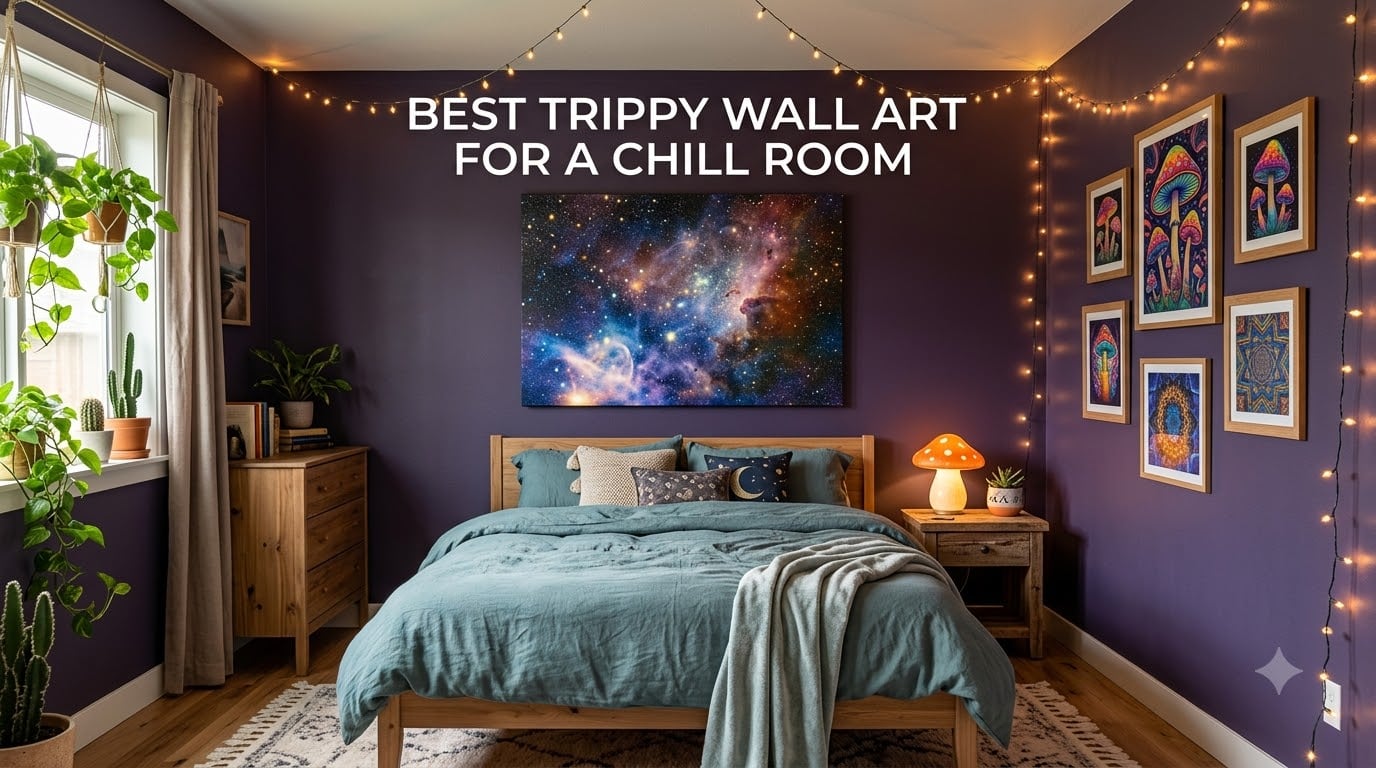
Trippy wall art transforms a room from bland to otherworldly, and finding the right pieces for a chill room is all about balance. You want psychedelic energy without visual chaos — bold colors and surreal motifs that relax rather than overstimulate. In this guide, I’ll walk you through exactly how to choose, style, and source the best trippy wall art for a chill room so your space feels like a creative sanctuary instead of a sensory overload.
Whether you’re decorating a bedroom, dorm, studio, or hangout zone, the difference between a room that feels trippy-calm and one that feels trippy-chaotic comes down to a few key decisions: color palette, motif intensity, print format, and layout. I’ve spent months browsing Reddit communities like r/TripCaves and r/interiordecorating, testing print sources, and studying what actually works on real walls. Here’s everything I’ve learned.
Table of Contents
What Is Trippy Wall Art (and Why It Works for a Chill Room)
Trippy wall art is psychedelic-inspired wall decor — bold, surreal, color-saturated prints, posters, canvases, or collages that use motifs like mushrooms, galaxies, aliens, fractals, and kaleidoscopic patterns to create an otherworldly mood. It draws from 1960s and 70s psychedelic art movements but has evolved into a broader aesthetic that includes dreamcore, weirdcore, and modern surrealism.
For a chill room, trippy art works because it sets a creative, immersive tone without requiring you to change your furniture or renovate. One or two statement pieces can re-anchor the entire visual energy of a space. The key is choosing art that leans toward ambient and contemplative rather than high-contrast and aggressive.
Think of it this way: a galaxy print in deep purples and blues feels meditative, while a neon fractal explosion in hot pink and electric green feels like a rave. Both are trippy — but only one belongs in a chill room.
Color Palette & Signature Motifs
The color palette you choose sets the entire mood of your trippy wall art. For a chill room, lean into deep, saturated tones rather than high-contrast neons.
Colors that work for chill rooms: Deep purple, midnight blue, muted teal, warm amber, soft magenta, dusty rose, and earthy greens. These tones feel psychedelic without jolting your nervous system. If you want neon accents, use them sparingly — one neon piece surrounded by calmer tones reads as intentional rather than overwhelming.
Colors to approach carefully: Pure hot pink, electric lime green, and high-saturation red-orange tend to energize a space rather than chill it out. They work beautifully in high-stim rooms but can feel restless in a bedroom or meditation corner.
Signature motifs to look for:
Mushrooms: The most popular trippy motif right now. Ranges from whimsical cartoon styles to detailed botanical illustrations with a surreal twist.
Galaxy and cosmic scenes: Deep-space nebulae, planets, and star fields create a contemplative, expansive feeling.
Fractals and kaleidoscopic patterns: Repeating geometric patterns that draw the eye inward — naturally meditative.
Aliens and UFOs: Playful and nostalgic, especially in retro or Y2K styles.
Surreal landscapes: Melting horizons, impossible architecture, dreamlike nature scenes.
Abstract rainbow and chromatic aberration: Modern digital art styles that feel contemporary and fresh.
2026 trend signal: Maximalist surrealism is having a major moment. Think layered, collage-style compositions that blend multiple motifs — a galaxy background with mushroom foreground elements and fractal borders. AI-assisted surreal art is also gaining traction, producing intricate patterns that would be nearly impossible to hand-draw. Y2K and 70s revival aesthetics continue to influence color choices and typography.
Types of Trippy Wall Art to Consider
Trippy wall art comes in several formats, and each one creates a different effect in a room. Here’s a breakdown of what’s available and what works best for a chill space.
1. Posters and prints — The most accessible and affordable option. Paper posters work well for gallery walls and collage arrangements. They’re easy to swap out if your taste evolves. Look for heavyweight matte paper to avoid glare under ambient lighting.
2. Canvas prints — Canvas adds texture and a gallery-quality feel. Large-format trippy canvases (24×36 inches or bigger) work as statement pieces above a bed or sofa. They don’t require framing, which simplifies hanging. Reddit communities consistently praise canvas prints for not having “ripples when framed” — a common concern with cheaper posters.
3. Wall collages and multi-piece sets — Groups of 3, 5, or even 50 small prints arranged in a gallery-wall pattern. Etsy sellers like MythPixPrints offer 50-piece collage kits for maximalist walls. These are perfect for covering large blank walls without committing to a single expensive piece.
4. Tapestries — Fabric wall hangings that double as sound dampeners. Blacklight-reactive tapestries are popular in r/TripCaves for creating immersive chill zones. They’re lightweight, easy to hang with push pins, and cover large areas.
5. Framed art — Framing grounds wild art and makes it feel intentional. A trippy print in a simple black or natural wood frame reads as curated rather than dorm-room. Matting (the white border inside the frame) adds breathing room around busy designs.
6. Digital downloads and printables — The budget-friendly option. Sellers on Etsy offer instant-download trippy art files you can print at home or at a local print shop. Great for experimenting with layouts before investing in premium prints.
7. Blacklight-reactive vs. ambient prints — This distinction matters for chill rooms. Blacklight-reactive prints glow under UV light and create a high-energy, immersive effect. Ambient prints look their best under normal lighting — warm bulbs, string lights, or natural light. For a chill room, ambient prints are usually the better call. Reserve blacklight-reactive pieces for a single accent wall or specific corner.
How to Style Trippy Wall Art in a Chill Room
Styling trippy art in a chill room is about creating focal points without visual clutter. Here’s the approach that works best.
Start with one anchor piece. Choose your favorite trippy print — the one that makes you feel something — and place it on the most visible wall. This becomes the room’s visual center. Everything else supports it. Above the bed, over the couch, or facing the door are prime anchor positions.
Build around it with restraint. Add 2-4 smaller complementary pieces flanking the anchor. They should share a color family or motif theme but don’t need to match exactly. A galaxy canvas anchor might be flanked by smaller mushroom prints and a fractal poster. The goal is cohesion, not uniformity.
Mix trippy art with neutral furniture. This is the secret to keeping a chill room from tipping into chaos. If your walls are wild, keep your bedding, curtains, and large furniture in solid, muted tones — white, cream, gray, natural wood, or black. The art pops harder against a calm backdrop. Reddit’s r/interiordecorating community repeatedly recommends this approach: “Let the walls be the show, keep everything else quiet.”
Use lighting intentionally. Warm string lights, a mushroom lamp, or a soft-glow projector complement trippy art beautifully. Avoid harsh overhead fluorescents — they flatten the depth of psychedelic prints. A lava lamp on a nightstand next to a galaxy print? That’s the chill-room energy.
Consider the “low-stim vs high-stim” calibration. A chill room leans low-stim: deeper colors, fewer competing patterns, more negative space on the walls. A high-stim room (think r/TripCaves at full intensity) layers every surface with art, tapestries, and LED strips. Both are valid — but if “chill” is your goal, leave some breathing room between pieces.
Sizing, Layout & the 2/3 Rule
The 2/3 rule is the most reliable guideline for hanging wall art: your art should be roughly two-thirds the width of the furniture below it. A 60-inch wide couch calls for art that’s about 40 inches wide. A 48-inch wide headboard needs art around 32 inches wide. This ratio creates visual balance and prevents art from looking either too small (floating awkwardly) or too large (overwhelming the furniture).
How to measure it:
Measure the width of your furniture piece (couch, bed, desk).
Multiply by 0.67 to get your target art width.
If using multiple pieces, measure the total width of the arrangement as one unit.
Center the art (or arrangement) over the furniture — it should be centered, not offset.
Gallery-wall layout styles:
Salon-style: A mix of different sizes arranged organically. Works great for trippy collage walls. Leave 2-3 inches between frames for a collected-over-time feel.
Grid: Same-sized prints in even rows. Reads as modern and intentional. Best with matching frames.
Linear row: 3-5 pieces hung in a straight horizontal line. Clean and minimalist — good for hallways or above desks.
Hanging height: The center of your art arrangement should be at eye level — about 57-60 inches from the floor. Above furniture, leave 6-8 inches between the top of the furniture and the bottom of the art.
Where to Shop for Trippy Wall Art
Finding the right source depends on your budget and how curated you want your collection to feel. Here’s where people are actually buying trippy wall art right now.
For variety and affordability: Etsy is the dominant marketplace for trippy wall art. You’ll find indie sellers offering everything from instant digital downloads to framed prints at various price points. Search terms like “trippy mushroom print,” “psychedelic galaxy poster,” or “surreal wall art collage kit” surface thousands of options. Sellers like MythPixPrints, RainbowWallCollage, and IPurpleMoon specialize in large collage kits.
For premium large-format canvas: Big Wall Décor carries artist-attributed trippy canvas prints from creators like Frank Moth, Wegs.Art, and Ali Gulec. These are statement pieces designed for large walls. Andy okay offers museum-quality giclée prints from indie artists and has strong community trust — their 4.9-star rating from nearly 15,000 reviews consistently highlights print quality and color vibrancy.
For curated indie art: Society6 and Redbubble let independent artists upload designs that get printed on various formats. You’ll find unique pieces that mass-market sellers don’t carry. Museum poster shops and national-park-style poster retailers also carry abstract and surreal prints with a more “collected” aesthetic.
For budget maximalism: Amazon offers bulk trippy poster packs — 50-piece sets at budget-friendly price points. Quality varies, so check reviews carefully. These work well for collage walls where individual print quality matters less than the overall arrangement.
Community-recommended sources: Reddit communities like r/interiordecorating and r/bitcheswithtaste recommend local museum print shops, personal travel photography printed as abstract art, and Etsy digital downloads as the best value options. Several threads praise the “collected over time” look that comes from mixing sources rather than buying everything from one store.
Frequently Asked Questions
What is the 2/3 rule for wall art?
The 2/3 rule means your wall art should be approximately two-thirds the width of the furniture it hangs above. For a 60-inch wide couch, choose art that’s about 40 inches wide. This ratio creates visual balance and prevents art from looking too small or overwhelming the space.
What kind of wall art is trending right now?
In 2026, maximalist surrealism, AI-assisted surreal art, and Y2K/70s revival aesthetics are dominating wall art trends. Mushroom motifs, galaxy scenes, fractal patterns, and kaleidoscopic designs remain popular. Deep saturated purples, blues, and magentas are trending over high-contrast neons.
What are some examples of trippy art styles?
Trippy art styles include psychedelic mushrooms, galaxy and cosmic scenes, fractal and kaleidoscopic patterns, surreal landscapes, alien and UFO motifs, abstract rainbow compositions, chromatic aberration art, and dreamcore or weirdcore aesthetics. Each creates a different mood, from meditative to energetic.
What are the trends in wall art for 2026?
Key wall art trends for 2026 include maximalist layered compositions, AI-generated surreal patterns, Y2K and 70s revival aesthetics, deep cosmic color palettes, and multi-motif collage arrangements. Sustainability and indie artist sourcing are also growing priorities for buyers.
How do I decorate a chill room with trippy art?
Start with one anchor piece on your most visible wall, then add 2-4 smaller complementary pieces that share a color family. Keep furniture and bedding in neutral, muted tones to let the art pop. Use warm ambient lighting like string lights or a mushroom lamp, and leave breathing room between pieces to maintain a low-stim, relaxed atmosphere.
What art does Gen Z like?
Gen Z gravitates toward trippy, surreal, and maximalist aesthetics — mushroom motifs, galaxy prints, Y2K nostalgia, weirdcore and dreamcore styles, and bold abstract compositions. They prefer affordable, easily swappable formats like posters, tapestries, and digital downloads, and often discover art through TikTok and Pinterest.
What is bohemian wall art?
Bohemian wall art features earthy, eclectic designs — think macramé hangings, botanical prints, desert landscapes, mandalas, and warm-toned abstracts. It overlaps with trippy art in its use of natural motifs and maximalist layering, but bohemian art tends toward warmer, more organic palettes while psychedelic art leans into cooler, more saturated colors.
Conclusion
Choosing the best trippy wall art for a chill room comes down to a few core principles: start with a color palette that leans deep and saturated, pick motifs that resonate with you personally, and use the 2/3 rule to get your sizing right. Build your collection gradually — one anchor piece at a time — and let neutral furniture and warm lighting do the heavy lifting on the “chill” factor. Whether you’re shopping on Etsy for indie prints, investing in a premium canvas, or downloading printable art to test layouts, the right trippy wall art will transform your space into the creative sanctuary you’ve been imagining.