
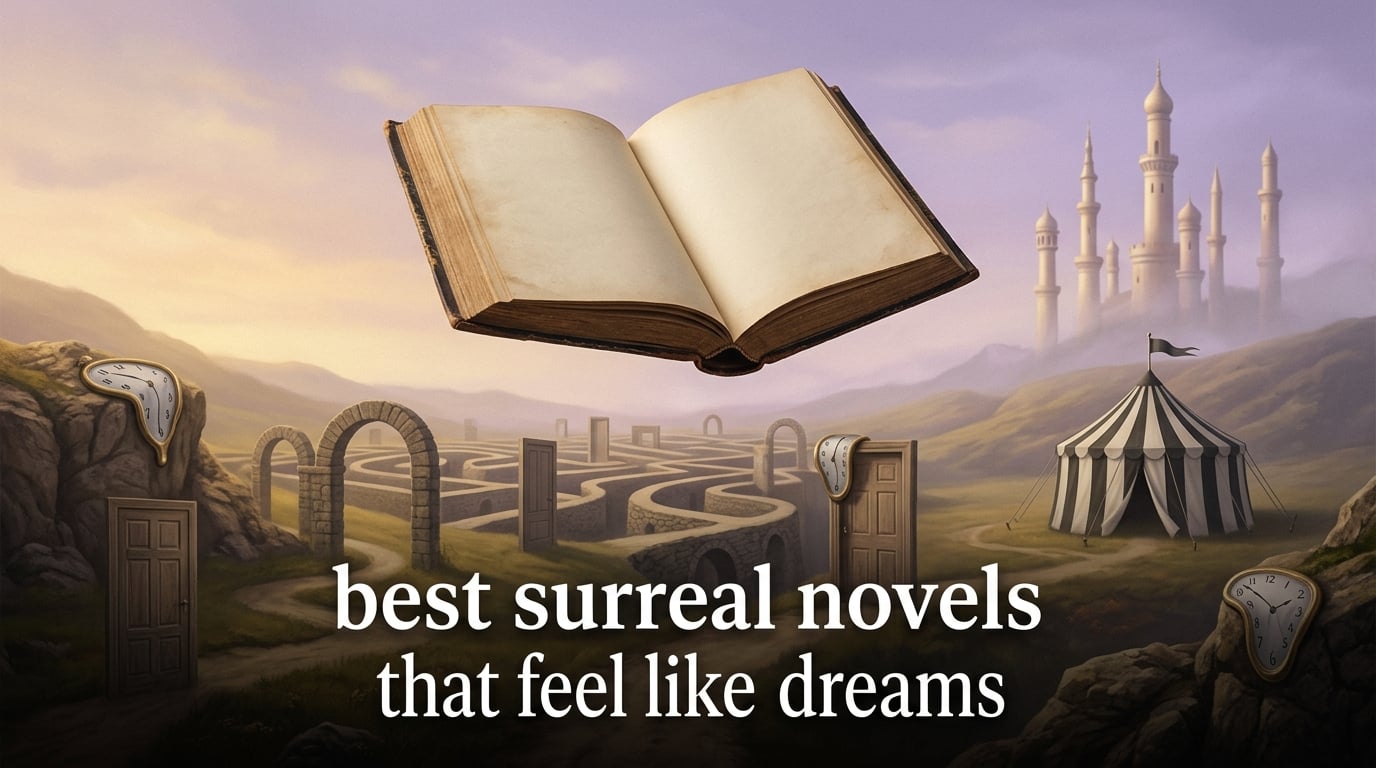
Looking for the best surreal novels that feel like dreams? You’ve come to the right place. I’ve spent years chasing books that blur the line between waking life and sleep, and I’m sharing the reads that genuinely unsettled my sense of reality. This 2026 guide covers 15 dreamlike novels, what structurally makes them feel like dreams, and how to pick the right one for your mood.
Surrealism isn’t just a literary trend. It’s an artistic movement born from the belief that the unconscious mind holds truths logic can’t reach. When that energy shows up in fiction, the result is a book that reads like a half-remembered dream: vivid, illogical, and impossible to shake.
Table of Contents
What Makes a Novel Feel Like a Dream?
A novel feels like a dream when it deliberately bends the rules of waking reality. The setting may look ordinary, but the logic underneath is loose, looping, or replaced by something stranger. Time skips. Characters morph. Objects gain memories.
I think of dreamlike fiction as working on three levels. First, the prose itself feels hazy or hypnotic, with sentences that drift instead of march. Second, the plot refuses linear logic, the way a dream refuses chronology. Third, the imagery is uncanny: familiar things appear in unfamiliar contexts, like a door that opens onto your childhood bedroom.
The Tate Museum defines surrealism as finding beauty in the strange and uncanny, balancing rational reality with the power of the unconscious mind. When a novelist takes that definition seriously, the result is a book you finish feeling slightly disoriented. You know the story happened, but you can’t quite explain how.
Reddit’s r/suggestmeabook readers often describe this quality as “fever dream books.” It’s a useful shorthand. A fever dream doesn’t obey rules, doesn’t resolve cleanly, and lingers long after you surface.
Surrealism, Magical Realism, and the New Weird: What’s the Difference?
Readers mix these terms up constantly, and I used to as well. They overlap, but each one signals something specific.
Surrealism comes from the 2026 century art movement led by André Breton. It treats the unconscious mind as the real subject and uses dream imagery to challenge rational thought. A surreal novel will feel jarring, symbolic, and emotionally raw.
Magical realism treats the strange as ordinary. A character might rise into the sky, and the narrator won’t mention it again. Gabriel García Márquez is the master of this mode. The magical element is woven into a recognizable world rather than standing apart from it.
The new weird is a younger category. China Miéville and Jeff VanderMeer built a genre that borrows from horror, fantasy, and surrealism. New weird novels feel like stepping into a dream, but a dream populated by monsters and political systems.
Here’s the practical difference. Magical realism invites you to accept. Surrealism invites you to question. The new weird invites you to feel unsettled. Knowing which one you’re after makes it much easier to pick a book.
15 Best Surreal Novels That Feel Like Dreams
These fifteen novels are my strongest recommendations for readers who want prose that lingers. I included something from each of the three categories above, plus a few that resist classification entirely.
1. One Hundred Years of Solitude by Gabriel García Márquez
Gabriel García Márquez’s generational saga follows the Buendía family through a century in the fictional town of Macondo. Ghosts attend parties. A plague of insomnia spreads through town. The novel reads like collective memory rather than a single plot.
Why it feels like a dream: time folds in on itself. Characters return under different names. Rain falls for years. The world is grounded in Latin American history, but the logic is purely dreamlike.
2. Kafka on the Shore by Haruki Murakami
Haruki Murakami’s novel runs on two tracks. A 15-year-old boy runs away from home and falls into an alternate world. An aging man loses his mind to a curse. Their stories don’t meet, but they echo each other.
Why it feels like a dream: the prose floats. Conversations about philosophy and fish. Metaphors slip into the literal. I closed this book unsure which scenes were real and which were dream.
3. The Night Circus by Erin Morgenstern
Erin Morgenstern’s debut imagines a magical competition between two young magicians. The arena: a black-and-white circus that appears without warning and vanishes by dawn. The stakes: their lives.
Why it feels like a dream: the circus itself is a dreamscape. It contains an ice garden, a cloud maze, and tents that smell of caramel. The plot moves on the logic of attraction and obsession rather than cause and effect.
4. House of Leaves by Mark Z. Danielewski
Mark Z. Danielewski’s cult novel pretends to be an academic analysis of a documentary about a house that’s bigger on the inside than the outside. The book itself spirals into footnotes, appendices, and reversed text.
Why it feels like a dream: the form mimics the content. Reading it feels like wandering a labyrinth, which is exactly what the characters experience. Reddit readers regularly call this the most dreamlike book they’ve ever read.
5. Piranesi by Susanna Clarke
Susanna Clarke’s slim novel is narrated by a man who lives in an infinite house filled with statues and tides. He keeps records, he explores, he waits for the Other to visit. The reader learns the truth slowly.
Why it feels like a dream: the narrator’s calm voice makes the impossible setting feel stable. You’re never sure what’s real, but his certainty pulls you through. The reveal lands like waking up.
6. The Wind-Up Bird Chronicle by Haruki Murakami
Murakami’s longer novel follows Toru Okada, who loses his cat, then his wife, then his grip on ordinary life. He descends into a dry well in a vacant lot and meets strange people in the dark.
Why it feels like a dream: the plot sounds absurd when summarized, but Murakami’s patient prose makes every strange event feel inevitable. The well is the literal unconscious, and the book trusts you to find your own meaning.
7. Fever Dream by Samanta Schweblin
Samanta Schweblin’s novella is built as a conversation between a dying woman and a boy beside her. She keeps asking about the exact moment things went wrong. He keeps trying to answer.
Why it feels like a dream: the prose is short, urgent, and hallucinatory. It’s only 200 pages but hits like a panic attack. You finish it shaken, the way you surface from a nightmare still seeing it.
8. The Ocean at the End of the Lane by Neil Gaiman
Neil Gaiman’s novel remembers a childhood. A man returns to his hometown and recalls an event from age seven: a lodger’s suicide, a creature from another world, and three women on a neighboring farm who may be gods.
Why it feels like a dream: childhood memory itself is the engine. The narrator admits he doesn’t know what’s real. Gaiman writes the supernatural so casually that the strange feels more honest than the ordinary.
9. Earthlings by Sayaka Murata
Sayaka Murata’s novel follows a young woman who has always pretended to be normal. When she escapes to a remote mountain cabin with a man she barely knows, her pretending collapses into something stranger.
Why it feels like a dream: the narrator’s voice is flat and gentle, even when describing things that should shock her. The book reads like an alien’s first attempt at understanding human life.
10. The Starless Sea by Erin Morgenstern
Erin Morgenstern’s second novel follows a graduate student who discovers a book that mentions him by name. Below the surface of his college town is a literal underground sea of stories, guarded by keys and cats.
Why it feels like a dream: the book is about reading itself. Stories spill into the real world. Doors open onto pages. It’s a love letter to the dreamlike state books can create.
11. The Master and Margarita by Mikhail Bulgakov
Mikhail Bulgakov’s novel bounces between three plots. The Devil visits Moscow in 1930. A poet writes a novel about Pontius Pilate. A cat walks around on two legs and complains about money.
Why it feels like a dream: the satire is sharp, but the atmosphere is pure dream. The Devil’s ball is the most quoted surreal scene in Russian literature. The book was too dangerous to publish in Bulgakov’s lifetime.
12. Hard-Boiled Wonderland and the End of the World by Haruki Murakami
This Murakami novel runs two parallel stories in alternating chapters. One is a near-future noir about data couriers and a creature called the Sound Man. The other is a dreamlike town where your shadow gets cut off when you arrive.
Why it feels like a dream: each chapter reads like a short story, but the worldbuilding accumulates. By the end, both storylines have blurred into a single meditation on consciousness.
13. The Complete Stories of Leonora Carrington
Leonora Carrington was a surrealist painter before she was a writer. Her stories read like her paintings: a woman gives birth to a hyena, a rabbit starts a society, an inn is run by a giant egg.
Why it feels like a dream: each story is short, dense, and refuses explanation. Carrington doesn’t tell you what anything means. She trusts you to sit with the image.
14. Freshwater by Akwaeke Emezi
Akwaeke Emezi’s debut follows an Ada, a Nigerian woman born with multiple beings inside her. The novel traces her childhood, her university years, and her eventual breakdown through the lens of these presences.
Why it feels like a dream: identity is treated as fluid and inhabited. Western readers may find this disorienting, which is the point. The book asks what it means to share a self.
15. The Raw Shark Texts by Steven Hall
Steven Hall’s debut is a literary thriller with teeth. A man wakes up with no memory and finds a stack of letters he wrote to himself, warning about a conceptual shark that swims through thoughts.
Why it feels like a dream: the book includes 36 typographical sharks hidden in the text. The narrator literally forgets his own story. By the end, you can’t tell where memory ends and invention begins.
Choosing a Surreal Novel Based on Your Mood
Surrealism isn’t one experience. Some books are cozy and hypnotic. Others are violent and disorienting. Here’s how I’d match the list above to what you’re after.
If you want gentle and beautiful, start with Piranesi or The Night Circus. Both build strange worlds with calm narrators. They’re dreamlike in a safe way.
If you want philosophical and puzzling, try Kafka on the Shore or Hard-Boiled Wonderland. Murakami rewards readers who don’t insist on plot.
If you want horror-leaning and intense, pick Earthlings or Fever Dream. Both are short, fast reads with lasting weight.
If you want a form experiment, go to House of Leaves or The Raw Shark Texts. These are books about what books can do.
If you want literary classics, One Hundred Years of Solitude and The Master and Margarita are the foundations. Everything since stands on their shoulders.
Content Warnings: When Surrealism Crosses Into the Disturbing
Some books on this list earn their dreamlike quality by going to dark places. Surrealism often involves the unconscious, and the unconscious doesn’t always play fair.
Fever Dream, Earthlings, Freshwater, and The Master and Margarita all contain scenes involving violence, suicide, or abuse. House of Leaves can trigger claustrophobia and anxiety in sensitive readers.
This isn’t a reason to avoid them. The discomfort is part of the artistic effect. But it’s worth knowing what you’re walking into. I always recommend reading content warnings before starting surreal fiction, especially the newer titles.
Frequently Asked Questions
Is surrealism inspired by dreams?
Yes. The surrealist movement was founded on the belief that dreams and the unconscious mind reveal truths that logic cannot. Surrealist writers borrowed imagery, structure, and loose logic directly from the dream state.
What are some of the best surreal novels?
Some of the best surreal novels are One Hundred Years of Solitude by Gabriel García Márquez, Kafka on the Shore by Haruki Murakami, House of Leaves by Mark Z. Danielewski, Piranesi by Susanna Clarke, and Fever Dream by Samanta Schweblin. Each uses dream logic, uncanny imagery, or non-linear time to create a disorienting reading experience.
What makes a novel feel like a dream?
A novel feels dreamlike when its prose is hypnotic, its plot refuses linear logic, and its imagery places familiar things in unfamiliar contexts. Time, identity, and physical rules often bend without explanation, mimicking how dreams actually feel.
What is the difference between magical realism and surrealism?
Magical realism treats the strange as ordinary and woven into a recognizable world. Surrealism treats the strange as uncanny and challenges rational thought directly. Magical realism invites acceptance, while surrealism invites questioning.
What is the best book about dreams?
Piranesi by Susanna Clarke and The Raw Shark Texts by Steven Hall are two strong starting points for books about dreams and memory. For a more classic surrealist take, The Master and Margarita by Mikhail Bulgakov remains influential.
Are surreal novels hard to read?
Surreal novels vary widely in difficulty. Accessible picks like The Night Circus and Piranesi use simple prose with strange settings. More challenging picks like House of Leaves and Hard-Boiled Wonderland and the End of the World use form experiments and non-linear plots that require patience.
Final Thoughts on Reading Dreams
The best surreal novels that feel like dreams share one thing: they trust the reader to keep walking when the ground shifts. They don’t explain themselves. They don’t apologize.
If you’re new to the genre, start with one of the gentler picks. Piranesi is a perfect entry point. If you’ve read everything mainstream and want something stranger, House of Leaves or The Master and Margarita will reward the time.
Keep a notebook nearby. Surreal novels have a way of leaving images stuck in your head for days. You may want to write them down before they fade.