
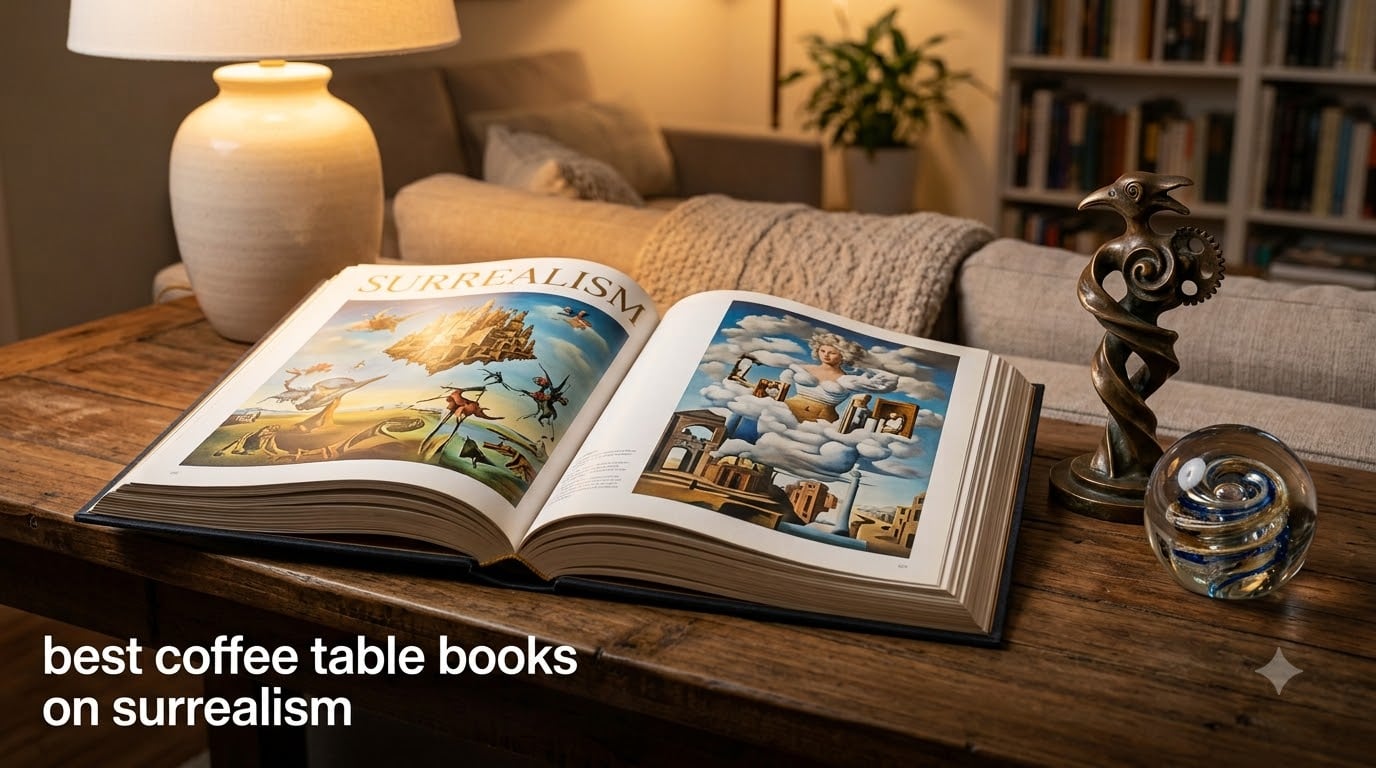
Looking for the best coffee table books on surrealism to anchor a shelf or spark a conversation? I have spent years collecting oversized art books, and the surrealism category consistently produces some of the most visually arresting objects you can own. This guide walks you through what makes a surrealism book worth buying, which editions I trust, and how to display them so they actually get picked up.
You will learn the core criteria I use when judging a surrealism art book, the movement context that helps you choose with confidence, my recommended picks across eight categories, where to source rare editions, and the styling tips interior designers use to make art books feel like part of the room rather than afterthoughts.
Table of Contents
What Makes a Surrealism Coffee Table Book Worth Buying
A surrealism coffee table book earns its place on your shelf through three qualities working together: large-format pages that show dreamlike imagery the way it deserves to be seen, pristine print reproduction of paintings and drawings, and enough scholarly writing to give you context without putting you to sleep.
When I evaluate a new candidate, I start with the publisher. Rizzoli, Phaidon, and Taschen have decades of experience producing oversized art books, and their color management is reliable. Museum-published editions from the Met, MoMA, and the Centre Pompidou also tend to deliver strong production values because the curators oversee every detail.
Format matters more than most buyers expect. A 9.8 x 13.4 inch hardcover is the sweet spot for surrealism reproductions because it accommodates both vertical portraits and horizontal landscapes. Anything smaller tends to crop Magritte’s skies, and anything much larger becomes a storage challenge.
Finally, I look at content depth. The strongest surrealism art books combine 150 to 300 plates with two or three scholarly essays from curators or art historians. Books that are pure image dumps look beautiful on day one but rarely get revisited. Books with real writing become reference volumes.
A Quick Surrealism Primer for New Collectors
Surrealism began in Paris in 1924 when André Breton published the first Surrealist Manifesto. The movement rejected rational thought and championed the unconscious mind as a creative force, drawing heavily from Freudian psychoanalysis and the psychological wreckage of World War I.
What separates surrealism from earlier avant-garde movements is the commitment to dreamlike imagery and irrational juxtaposition. A melting clock draped over a branch. A bowler-hatted man whose face is hidden by an apple. A train emerging from a fireplace. These are not random images; they are deliberate attempts to bypass conscious control.
The major figures you will encounter in any coffee table book on surrealism include Salvador Dalí, René Magritte, Max Ernst, Joan Miró, Leonora Carrington, Remedios Varo, and Dorothea Tanning. Photographers like Man Ray and filmmakers like Luis Buñuel also shaped the movement’s visual language and show up in comprehensive retrospectives.
Why does this history matter when you buy a book? Because a monograph that places Dalí alongside his Catalan predecessors reads completely differently from a flat catalog of finished paintings. The best surrealism books give you this context so each plate feels part of a story rather than an isolated curiosity.
The Best Coffee Table Books on Surrealism to Own
I have grouped my recommendations by what each book does best, rather than ranking them strictly. Whether you want a definitive Dalí monograph, a feminist re-reading of the movement, or a museum-quality exhibition catalog, the picks below cover the strongest options in print right now.
Dalí: The Paintings by Rainer Zervos and Gilles Néret (Taschen)
This is the most comprehensive single-volume treatment of Salvador Dalí I have found. Taschen’s reproduction quality is consistently excellent, and the book covers roughly 1,500 paintings across Dalí’s full career, from his early Impressionist-influenced work through his nuclear mysticism period.
The format is a substantial 9.4 x 13.7 inch hardcover with a sturdy sewn binding. It weighs around 10 pounds, so plan shelf space accordingly. The scholarly essays by Zervos and Néret give you genuine art historical context rather than breathless Dalí anecdotes, which is what you want when you actually sit down with the book.
Magritte: The Treachery of Images (Taschen)
If surrealism has one definitive image most people recognize, it is Magritte’s “The Treachery of Images” with the caption “Ceci n’est pas une pipe.” This Taschen monograph treats that painting as a starting point and walks you through Magritte’s full exploration of perception, language, and visual deception.
What I appreciate is how the book pairs finished paintings with Magritte’s preparatory sketches and photographs of his studio. You see how he staged his work, which makes the eventual paintings feel less magical and more engineered. It is a generous format at 9.4 x 13 inches and 320 pages.
Max Ernst: A Retrospective (Prestel)
Published alongside the 2024 Neue Nationalgalerie retrospective in Berlin, this Prestel catalog covers Ernst’s six-decade career across painting, sculpture, collage, and printmaking. Ernst is the most experimental of the major surrealists, and this book finally gives his innovations proper visual weight.
The standout feature is the fold-out plate sections. Ernst’s collage novels and frottage drawings demand larger formats to be appreciated, and Prestel obliges with several gatefold spreads. It is the kind of book that makes visitors pick it up off the coffee table and leaf through the oversized sections.
Leonora Carrington: The Mexican Surrealist (Rizzoli)
Carrington is having a long-overdue moment, and this Rizzoli monograph from her 2024 retrospective at the Museo de Arte Moderno is the most beautiful catalog dedicated to her work. The color reproduction of her Mexican period paintings, with their alchemical and feminist symbolism, is genuinely stunning.
I recommend this book specifically because it does what most surrealism surveys do not: it centers a female surrealist with the same scholarly rigor usually reserved for Dalí and Magritte. The essays contextualize Carrington within both the European surrealist circle and her Mexican exile community.
Surrealism: The Big Book (Taschen)
At roughly 12 x 16 inches and weighing close to 15 pounds, this is the largest of Taschen’s XL series and the closest thing to a coffee table book in the literal sense. It covers 80 artists and over 400 works, making it the most comprehensive single-volume overview of the movement currently in print.
The trade-off is that it is not a reading book. There is solid introductory text and a useful chronology, but the format invites browsing rather than study. I treat my copy as a visual reference and a display piece; it is the book guests flip through most often when they visit.
The Dalí Museum Collection (Dali Museum / Rizzoli)
For collectors who want Dalí specifically from his American period, this Rizzoli catalog of the Dalí Museum in St. Petersburg, Florida is excellent. It focuses on the works the museum actually holds, which gives the book a coherent curatorial voice rather than scattered masterpieces.
The 200 oversized plates feature essays by the museum’s chief curator, and the binding is sewn for durability. I recommend pairing this with the Taschen Dalí monograph above: the Taschen covers breadth, and this Rizzoli covers the American masterworks with proper depth.
Miró: The Experience of Seeing (MoMA)
Joan Miró’s work can feel quiet next to Dalí’s theatricality, which is exactly why a strong monograph helps. This MoMA-published book covers the full arc of Miró’s career and includes generous sections on his ceramic work, his Barcelona studio, and his relationship with the Catalan avant-garde.
The format is more modest than the Taschen XL volumes, around 9 x 11 inches, which makes it more practical for shelves with limited depth. It is also one of the few Miró books that treats his late ceramic sculptures with the same seriousness as his paintings.
Dorothea Tanning: Behind the Door, Another Door (Hatje Cantz)
Tanning is another female surrealist whose work deserves far more attention than it usually gets. This Hatje Cantz retrospective catalog from the 2025 exhibitions in London and Zurich is the definitive visual record of her seven-decade career.
The reproductions of her soft sculptures are particularly striking because the book captures the textile texture in a way that smaller catalogs cannot. Pair this with the Carrington monograph above and you have a strong foundation for a feminist surrealism library.
Surrealism Books by Artist and Theme
Once you move past single-artist monographs, surrealism catalogs fall into three useful categories. Choosing among them depends on whether you want to deepen your knowledge of one figure, understand the movement’s arc, or explore a specific theme like photography or the female surrealists.
Single-Artist Monographs Versus Movement Surveys
Single-artist monographs give you depth on one creator. The Taschen Dalí and Magritte books above are textbook examples: 300+ plates, multiple scholarly essays, and a coherent curatorial argument about why this artist matters. The downside is that you see one person’s world without much context for who they influenced or were influenced by.
Movement surveys do the opposite. Books like Taschen’s “Surrealism: The Big Book” or Thames & Hudson’s “Surrealism and the Dream” trade individual depth for breadth. You see the movement as a network of overlapping experiments, which helps you understand why, for example, Dalí and Magritte made such different work despite sharing a movement.
My personal library leans roughly 60/40 toward artist monographs because I find myself returning to single figures more often than to surveys. But if you are new to surrealism, start with one strong survey and let it point you toward the monographs you actually want to own.
Female Surrealists and the Feminist Re-Reading
The surrealism canon has historically been male-dominated, with Dalí, Magritte, and Ernst dominating museum walls and bookstore tables. Recent scholarship has done much to correct this, and the resulting catalogs are some of the most exciting surrealism books published in the last five years.
The Carrington Rizzoli monograph and the Tanning Hatje Cantz catalog are both essential. Add the Whitney Museum’s “Labyrinth of Forms: Women and Surrealism” catalog if you can find a copy, and you have a strong feminist surrealism shelf that challenges the traditional narrative.
Photography, Film, and Surrealism
Surrealism was as much a literary and cinematic movement as a visual one, and a few coffee table books do this justice. Taschen’s “The Surrealist Body” includes substantial sections on Man Ray’s photography and experimental films, and Prestel has published excellent retrospectives on Buñuel and on the photographic surrealists.
These interdisciplinary books are particularly good gifts for readers who already own plenty of painting monographs. They show how surrealism extended into fashion photography, advertising, and cinema in ways that shaped twentieth-century visual culture.
How to Choose the Right Surrealism Book for Your Shelf
With surrealism books ranging from 2-pound paperbacks to 15-pound XL volumes, choosing the right one is mostly about matching format to your space and reading habits.
Hardback Versus Paperback
For coffee table duty, always choose hardcover. The larger the book, the more important a sewn binding becomes. Paperback surrealism art books are fine for backpacks and study, but they do not survive long on a coffee table where hands keep picking them up.
Look for “smyth-sewn” bindings on the publisher’s description. This means the pages are stitched together in signatures, which is far more durable than the glued bindings that fall apart after a few years of handling.
Publisher Differences Worth Knowing
Taschen publishes at every price point but excels at mid-range and XL formats with strong color reproduction. Rizzoli leans into museum partnerships and tends toward more curated, essay-driven books. Phaidon favors restraint and design clarity, often producing cleaner, more design-conscious volumes. Prestel publishes alongside major German museum exhibitions and tends toward scholarly depth. Hatje Cantz is similar to Prestel but often more daring visually.
Assouline occupies a different lane entirely. Their books are luxury objects with silk bindings and slipcases, often focused on cultural themes rather than art historical rigor. They look gorgeous on a shelf but are usually thinner on content than a Taschen or Rizzoli equivalent.
Format and Size
Standard coffee table sizes range from 9.5 x 12 inches up to 13 x 19 inches for XL volumes. The 9.5 to 11 inch range is most practical for most shelves and coffee tables. Anything larger requires dedicated surface space, which is part of why XL books often end up on art bookshelves rather than actual coffee tables.
Square formats work well for surrealism because many surrealist compositions are square or near-square. The square Dalí monograph from the Dalí Museum and several Taschen editions take advantage of this geometric harmony.
Where to Buy Surrealism Coffee Table Books
Your sourcing options broadly fall into four categories: museum stores, publisher websites, independent art bookshops, and second-hand dealers. Each has its strengths.
Museum Stores
The Met Store, MoMA Design Store, the Tate, and the Centre Pompidou all sell exhibition catalogs online. Museum stores are the best source for retrospective catalogs tied to specific exhibitions, which are often out of print within a year or two. Shipping costs can be high, but the catalogs themselves are usually priced competitively with the publisher’s direct price.
Publisher Direct and Major Retailers
Taschen, Rizzoli, Phaidon, and Prestel all sell directly through their websites, often with signed editions and occasional discounts on overstock. The major online retailers carry most current catalogs as well. Publisher direct is the safest bet for the freshest editions, while secondhand dealers are where you find older catalogs that are now out of print.
Independent Art Bookshops
If you have an independent art bookshop nearby, go there. The advice is genuinely better than what you get from algorithms, and staff can usually steer you toward editions you did not know existed. Cities with strong independent art bookshops include New York, Los Angeles, London, Berlin, and Paris.
Second-Hand and Rare Book Dealers
For out-of-print surrealism books, AbeBooks, Strand Bookstore (if you are in New York), Maggs Bros, and various European rare book dealers are the main options. First-edition Dalí catalogs from the 1970s and 1980s can be found for a fraction of their original cost, and the older Taschen surrealism series from the 1980s includes some books that have become genuinely scarce.
The caveat with second-hand is that you cannot always verify print quality before purchase. Look for sellers who describe the book’s condition carefully and who accept returns.
How to Display Surrealism Coffee Table Books at Home
Most coffee table books live a sad, untouched existence on a coffee table for a year and then migrate to a storage bin. A few small display choices can change this dramatically. The goal is to make the books feel like part of the room, not props for a magazine spread.
Stacking Versus Fanning
Stacking three to five books in a low pile on one corner of the table gives you a strong horizontal anchor. Put the largest book on the bottom and progressively smaller ones on top, then add a small object like a ceramic bowl or a candle on the very top to break the rectangular geometry. This is the classic interior designer move and it works because it creates visual layers.
Fanning three or four books upright next to a vase or sculpture has a different effect: it makes the books feel like part of a still life. The trade-off is that fanned books take up more surface area than a stack, so this works better on a larger table.
Pairing Books With Objects
A surrealism coffee table book pairs beautifully with objects that share its sensibility: a small bronze sculpture, a glass paperweight, an antique magnifying glass, or a curious ceramic vessel. The object should not be precious-looking; the goal is to make guests want to pick up and investigate, not to admire from a distance.
Avoid pairing books with remote controls, drink coasters (unless they are themselves beautiful objects), or anything that introduces a competing visual rhythm. Coffee table books do their best work when surrounded by negative space.
Bookshelf Display
On a built-in bookshelf, surrealism books deserve to breathe. Resist the urge to jam them in vertically between unrelated hardcovers. Instead, group three or four together horizontally as a stack, or stand one large XL volume upright on its own with a small object on top of the adjacent shelf.
Lighting matters more than people realize. A picture light mounted above a bookshelf turns a row of art books into a small gallery wall. This is one of the cheapest upgrades you can make to a room that contains serious art books.
Reading Versus Display Use
Most surrealism books will be both read and displayed over their lifetime. Keep your favorite reading copy separate from the display copy if you can afford it. A book that gets opened daily on a coffee table will start to show wear around the spine within a year, and a battered art book looks worse than no art book at all.
If you only own one copy, consider treating it as a display piece and reading essays online or in cheaper paperback companions. The most beautiful art books are the ones that survive looking beautiful a decade later.
Frequently Asked Questions
What is the most famous coffee table book?
The most famous coffee table books in the surrealism category are Taschen’s Dalí: The Paintings and Magritte: The Treachery of Images. Both are large-format hardcover monographs that have sold hundreds of thousands of copies and are recognized by collectors and casual readers alike as definitive treatments of their subjects.
What are some good books about Surrealism?
Strong starting points include Taschen’s Surrealism: The Big Book for an overview, Thames and Hudson’s Surrealism and the Dream for scholarly context, and a single-artist monograph such as Dalí: The Paintings or Leonora Carrington: The Mexican Surrealist if you want to go deeper on one figure.
What are some famous surrealist books?
Famous surrealist-authored books include André Breton’s Surrealist Manifesto (1924), the novel Nadja also by Breton, Leonora Carrington’s The Hearing Trumpet, Max Ernst’s collage novels such as Une Semaine de Bonté, and the Surrealist journals La Révolution Surréaliste and Minotaure, which were published throughout the 1920s and 1930s.
What are some good artist coffee table books?
Beyond surrealism, strong artist coffee table books include Frida Kahlo: The Complete Paintings (Taschen), Annie Leibovitz: Women (Phaidon), Hokusai (Prestel), David Hockney: A Bigger Picture, and James Turrell’s catalog raisonné. These share the same large-format hardcover format and scholarly essay structure as the strongest surrealism monographs.
How do I know if a surrealism art book is well produced?
Look for a smyth-sewn binding, a hardcover with a sturdy slipcase for the most oversized formats, large-format dimensions above 9 inches on the short edge, and essays by recognized curators or art historians. Publisher reputation (Taschen, Rizzoli, Phaidon, Prestel, Hatje Cantz) is usually a reliable proxy for production quality.
Final Thoughts on Building a Surrealism Library
The best coffee table books on surrealism share a few things in common: oversized pages that do justice to dreamlike imagery, scholarly essays that explain what you are looking at, and physical production sturdy enough to survive a decade of being handled. Start with one definitive monograph that matches the artist you are most drawn to, then build outward into movement surveys and thematic catalogs.
Whether you are buying your first surrealism book for your own shelf, choosing a gift for an art lover, or adding to a serious collection, focus on publisher reputation, format, and content depth. The picks above cover the strongest options currently in print, from the foundational Taschen monographs to the newer feminist re-readings that have transformed the field over the last five years.
A well-chosen surrealism book is one of the few decor objects that gets richer the more time you spend with it. Choose carefully, display it where people will actually pick it up, and it will repay the investment for years.