
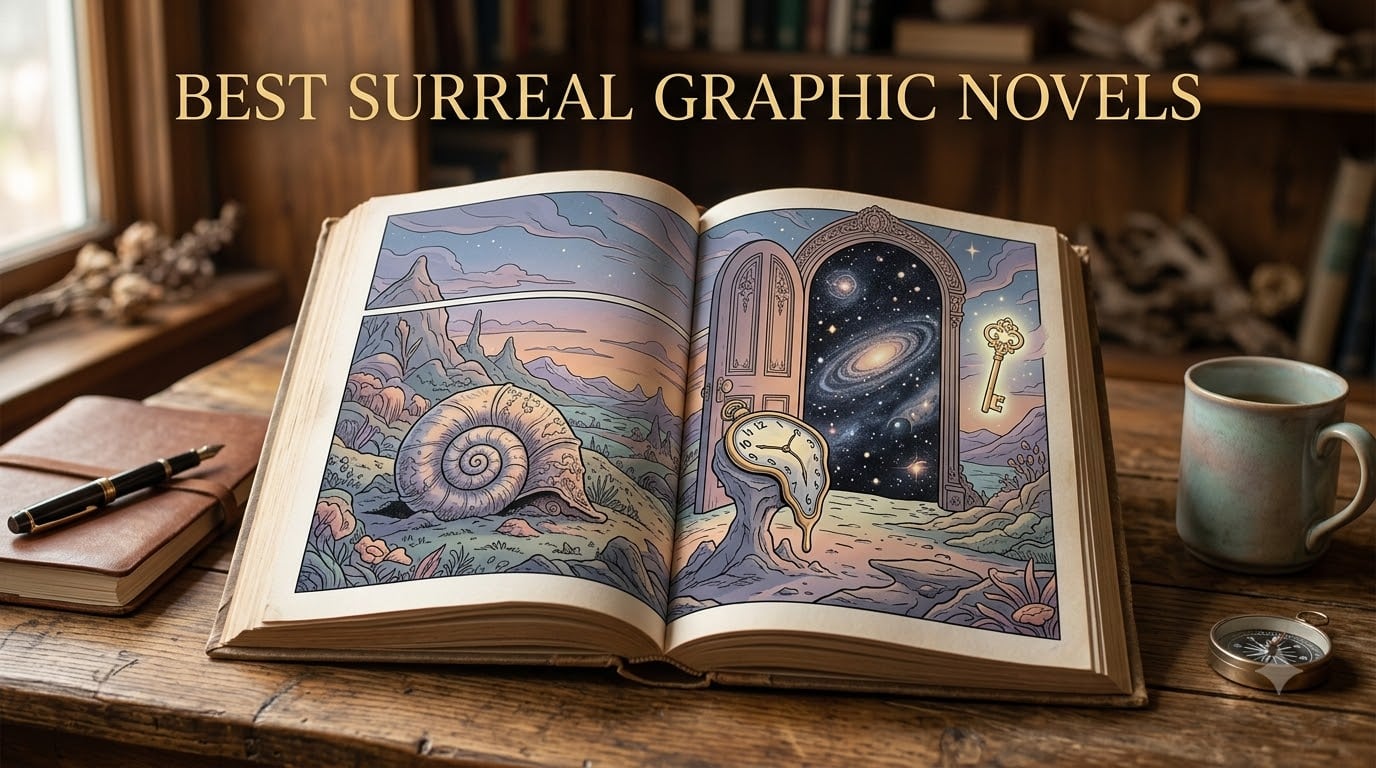
I still remember the first time I cracked open a copy of Grant Morrison’s The Invisibles. Within three pages, I had no idea what was happening, where the story was going, or which reality I was standing in. By the end of the chapter, I was hooked for life. That disorienting wonder is exactly what the best surreal graphic novels deliver: a reading experience that pulls the rug out from under your expectations.
After months of pulling titles from library shelves, second-hand bins, and Reddit threads, our team has put together a curated guide to the most dreamlike, impossible, and boundary-pushing comics ever published. Whether you are hunting for something trippy, an underground classic, or a manga that bends reality, this list will get you started.
Table of Contents
What Is Surrealism in Graphic Novels?
Surrealism is a literary and artistic movement that began in 1924 with French writer André Breton’s Surrealist Manifesto. It rejects rational thought and embraces the unconscious mind, dreams, and irrational juxtapositions. When this philosophy moves into graphic novels, it takes advantage of the medium’s unique power: the marriage of image and text in a sequence of panels.
Surrealism in graphic novels means the deliberate collapse of logical space and time. A character walks through a doorway and lands in a flooded Victorian parlor. A panel shows a city skyline made of human teeth. Linear narrative gives way to dream logic, and the reader’s job is to feel their way through rather than follow a clean plot thread.
Surrealist comics rely on four signature techniques: non-linear sequencing, impossible imagery, symbolic visual metaphor, and an atmosphere of uncanny wrongness. Pioneers like Winsor McCay (Little Nemo in Slumberland) planted the seeds in 1905, but the modern surreal comic took shape in underground comix of the 1970s and exploded through creators like Grant Morrison, Brendan McCarthy, and Peter Milligan.
Surreal vs. Psychedelic vs. Weird: Key Differences
On Reddit’s r/comicbooks and r/WeirdLit, the same confusion pops up again and again. People use “surreal,” “psychedelic,” and “weird” as if they mean the same thing. They do not.
Surreal work explores the unconscious mind. It feels like a dream you cannot quite shake. Psychedelic comics, by contrast, are designed to replicate the visual experience of altered perception: kaleidoscopic color, repeated patterns, optical distortion. Weird comics share surrealism’s strangeness but lean into body horror, cosmic dread, and the grotesque.
The lines blur, and that is part of the fun. Uzumaki by Junji Ito reads as both surreal and weird. Saga of the Swamp Thing by Alan Moore feels psychedelic and surreal in equal measure. Knowing the difference helps you choose the right read for the mood you want.
Best Indie and Alternative Surreal Graphic Novels
Independent publishers have long been the engine driving surreal comics forward. Without the constraints of mainstream cape-and-cowl publishing, indie creators can experiment with form, narrative, and image in ways that bigger houses rarely greenlight. The titles below are where most surreal comic fans begin their collections.
1. Beautiful Darkness by Fabien Vehlmann and Kerascoët
A children’s book illustrator and his fairy-tale woodland creatures. Everything is cute and pastel until the creatures discover the dead girl beneath the floorboards. From there, the story spirals into a haunting meditation on grief and the masks people wear to survive. The art stays bright even when the subject matter gets devastating.
2. Nijigahara Holograph by Inio Asano
A rural Japanese community. A dried-up reservoir that hides a dark secret. Past trauma bleeds into present violence across two timelines. Asano’s brushwork keeps shifting between innocent childhood scenes and grotesque horrors, which is what gives the book its haunting effect.
3. Black Hole by Charles Burns
A suburban teen plague turns teenagers into grotesque, sexually transmitted mutants. Burns draws every panel in his signature high-contrast black-and-white, giving the story a 1950s horror-movie feel. The fear is real, but the imagery is what makes the book unforgettable: blossoms, frogs, oozing wounds, all rendered with obsessive detail.
4. The Arrival by Shaun Tan
No text, only pictures. A father emigrates to a strange new land where the alphabet is unrecognizable, the animals are fantastical, and every encounter requires an act of imagination. Tan uses surreal visual metaphor to capture the universal immigrant experience of arriving in a place that does not make sense yet.
5. Patience by Daniel Clowes
A widower discovers a serum that lets him travel back in time. The catch: every trip reshuffles his present in tragic new ways. Clowes uses sequential art like no one else, building dread in single panels that reveal nothing at first and everything on second read.
Classic Surreal Comics from Legendary Creators
When readers on r/comicbooks are asked which surreal comics they recommend, the same names always surface. Grant Morrison and Brendan McCarthy are the most cited creators on the topic. Alan Moore shows up just below them, blending psychedelic elements with deeper surrealist tradition. These are the foundational works no surreal comics fan should skip.
1. The Invisibles by Grant Morrison
A ragtag group of anarchists fights a hidden war against extradimensional forces controlling human civilization. Morrison called this series “a magic spell” and designed each issue to disrupt the reader’s expectations. Lord Fanny, King Mob, Boy, and John Flood become Virgilian guides through the chaos. Read it in trade paperback form. This is the most influential surreal comic of the past 30 years.
2. Flex Mentallo by Grant Morrison and Frank Quitely
Four friends invent a musclebound superhero who gets his power from sniffing solvents. Decades later, a deranged amnesiac wanders a decaying seaside town, trying to remember who Flex Mentallo was and what happened to him. Quitely’s distorted artwork makes every page feel like a hallucination.
3. Bug! The Adventures of Forager by Mike Allred and others
Grant Morrison’s reimagining of Jack Kirby’s Fourth World through a psychedelic, Morrison-approved lens. Dreamy colors, experimental layouts, and a hero who floats through dimensions on a quest for belonging.
4. Watchmen by Alan Moore and Dave Gibbons
More often classified as deconstructive superhero work, Watchmen also delivers major surrealist payload. The chapter set on Mars is pure metaphysics rendered in comic form. Dr. Manhattan’s scenes bend time and perception until the reader feels like they are looking at reality through broken glass.
5. V for Vendetta by Alan Moore and David Lloyd
A masked anarchist wages psychological war against a totalitarian British government in a dystopian future. Lloyd’s art style, with its mix of noir shadow, symbolist flourishes, and dreamlike sequences, pushes the book well past political thriller into something stranger and more poetic.
Must-Read Surreal Manga
Japanese surreal manga deserves its own section because the tradition runs deep and stylistically distinct from Western surreal comics. NYPL librarian collections routinely feature these titles as the gateway reading for new surreal manga fans.
1. Uzumaki by Junji Ito
A coastal town becomes obsessed with spirals. Shells, whirlpools, hair, tornadoes, the body itself. People mutate, merge, and twist into shapes that follow the spiral pattern. Ito’s obsession with one repeating form makes Uzumaki one of the most purely weird and surreal graphic novels ever published.
2. Blame! by Tsutomu Nihei
Megastructure city. Endless vertical steel. A lone wanderer named Killy hunts down genetic criminals called silicon lifeforms. There is barely any dialogue. The book is almost entirely mood and architecture rendered at impossible scale. It’s the closest a comic has come to rendering cosmic horror as visual experience.
3. Dorohedoro by Q Hayashida
A sorcerer in a chaotic, dust-covered city called The Hole is cursed by a stranger’s blue smoke: he cannot remember who hexed him, and every now and then he grows a new lizard head. Friends who are bird people, cross-dressing sorcerers, and a massive, surreal cast populate one of the most original manga series of the 2000s.
4. The Drifting Classroom by Kazuo Umezu
A Japanese elementary school is transported into a post-apocalyptic wasteland. Children and teachers must navigate earthquakes, time warps, and bizarre survival scenarios while parents back home age in real time. Umezu is one of the founders of modern horror manga, and this 1970s classic still reads as fresh.
Surreal Mystery Graphic Novels to Solve the Reading Slump
Surreal mystery is one of the most underrated sub-categories in graphic novels. A detective story already destabilizes the reader by withholding information. Add dream logic and impossible imagery, and you get something that genuinely feels new. Many readers report that surreal mysteries ended their reading slumps, when nothing else could.
1. Locke & Key by Joe Hill and Gabriel Rodriguez
A family moves into a haunted New England mansion after a brutal tragedy. The house holds magical keys that unlock impossible doors: one turns anyone into a ghost, one opens your head and lets you remove your own memories, one opens a doorway inside your mind. The supernatural mystery escalates steadily and resolves with the kind of clarity surreal narratives usually avoid.
2. Sea of Rust by C. Robert Cargill
A post-apocalyptic world run entirely by warring robot factions. The human species is extinct. Our protagonist is a scavenger robot named Brittle piecing together what happened. Cargill layers noir detective tropes on top of robot existentialism, and the result feels like Blade Runner rendered as graphic novel.
3. Daytripper by Fábio Moon and Gabriel Bá
Each chapter explores a different possible day in the life of Brazilian writer Brás de Oliva Domingos. Every chapter ends with his death. Some deaths are tragic, some absurd, some quiet. The book asks: what is a life, if every moment is both random and meaningful? The art shifts style as Brás ages, mirroring a surrealist’s playful relationship with form.
How Artists Create Surreal Effects on the Page
The best surreal graphic novels would not work in any other medium. Comics uniquely combine three tools to break your grip on reality.
First, panel composition itself. A surrealist artist can break the grid: panels tilted at angles, panels overlapping, panels shaped like the objects they contain, and wordless splash pages that force you to inhabit the image before reading. Daniel Clowes does this. Shaun Tan does it without text at all.
Second, color and texture. Acid greens, decaying yellows, and impossible contrasts signal something is wrong. Brendan McCady’s Paradox Oyster uses watercolors so washed out you feel like you are reading through fog. Charles Burns sticks to black ink and uses negative space as a weapon.
Third, the gutted caption. A surrealist narrator might say, “There was no way to know what time it was, because clocks had stopped working three days ago.” That kind of statement plants a small impossibility in your mind and lets it grow. The Arrival communicates entire backstories with a single floating question mark.
Sequential surrealism depends on rhythm too. A panel of pure stillness, then a panel of total chaos, then a return to stillness. The way panels sequence becomes the surrealist music of the page.
How to Choose the Right Surreal Graphic Novel for You
Surreal graphic novels span a massive range in length, intensity, and difficulty. Choosing the right one matters more than for most genres, because a poorly matched reader can bounce off something excellent.
Match Mood, Not Subject
If you want creepy unease, start with Uzumaki or Black Hole. If you want philosophical wonder, start with The Invisibles, Daytripper, or The Arrival. If you want pure visual delight and architecture porn, Blame! is unmatched. Start by asking what feeling you want, not what plot summary appeals.
Check the Difficulty Rating
Titles vary wildly in how hard they hit newcomers. We rate surreal graphic novels on three accessibility tiers.
Easy (start here): The Arrival, Daytripper, Uzumaki, Beautiful Darkness. These give you vivid entry points without asking you to surrender too much plot sense.
Medium: Black Hole, Locke & Key, Persistence of Memory, Dorohedoro. These ask for patience and a willingness to sit with uncomfortable imagery.
Advanced: The Invisibles, Flex Mentallo, Blame!, Nijigahara Holograph. These demand full attention and reward repeat reads above all.
Consider Format and Length
Some readers want a one-shot comic to finish in an evening. Others want a 1,000-page saga. The Arrival is a single hardcover. The Invisibles is a 1,200-page commitment. Decide how much shelf time you want before falling in love with an epic.
Trust Curator Recommendations
Surreal comics get more out of trusted recommendations than almost any other genre. Reddit threads in r/comicbooks, NYPL staff lists, and Goodreads lists like “Surreal Comics with Tinges of Horror and Humour” are gold mines for finding hidden gems specific curators love. Don’t pick at random: ask communities what they recommend.
Frequently Asked Questions
What is the most beautiful graphic novel?
The most beautiful graphic novel is often listed as Shaun Tan’s The Arrival, a wordless hardcover built around surreal visuals that capture the wonder of migration. For artists who love ornate imagery, Daniel Clowes’ Patience and Charles Burns’ Black Hole also receive consistent recommendations from collectors and librarians alike.
What are some good books about Surrealism?
Start with the foundational surrealist comic works: The Invisibles by Grant Morrison, Flex Mentallo by Morrison and Quitely, and Alan Moore’s Watchmen and V for Vendetta. Add indie classics like The Arrival by Shaun Tan, Beautiful Darkness by Vehlmann and Kerascoët, and Black Hole by Charles Burns. For surreal manga, Uzumaki by Junji Ito and Blame! by Tsutomu Nihei are unbeatable entry points.
What are some of the best weird graphic novels?
Top weird graphic novels include Uzumaki by Junji Ito (spiral horror in rural Japan), Black Hole by Charles Burns (teen plague as body horror), Nijigahara Holograph by Inio Asano (rural trauma across timelines), and Dorohedoro by Q Hayashida (a chaotic sorcerer metropolis). For Western weird, dive into Peter Milligan and Brendan McCarthy’s run on The Filth or Shane Booker’s Curb Stomp.
What makes a graphic novel surreal?
A graphic novel is surreal when it uses dream logic, impossible imagery, and unconscious symbolism to break rational sequencing. Common markers are non-linear timelines, panels that break the grid, impossible color choices, and metaphors rendered literally on the page (a clock melting in the sky, a doorway that opens onto a memory). Visual experimentation is the medium’s biggest surreal asset, since image and text can be aligned against each other in ways prose cannot match.
Where should I start with surreal comics?
Start with one of these four beginner-friendly titles: The Arrival by Shaun Tan (wordless, beautiful, easy to finish in one sitting), Daytripper by Fábio Moon and Gabriel Bá (warm, philosophical, comic in feel), Uzumaki by Junji Ito (intense but short, pure mood), or Beautiful Darkness by Vehlmann and Kerascoët (fairy tale surface, dark depths). All four ease newcomers into surrealism without giving up the strangeness that defines the genre.
Final Thoughts on Building a Surreal Collection
The best surreal graphic novels share a single quality: they refuse to let the reader stay comfortably outside the story. Every page invites you into a world where the rules keep shifting, and the only reliable compass is your own emotional response. That is why this list spans classics, manga, indie zines, and mystery crossovers, because surrealism never stayed in one lane, and readers who love it tend to crave variety.
Begin with whatever pull calls to you from the picks above. Finish one. Sit with the feeling. Then pick another. Our team has revisited The Invisibles every couple of years since we first read it, and each time we notice a new image we missed, a thread that ties together differently. The best surreal graphic novels reward rereading the way dreams sometimes make more sense years later. Keep an open shelf, take a few risks, and let the spiral pull you in.