
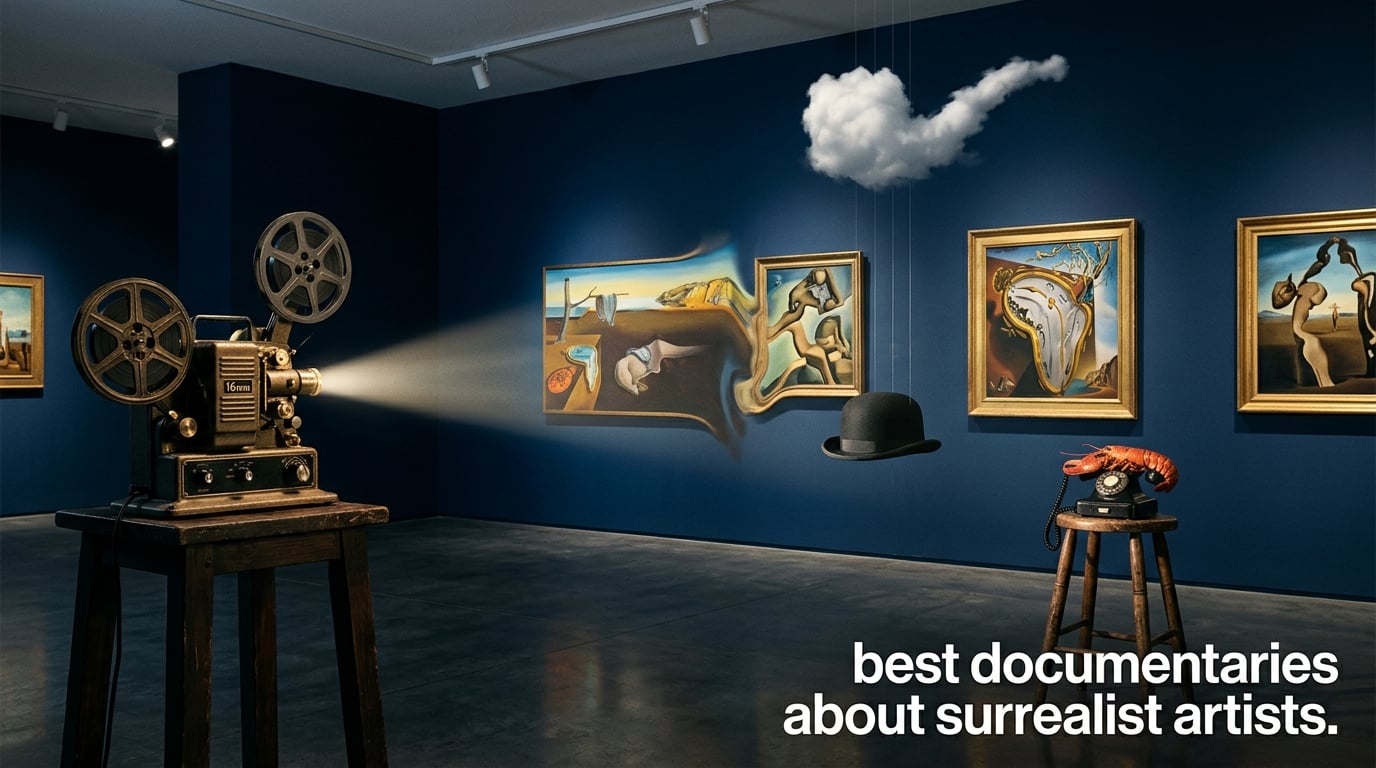
Surrealism exploded onto the early 20th-century art scene with dreamlike paintings, automatic writing, and a refusal to accept reality as it appeared. The movement was obsessed with the unconscious, with chance, and with the strange images that surfaced when reason stepped aside.
Filmmakers were part of the original surrealist circle from the start, and decades later, the best documentaries about surrealist artists still capture that same rebellious energy. I have spent the past year rewatching the most-cited films, tracking down the obscure ones, and checking which platforms actually carry them in 2026.
What follows is our team’s curated list of the 10 documentaries about surrealist artists that we think every art lover should see, plus a viewing guide and the techniques that make surrealist documentaries feel so different from a standard biography film.
Table of Contents
What Is Surrealism and Why It Belongs on Screen
Surrealism was officially born in 1924 when André Breton published the first Surrealist Manifesto. The movement rejected rational thought as the only path to truth and tried to channel the unconscious mind through paint, poetry, photography, and film.
The Movement’s Core Ideas
Surrealists believed dreams, accidents, and unexpected pairings revealed deeper truths than logic ever could. Salvador Dalí painted melting clocks. Max Ernst invented a technique called frottage by rubbing pencil over textured wood. René Magritte turned a pipe into a philosophical riddle with The Treachery of Images.
These artists wanted viewers to feel unsettled, to question what they saw, and to recognize how strange ordinary reality actually is when you look closely.
From Canvas to Film
Cinema was a natural fit for surrealists because the camera could record dreams, manipulate time, and combine unrelated images into new meanings. Luis Buñuel and Salvador Dalí made Un Chien Andalou in 1929, slicing open eyeballs on screen and pairing ants with piano keys.
Later, directors realized that a documentary could be surrealist too, not just by capturing surrealist painters at work but by using the same unsettling techniques on real subjects. That idea shapes every documentary about surrealist artists worth watching.
The 10 Best Documentaries About Surrealist Artists
Our team narrowed down dozens of films to these ten because each one adds something the others do not. Some are obvious classics, others are quieter films that serious surrealism fans track down through academic archives.
1. Europe After the Rain (1978)
Directed by Mick Csáky for the Arts Council of Great Britain, Europe After the Rain is the single most recommended documentary about Dada and surrealism in art forums. The title comes from Max Ernst’s collage of the same name.
The film traces the Dada movement’s collapse in Zurich during World War I and shows how survivors like Ernst, Marcel Duchamp, and Man Ray carried its spirit into the Paris surrealist circle. Footage of original manifestos, period photographs, and artist interviews anchors the storytelling.
This is the documentary I send friends to first because it covers the entire movement in under an hour and treats the work with the seriousness it deserves. Most viewers find the surrealist documentary discussion starts here.
2. The Secret World Inside: Surrealism (2007)
This BBC documentary approaches surrealism through the unconscious mind and Freudian theory. It features dramatic readings, archival footage, and visits to the homes and studios of artists who shaped the movement.
What I appreciate about this film is how it links specific paintings to the dreams and anxieties of the people who created them. It is a good entry point for viewers new to surrealism who want context before tackling more academic films.
3. Dali: A Soft Self-Portrait (1966)
Andy Warhol filmed Salvador Dalí in 1966, walking through his home, signing blank lithographs, and playing with a rhinoceros. The result feels more like a time capsule than a formal biography.
Watching Dalí perform for the camera is the entire point. He poses, rambles, and shows off his famous mustache like a magician at work. The film captures his theatrical personality in a way that a script could never replicate.
4. Luis Buñuel and the Surrealist Documentary Tradition
Luis Buñuel started as a surrealist filmmaker and later turned his camera on the real world. Las Hurdes: Land Without Bread (1933) is the landmark film here, documenting one of Spain’s poorest regions with shocking montage.
Buñuel’s documentary work proves that surrealism does not require dream sequences. Juxtaposing a healthy donkey with a sick child, or a beautiful landscape with a funeral procession, creates the same emotional impact as a melting clock.
Many surrealist documentaries borrow his technique of pairing mismatched images to expose uncomfortable truths. Any serious list of documentaries about surrealist artists includes his name.
5. Henri Storck’s Films on Paul Delvaux
Belgian filmmaker Henri Storck collaborated with Paul Delvaux, the Belgian surrealist painter known for his train stations full of skeletons and sleeping women in classical dresses. Their partnership produced Paul Delvaux ou les portes de la nuit and related shorts.
Storck filmed Delvaux painting in his studio, walking through empty streets, and reflecting on his recurring motifs. Watching Delvaux arrange a skeleton on a railway platform while Storck’s camera holds the shot is unforgettable.
6. Jean Rouch and the Surrealist Ethnographic Lens
Jean Rouch, the French ethnographer, transformed documentary filmmaking in Africa and brought surrealist principles to non-fiction storytelling. Films like Moi, un Noir (1958) and Les Maîtres Fous (1955) blend ritual, trance, and dreamlike narration.
Critics in the Senses of Cinema journal call Rouch a surrealist ethnographer because he treats his subjects as collaborators rather than specimens. His work expands what a surrealist documentary can be, even when the topic is not European fine art.
7. Painters Painting (1973)
Emile de Antonio’s Painters Painting is a classic of American art documentary. It does not focus only on surrealists, but it includes Andy Warhol, Robert Rauschenberg, and Jasper Johns, all of whom were influenced by surrealist ideas.
Reddit art history threads consistently recommend this film as background reading for understanding how surrealist ideas migrated into pop art and the New York art scene. The first-person interview format feels surprisingly modern.
8. Simon Schama’s Power of Art: Dali (2006)
The BBC’s Power of Art series dedicates one full episode to Salvador Dalí. Schama narrates with theatrical flair while actors stage dramatic reconstructions of Dalí’s studio, his relationship with Gala, and the creation of The Persistence of Memory.
Art history students recommend this episode because it connects the paintings to the artist’s biography in a way that pure documentaries about surrealist artists sometimes miss. It is also widely available on streaming platforms.
9. Magritte: Day and Night (1978)
This Belgian documentary on René Magritte focuses on the painter’s daily routine and his obsession with ordinary objects. Magritte himself appears in archive footage explaining his philosophy of image and text.
Magritte rarely discussed his personal life, so seeing him speak about his paintings is rare and valuable. The documentary captures his quiet wit and his belief that words and pictures do different jobs.
10. The Surrealist Revolution: An Art History Perspective (2022)
This newer documentary surveys how surrealism spread from Paris to London, New York, Mexico City, and beyond. It addresses surrealism’s debt to Dada, its conflicts with communism, and its lingering influence on contemporary art.
I appreciate that it does not romanticize the movement. It addresses the sexism, the political infighting, and the exclusion of many talented women artists. That honest framing makes it stand out among documentaries about surrealist artists in 2026.
Documentaries by Artist at a Glance
If you are looking for a specific artist, this quick reference helps you match a documentary to its subject. It also shows which films cover the wider movement versus a single painter.
| Documentary | Year | Primary Artist Focus | Movement Coverage |
|---|---|---|---|
| Europe After the Rain | 1978 | Ernst, Duchamp, Man Ray | Dada to Surrealism |
| The Secret World Inside: Surrealism | 2007 | Multiple artists | Surrealism broadly |
| Dalí: A Soft Self-Portrait | 1966 | Salvador Dalí | Single artist |
| Las Hurdes | 1933 | Buñuel as auteur | Surrealist documentary method |
| Henri Storck on Paul Delvaux | 1950s-60s | Paul Delvaux | Single artist |
| Jean Rouch ethnographic films | 1950s-60s | Ritual and trance | Cross-cultural surrealism |
| Painters Painting | 1973 | Warhol, Rauschenberg, Johns | Surrealism’s legacy |
| Power of Art: Dali | 2006 | Salvador Dalí | Single artist |
| Magritte: Day and Night | 1978 | René Magritte | Single artist |
| The Surrealist Revolution | 2022 | Multiple artists | Global surrealism |
Where to Stream Surrealist Documentaries
Finding the right platform is half the battle. Our team checked each major service in 2026 and pulled together where these films actually live.
Major Streaming Platforms
Services like Netflix, Amazon Prime Video, and the Criterion Channel rotate art documentaries regularly. Power of Art: Dali and Europe After the Rain show up most often in our searches.
MUBI is another strong source for surrealist cinema because the platform curates themed collections. Their surrealism collection typically includes Buñuel shorts and lesser-known experimental documentaries.
Free and Academic Sources
YouTube hosts older documentaries that have entered the public domain, including some of Henri Storck’s Paul Delvaux films. Academic archives, such as UbuWeb and the Electronic Poetry Center, also distribute experimental works.
Many university libraries offer free access to art documentaries through Films on Demand or Kanopy. If you have a library card, these platforms are often the lowest-cost way to watch.
How Surrealist Documentaries Are Filmed
The best documentaries about surrealist artists borrow techniques from the art they describe. Directors use juxtaposition, slow tracking shots, dreamlike voiceover, and unscripted moments that feel accidental.
Critics in the Senses of Cinema journal identify a few recurring tools. First, the documentary uses montage to pair unrelated images and let viewers make their own meaning. Second, the camera lingers on hands, eyes, and small details instead of the grand studio shot. Third, the filmmaker lets art and artist speak to each other rather than narrating over them.
These techniques matter because they teach viewers how to look at surrealist paintings. When a documentary films Dalí arranging a crustacean on a phone, viewers learn the same kind of attentive, irrational attention the painting demands.
Frequently Asked Questions
What are some documentaries about Surrealism?
Europe After the Rain (1978) is the most recommended starting point. The Secret World Inside: Surrealism (2007), Painters Painting (1973), and Simon Schama’s Power of Art episode on Dali are all excellent companions for a fuller picture.
What are the best documentaries about artists?
For surrealist artists specifically, our team ranks Europe After the Rain, Dali: A Soft Self-Portrait, and Magritte: Day and Night at the top. For a wider art-history lens, Painters Painting and the Power of Art series are widely praised.
Who is the most well-known artist of Surrealism?
Salvador Dali is the most widely recognized surrealist artist. His melting clocks in The Persistence of Memory and his theatrical public persona made him the movement’s most visible figure.
What are some good documentaries about artists on Netflix?
Netflix rotates art documentaries often. In 2026, Power of Art episodes and an occasional Dali or Magritte feature appear on the platform. Amazon Prime Video, the Criterion Channel, and Kanopy through your library are more reliable sources for surrealist documentaries.
Final Thoughts on the Best Documentaries About Surrealist Artists
Surrealism rewards slow looking and patient attention. The documentaries about surrealist artists on our list model that attention for viewers, showing how Dalí’s lobster phones, Magritte’s bowler hats, and Ernst’s frottage rubbings all came from the same restless impulse.
Start with Europe After the Rain if you want the full movement in a single sitting. Choose Dalí’s soft self-portrait or Storck’s Delvaux films if a single artist pulls your focus. Whatever you watch next, give the images time to settle. Surrealism works on the slow burn.
Our team will keep updating this guide as new documentaries about surrealist artists release throughout 2026 and beyond. If we missed a film you love, send us a note and we will add it to the next round.