
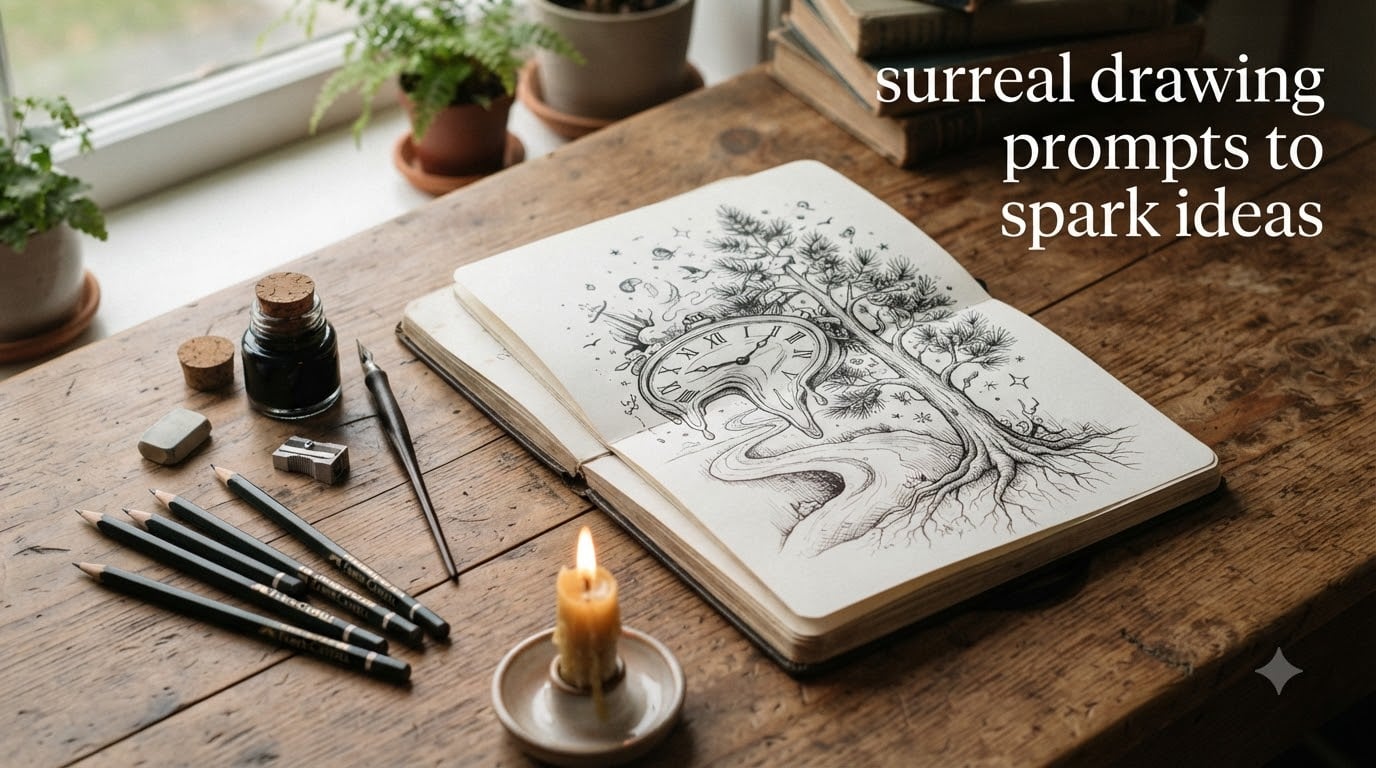
Staring at a blank page is the part of art that hurts most. The cure is a good surreal drawing prompts to spark ideas list — a single weird image that breaks your brain out of its default settings and pulls something impossible onto the paper. I have been collecting and testing surrealist drawing prompts for years, and the ones below are the ones that actually get the pencil moving.
If you only have five minutes, scroll to the numbered list and grab the first prompt that catches your eye. If you want the full method, keep reading: I will walk you through surrealism itself, six surrealist techniques, a combinatorial formula for inventing your own prompts, and a 30-day surreal drawing challenge you can start tonight.
Here are ten surreal drawing prompts to spark ideas right now. Pick one and time yourself for twenty minutes — that constraint is half the magic.
- A clock melting into the trunk of a pine tree. Try it in ink — the contrast between hard lines and soft bleeds is everything.
- An open book growing actual roots that crawl across the floor. Pencil, then a wash of watercolor on the roots only.
- A Victorian sitting room where the chandelier is made of jellyfish. Graphite on cold-press paper for soft shadows.
- A child holding a balloon shaped like a locked door. Charcoal — let the door melt.
- A forest in which every leaf is a small human eye. Colored pencil. Tiny pupils, big patience.
- A fish swimming through a desert, leaving a wet trail that sprouts flowers. Ink and white gel pen.
- An attic full of windows, none of which look outside. Soft graphite — lean into the gloom.
- A man whose shadow has stepped out of him and is walking ahead. Bold black ink, no hesitation lines.
- A train made of bread rolls steaming out of an oven tunnel. Watercolor. The steam is the whole joke.
- A staircase that climbs into the back of a standing deer. Pencil and ink — see what the deer does with it.
Any one of those is a complete surreal drawing prompt. The rest of this guide is how to make dozens more, deepen them, and turn them into a habit.
Table of Contents
What Is Surrealism? (And Why It Beats Blank-Page Anxiety)
Surrealism is a twentieth-century literary and artistic movement that uses dreamlike imagery, unexpected juxtapositions, and subconscious exploration to free the mind from rational thought. Andre Breton founded the movement in 1924 with his Manifesto of Surrealism, declaring the aim to resolve the previously contradictory conditions of dream and reality into an absolute reality.
In plain terms: surrealism is art that follows the logic of dreams instead of the logic of waking life. Salvador Dali painted watches that droop over cliffs. Rene Magritte painted men whose faces are apples. Max Ernst pressed paper against wood grain and called the rubbings art. None of it makes sense — that is the point.
The reason surreal drawing prompts are better than generic ones for breaking creative block is simple. Your conscious mind has already catalogued every literal scene it can think of. The instant a prompt introduces something impossible — a fish in a desert, a balloon shaped like a door — your brain has to make new connections on the fly, and that is exactly where fresh drawing ideas live. I lean on surrealist drawing prompts whenever my sketchbook starts feeling safe.
The 7 Characteristics of Surrealist Art
Surrealist art almost always carries at least a few of these traits. Use them as a checklist when you evaluate your own surreal drawing prompts later:
- Dreamlike — feels like it could only happen while sleeping.
- Unexpected juxtaposition — two unrelated objects placed together so the meaning is yours to invent.
- Subconscious — references personal symbols, fears, or memories you did not plan to include.
- Symbolic — every object suggests something beyond itself.
- Absurd — funny, illogical, or quietly unsettling.
- Metaphorical — stands in for an emotion or idea the title does not name.
- Autobiographical — even a strange scene reveals the maker once you look closely.
Surrealism is also a descendant of Dadaism, the anti-art movement that came out of World War One and rejected logic entirely. Many surrealist games — including the Exquisite Corpse, which I cover below — started as Dadaist games before the surrealists adopted them.
10 Surreal Drawing Prompts to Spark Ideas Right Now
I just gave you ten. Here is the second batch, organized for variety: still life, landscape, figure, and pure absurdity. These surrealist drawing prompts are designed for a single session of thirty minutes or less.
- A typewriter that types out butterflies instead of letters. Best in ink. Let a few butterflies escape off the page.
- A bowl of fruit where one of the apples is whispering. Colored pencil. Tiny mouth, huge shadows.
- An empty swimming pool with the ocean at the bottom. Watercolor. The tiles should still be there.
- A train station where every clock reads the same minute. Graphite, plus a single red dot somewhere.
- A door that opens onto itself. Pen. You can suggest an entire infinite hallway with three lines.
- A woman holding a mirror that reflects a different person. Soft charcoal.
- A field of daisies, each one blooming with a small fire. Ink and a single warm wash of yellow.
- A library where all the books are blank except one. Pencil, heavy crosshatch on the spines.
- A piano that grows like a tree from a swamp. Charcoal — let the keys become roots.
- A moon landing, but the moon is an eye. Ink. Make the eye blink somehow.
Twenty prompts in and you have already got weeks of surreal sketchbook ideas. Keep reading for category-specific prompts, the artist-inspired lists, and the techniques that make surreal art actually look surreal.
Surreal Landscape Drawing Prompts — Dali-Inspired Worlds
Landscapes are the easiest surreal drawing prompts to start with because you already know how to draw trees, water, and sky. The surrealism happens when you make one element refuse to behave. Salvador Dali was the master of this — the long flat horizon of Port Lligat gave every melting, levitating, multiplying object a stage to perform on.
Try these surreal landscape drawing ideas in a single-page sketchbook spread so the whole scene stays in one frame:
- A tree growing upside down from the sky with its roots fanning into clouds.
- A desert where each dune is a sleeping animal.
- A waterfall made of fabric instead of water.
- A mountain range where every peak is a face in profile.
- A lake so still it reflects a sky that is not the sky above it.
- A horizon line made of piano keys stretching to infinity.
- A wheat field where each stalk ends in a small lit candle.
- A canyon with a Victorian living room tucked into one wall.
- A river that flows up into a low cloud instead of down to the sea.
- A coastline where the waves are made of old letters.
- A road that disappears into the back of a standing elephant.
- A cave mouth opening onto a sunlit library interior.
Dali-leaning surreal landscape drawing prompts work best when you commit to one impossible swap and let everything else be believable. The eye needs an anchor before it accepts the strange.
Surreal Portrait and Figure Prompts — Magritte-Inspired Faces
Figures and faces are where surrealist portrait ideas get unsettling. Rene Magritte spent decades hiding faces behind apples, cloth, doves, and bubbles — turning the human body into a question instead of an answer. These surreal portrait ideas borrow that trick: cover the expected, reveal the weird.
- A man in a bowler hat whose face is a single large egg.
- A portrait where the subject is reflected in a mirror but the mirror reflects someone else.
- A woman whose hair is a flock of small birds lifting off her head.
- A child holding a mirror that shows an old woman instead of their own face.
- A portrait painter painting themselves painting themselves.
- A figure whose body is a window onto a city street.
- A man wearing a suit made entirely of green leaves.
- A woman whose hands have been replaced by two doves.
- A portrait where only the eyes are drawn — everything else is a flat painted background.
- A pair of figures, one wax and one flame, sharing one silhouette.
- A man walking through fog that is also the body of a sleeping giant.
- A child whose shadow is much older than the child is.
Magritte himself often said his paintings were not portraits of people but portraits of ideas. When you draw these surreal portrait ideas, ask yourself what idea you are drawing the picture of.
Surreal Object Prompts — Ernst-Inspired Still Lifes
Max Ernst invented two of the most useful surrealist techniques — frottage and decollage — specifically to get strange imagery out of ordinary objects. Treat these surreal object ideas the same way: pick three unrelated objects, place them in conversation, and let the drawing explain their relationship.
- A grandfather clock with a beehive inside the glass.
- A violin whose strings are thin rivers.
- A teacup from which a small ship is sailing.
- A pair of glasses through which a different world is visible.
- A shoe sprouting a small pine tree from the toe.
- A lantern casting a shadow of a completely different object.
- A sewing machine on a surgeon’s table.
- A key whose teeth are small human teeth.
- A typewriter with a finger still typing after the typist is gone.
- A compass pointing at a memory instead of north.
When you draw Ernst-style surreal object ideas, do not over-explain them. The less context you give the viewer, the more they will bring to the picture.
Dark and Whimsical Surreal Prompts for When You Want Edge
Most surreal drawing prompt lists lean whimsical. That is a missed opportunity — surrealism has a long dark vein, from Goya through Ernst’s “Europe After the Rain” to Leonora Carrington. Here are eight dark surreal drawing prompts and eight whimsical ones, paired so you can pick the mood that fits the day.
Dark Surreal Drawing Prompts
- A wedding cake with a small door at the base and nothing coming out.
- A child’s birthday party where every balloon contains a single tooth.
- A house plant that grows a single perfect hand from the soil.
- A mirror that reflects the room exactly one minute earlier.
- A dinner table set for a family whose chairs are empty except one full plate.
- A tooth fairy that collects something other than teeth.
- A nurse’s station in a hospital where the patients are all the doctor.
- A graveyard where every headstone is a keyhole.
Whimsical Surreal Drawing Prompts
- A giraffe whose spots are tiny windows into other rooms.
- A rain cloud that drops letters instead of water.
- A musician whose instrument is a small sleeping cat.
- A mailbox with a red door in it.
- A bookshelf with one volume labeled “Don’t Read Me.”
- A turtle whose shell is a small wooden cottage.
- A chess game where the pieces have begun playing themselves.
- A gardener planting tiny stars instead of seeds.
The Reddit r/surrealism community tends to respond more strongly to the dark side, in my experience, while whimsical surreal drawing prompts travel further on art journal pages. Both are valid — choose by mood.
Surrealist Techniques to Try When Drawing These Prompts
A prompt is just a starting point. The technique you draw with decides whether the result feels like a sketch or like a real piece of surrealist art. These six surrealist techniques are the ones I reach for most often.
1. Automatic Drawing
Automatic drawing — invented by Andre Masson and adopted by Dali — is drawing without consciously directing the hand. Let the pencil move before the image in your head is clear. Stop trying to make it look like anything for the first five minutes; afterwards, choose the most interesting shape that emerged and develop it.
2. Exquisite Corpse
The Exquisite Corpse is a folding-paper game invented by the Surrealists in 1925. Each artist draws a section without seeing the others, then unfolds the page. It works for one person, too: fold a sheet into thirds, draw the head on the top third without thinking, fold it over, draw the torso, fold again, draw the legs, and unfold.
3. Frottage
Max Ernst invented frottage — placing paper over a textured surface (wood grain, leaves, lace) and rubbing with a soft pencil. What appears is half real, half invented. Use it as the background layer under one of the surreal object prompts above.
4. Decollage
Decollage is the opposite of collage. Instead of gluing things onto a surface, you tear or cut away layers to reveal what is underneath. A quick version for beginners: take an old magazine page, tear away a shape, and draw the surreal drawing prompt into the revealed negative space.
5. Collage
Classical surrealist collage — Ernst, Hannah Hoch, the Paris group — mixed Victorian engravings with unrelated imagery. You can do the same today with photocopied images or old books from a thrift store. Pair an engraving of a hand with a photo of clouds and let your surreal drawing prompts to spark ideas do the rest.
6. Photomontage
Photomontage assembles cut photographs into a single impossible image. For analog drawing, treat it as a compositional reference: gather three or four unrelated photos and draw a new scene that contains them all.
Try combining techniques. Automatic drawing plus an Exquisite Corpse fold produces results I cannot get any other way. Frottage plus a single surreal object prompt can become a finished piece in under an hour.
The Surreal Prompt Formula: Object + Action + Emotion + Location
Once you have a stack of surrealist drawing prompts, you start to see the pattern. Every good one has four ingredients. This is the combinatorial formula that the drawingideaprompts.com generator is built on, and I use it on paper any time I want a fresh surreal drawing idea on demand.
- Object — a thing, ideally ordinary. (Clock, shoe, teacup, key.)
- Action — what it is doing that it cannot do. (Melting, weeping, climbing, singing.)
- Emotion — a feeling the scene should evoke. (Lonely, defiant, playful, mournful.)
- Location — a setting that contrasts with the object. (Forest, kitchen, ocean, library.)
Roll the four together and you have a surreal drawing prompt. A teacup that is weeping in a kitchen that feels lonely. Or a key that is climbing through a defiant forest. Or a clock that is singing in a mournful ocean. None of those sentences existed before you generated them — that is the point. You have moved from zero surreal sketchbook ideas to one in roughly five seconds, and from one to a hundred in an afternoon.
Write the four categories as four columns on a notebook page, then drop a die onto each column to pick. You now have a personal surreal drawing prompts generator that works without electricity.
How to Actually Use These Surreal Drawing Prompts (Without Burning Out)
A long list of surreal drawing prompts to spark ideas only helps if you actually use them. After several years of running a daily surreal sketchbook practice, here are the rules that keep the habit alive.
Pick a Time Limit, Not a Finish Line
Twenty minutes is the sweet spot. Long enough to push past the awkward first few marks, short enough that you cannot waste a whole evening staring at the page.
Match the Prompt to the Medium
Ink suits crisp juxtapositions. Watercolor suits surreal landscape drawing ideas where you want soft bleeding edges. Charcoal is the right call for surreal portrait ideas where shadow does the work. Digital is fine — Procreate and similar apps make surreal object ideas easier to revise. Do not let anyone tell you the medium matters more than the idea.
Sketchbook, Not Final Paper
Use cheap paper for these prompts. The page will be filled with experiments. Save the expensive sketchbook for the rare prompt that lands on the first try.
Keep a Surrealism Prompt Jar
Write each favorite surreal drawing prompt on a slip of paper, drop it into a jar, and pull one out when you are stuck. This is how I start every session when the morning is foggy.
Skip Days on Purpose
Art block usually means the well needs a refill, not that you need to push harder. Walk, look at clouds, read a poem, and the next surreal drawing prompt will arrive on its own.
Share the Weirdest One
Posting the strangest drawing of the week on r/surrealism, r/learnart, or your own social feed does two things: it gives you a deadline and a tiny accountability loop. Reddit users specifically call out how much they love prompts that combine the familiar with the impossible, so lean into the dissonance.
The 30-Day Surreal Drawing Challenge
If a list of surreal drawing prompts to spark ideas is not enough structure, this is. The 30-day surreal drawing challenge gives you one prompt per day, organized into four weekly themes. Each prompt is designed for thirty minutes or less.
Week 1: Familiar Made Strange (Objects)
- Day 1 — A teacup that contains a small sleeping cat.
- Day 2 — A key whose teeth are letters spelling your name.
- Day 3 — A pair of glasses through which a different season is visible.
- Day 4 — A violin whose strings are thin rivers.
- Day 5 — A grandfather clock with a beehive inside.
- Day 6 — A shoe sprouting a pine tree from the toe.
- Day 7 — A lantern casting a shadow of a different object.
Week 2: People in the Wrong Places (Figures)
- Day 8 — A man in a bowler hat whose face is one large egg.
- Day 9 — A woman whose hair is a flock of birds lifting off.
- Day 10 — A child holding a mirror that shows an old woman.
- Day 11 — A figure whose body is a window onto a city.
- Day 12 — A man walking through fog that is also a sleeping giant.
- Day 13 — A pair of figures sharing one silhouette, one wax, one flame.
- Day 14 — A child whose shadow is much older than the child.
Week 3: Worlds That Refuse (Landscapes)
- Day 15 — A tree growing upside down from the sky.
- Day 16 — A waterfall made of fabric.
- Day 17 — A mountain range where every peak is a face in profile.
- Day 18 — A lake reflecting a sky that is not above it.
- Day 19 — A wheat field where each stalk ends in a small lit candle.
- Day 20 — A canyon with a Victorian living room tucked into one wall.
- Day 21 — A coastline where the waves are made of old letters.
Week 4: Edge and Emotion (Dark and Whimsical)
- Day 22 — A wedding cake with a small door at the base.
- Day 23 — A house plant that grows a single perfect hand from the soil.
- Day 24 — A dinner table set for a family whose chairs are empty except one full plate.
- Day 25 — A graveyard where every headstone is a keyhole.
- Day 26 — A giraffe whose spots are tiny windows into other rooms.
- Day 27 — A rain cloud that drops letters instead of water.
- Day 28 — A mailbox with a red door in it.
- Day 29 — A turtle whose shell is a small wooden cottage.
- Day 30 — A gardener planting tiny stars instead of seeds.
Finish the thirty days and you will have a surreal sketchbook thick enough to look back through. That archive is your next source of surreal drawing prompts to spark ideas — the strongest ideas tend to be the ones you almost skipped.
Frequently Asked Questions
What are some good ideas for surreal drawings?
Good surreal drawing prompts mix the familiar with the impossible so the brain has to build a new connection. Try a clock melting into a tree, an open book growing roots, a chandelier made of jellyfish, a fish swimming through a desert leaving a trail of flowers, a man whose shadow has stepped out and is walking ahead, a staircase that climbs into the back of a standing deer, a typewriter that types butterflies instead of letters, a door that opens onto itself, a library where every book is blank except one, and a moon that is actually a giant eye.
What are some cool prompts for drawing?
Cool drawing prompts work best when they include a specific unexpected combination rather than a generic instruction. Use the surreal prompt formula: pick an ordinary Object (clock, shoe, teacup, key), give it an impossible Action (melting, weeping, climbing, singing), pick an Emotion the scene should hold (lonely, defiant, playful, mournful), and place it in a Location that contrasts (forest, kitchen, ocean, library). The collision of the four ingredients is what makes the prompt cool.
What are 6 Surrealist techniques?
The six core surrealist techniques are: (1) Automatic drawing, where you let the hand move without conscious direction; (2) Exquisite Corpse, a folding-paper game where each artist draws a section without seeing the others; (3) Frottage, rubbing pencil over textured surfaces to reveal hidden imagery; (4) Decollage, tearing or cutting away layers to reveal what is underneath; (5) Collage, combining unrelated images into a single composition; and (6) Photomontage, assembling cut photographs into one impossible image.
What are the 7 characteristics of Surrealist art?
The seven characteristics of Surrealist art are: (1) dreamlike imagery that feels like it could only happen while sleeping; (2) unexpected juxtaposition of unrelated objects; (3) subconscious references to personal symbols, fears, or memories; (4) symbolic weight where every object suggests something beyond itself; (5) absurd, illogical, or quietly unsettling tone; (6) metaphorical meaning that stands in for an emotion the title does not name; and (7) autobiographical traces that reveal the maker once you look closely.
Final Thoughts: Pick a Prompt and Start Drawing Tonight
The shortest path through creative block is one specific surreal drawing prompt, one timer set for twenty minutes, and one cheap sketchbook. That is the whole trick. The list of surreal drawing prompts to spark ideas above will keep you drawing for months; the combinatorial formula will keep you supplied with new ones for years.
Tonight, pick the prompt that made you blink when you read it. That little flinch is your unconscious telling you which image wants to be drawn. Trust it, sit down, and start. The art you make from these surreal drawing prompts to spark ideas belongs to you and to no one else, and the sketchbook you fill in 2026 will be the most honest record of how your imagination works right now.