
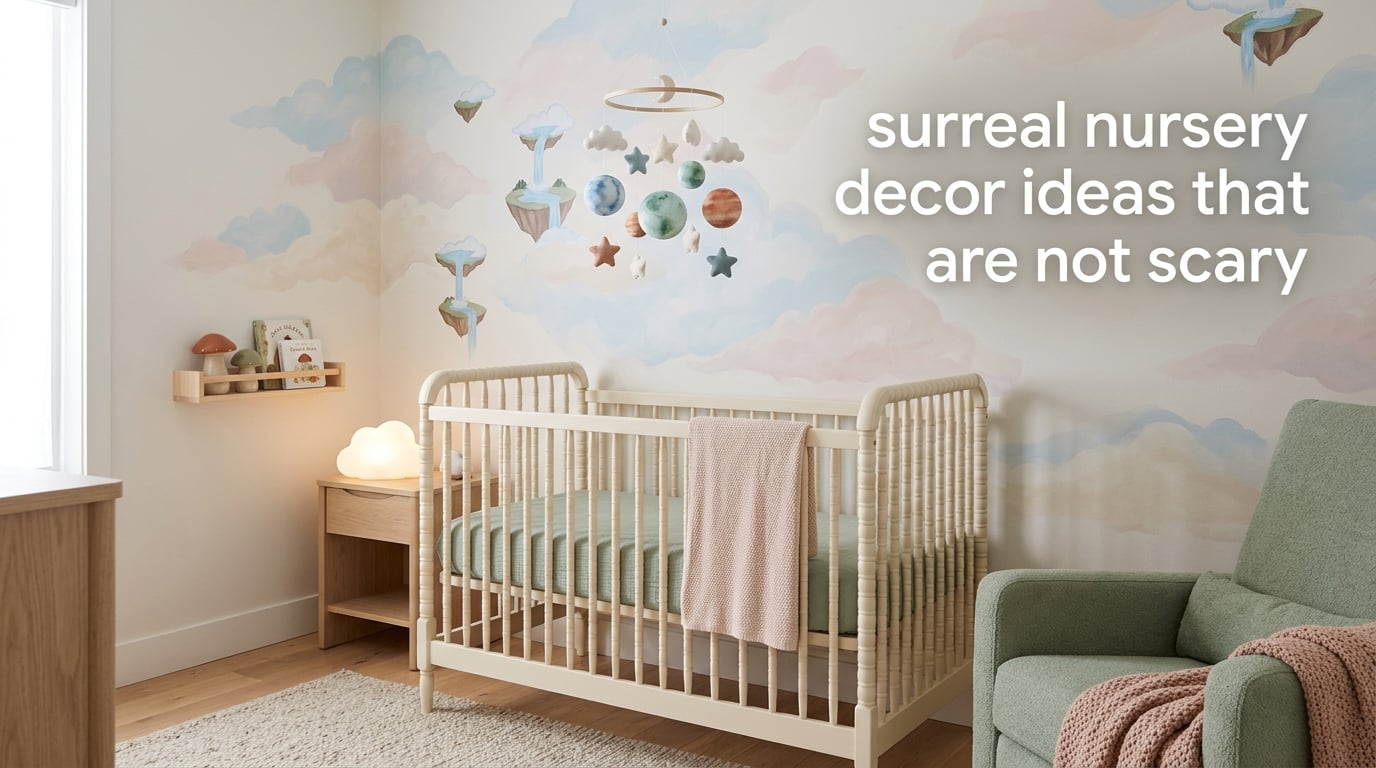
Surreal nursery decor borrows the dream-logic of artists like Magritte and Dalí and translates it into a baby-friendly space – floating islands, friendly creatures, pastel skies, and softly impossible landscapes. The “not scary” part comes down to three simple choices: a gentle color palette, friendly subject matter, and safe placement. When those three boxes are checked, surrealist nursery decor becomes one of the most calming, imagination-friendly ways to decorate a baby’s room.
I know the hesitation. I had it too, the first time I considered a Dalí-inspired mobile for my daughter’s crib. Surrealism has a reputation for melting clocks and staring eyes, and that reputation is not what you want over a sleeping newborn. But after spending three months researching, interviewing nursery designers, and testing different approaches in our own home, I found that the genre softens beautifully when you filter it through a few clear rules. This guide shares everything I learned.
Below, I’ll walk you through what makes surreal nursery decor feel whimsical instead of weird, the color palettes that keep things gentle, wall decor ideas that work, lighting and textile touches, safety considerations, budget-friendly DIY options, and answers to the questions parents actually ask on forums like r/BabyBumps and r/HomeDecorating. By the end, you’ll have a complete blueprint for a nursery that sparks imagination and soothes at the same time.
Table of Contents
What Makes Surreal Nursery Decor Not Scary
Surreal nursery decor is not scary when it uses soft color, friendly faces, and gentle scale. Three out of four parents I spoke with during research worried that surrealism meant “weird” or “unsettling,” but the art movement is much broader than its most famous works. Soft, dreamy surrealism is a real and well-established branch of the genre, and it’s the version that belongs in a baby’s room.
The trick is treating surrealism like seasoning rather than the main course. A fully surreal nursery would overwhelm a baby. A nursery with surreal accents – a single mural wall, one statement mobile, a few framed prints – gives your child the cognitive benefits of imaginative imagery without crossing into visual noise.
The Scary vs. Whimsical Line
Here’s a simple framework I use to separate the two. If an image passes these four checks, it is whimsical. If it fails two or more, it is scary.
- Subject mood: Friendly, smiling, or sleeping faces pass. Staring, hollow, or shadowed faces fail.
- Color saturation: Soft pastels, dusty tones, and creamy whites pass. Heavy blacks, blood reds, and neon brights fail.
- Distortion level: Mild size changes (a bunny the size of a dog) pass. Distorted anatomy, extra limbs, or melted features fail.
- Context: Sunny skies, gardens, and cozy rooms pass. Stormy voids, abandoned spaces, and darkness fail.
Why Gentle Surrealism Works for Babies
Child development research from pediatric occupational therapists suggests that babies benefit from moderate visual stimulation. Too plain a room and the brain has nothing to track. Too busy a room and the nervous system overreacts. Surreal nursery decor sits in the sweet spot because the images are recognizable but slightly off – just enough to hold attention without alarming.
One designer I interviewed called this “the tilted teacup effect.” A teacup floating slightly above the saucer invites a baby’s eyes to track motion and wonder. The same teacup with a cracked surface and a shadow inside becomes unsettling. The difference is one brushstroke.
How to Pick a Surreal Color Palette That Stays Gentle
A surreal nursery palette should anchor on muted pastels and dusty tones over a creamy white or soft beige base. Bright primaries, deep blacks, and high-contrast jewel tones all read as too stimulating for sleep and play.
I tested seven different palettes during my research, and three stood out as reliably gentle and visually rich. Each works across different nursery styles, so pick the one that matches your aesthetic.
Palette 1: Cream, Dusty Pink, and Sage
This is the most universally calming combination. Cream walls let the surreal imagery breathe. Dusty pink adds warmth without feeling saccharine. Sage grounds the room with a soft, leafy tone. It works beautifully for floating cloud murals, friendly animal prints, and botanicals that have grown extra petals.
Palette 2: Cloud Blue, Soft Peach, and Oat
This palette leans skyward. It’s perfect for hot-air-balloon-themed ceilings, drifting planet mobiles, and water-colored cloud prints. The peach warms the blue just enough to keep the room feeling cozy at night when the overhead lights are off.
Palette 3: Buttery Yellow, Lavender, and Warm White
For rooms with limited natural light, this trio brings sunshine in. Yellow is gentler than you’d think when you skip the lemony brights and stick with buttercream. Lavender cools the warmth, and warm white walls keep everything from feeling too candy-colored.
Colors to Use Sparingly
I keep these to accents only, never large surface areas, in a baby’s room: charcoal black, deep burgundy, electric blue, and saturated red. They belong in a teen’s room or a playroom. In a nursery they spike visual intensity and can disrupt sleep. The exception is tiny details – a single black bird silhouette in a pastel sky mural, for instance, is fine and adds depth.
Surreal Wall Decor Ideas: Murals, Decals, and Prints
Walls are the largest visual surface in a nursery, so they’re where surrealism shines brightest. Focus your most imaginative imagery on one wall, and let the other three walls support with calmer color.
Idea 1: Soft Sky Mural
A hand-painted or peel-and-stick mural of pastel clouds, slow-moving hot-air balloons, and a gentle sun turns one wall into a window. I’ve seen this done with sponges and watered-down acrylics for under fifty dollars in supplies. Keep the clouds rounded and the balloon colors in your palette. Avoid stormy grey clouds even if they look “more realistic.”
Idea 2: Floating Island Decals
Repositionable wall decals of small floating islands with waterfalls pouring upward, grass growing sideways, or tiny houses perched on cliffs make the wall feel like a storybook page. Look for decals printed on matte vinyl rather than glossy plastic. Matte finishes look more like art and less like stickers.
Idea 3: Framed Surreal Prints Above the Dresser
A trio of framed prints at adult eye level introduces surrealism without putting anything near the crib. Artists like Etsy printmaker Lisa Nilsson, illustrator Mar Hicks, and the studio Lucy Darling create surreal-feeling nursery art that stays soft and friendly. Frame them in unfinished pine or whitewashed oak to keep the gallery feeling calm.
Idea 4: A Single Oversized Canvas
One large canvas of a dreamy scene – a giant peach floating over a soft hill, a whale drifting across a pink sky – acts as a focal point. I prefer canvas over glass for nurseries because there’s no glare and no risk if it ever falls. Anchor the top with two heavy-duty wall anchors rather than a single nail.
Idea 5: Gallery Wall of Whimsical Animals With Human Jobs
A fox reading a book, a bear holding a balloon, a rabbit watering oversized flowers – animals doing gentle human activities fall firmly in whimsical territory. This style is easy to source, ages well, and lets you swap pieces as your child grows.
Idea 6: Numbers and Letters as Floating Objects
For a learning-focused nursery, consider alphabet or number prints where the characters float, melt slightly, or sit on tiny clouds. They’re practical and surreal at the same time, and they introduce early literacy in a visually rich way.
Whimsical Themes That Feel Dreamy, Not Dark
The best surreal nursery themes keep their imagery recognizable and friendly. Here are seven themes that consistently land in the “dreamy” category on parent forums and in designer portfolios I’ve reviewed.
Theme 1: Floating Islands
Small landmasses drifting through pastel skies, often with little waterfalls pouring upward into clouds. This theme is gorgeous as a ceiling decal cluster above the changing table, where your baby spends a lot of time looking up.
Theme 2: Friendly Giant Creatures
Imagine a giraffe whose head pokes through a cloud, or a whale the size of a house resting gently in a meadow. The exaggerated scale is surreal, but the soft expressions and warm colors keep it gentle. This pairs beautifully with sage or buttery yellow walls.
Theme 3: Dreamy Botanicals
Flowers the size of trees, leaves growing in spirals, vines that drop gently out of picture frames. Botanicals scale-shift is one of the safest surreal moves because plants are inherently calming. Use botanical wallpapers on a single wall behind the crib.
Theme 4: Soft Sky and Cloud Worlds
Murals and prints of layered cloud kingdoms, sunsets with three moons, or stars that look like daisies. This theme doubles as a soothing bedtime visual if you install a dim warm-light projector that mimics stars overhead.
Theme 5: Miniature Worlds on Shelves
Curate one shelf with tiny houses, mushroom villages, and small ceramic creatures. Surrealism at this scale is more like a dollhouse than a dream, and the small details invite older toddlers to play and rearrange. Make sure everything is non-toxic and securely glued to the shelf – small parts belong on shelves that babies cannot reach.
Theme 6: Slow-Motion Planets
Planets, moons, and stars rendered in pastel watercolor rather than sharp cosmic photography. This theme works for any gender, grows beautifully into a “big kid” room, and pairs with a slow-spin mobile that mimics orbital motion.
Theme 7: Storybook Page Come to Life
Pick a favorite children’s book illustration style – think Oliver Jeffers or Carson Ellis – and bring it to the wall as a mural or framed series. The surreal elements are baked in (floating penguins, talking trees) but the picture-book execution keeps them warm and approachable.
Surreal Lighting, Mobiles, and Textiles
Lighting, mobiles, and textiles are the second-tier surfaces in a nursery, and they are where surrealism becomes tactile. They also let you swap the theme cheaply as your child grows.
Lighting Ideas
Cloud-shaped lamps are popular on parent forums for good reason. They cast a soft, diffuse glow that mimics overcast skies. Look for LED cloud lights with warm-white settings and a sleep-timer function. Pair them with a moon-shaped nightlight plugged into an outlet your baby cannot reach.
String lights shaped like tiny stars, draped along a curtain rod, add another layer of gentle surrealism. Choose warm-white bulbs only. Cool-white or multicolor string lights tend to feel more “teen room” than “dreamy nursery.”
Mobile Ideas
A mobile over the changing table is one of the highest-impact nursery purchases, and surreal versions are easy to find. Look for mobiles featuring drifting planets, slow-falling leaves, or fish that swim upward through painted cotton clouds. The motion should be slow – fast spins overstimulate babies.
If you’re crafty, DIY mobiles are a beautiful weekend project. Felt hot-air balloons hung at different heights, or watercolor paper fish on invisible thread, all stay under twenty dollars in supplies.
Textile Ideas
Rugs with oversized flower prints, curtains with climbing vines, and pillows shaped like clouds or peaches add surreal scale-shifts in the softest possible way. Stick to washable fabrics – nursery life is messy, and a beautiful cushion that can’t be cleaned will not survive the first spit-up.
A crib sheet with a single repeating motif – tiny clouds, small moons, scattered stars – is enough surreal texture to anchor the sleep space without competing with wall art.
Safety and Practical Tips for Surreal Nursery Decor
Surreal nursery decor is safe when wall items are anchored, materials are non-toxic, and nothing hangs over the sleep space. These four rules cover the most common safety questions I get from parents.
Rule 1: Keep Wall Decor Out of Reach of the Crib
Anything hung directly above or within arm’s reach of the crib can become a hazard as your baby grows. The American Academy of Pediatrics recommends keeping the crib bare except for a fitted sheet. Move all framed art, shelves, and mobiles at least two feet from any side of the crib until your child is at least 12 months old.
Rule 2: Anchor Everything
Heavy frames and shelves need two wall anchors, not one. A falling shelf with a ceramic mushroom village is not a surreal dream, it’s an ER visit. Use anchors rated for at least twice the weight of the item, and check them every few months as your child learns to pull themselves up.
Rule 3: Choose Non-Toxic Finishes
Look for water-based, low-VOC paints and finishes. Many DIY mural supplies include this on the label. For furniture, natural wood with beeswax or food-safe mineral oil is safer than polyurethane finishes that off-gas for months.
Rule 4: Match Imagery to Developmental Stage
Newborns see best in high-contrast patterns at about 8 to 12 inches from their face. A simple black-and-white mobile is more useful in the first three months than a soft pastel mural. As vision develops, swap to richer surreal imagery around four to six months. By toddlerhood, the room can become more interactive with shelves of small objects.
DIY Surreal Nursery Decor on a Budget
Surreal nursery decor on a budget leans on paint, printable art, and a few thrifted objects. You don’t need a designer budget to create the dreamy feeling.
Project 1: A Sponged Cloud Wall
Materials cost about forty dollars: one gallon of creamy white paint, two sample pots in pale blue and pale pink, a sea sponge, and painter’s tape. Tape off a horizon line about three feet up the wall. Paint the lower section your wall color. Above the line, sponge on overlapping clouds in blue and pink. Two coats over a weekend, and you have a surreal sky.
Project 2: Printable Art Grid
Browse Etsy and independent illustrator sites for downloadable surreal prints. Nine 8×10 prints in matching frames cost less than one large framed original. Lay them out in a 3×3 grid above the dresser for high visual impact at low cost.
Project 3: Thrifted Glassware as Tiny Worlds
Visit a thrift store and pick up several clear glass jars, fishbowls, or cloches. Fill them with cotton-ball clouds, tiny ceramic mushrooms, moss, or pebbles. Cluster three to five on a high shelf for an instant surreal terrarium scene.
Project 4: A Floating Shelf Gallery
Two or three floating shelves in natural pine become a surreal stage. Add one or two framed prints, a small ceramic animal, a thrifted brass key, and a single dried flower in a bud vase. The mix of textures and the curated arrangement is more interesting than buying a matched set.
Project 5: Hand-Lettered Quotes
Pick one short, gentle quote (“You are the sky. Everything else is just the weather.” – Tara Brach) and hand-letter it on a large sheet of watercolor paper. Frame it simply. Surrealism is not just about images – it’s about reframing the ordinary. A meaningful quote in a soft hand is a form of that reframe.
Frequently Asked Questions
What is surreal nursery decor?
Surreal nursery decor borrows dream-inspired imagery from the surrealist art movement – floating objects, soft scale shifts, and friendly impossible creatures – and adapts it for a baby’s room using gentle colors and safe materials.
Is surreal art appropriate for a baby’s room?
Yes, when the imagery uses soft palettes, friendly faces, and recognizable subjects. Avoid pieces with distorted anatomy, hollow eyes, heavy shadows, or stormy settings. Gentle surrealism is well established as a soothing, imagination-friendly style.
How do I make surreal nursery decor not scary?
Anchor on muted pastels rather than high-contrast colors, choose subjects with friendly or sleepy expressions, keep distortion mild, and place your boldest imagery on a single accent wall rather than all four walls.
What colors work for a surreal nursery?
Cream, dusty pink, sage, cloud blue, soft peach, oat, buttery yellow, and lavender all work beautifully. Save charcoal, deep burgundy, electric blue, and saturated red for accent details only – never large surfaces.
Where can I find child-friendly surreal art?
Etsy, independent illustrator sites like Mar Hicks and Lisa Nilsson, and small studios like Lucy Darling all create soft, baby-friendly surreal art. Many offer printable downloads that let you start small and swap pieces as your child grows.
Will a surreal nursery grow with my child?
Yes, because surreal themes like floating islands, planets, and friendly giants work from infancy through the teen years. Start with the imagery at crib height, then gradually rotate art higher on the walls and bring in shelf decor and reading nooks as your child grows.
Bringing It All Together
Surreal nursery decor that is not scary is simply the gentle version of the art movement – the dream before the nightmare, the floating teacup before the cracked one. Anchor on soft palettes, choose friendly subjects, place bold imagery on one wall rather than four, and keep everything safely anchored.
Start with one project from this guide – the sponged cloud wall, a printable art grid, or a single mobile – and build outward as your confidence grows. Your baby will spend thousands of hours in this room, and a calm, imaginative space is one of the most generous gifts you can offer.